
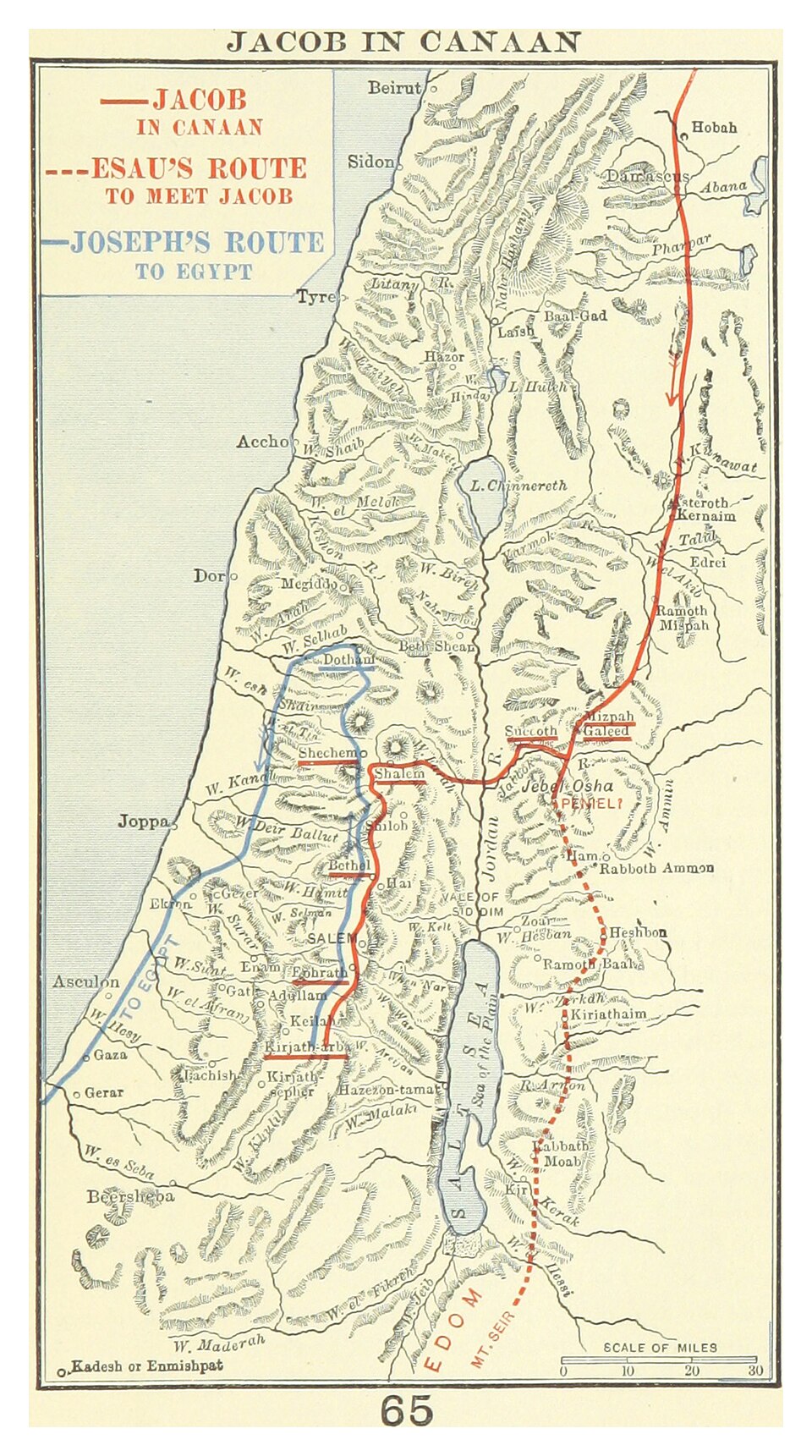
Look at the red line on this map. It begins at Beer-sheba in the lower-left and traces northward through the central highlands of Canaan — through Bethel, past Shechem, up through Damascus, and all the way to Haran in the upper right corner. This is the route of a man running for his life. Jacob had deceived his father Isaac and stolen the blessing that belonged to Esau. Esau had sworn to kill him. Rebekah sent Jacob away urgently, telling him to flee to her brother Laban in Haran. He left with nothing.
Find Bethel on the map — it sits in the central hill country of Canaan, west of the Jordan River. This is where Jacob spent his first night on the road. He lay down with a stone for a pillow in what he thought was just another stopping place on a long journey. Instead, God met him there in a dream unlike anything in the patriarchal record: a ladder — or staircase — set up from earth to heaven, with angels ascending and descending, and God himself standing at the top reaffirming the covenant: the land, the descendants, the blessing to all nations. All for this fugitive running in the night.
Jacob's response when he woke is one of the most honest reactions to an encounter with God in all of Scripture: "Surely the LORD is in this place; and I knew it not. And he was afraid, and said, How dreadful is this place! this is none other but the house of God, and this is the gate of heaven" (Genesis 28:16–17). He had not come to Bethel seeking God. He was not on a pilgrimage. He was fleeing a murder threat. And God found him anyway — at a random stopping point on a lonely road — and made him a promise that required nothing from Jacob except that he keep going.
Jacob set up the stone as a pillar, poured oil on it, and made a conditional vow: "If God will be with me, and will keep me in this way that I go, and will give me bread to eat, and raiment to put on, so that I come again to my father's house in peace; then shall the LORD be my God" (Genesis 28:20–21). It is not yet the full surrender — the wrestling at Peniel would come twenty years later — but it is the beginning. Bethel was the first stake in the ground: the place where Jacob acknowledged, however tentatively, that God was real and that his life was not entirely his own. He then continued north — follow the red line — through Shechem, up through Damascus, and on to Haran, where twenty years of labor, marriage, and family would forge the man who would become Israel.