✡ "Pray for the peace of Jerusalem" — Psalm 122:6
Christians Standing With Israel
Home Site Map Search About Us Our Beliefs Online Bible Maps of Israel Articles Grafted In? Apple of His Eye Contact
TOPICS
Israel — Then & Now Anti-Semitism Middle East Christian Zionism Bible Prophecy US & Israel Media Bias Spiritual Deception Arab-Israeli Conflict Islamic Extremism The Iranian Threat Replacement Theology
LATEST: New article by Michael Knighton  •  Subscribe to our weekly newsletter  •  400 Maps of Israel now available  •  Online Bible (KJV) now online
Advertisement
Map 045  ·  The Patriarchs & the Exodus  ·  Genesis 37:12–36

Joseph Sold into Slavery

Thrown into a pit by his brothers at Dothan, then sold to Ishmaelite traders for twenty pieces of silver — and carried down the blue road to Egypt
"And they sat down to eat bread: and they lifted up their eyes and looked, and, behold, a company of Ishmeelites came from Gilead with their camels bearing spicery and balm and myrrh, going to carry it down to Egypt."
— Genesis 37:25 (KJV)
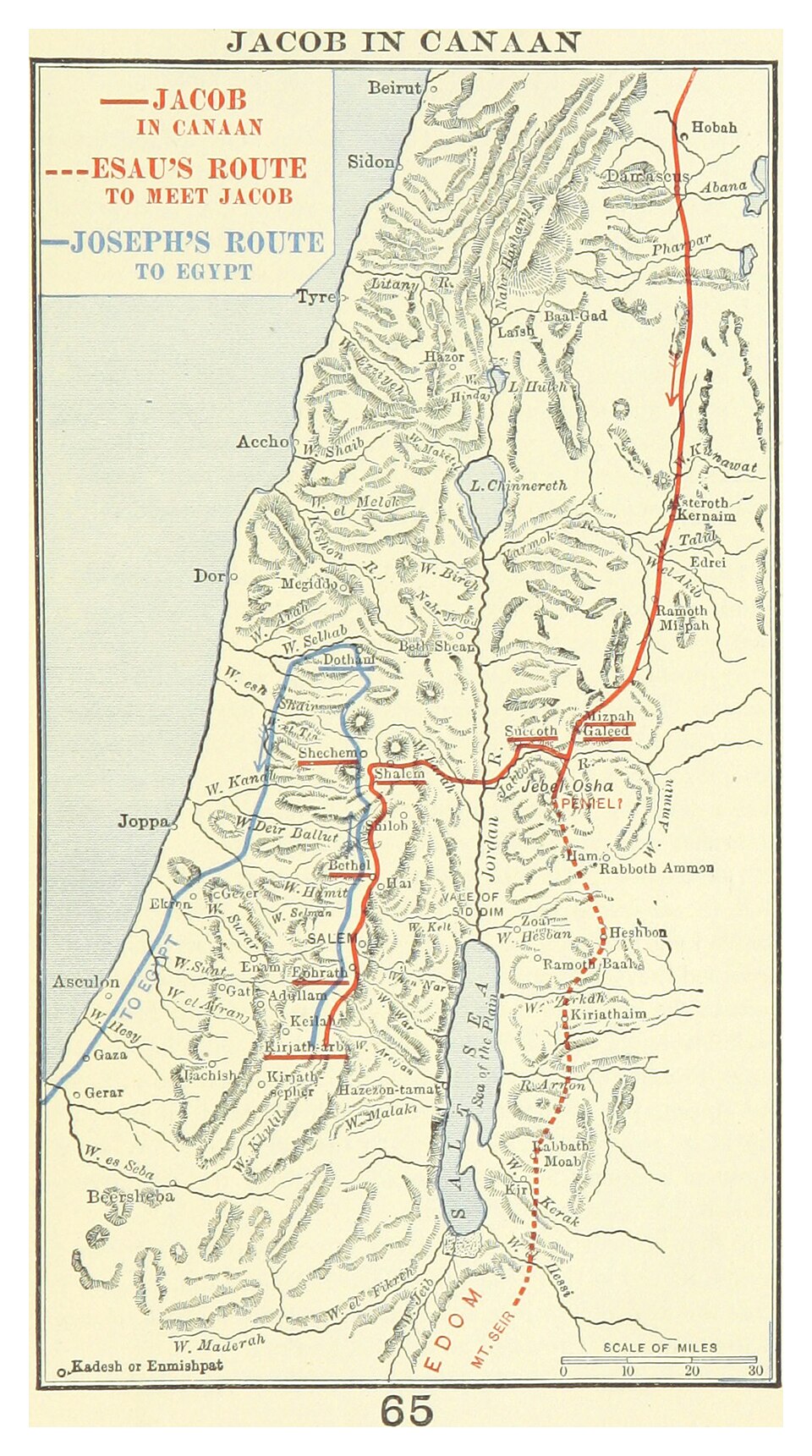
Map of Jacob in Canaan showing Jacob's route in red from Beer-sheba north through Bethel, Shechem, Damascus and on to Haran; Esau's route in dashed red coming south to meet Jacob; and Joseph's route in blue going south to Egypt. Key locations include Bethel, Dothan, Peniel on the Jabbok River, Succoth, Shechem, Mahanaim, and Beersheba.
Jacob in Canaan — showing Joseph's route to Egypt in blue. Find 'Dothan' labeled in the central highlands where Joseph was thrown into the pit. The blue line then traces southward through Shechem, Bethel, Salem (Jerusalem), Hebron, and on to Egypt — the exact route of the Ishmaelite caravan.
Source: Maccoun, The Holy Land in Geography and in History (1899). Public domain, via Wikimedia Commons.  ·  Historical commentary by Michael Knighton  ·  Christians Standing With Israel
🗺 How to Read This Map
① Dothan — The Pit — Find 'Dothan' labeled on the map in the central highlands, north of Shechem and south of Jezreel. This is where Jacob's sons were grazing their flocks when Joseph arrived wearing his coat of many colors. His brothers threw him into a dry cistern (the 'pit') here. Dothan was a real city — archaeological excavations have confirmed its Bronze Age occupation.
② The Blue Line — Joseph's Route to Egypt — Find the blue line on the map — the legend identifies it as 'Joseph's Route to Egypt.' It begins at Dothan in the north, traces south through Shechem, Bethel, Salem (Jerusalem), and Hebron, before heading southwest to Egypt. This is the route of the Ishmaelite trading caravan that purchased Joseph for twenty pieces of silver.
③ The Ishmaelite Trade Road — The route Joseph was carried along follows the main north-south trade road through Canaan's central highlands. Find how it passes through all the major patriarchal cities — Shechem, Bethel, Salem, Hebron — before turning toward Egypt. Note that the caravan came from Gilead (east of the Jordan) bearing spices and balm — exactly as Genesis 37:25 describes.
④ Beersheba — Jacob's Home — Find Beersheba at the bottom-left of the map. This is where Jacob was living when Joseph was sold. He would eventually be told that Joseph was dead (a bloody coat as false evidence), and would mourn for years until the reunion in Egypt. The blue line passes near his home before continuing to Egypt.
What This Map Shows
✦ Dothan — where Joseph was thrown in the pit
✦ The blue line — Joseph's route to Egypt
✦ Shechem — Joseph came looking for his brothers
✦ Salem (Jerusalem) — waypoint on the trade road
✦ Hebron — Jacob's home; the deception happened here
✦ Beersheba — southern base of the family
✦ The Ishmaelite trade route from Gilead
✦ Egypt — Joseph's destination and destiny

The Road That Led to a Throne

Find Dothan on the map — in the central highlands, north of Shechem. Joseph had been sent from Hebron by his father Jacob to check on his brothers grazing their flocks. They were not at Shechem as expected, and a man found Joseph wandering in a field and told him: "They are departed hence; for I heard them say, Let us go to Dothan" (Genesis 37:17). Joseph traveled another twelve miles north. His brothers saw him coming while he was still far off, recognized the coat of many colors, and conspired to kill him. Reuben talked them down to throwing him in a pit instead.

Now follow the blue line southward from Dothan. This is the route Joseph was carried against his will — all the way to Egypt. The caravan was Ishmaelite traders from Gilead, carrying spicery, balm, and myrrh down to Egypt. Judah proposed selling Joseph rather than killing him: "What profit is it if we slay our brother?" (Genesis 37:26). They sold him for twenty pieces of silver — the price of a young male slave in the ancient Near Eastern market codes. The caravan moved south through Shechem, past Bethel, through Jerusalem, through Hebron — within miles of his father's house — and on down to Egypt.

The brothers dipped Joseph's coat in goat's blood and brought it to Jacob. "Joseph is without doubt rent in pieces," Jacob concluded, and mourned so deeply that none of his children could comfort him. Meanwhile — follow the blue line to the bottom of the map — Joseph arrived in Egypt and was sold again to Potiphar, an officer of Pharaoh. He was seventeen years old. He had been betrayed by the brothers he loved, sold twice as a slave, and carried to a foreign country where he knew no one. What looked like absolute catastrophe was, as Joseph would later recognize, the hidden hand of God positioning him exactly where he needed to be: "Ye thought evil against me; but God meant it unto good" (Genesis 50:20).

Key Scripture References
Genesis 37:12–17 — Joseph sent to find his brothers at Shechem and Dothan
Genesis 37:18–24 — The conspiracy; Joseph thrown in the pit
Genesis 37:25–28 — Sold to Ishmaelites for twenty pieces of silver
Genesis 37:29–36 — The coat of blood; Jacob mourns
Genesis 39:1 — Joseph sold to Potiphar in Egypt
Genesis 50:20 — Joseph's perspective: God meant it for good
Map: Maccoun, The Holy Land in Geography and in History (1899). Public domain, via Wikimedia Commons.  ·  Historical commentary: © 2026 Michael Wayne Knighton | Christians Standing With Israel™ | All Rights Reserved.
MAP 044
Jacob's Journey Through Canaan
MAP 046
Joseph in Egypt — Prison to Palace
Advertisement
Joseph Sold into Slavery | Christians Standing With Israel — Michael Knighton Joseph Sold into Slavery | Christians Standing With Israel — Michael Knighton
✡ "Pray for the peace of Jerusalem" — Psalm 122:6
Christians Standing With Israel
Home Site Map Search About Us Our Beliefs Online Bible Maps of Israel Articles Grafted In? Apple of His Eye Contact
TOPICS
Israel — Then & Now Anti-Semitism Middle East Christian Zionism Bible Prophecy US & Israel Media Bias Spiritual Deception Arab-Israeli Conflict Islamic Extremism The Iranian Threat Replacement Theology
LATEST: New article by Michael Knighton  •  Subscribe to our weekly newsletter  •  400 Maps of Israel now available  •  Online Bible (KJV) now online
Advertisement
Map 045  ·  The Patriarchs & the Exodus  ·  Genesis 37:12–36

Joseph Sold into Slavery

Thrown into a pit by his brothers at Dothan, then sold to Ishmaelite traders for twenty pieces of silver — and carried down the blue road to Egypt
"And they sat down to eat bread: and they lifted up their eyes and looked, and, behold, a company of Ishmeelites came from Gilead with their camels bearing spicery and balm and myrrh, going to carry it down to Egypt."
— Genesis 37:25 (KJV)
Map of Jacob in Canaan showing Jacob's route in red from Beer-sheba north through Bethel, Shechem, Damascus and on to Haran; Esau's route in dashed red coming south to meet Jacob; and Joseph's route in blue going south to Egypt. Key locations include Bethel, Dothan, Peniel on the Jabbok River, Succoth, Shechem, Mahanaim, and Beersheba.
Jacob in Canaan — showing Joseph's route to Egypt in blue. Find 'Dothan' labeled in the central highlands where Joseph was thrown into the pit. The blue line then traces southward through Shechem, Bethel, Salem (Jerusalem), Hebron, and on to Egypt — the exact route of the Ishmaelite caravan.
Source: Maccoun, The Holy Land in Geography and in History (1899). Public domain, via Wikimedia Commons.  ·  Historical commentary by Michael Knighton  ·  Christians Standing With Israel
🗺 How to Read This Map
① Dothan — The Pit — Find 'Dothan' labeled on the map in the central highlands, north of Shechem and south of Jezreel. This is where Jacob's sons were grazing their flocks when Joseph arrived wearing his coat of many colors. His brothers threw him into a dry cistern (the 'pit') here. Dothan was a real city — archaeological excavations have confirmed its Bronze Age occupation.
② The Blue Line — Joseph's Route to Egypt — Find the blue line on the map — the legend identifies it as 'Joseph's Route to Egypt.' It begins at Dothan in the north, traces south through Shechem, Bethel, Salem (Jerusalem), and Hebron, before heading southwest to Egypt. This is the route of the Ishmaelite trading caravan that purchased Joseph for twenty pieces of silver.
③ The Ishmaelite Trade Road — The route Joseph was carried along follows the main north-south trade road through Canaan's central highlands. Find how it passes through all the major patriarchal cities — Shechem, Bethel, Salem, Hebron — before turning toward Egypt. Note that the caravan came from Gilead (east of the Jordan) bearing spices and balm — exactly as Genesis 37:25 describes.
④ Beersheba — Jacob's Home — Find Beersheba at the bottom-left of the map. This is where Jacob was living when Joseph was sold. He would eventually be told that Joseph was dead (a bloody coat as false evidence), and would mourn for years until the reunion in Egypt. The blue line passes near his home before continuing to Egypt.
What This Map Shows
✦ Dothan — where Joseph was thrown in the pit
✦ The blue line — Joseph's route to Egypt
✦ Shechem — Joseph came looking for his brothers
✦ Salem (Jerusalem) — waypoint on the trade road
✦ Hebron — Jacob's home; the deception happened here
✦ Beersheba — southern base of the family
✦ The Ishmaelite trade route from Gilead
✦ Egypt — Joseph's destination and destiny

The Road That Led to a Throne

Find Dothan on the map — in the central highlands, north of Shechem. Joseph had been sent from Hebron by his father Jacob to check on his brothers grazing their flocks. They were not at Shechem as expected, and a man found Joseph wandering in a field and told him: "They are departed hence; for I heard them say, Let us go to Dothan" (Genesis 37:17). Joseph traveled another twelve miles north. His brothers saw him coming while he was still far off, recognized the coat of many colors, and conspired to kill him. Reuben talked them down to throwing him in a pit instead.

Now follow the blue line southward from Dothan. This is the route Joseph was carried against his will — all the way to Egypt. The caravan was Ishmaelite traders from Gilead, carrying spicery, balm, and myrrh down to Egypt. Judah proposed selling Joseph rather than killing him: "What profit is it if we slay our brother?" (Genesis 37:26). They sold him for twenty pieces of silver — the price of a young male slave in the ancient Near Eastern market codes. The caravan moved south through Shechem, past Bethel, through Jerusalem, through Hebron — within miles of his father's house — and on down to Egypt.

The brothers dipped Joseph's coat in goat's blood and brought it to Jacob. "Joseph is without doubt rent in pieces," Jacob concluded, and mourned so deeply that none of his children could comfort him. Meanwhile — follow the blue line to the bottom of the map — Joseph arrived in Egypt and was sold again to Potiphar, an officer of Pharaoh. He was seventeen years old. He had been betrayed by the brothers he loved, sold twice as a slave, and carried to a foreign country where he knew no one. What looked like absolute catastrophe was, as Joseph would later recognize, the hidden hand of God positioning him exactly where he needed to be: "Ye thought evil against me; but God meant it unto good" (Genesis 50:20).

Key Scripture References
Genesis 37:12–17 — Joseph sent to find his brothers at Shechem and Dothan
Genesis 37:18–24 — The conspiracy; Joseph thrown in the pit
Genesis 37:25–28 — Sold to Ishmaelites for twenty pieces of silver
Genesis 37:29–36 — The coat of blood; Jacob mourns
Genesis 39:1 — Joseph sold to Potiphar in Egypt
Genesis 50:20 — Joseph's perspective: God meant it for good
Map: Maccoun, The Holy Land in Geography and in History (1899). Public domain, via Wikimedia Commons.  ·  Historical commentary: © 2026 Michael Wayne Knighton | Christians Standing With Israel™ | All Rights Reserved.
MAP 044
Jacob's Journey Through Canaan
MAP 046
Joseph in Egypt — Prison to Palace
Advertisement
Joseph Sold into Slavery | Christians Standing With Israel — Michael Knighton Joseph Sold into Slavery | Christians Standing With Israel — Michael Knighton
✡ "Pray for the peace of Jerusalem" — Psalm 122:6
Christians Standing With Israel
Home Site Map Search About Us Our Beliefs Online Bible Maps of Israel Articles Grafted In? Apple of His Eye Contact
TOPICS
Israel — Then & Now Anti-Semitism Middle East Christian Zionism Bible Prophecy US & Israel Media Bias Spiritual Deception Arab-Israeli Conflict Islamic Extremism The Iranian Threat Replacement Theology
LATEST: New article by Michael Knighton  •  Subscribe to our weekly newsletter  •  400 Maps of Israel now available  •  Online Bible (KJV) now online
Advertisement
Map 045  ·  The Patriarchs & the Exodus  ·  Genesis 37:12–36

Joseph Sold into Slavery

Thrown into a pit by his brothers at Dothan, then sold to Ishmaelite traders for twenty pieces of silver — and carried down the blue road to Egypt
"And they sat down to eat bread: and they lifted up their eyes and looked, and, behold, a company of Ishmeelites came from Gilead with their camels bearing spicery and balm and myrrh, going to carry it down to Egypt."
— Genesis 37:25 (KJV)
Map of Jacob in Canaan showing Jacob's route in red from Beer-sheba north through Bethel, Shechem, Damascus and on to Haran; Esau's route in dashed red coming south to meet Jacob; and Joseph's route in blue going south to Egypt. Key locations include Bethel, Dothan, Peniel on the Jabbok River, Succoth, Shechem, Mahanaim, and Beersheba.
Jacob in Canaan — showing Joseph's route to Egypt in blue. Find 'Dothan' labeled in the central highlands where Joseph was thrown into the pit. The blue line then traces southward through Shechem, Bethel, Salem (Jerusalem), Hebron, and on to Egypt — the exact route of the Ishmaelite caravan.
Source: Maccoun, The Holy Land in Geography and in History (1899). Public domain, via Wikimedia Commons.  ·  Historical commentary by Michael Knighton  ·  Christians Standing With Israel
🗺 How to Read This Map
① Dothan — The Pit — Find 'Dothan' labeled on the map in the central highlands, north of Shechem and south of Jezreel. This is where Jacob's sons were grazing their flocks when Joseph arrived wearing his coat of many colors. His brothers threw him into a dry cistern (the 'pit') here. Dothan was a real city — archaeological excavations have confirmed its Bronze Age occupation.
② The Blue Line — Joseph's Route to Egypt — Find the blue line on the map — the legend identifies it as 'Joseph's Route to Egypt.' It begins at Dothan in the north, traces south through Shechem, Bethel, Salem (Jerusalem), and Hebron, before heading southwest to Egypt. This is the route of the Ishmaelite trading caravan that purchased Joseph for twenty pieces of silver.
③ The Ishmaelite Trade Road — The route Joseph was carried along follows the main north-south trade road through Canaan's central highlands. Find how it passes through all the major patriarchal cities — Shechem, Bethel, Salem, Hebron — before turning toward Egypt. Note that the caravan came from Gilead (east of the Jordan) bearing spices and balm — exactly as Genesis 37:25 describes.
④ Beersheba — Jacob's Home — Find Beersheba at the bottom-left of the map. This is where Jacob was living when Joseph was sold. He would eventually be told that Joseph was dead (a bloody coat as false evidence), and would mourn for years until the reunion in Egypt. The blue line passes near his home before continuing to Egypt.
What This Map Shows
✦ Dothan — where Joseph was thrown in the pit
✦ The blue line — Joseph's route to Egypt
✦ Shechem — Joseph came looking for his brothers
✦ Salem (Jerusalem) — waypoint on the trade road
✦ Hebron — Jacob's home; the deception happened here
✦ Beersheba — southern base of the family
✦ The Ishmaelite trade route from Gilead
✦ Egypt — Joseph's destination and destiny

The Road That Led to a Throne

Find Dothan on the map — in the central highlands, north of Shechem. Joseph had been sent from Hebron by his father Jacob to check on his brothers grazing their flocks. They were not at Shechem as expected, and a man found Joseph wandering in a field and told him: "They are departed hence; for I heard them say, Let us go to Dothan" (Genesis 37:17). Joseph traveled another twelve miles north. His brothers saw him coming while he was still far off, recognized the coat of many colors, and conspired to kill him. Reuben talked them down to throwing him in a pit instead.

Now follow the blue line southward from Dothan. This is the route Joseph was carried against his will — all the way to Egypt. The caravan was Ishmaelite traders from Gilead, carrying spicery, balm, and myrrh down to Egypt. Judah proposed selling Joseph rather than killing him: "What profit is it if we slay our brother?" (Genesis 37:26). They sold him for twenty pieces of silver — the price of a young male slave in the ancient Near Eastern market codes. The caravan moved south through Shechem, past Bethel, through Jerusalem, through Hebron — within miles of his father's house — and on down to Egypt.

The brothers dipped Joseph's coat in goat's blood and brought it to Jacob. "Joseph is without doubt rent in pieces," Jacob concluded, and mourned so deeply that none of his children could comfort him. Meanwhile — follow the blue line to the bottom of the map — Joseph arrived in Egypt and was sold again to Potiphar, an officer of Pharaoh. He was seventeen years old. He had been betrayed by the brothers he loved, sold twice as a slave, and carried to a foreign country where he knew no one. What looked like absolute catastrophe was, as Joseph would later recognize, the hidden hand of God positioning him exactly where he needed to be: "Ye thought evil against me; but God meant it unto good" (Genesis 50:20).

Key Scripture References
Genesis 37:12–17 — Joseph sent to find his brothers at Shechem and Dothan
Genesis 37:18–24 — The conspiracy; Joseph thrown in the pit
Genesis 37:25–28 — Sold to Ishmaelites for twenty pieces of silver
Genesis 37:29–36 — The coat of blood; Jacob mourns
Genesis 39:1 — Joseph sold to Potiphar in Egypt
Genesis 50:20 — Joseph's perspective: God meant it for good
Map: Maccoun, The Holy Land in Geography and in History (1899). Public domain, via Wikimedia Commons.  ·  Historical commentary: © 2026 Michael Wayne Knighton | Christians Standing With Israel™ | All Rights Reserved.
MAP 044
Jacob's Journey Through Canaan
MAP 046
Joseph in Egypt — Prison to Palace
Advertisement
Joseph Sold into Slavery | Christians Standing With Israel — Michael Knighton Joseph Sold into Slavery | Christians Standing With Israel — Michael Knighton
✡ "Pray for the peace of Jerusalem" — Psalm 122:6
Christians Standing With Israel
Home Site Map Search About Us Our Beliefs Online Bible Maps of Israel Articles Grafted In? Apple of His Eye Contact
TOPICS
Israel — Then & Now Anti-Semitism Middle East Christian Zionism Bible Prophecy US & Israel Media Bias Spiritual Deception Arab-Israeli Conflict Islamic Extremism The Iranian Threat Replacement Theology
LATEST: New article by Michael Knighton  •  Subscribe to our weekly newsletter  •  400 Maps of Israel now available  •  Online Bible (KJV) now online
Advertisement
Map 045  ·  The Patriarchs & the Exodus  ·  Genesis 37:12–36

Joseph Sold into Slavery

Thrown into a pit by his brothers at Dothan, then sold to Ishmaelite traders for twenty pieces of silver — and carried down the blue road to Egypt
"And they sat down to eat bread: and they lifted up their eyes and looked, and, behold, a company of Ishmeelites came from Gilead with their camels bearing spicery and balm and myrrh, going to carry it down to Egypt."
— Genesis 37:25 (KJV)
Map of Jacob in Canaan showing Jacob's route in red from Beer-sheba north through Bethel, Shechem, Damascus and on to Haran; Esau's route in dashed red coming south to meet Jacob; and Joseph's route in blue going south to Egypt. Key locations include Bethel, Dothan, Peniel on the Jabbok River, Succoth, Shechem, Mahanaim, and Beersheba.
Jacob in Canaan — showing Joseph's route to Egypt in blue. Find 'Dothan' labeled in the central highlands where Joseph was thrown into the pit. The blue line then traces southward through Shechem, Bethel, Salem (Jerusalem), Hebron, and on to Egypt — the exact route of the Ishmaelite caravan.
Source: Maccoun, The Holy Land in Geography and in History (1899). Public domain, via Wikimedia Commons.  ·  Historical commentary by Michael Knighton  ·  Christians Standing With Israel
🗺 How to Read This Map
① Dothan — The Pit — Find 'Dothan' labeled on the map in the central highlands, north of Shechem and south of Jezreel. This is where Jacob's sons were grazing their flocks when Joseph arrived wearing his coat of many colors. His brothers threw him into a dry cistern (the 'pit') here. Dothan was a real city — archaeological excavations have confirmed its Bronze Age occupation.
② The Blue Line — Joseph's Route to Egypt — Find the blue line on the map — the legend identifies it as 'Joseph's Route to Egypt.' It begins at Dothan in the north, traces south through Shechem, Bethel, Salem (Jerusalem), and Hebron, before heading southwest to Egypt. This is the route of the Ishmaelite trading caravan that purchased Joseph for twenty pieces of silver.
③ The Ishmaelite Trade Road — The route Joseph was carried along follows the main north-south trade road through Canaan's central highlands. Find how it passes through all the major patriarchal cities — Shechem, Bethel, Salem, Hebron — before turning toward Egypt. Note that the caravan came from Gilead (east of the Jordan) bearing spices and balm — exactly as Genesis 37:25 describes.
④ Beersheba — Jacob's Home — Find Beersheba at the bottom-left of the map. This is where Jacob was living when Joseph was sold. He would eventually be told that Joseph was dead (a bloody coat as false evidence), and would mourn for years until the reunion in Egypt. The blue line passes near his home before continuing to Egypt.
What This Map Shows
✦ Dothan — where Joseph was thrown in the pit
✦ The blue line — Joseph's route to Egypt
✦ Shechem — Joseph came looking for his brothers
✦ Salem (Jerusalem) — waypoint on the trade road
✦ Hebron — Jacob's home; the deception happened here
✦ Beersheba — southern base of the family
✦ The Ishmaelite trade route from Gilead
✦ Egypt — Joseph's destination and destiny

The Road That Led to a Throne

Find Dothan on the map — in the central highlands, north of Shechem. Joseph had been sent from Hebron by his father Jacob to check on his brothers grazing their flocks. They were not at Shechem as expected, and a man found Joseph wandering in a field and told him: "They are departed hence; for I heard them say, Let us go to Dothan" (Genesis 37:17). Joseph traveled another twelve miles north. His brothers saw him coming while he was still far off, recognized the coat of many colors, and conspired to kill him. Reuben talked them down to throwing him in a pit instead.

Now follow the blue line southward from Dothan. This is the route Joseph was carried against his will — all the way to Egypt. The caravan was Ishmaelite traders from Gilead, carrying spicery, balm, and myrrh down to Egypt. Judah proposed selling Joseph rather than killing him: "What profit is it if we slay our brother?" (Genesis 37:26). They sold him for twenty pieces of silver — the price of a young male slave in the ancient Near Eastern market codes. The caravan moved south through Shechem, past Bethel, through Jerusalem, through Hebron — within miles of his father's house — and on down to Egypt.

The brothers dipped Joseph's coat in goat's blood and brought it to Jacob. "Joseph is without doubt rent in pieces," Jacob concluded, and mourned so deeply that none of his children could comfort him. Meanwhile — follow the blue line to the bottom of the map — Joseph arrived in Egypt and was sold again to Potiphar, an officer of Pharaoh. He was seventeen years old. He had been betrayed by the brothers he loved, sold twice as a slave, and carried to a foreign country where he knew no one. What looked like absolute catastrophe was, as Joseph would later recognize, the hidden hand of God positioning him exactly where he needed to be: "Ye thought evil against me; but God meant it unto good" (Genesis 50:20).

Key Scripture References
Genesis 37:12–17 — Joseph sent to find his brothers at Shechem and Dothan
Genesis 37:18–24 — The conspiracy; Joseph thrown in the pit
Genesis 37:25–28 — Sold to Ishmaelites for twenty pieces of silver
Genesis 37:29–36 — The coat of blood; Jacob mourns
Genesis 39:1 — Joseph sold to Potiphar in Egypt
Genesis 50:20 — Joseph's perspective: God meant it for good
Map: Maccoun, The Holy Land in Geography and in History (1899). Public domain, via Wikimedia Commons.  ·  Historical commentary: © 2026 Michael Wayne Knighton | Christians Standing With Israel™ | All Rights Reserved.
MAP 044
Jacob's Journey Through Canaan
MAP 046
Joseph in Egypt — Prison to Palace
Advertisement
Joseph Sold into Slavery | Christians Standing With Israel — Michael Knighton Joseph Sold into Slavery | Christians Standing With Israel — Michael Knighton
✡ "Pray for the peace of Jerusalem" — Psalm 122:6
Christians Standing With Israel
Home Site Map Search About Us Our Beliefs Online Bible Maps of Israel Articles Grafted In? Apple of His Eye Contact
TOPICS
Israel — Then & Now Anti-Semitism Middle East Christian Zionism Bible Prophecy US & Israel Media Bias Spiritual Deception Arab-Israeli Conflict Islamic Extremism The Iranian Threat Replacement Theology
LATEST: New article by Michael Knighton  •  Subscribe to our weekly newsletter  •  400 Maps of Israel now available  •  Online Bible (KJV) now online
Advertisement
Map 045  ·  The Patriarchs & the Exodus  ·  Genesis 37:12–36

Joseph Sold into Slavery

Thrown into a pit by his brothers at Dothan, then sold to Ishmaelite traders for twenty pieces of silver — and carried down the blue road to Egypt
"And they sat down to eat bread: and they lifted up their eyes and looked, and, behold, a company of Ishmeelites came from Gilead with their camels bearing spicery and balm and myrrh, going to carry it down to Egypt."
— Genesis 37:25 (KJV)
Map of Jacob in Canaan showing Jacob's route in red from Beer-sheba north through Bethel, Shechem, Damascus and on to Haran; Esau's route in dashed red coming south to meet Jacob; and Joseph's route in blue going south to Egypt. Key locations include Bethel, Dothan, Peniel on the Jabbok River, Succoth, Shechem, Mahanaim, and Beersheba.
Jacob in Canaan — showing Joseph's route to Egypt in blue. Find 'Dothan' labeled in the central highlands where Joseph was thrown into the pit. The blue line then traces southward through Shechem, Bethel, Salem (Jerusalem), Hebron, and on to Egypt — the exact route of the Ishmaelite caravan.
Source: Maccoun, The Holy Land in Geography and in History (1899). Public domain, via Wikimedia Commons.  ·  Historical commentary by Michael Knighton  ·  Christians Standing With Israel
🗺 How to Read This Map
① Dothan — The Pit — Find 'Dothan' labeled on the map in the central highlands, north of Shechem and south of Jezreel. This is where Jacob's sons were grazing their flocks when Joseph arrived wearing his coat of many colors. His brothers threw him into a dry cistern (the 'pit') here. Dothan was a real city — archaeological excavations have confirmed its Bronze Age occupation.
② The Blue Line — Joseph's Route to Egypt — Find the blue line on the map — the legend identifies it as 'Joseph's Route to Egypt.' It begins at Dothan in the north, traces south through Shechem, Bethel, Salem (Jerusalem), and Hebron, before heading southwest to Egypt. This is the route of the Ishmaelite trading caravan that purchased Joseph for twenty pieces of silver.
③ The Ishmaelite Trade Road — The route Joseph was carried along follows the main north-south trade road through Canaan's central highlands. Find how it passes through all the major patriarchal cities — Shechem, Bethel, Salem, Hebron — before turning toward Egypt. Note that the caravan came from Gilead (east of the Jordan) bearing spices and balm — exactly as Genesis 37:25 describes.
④ Beersheba — Jacob's Home — Find Beersheba at the bottom-left of the map. This is where Jacob was living when Joseph was sold. He would eventually be told that Joseph was dead (a bloody coat as false evidence), and would mourn for years until the reunion in Egypt. The blue line passes near his home before continuing to Egypt.
What This Map Shows
✦ Dothan — where Joseph was thrown in the pit
✦ The blue line — Joseph's route to Egypt
✦ Shechem — Joseph came looking for his brothers
✦ Salem (Jerusalem) — waypoint on the trade road
✦ Hebron — Jacob's home; the deception happened here
✦ Beersheba — southern base of the family
✦ The Ishmaelite trade route from Gilead
✦ Egypt — Joseph's destination and destiny

The Road That Led to a Throne

Find Dothan on the map — in the central highlands, north of Shechem. Joseph had been sent from Hebron by his father Jacob to check on his brothers grazing their flocks. They were not at Shechem as expected, and a man found Joseph wandering in a field and told him: "They are departed hence; for I heard them say, Let us go to Dothan" (Genesis 37:17). Joseph traveled another twelve miles north. His brothers saw him coming while he was still far off, recognized the coat of many colors, and conspired to kill him. Reuben talked them down to throwing him in a pit instead.

Now follow the blue line southward from Dothan. This is the route Joseph was carried against his will — all the way to Egypt. The caravan was Ishmaelite traders from Gilead, carrying spicery, balm, and myrrh down to Egypt. Judah proposed selling Joseph rather than killing him: "What profit is it if we slay our brother?" (Genesis 37:26). They sold him for twenty pieces of silver — the price of a young male slave in the ancient Near Eastern market codes. The caravan moved south through Shechem, past Bethel, through Jerusalem, through Hebron — within miles of his father's house — and on down to Egypt.

The brothers dipped Joseph's coat in goat's blood and brought it to Jacob. "Joseph is without doubt rent in pieces," Jacob concluded, and mourned so deeply that none of his children could comfort him. Meanwhile — follow the blue line to the bottom of the map — Joseph arrived in Egypt and was sold again to Potiphar, an officer of Pharaoh. He was seventeen years old. He had been betrayed by the brothers he loved, sold twice as a slave, and carried to a foreign country where he knew no one. What looked like absolute catastrophe was, as Joseph would later recognize, the hidden hand of God positioning him exactly where he needed to be: "Ye thought evil against me; but God meant it unto good" (Genesis 50:20).

Key Scripture References
Genesis 37:12–17 — Joseph sent to find his brothers at Shechem and Dothan
Genesis 37:18–24 — The conspiracy; Joseph thrown in the pit
Genesis 37:25–28 — Sold to Ishmaelites for twenty pieces of silver
Genesis 37:29–36 — The coat of blood; Jacob mourns
Genesis 39:1 — Joseph sold to Potiphar in Egypt
Genesis 50:20 — Joseph's perspective: God meant it for good
Map: Maccoun, The Holy Land in Geography and in History (1899). Public domain, via Wikimedia Commons.  ·  Historical commentary: © 2026 Michael Wayne Knighton | Christians Standing With Israel™ | All Rights Reserved.
MAP 044
Jacob's Journey Through Canaan
MAP 046
Joseph in Egypt — Prison to Palace
Advertisement
Joseph Sold into Slavery | Christians Standing With Israel — Michael Knighton Joseph Sold into Slavery | Christians Standing With Israel — Michael Knighton
✡ "Pray for the peace of Jerusalem" — Psalm 122:6
Christians Standing With Israel
Home Site Map Search About Us Our Beliefs Online Bible Maps of Israel Articles Grafted In? Apple of His Eye Contact
TOPICS
Israel — Then & Now Anti-Semitism Middle East Christian Zionism Bible Prophecy US & Israel Media Bias Spiritual Deception Arab-Israeli Conflict Islamic Extremism The Iranian Threat Replacement Theology
LATEST: New article by Michael Knighton  •  Subscribe to our weekly newsletter  •  400 Maps of Israel now available  •  Online Bible (KJV) now online
Advertisement
Map 045  ·  The Patriarchs & the Exodus  ·  Genesis 37:12–36

Joseph Sold into Slavery

Thrown into a pit by his brothers at Dothan, then sold to Ishmaelite traders for twenty pieces of silver — and carried down the blue road to Egypt
"And they sat down to eat bread: and they lifted up their eyes and looked, and, behold, a company of Ishmeelites came from Gilead with their camels bearing spicery and balm and myrrh, going to carry it down to Egypt."
— Genesis 37:25 (KJV)
Map of Jacob in Canaan showing Jacob's route in red from Beer-sheba north through Bethel, Shechem, Damascus and on to Haran; Esau's route in dashed red coming south to meet Jacob; and Joseph's route in blue going south to Egypt. Key locations include Bethel, Dothan, Peniel on the Jabbok River, Succoth, Shechem, Mahanaim, and Beersheba.
Jacob in Canaan — showing Joseph's route to Egypt in blue. Find 'Dothan' labeled in the central highlands where Joseph was thrown into the pit. The blue line then traces southward through Shechem, Bethel, Salem (Jerusalem), Hebron, and on to Egypt — the exact route of the Ishmaelite caravan.
Source: Maccoun, The Holy Land in Geography and in History (1899). Public domain, via Wikimedia Commons.  ·  Historical commentary by Michael Knighton  ·  Christians Standing With Israel
🗺 How to Read This Map
① Dothan — The Pit — Find 'Dothan' labeled on the map in the central highlands, north of Shechem and south of Jezreel. This is where Jacob's sons were grazing their flocks when Joseph arrived wearing his coat of many colors. His brothers threw him into a dry cistern (the 'pit') here. Dothan was a real city — archaeological excavations have confirmed its Bronze Age occupation.
② The Blue Line — Joseph's Route to Egypt — Find the blue line on the map — the legend identifies it as 'Joseph's Route to Egypt.' It begins at Dothan in the north, traces south through Shechem, Bethel, Salem (Jerusalem), and Hebron, before heading southwest to Egypt. This is the route of the Ishmaelite trading caravan that purchased Joseph for twenty pieces of silver.
③ The Ishmaelite Trade Road — The route Joseph was carried along follows the main north-south trade road through Canaan's central highlands. Find how it passes through all the major patriarchal cities — Shechem, Bethel, Salem, Hebron — before turning toward Egypt. Note that the caravan came from Gilead (east of the Jordan) bearing spices and balm — exactly as Genesis 37:25 describes.
④ Beersheba — Jacob's Home — Find Beersheba at the bottom-left of the map. This is where Jacob was living when Joseph was sold. He would eventually be told that Joseph was dead (a bloody coat as false evidence), and would mourn for years until the reunion in Egypt. The blue line passes near his home before continuing to Egypt.
What This Map Shows
✦ Dothan — where Joseph was thrown in the pit
✦ The blue line — Joseph's route to Egypt
✦ Shechem — Joseph came looking for his brothers
✦ Salem (Jerusalem) — waypoint on the trade road
✦ Hebron — Jacob's home; the deception happened here
✦ Beersheba — southern base of the family
✦ The Ishmaelite trade route from Gilead
✦ Egypt — Joseph's destination and destiny

The Road That Led to a Throne

Find Dothan on the map — in the central highlands, north of Shechem. Joseph had been sent from Hebron by his father Jacob to check on his brothers grazing their flocks. They were not at Shechem as expected, and a man found Joseph wandering in a field and told him: "They are departed hence; for I heard them say, Let us go to Dothan" (Genesis 37:17). Joseph traveled another twelve miles north. His brothers saw him coming while he was still far off, recognized the coat of many colors, and conspired to kill him. Reuben talked them down to throwing him in a pit instead.

Now follow the blue line southward from Dothan. This is the route Joseph was carried against his will — all the way to Egypt. The caravan was Ishmaelite traders from Gilead, carrying spicery, balm, and myrrh down to Egypt. Judah proposed selling Joseph rather than killing him: "What profit is it if we slay our brother?" (Genesis 37:26). They sold him for twenty pieces of silver — the price of a young male slave in the ancient Near Eastern market codes. The caravan moved south through Shechem, past Bethel, through Jerusalem, through Hebron — within miles of his father's house — and on down to Egypt.

The brothers dipped Joseph's coat in goat's blood and brought it to Jacob. "Joseph is without doubt rent in pieces," Jacob concluded, and mourned so deeply that none of his children could comfort him. Meanwhile — follow the blue line to the bottom of the map — Joseph arrived in Egypt and was sold again to Potiphar, an officer of Pharaoh. He was seventeen years old. He had been betrayed by the brothers he loved, sold twice as a slave, and carried to a foreign country where he knew no one. What looked like absolute catastrophe was, as Joseph would later recognize, the hidden hand of God positioning him exactly where he needed to be: "Ye thought evil against me; but God meant it unto good" (Genesis 50:20).

Key Scripture References
Genesis 37:12–17 — Joseph sent to find his brothers at Shechem and Dothan
Genesis 37:18–24 — The conspiracy; Joseph thrown in the pit
Genesis 37:25–28 — Sold to Ishmaelites for twenty pieces of silver
Genesis 37:29–36 — The coat of blood; Jacob mourns
Genesis 39:1 — Joseph sold to Potiphar in Egypt
Genesis 50:20 — Joseph's perspective: God meant it for good
Map: Maccoun, The Holy Land in Geography and in History (1899). Public domain, via Wikimedia Commons.  ·  Historical commentary: © 2026 Michael Wayne Knighton | Christians Standing With Israel™ | All Rights Reserved.
MAP 044
Jacob's Journey Through Canaan
MAP 046
Joseph in Egypt — Prison to Palace
Advertisement
Joseph Sold into Slavery | Christians Standing With Israel — Michael Knighton Joseph Sold into Slavery | Christians Standing With Israel — Michael Knighton
✡ "Pray for the peace of Jerusalem" — Psalm 122:6
Christians Standing With Israel
Home Site Map Search About Us Our Beliefs Online Bible Maps of Israel Articles Grafted In? Apple of His Eye Contact
TOPICS
Israel — Then & Now Anti-Semitism Middle East Christian Zionism Bible Prophecy US & Israel Media Bias Spiritual Deception Arab-Israeli Conflict Islamic Extremism The Iranian Threat Replacement Theology
LATEST: New article by Michael Knighton  •  Subscribe to our weekly newsletter  •  400 Maps of Israel now available  •  Online Bible (KJV) now online
Advertisement
Map 045  ·  The Patriarchs & the Exodus  ·  Genesis 37:12–36

Joseph Sold into Slavery

Thrown into a pit by his brothers at Dothan, then sold to Ishmaelite traders for twenty pieces of silver — and carried down the blue road to Egypt
"And they sat down to eat bread: and they lifted up their eyes and looked, and, behold, a company of Ishmeelites came from Gilead with their camels bearing spicery and balm and myrrh, going to carry it down to Egypt."
— Genesis 37:25 (KJV)
Map of Jacob in Canaan showing Jacob's route in red from Beer-sheba north through Bethel, Shechem, Damascus and on to Haran; Esau's route in dashed red coming south to meet Jacob; and Joseph's route in blue going south to Egypt. Key locations include Bethel, Dothan, Peniel on the Jabbok River, Succoth, Shechem, Mahanaim, and Beersheba.
Jacob in Canaan — showing Joseph's route to Egypt in blue. Find 'Dothan' labeled in the central highlands where Joseph was thrown into the pit. The blue line then traces southward through Shechem, Bethel, Salem (Jerusalem), Hebron, and on to Egypt — the exact route of the Ishmaelite caravan.
Source: Maccoun, The Holy Land in Geography and in History (1899). Public domain, via Wikimedia Commons.  ·  Historical commentary by Michael Knighton  ·  Christians Standing With Israel
🗺 How to Read This Map
① Dothan — The Pit — Find 'Dothan' labeled on the map in the central highlands, north of Shechem and south of Jezreel. This is where Jacob's sons were grazing their flocks when Joseph arrived wearing his coat of many colors. His brothers threw him into a dry cistern (the 'pit') here. Dothan was a real city — archaeological excavations have confirmed its Bronze Age occupation.
② The Blue Line — Joseph's Route to Egypt — Find the blue line on the map — the legend identifies it as 'Joseph's Route to Egypt.' It begins at Dothan in the north, traces south through Shechem, Bethel, Salem (Jerusalem), and Hebron, before heading southwest to Egypt. This is the route of the Ishmaelite trading caravan that purchased Joseph for twenty pieces of silver.
③ The Ishmaelite Trade Road — The route Joseph was carried along follows the main north-south trade road through Canaan's central highlands. Find how it passes through all the major patriarchal cities — Shechem, Bethel, Salem, Hebron — before turning toward Egypt. Note that the caravan came from Gilead (east of the Jordan) bearing spices and balm — exactly as Genesis 37:25 describes.
④ Beersheba — Jacob's Home — Find Beersheba at the bottom-left of the map. This is where Jacob was living when Joseph was sold. He would eventually be told that Joseph was dead (a bloody coat as false evidence), and would mourn for years until the reunion in Egypt. The blue line passes near his home before continuing to Egypt.
What This Map Shows
✦ Dothan — where Joseph was thrown in the pit
✦ The blue line — Joseph's route to Egypt
✦ Shechem — Joseph came looking for his brothers
✦ Salem (Jerusalem) — waypoint on the trade road
✦ Hebron — Jacob's home; the deception happened here
✦ Beersheba — southern base of the family
✦ The Ishmaelite trade route from Gilead
✦ Egypt — Joseph's destination and destiny

The Road That Led to a Throne

Find Dothan on the map — in the central highlands, north of Shechem. Joseph had been sent from Hebron by his father Jacob to check on his brothers grazing their flocks. They were not at Shechem as expected, and a man found Joseph wandering in a field and told him: "They are departed hence; for I heard them say, Let us go to Dothan" (Genesis 37:17). Joseph traveled another twelve miles north. His brothers saw him coming while he was still far off, recognized the coat of many colors, and conspired to kill him. Reuben talked them down to throwing him in a pit instead.

Now follow the blue line southward from Dothan. This is the route Joseph was carried against his will — all the way to Egypt. The caravan was Ishmaelite traders from Gilead, carrying spicery, balm, and myrrh down to Egypt. Judah proposed selling Joseph rather than killing him: "What profit is it if we slay our brother?" (Genesis 37:26). They sold him for twenty pieces of silver — the price of a young male slave in the ancient Near Eastern market codes. The caravan moved south through Shechem, past Bethel, through Jerusalem, through Hebron — within miles of his father's house — and on down to Egypt.

The brothers dipped Joseph's coat in goat's blood and brought it to Jacob. "Joseph is without doubt rent in pieces," Jacob concluded, and mourned so deeply that none of his children could comfort him. Meanwhile — follow the blue line to the bottom of the map — Joseph arrived in Egypt and was sold again to Potiphar, an officer of Pharaoh. He was seventeen years old. He had been betrayed by the brothers he loved, sold twice as a slave, and carried to a foreign country where he knew no one. What looked like absolute catastrophe was, as Joseph would later recognize, the hidden hand of God positioning him exactly where he needed to be: "Ye thought evil against me; but God meant it unto good" (Genesis 50:20).

Key Scripture References
Genesis 37:12–17 — Joseph sent to find his brothers at Shechem and Dothan
Genesis 37:18–24 — The conspiracy; Joseph thrown in the pit
Genesis 37:25–28 — Sold to Ishmaelites for twenty pieces of silver
Genesis 37:29–36 — The coat of blood; Jacob mourns
Genesis 39:1 — Joseph sold to Potiphar in Egypt
Genesis 50:20 — Joseph's perspective: God meant it for good
Map: Maccoun, The Holy Land in Geography and in History (1899). Public domain, via Wikimedia Commons.  ·  Historical commentary: © 2026 Michael Wayne Knighton | Christians Standing With Israel™ | All Rights Reserved.
MAP 044
Jacob's Journey Through Canaan
MAP 046
Joseph in Egypt — Prison to Palace
Advertisement
Joseph Sold into Slavery | Christians Standing With Israel — Michael Knighton Joseph Sold into Slavery | Christians Standing With Israel — Michael Knighton
✡ "Pray for the peace of Jerusalem" — Psalm 122:6
Christians Standing With Israel
Home Site Map Search About Us Our Beliefs Online Bible Maps of Israel Articles Grafted In? Apple of His Eye Contact
TOPICS
Israel — Then & Now Anti-Semitism Middle East Christian Zionism Bible Prophecy US & Israel Media Bias Spiritual Deception Arab-Israeli Conflict Islamic Extremism The Iranian Threat Replacement Theology
LATEST: New article by Michael Knighton  •  Subscribe to our weekly newsletter  •  400 Maps of Israel now available  •  Online Bible (KJV) now online
Advertisement
Map 045  ·  The Patriarchs & the Exodus  ·  Genesis 37:12–36

Joseph Sold into Slavery

Thrown into a pit by his brothers at Dothan, then sold to Ishmaelite traders for twenty pieces of silver — and carried down the blue road to Egypt
"And they sat down to eat bread: and they lifted up their eyes and looked, and, behold, a company of Ishmeelites came from Gilead with their camels bearing spicery and balm and myrrh, going to carry it down to Egypt."
— Genesis 37:25 (KJV)
Map of Jacob in Canaan showing Jacob's route in red from Beer-sheba north through Bethel, Shechem, Damascus and on to Haran; Esau's route in dashed red coming south to meet Jacob; and Joseph's route in blue going south to Egypt. Key locations include Bethel, Dothan, Peniel on the Jabbok River, Succoth, Shechem, Mahanaim, and Beersheba.
Jacob in Canaan — showing Joseph's route to Egypt in blue. Find 'Dothan' labeled in the central highlands where Joseph was thrown into the pit. The blue line then traces southward through Shechem, Bethel, Salem (Jerusalem), Hebron, and on to Egypt — the exact route of the Ishmaelite caravan.
Source: Maccoun, The Holy Land in Geography and in History (1899). Public domain, via Wikimedia Commons.  ·  Historical commentary by Michael Knighton  ·  Christians Standing With Israel
🗺 How to Read This Map
① Dothan — The Pit — Find 'Dothan' labeled on the map in the central highlands, north of Shechem and south of Jezreel. This is where Jacob's sons were grazing their flocks when Joseph arrived wearing his coat of many colors. His brothers threw him into a dry cistern (the 'pit') here. Dothan was a real city — archaeological excavations have confirmed its Bronze Age occupation.
② The Blue Line — Joseph's Route to Egypt — Find the blue line on the map — the legend identifies it as 'Joseph's Route to Egypt.' It begins at Dothan in the north, traces south through Shechem, Bethel, Salem (Jerusalem), and Hebron, before heading southwest to Egypt. This is the route of the Ishmaelite trading caravan that purchased Joseph for twenty pieces of silver.
③ The Ishmaelite Trade Road — The route Joseph was carried along follows the main north-south trade road through Canaan's central highlands. Find how it passes through all the major patriarchal cities — Shechem, Bethel, Salem, Hebron — before turning toward Egypt. Note that the caravan came from Gilead (east of the Jordan) bearing spices and balm — exactly as Genesis 37:25 describes.
④ Beersheba — Jacob's Home — Find Beersheba at the bottom-left of the map. This is where Jacob was living when Joseph was sold. He would eventually be told that Joseph was dead (a bloody coat as false evidence), and would mourn for years until the reunion in Egypt. The blue line passes near his home before continuing to Egypt.
What This Map Shows
✦ Dothan — where Joseph was thrown in the pit
✦ The blue line — Joseph's route to Egypt
✦ Shechem — Joseph came looking for his brothers
✦ Salem (Jerusalem) — waypoint on the trade road
✦ Hebron — Jacob's home; the deception happened here
✦ Beersheba — southern base of the family
✦ The Ishmaelite trade route from Gilead
✦ Egypt — Joseph's destination and destiny

The Road That Led to a Throne

Find Dothan on the map — in the central highlands, north of Shechem. Joseph had been sent from Hebron by his father Jacob to check on his brothers grazing their flocks. They were not at Shechem as expected, and a man found Joseph wandering in a field and told him: "They are departed hence; for I heard them say, Let us go to Dothan" (Genesis 37:17). Joseph traveled another twelve miles north. His brothers saw him coming while he was still far off, recognized the coat of many colors, and conspired to kill him. Reuben talked them down to throwing him in a pit instead.

Now follow the blue line southward from Dothan. This is the route Joseph was carried against his will — all the way to Egypt. The caravan was Ishmaelite traders from Gilead, carrying spicery, balm, and myrrh down to Egypt. Judah proposed selling Joseph rather than killing him: "What profit is it if we slay our brother?" (Genesis 37:26). They sold him for twenty pieces of silver — the price of a young male slave in the ancient Near Eastern market codes. The caravan moved south through Shechem, past Bethel, through Jerusalem, through Hebron — within miles of his father's house — and on down to Egypt.

The brothers dipped Joseph's coat in goat's blood and brought it to Jacob. "Joseph is without doubt rent in pieces," Jacob concluded, and mourned so deeply that none of his children could comfort him. Meanwhile — follow the blue line to the bottom of the map — Joseph arrived in Egypt and was sold again to Potiphar, an officer of Pharaoh. He was seventeen years old. He had been betrayed by the brothers he loved, sold twice as a slave, and carried to a foreign country where he knew no one. What looked like absolute catastrophe was, as Joseph would later recognize, the hidden hand of God positioning him exactly where he needed to be: "Ye thought evil against me; but God meant it unto good" (Genesis 50:20).

Key Scripture References
Genesis 37:12–17 — Joseph sent to find his brothers at Shechem and Dothan
Genesis 37:18–24 — The conspiracy; Joseph thrown in the pit
Genesis 37:25–28 — Sold to Ishmaelites for twenty pieces of silver
Genesis 37:29–36 — The coat of blood; Jacob mourns
Genesis 39:1 — Joseph sold to Potiphar in Egypt
Genesis 50:20 — Joseph's perspective: God meant it for good
Map: Maccoun, The Holy Land in Geography and in History (1899). Public domain, via Wikimedia Commons.  ·  Historical commentary: © 2026 Michael Wayne Knighton | Christians Standing With Israel™ | All Rights Reserved.
MAP 044
Jacob's Journey Through Canaan
MAP 046
Joseph in Egypt — Prison to Palace
Advertisement
Joseph Sold into Slavery | Christians Standing With Israel — Michael Knighton Joseph Sold into Slavery | Christians Standing With Israel — Michael Knighton
✡ "Pray for the peace of Jerusalem" — Psalm 122:6
Christians Standing With Israel
Home Site Map Search About Us Our Beliefs Online Bible Maps of Israel Articles Grafted In? Apple of His Eye Contact
TOPICS
Israel — Then & Now Anti-Semitism Middle East Christian Zionism Bible Prophecy US & Israel Media Bias Spiritual Deception Arab-Israeli Conflict Islamic Extremism The Iranian Threat Replacement Theology
LATEST: New article by Michael Knighton  •  Subscribe to our weekly newsletter  •  400 Maps of Israel now available  •  Online Bible (KJV) now online
Advertisement
Map 045  ·  The Patriarchs & the Exodus  ·  Genesis 37:12–36

Joseph Sold into Slavery

Thrown into a pit by his brothers at Dothan, then sold to Ishmaelite traders for twenty pieces of silver — and carried down the blue road to Egypt
"And they sat down to eat bread: and they lifted up their eyes and looked, and, behold, a company of Ishmeelites came from Gilead with their camels bearing spicery and balm and myrrh, going to carry it down to Egypt."
— Genesis 37:25 (KJV)
Map of Jacob in Canaan showing Jacob's route in red from Beer-sheba north through Bethel, Shechem, Damascus and on to Haran; Esau's route in dashed red coming south to meet Jacob; and Joseph's route in blue going south to Egypt. Key locations include Bethel, Dothan, Peniel on the Jabbok River, Succoth, Shechem, Mahanaim, and Beersheba.
Jacob in Canaan — showing Joseph's route to Egypt in blue. Find 'Dothan' labeled in the central highlands where Joseph was thrown into the pit. The blue line then traces southward through Shechem, Bethel, Salem (Jerusalem), Hebron, and on to Egypt — the exact route of the Ishmaelite caravan.
Source: Maccoun, The Holy Land in Geography and in History (1899). Public domain, via Wikimedia Commons.  ·  Historical commentary by Michael Knighton  ·  Christians Standing With Israel
🗺 How to Read This Map
① Dothan — The Pit — Find 'Dothan' labeled on the map in the central highlands, north of Shechem and south of Jezreel. This is where Jacob's sons were grazing their flocks when Joseph arrived wearing his coat of many colors. His brothers threw him into a dry cistern (the 'pit') here. Dothan was a real city — archaeological excavations have confirmed its Bronze Age occupation.
② The Blue Line — Joseph's Route to Egypt — Find the blue line on the map — the legend identifies it as 'Joseph's Route to Egypt.' It begins at Dothan in the north, traces south through Shechem, Bethel, Salem (Jerusalem), and Hebron, before heading southwest to Egypt. This is the route of the Ishmaelite trading caravan that purchased Joseph for twenty pieces of silver.
③ The Ishmaelite Trade Road — The route Joseph was carried along follows the main north-south trade road through Canaan's central highlands. Find how it passes through all the major patriarchal cities — Shechem, Bethel, Salem, Hebron — before turning toward Egypt. Note that the caravan came from Gilead (east of the Jordan) bearing spices and balm — exactly as Genesis 37:25 describes.
④ Beersheba — Jacob's Home — Find Beersheba at the bottom-left of the map. This is where Jacob was living when Joseph was sold. He would eventually be told that Joseph was dead (a bloody coat as false evidence), and would mourn for years until the reunion in Egypt. The blue line passes near his home before continuing to Egypt.
What This Map Shows
✦ Dothan — where Joseph was thrown in the pit
✦ The blue line — Joseph's route to Egypt
✦ Shechem — Joseph came looking for his brothers
✦ Salem (Jerusalem) — waypoint on the trade road
✦ Hebron — Jacob's home; the deception happened here
✦ Beersheba — southern base of the family
✦ The Ishmaelite trade route from Gilead
✦ Egypt — Joseph's destination and destiny

The Road That Led to a Throne

Find Dothan on the map — in the central highlands, north of Shechem. Joseph had been sent from Hebron by his father Jacob to check on his brothers grazing their flocks. They were not at Shechem as expected, and a man found Joseph wandering in a field and told him: "They are departed hence; for I heard them say, Let us go to Dothan" (Genesis 37:17). Joseph traveled another twelve miles north. His brothers saw him coming while he was still far off, recognized the coat of many colors, and conspired to kill him. Reuben talked them down to throwing him in a pit instead.

Now follow the blue line southward from Dothan. This is the route Joseph was carried against his will — all the way to Egypt. The caravan was Ishmaelite traders from Gilead, carrying spicery, balm, and myrrh down to Egypt. Judah proposed selling Joseph rather than killing him: "What profit is it if we slay our brother?" (Genesis 37:26). They sold him for twenty pieces of silver — the price of a young male slave in the ancient Near Eastern market codes. The caravan moved south through Shechem, past Bethel, through Jerusalem, through Hebron — within miles of his father's house — and on down to Egypt.

The brothers dipped Joseph's coat in goat's blood and brought it to Jacob. "Joseph is without doubt rent in pieces," Jacob concluded, and mourned so deeply that none of his children could comfort him. Meanwhile — follow the blue line to the bottom of the map — Joseph arrived in Egypt and was sold again to Potiphar, an officer of Pharaoh. He was seventeen years old. He had been betrayed by the brothers he loved, sold twice as a slave, and carried to a foreign country where he knew no one. What looked like absolute catastrophe was, as Joseph would later recognize, the hidden hand of God positioning him exactly where he needed to be: "Ye thought evil against me; but God meant it unto good" (Genesis 50:20).

Key Scripture References
Genesis 37:12–17 — Joseph sent to find his brothers at Shechem and Dothan
Genesis 37:18–24 — The conspiracy; Joseph thrown in the pit
Genesis 37:25–28 — Sold to Ishmaelites for twenty pieces of silver
Genesis 37:29–36 — The coat of blood; Jacob mourns
Genesis 39:1 — Joseph sold to Potiphar in Egypt
Genesis 50:20 — Joseph's perspective: God meant it for good
Map: Maccoun, The Holy Land in Geography and in History (1899). Public domain, via Wikimedia Commons.  ·  Historical commentary: © 2026 Michael Wayne Knighton | Christians Standing With Israel™ | All Rights Reserved.
MAP 044
Jacob's Journey Through Canaan
MAP 046
Joseph in Egypt — Prison to Palace
Advertisement
Joseph Sold into Slavery | Christians Standing With Israel — Michael Knighton Joseph Sold into Slavery | Christians Standing With Israel — Michael Knighton
✡ "Pray for the peace of Jerusalem" — Psalm 122:6
Christians Standing With Israel
Home Site Map Search About Us Our Beliefs Online Bible Maps of Israel Articles Grafted In? Apple of His Eye Contact
TOPICS
Israel — Then & Now Anti-Semitism Middle East Christian Zionism Bible Prophecy US & Israel Media Bias Spiritual Deception Arab-Israeli Conflict Islamic Extremism The Iranian Threat Replacement Theology
LATEST: New article by Michael Knighton  •  Subscribe to our weekly newsletter  •  400 Maps of Israel now available  •  Online Bible (KJV) now online
Advertisement
Map 045  ·  The Patriarchs & the Exodus  ·  Genesis 37:12–36

Joseph Sold into Slavery

Thrown into a pit by his brothers at Dothan, then sold to Ishmaelite traders for twenty pieces of silver — and carried down the blue road to Egypt
"And they sat down to eat bread: and they lifted up their eyes and looked, and, behold, a company of Ishmeelites came from Gilead with their camels bearing spicery and balm and myrrh, going to carry it down to Egypt."
— Genesis 37:25 (KJV)
Map of Jacob in Canaan showing Jacob's route in red from Beer-sheba north through Bethel, Shechem, Damascus and on to Haran; Esau's route in dashed red coming south to meet Jacob; and Joseph's route in blue going south to Egypt. Key locations include Bethel, Dothan, Peniel on the Jabbok River, Succoth, Shechem, Mahanaim, and Beersheba.
Jacob in Canaan — showing Joseph's route to Egypt in blue. Find 'Dothan' labeled in the central highlands where Joseph was thrown into the pit. The blue line then traces southward through Shechem, Bethel, Salem (Jerusalem), Hebron, and on to Egypt — the exact route of the Ishmaelite caravan.
Source: Maccoun, The Holy Land in Geography and in History (1899). Public domain, via Wikimedia Commons.  ·  Historical commentary by Michael Knighton  ·  Christians Standing With Israel
🗺 How to Read This Map
① Dothan — The Pit — Find 'Dothan' labeled on the map in the central highlands, north of Shechem and south of Jezreel. This is where Jacob's sons were grazing their flocks when Joseph arrived wearing his coat of many colors. His brothers threw him into a dry cistern (the 'pit') here. Dothan was a real city — archaeological excavations have confirmed its Bronze Age occupation.
② The Blue Line — Joseph's Route to Egypt — Find the blue line on the map — the legend identifies it as 'Joseph's Route to Egypt.' It begins at Dothan in the north, traces south through Shechem, Bethel, Salem (Jerusalem), and Hebron, before heading southwest to Egypt. This is the route of the Ishmaelite trading caravan that purchased Joseph for twenty pieces of silver.
③ The Ishmaelite Trade Road — The route Joseph was carried along follows the main north-south trade road through Canaan's central highlands. Find how it passes through all the major patriarchal cities — Shechem, Bethel, Salem, Hebron — before turning toward Egypt. Note that the caravan came from Gilead (east of the Jordan) bearing spices and balm — exactly as Genesis 37:25 describes.
④ Beersheba — Jacob's Home — Find Beersheba at the bottom-left of the map. This is where Jacob was living when Joseph was sold. He would eventually be told that Joseph was dead (a bloody coat as false evidence), and would mourn for years until the reunion in Egypt. The blue line passes near his home before continuing to Egypt.
What This Map Shows
✦ Dothan — where Joseph was thrown in the pit
✦ The blue line — Joseph's route to Egypt
✦ Shechem — Joseph came looking for his brothers
✦ Salem (Jerusalem) — waypoint on the trade road
✦ Hebron — Jacob's home; the deception happened here
✦ Beersheba — southern base of the family
✦ The Ishmaelite trade route from Gilead
✦ Egypt — Joseph's destination and destiny

The Road That Led to a Throne

Find Dothan on the map — in the central highlands, north of Shechem. Joseph had been sent from Hebron by his father Jacob to check on his brothers grazing their flocks. They were not at Shechem as expected, and a man found Joseph wandering in a field and told him: "They are departed hence; for I heard them say, Let us go to Dothan" (Genesis 37:17). Joseph traveled another twelve miles north. His brothers saw him coming while he was still far off, recognized the coat of many colors, and conspired to kill him. Reuben talked them down to throwing him in a pit instead.

Now follow the blue line southward from Dothan. This is the route Joseph was carried against his will — all the way to Egypt. The caravan was Ishmaelite traders from Gilead, carrying spicery, balm, and myrrh down to Egypt. Judah proposed selling Joseph rather than killing him: "What profit is it if we slay our brother?" (Genesis 37:26). They sold him for twenty pieces of silver — the price of a young male slave in the ancient Near Eastern market codes. The caravan moved south through Shechem, past Bethel, through Jerusalem, through Hebron — within miles of his father's house — and on down to Egypt.

The brothers dipped Joseph's coat in goat's blood and brought it to Jacob. "Joseph is without doubt rent in pieces," Jacob concluded, and mourned so deeply that none of his children could comfort him. Meanwhile — follow the blue line to the bottom of the map — Joseph arrived in Egypt and was sold again to Potiphar, an officer of Pharaoh. He was seventeen years old. He had been betrayed by the brothers he loved, sold twice as a slave, and carried to a foreign country where he knew no one. What looked like absolute catastrophe was, as Joseph would later recognize, the hidden hand of God positioning him exactly where he needed to be: "Ye thought evil against me; but God meant it unto good" (Genesis 50:20).

Key Scripture References
Genesis 37:12–17 — Joseph sent to find his brothers at Shechem and Dothan
Genesis 37:18–24 — The conspiracy; Joseph thrown in the pit
Genesis 37:25–28 — Sold to Ishmaelites for twenty pieces of silver
Genesis 37:29–36 — The coat of blood; Jacob mourns
Genesis 39:1 — Joseph sold to Potiphar in Egypt
Genesis 50:20 — Joseph's perspective: God meant it for good
Map: Maccoun, The Holy Land in Geography and in History (1899). Public domain, via Wikimedia Commons.  ·  Historical commentary: © 2026 Michael Wayne Knighton | Christians Standing With Israel™ | All Rights Reserved.
MAP 044
Jacob's Journey Through Canaan
MAP 046
Joseph in Egypt — Prison to Palace
Advertisement
Joseph Sold into Slavery | Christians Standing With Israel — Michael Knighton Joseph Sold into Slavery | Christians Standing With Israel — Michael Knighton
✡ "Pray for the peace of Jerusalem" — Psalm 122:6
Christians Standing With Israel
Home Site Map Search About Us Our Beliefs Online Bible Maps of Israel Articles Grafted In? Apple of His Eye Contact
TOPICS
Israel — Then & Now Anti-Semitism Middle East Christian Zionism Bible Prophecy US & Israel Media Bias Spiritual Deception Arab-Israeli Conflict Islamic Extremism The Iranian Threat Replacement Theology
LATEST: New article by Michael Knighton  •  Subscribe to our weekly newsletter  •  400 Maps of Israel now available  •  Online Bible (KJV) now online
Advertisement
Map 045  ·  The Patriarchs & the Exodus  ·  Genesis 37:12–36

Joseph Sold into Slavery

Thrown into a pit by his brothers at Dothan, then sold to Ishmaelite traders for twenty pieces of silver — and carried down the blue road to Egypt
"And they sat down to eat bread: and they lifted up their eyes and looked, and, behold, a company of Ishmeelites came from Gilead with their camels bearing spicery and balm and myrrh, going to carry it down to Egypt."
— Genesis 37:25 (KJV)
Map of Jacob in Canaan showing Jacob's route in red from Beer-sheba north through Bethel, Shechem, Damascus and on to Haran; Esau's route in dashed red coming south to meet Jacob; and Joseph's route in blue going south to Egypt. Key locations include Bethel, Dothan, Peniel on the Jabbok River, Succoth, Shechem, Mahanaim, and Beersheba.
Jacob in Canaan — showing Joseph's route to Egypt in blue. Find 'Dothan' labeled in the central highlands where Joseph was thrown into the pit. The blue line then traces southward through Shechem, Bethel, Salem (Jerusalem), Hebron, and on to Egypt — the exact route of the Ishmaelite caravan.
Source: Maccoun, The Holy Land in Geography and in History (1899). Public domain, via Wikimedia Commons.  ·  Historical commentary by Michael Knighton  ·  Christians Standing With Israel
🗺 How to Read This Map
① Dothan — The Pit — Find 'Dothan' labeled on the map in the central highlands, north of Shechem and south of Jezreel. This is where Jacob's sons were grazing their flocks when Joseph arrived wearing his coat of many colors. His brothers threw him into a dry cistern (the 'pit') here. Dothan was a real city — archaeological excavations have confirmed its Bronze Age occupation.
② The Blue Line — Joseph's Route to Egypt — Find the blue line on the map — the legend identifies it as 'Joseph's Route to Egypt.' It begins at Dothan in the north, traces south through Shechem, Bethel, Salem (Jerusalem), and Hebron, before heading southwest to Egypt. This is the route of the Ishmaelite trading caravan that purchased Joseph for twenty pieces of silver.
③ The Ishmaelite Trade Road — The route Joseph was carried along follows the main north-south trade road through Canaan's central highlands. Find how it passes through all the major patriarchal cities — Shechem, Bethel, Salem, Hebron — before turning toward Egypt. Note that the caravan came from Gilead (east of the Jordan) bearing spices and balm — exactly as Genesis 37:25 describes.
④ Beersheba — Jacob's Home — Find Beersheba at the bottom-left of the map. This is where Jacob was living when Joseph was sold. He would eventually be told that Joseph was dead (a bloody coat as false evidence), and would mourn for years until the reunion in Egypt. The blue line passes near his home before continuing to Egypt.
What This Map Shows
✦ Dothan — where Joseph was thrown in the pit
✦ The blue line — Joseph's route to Egypt
✦ Shechem — Joseph came looking for his brothers
✦ Salem (Jerusalem) — waypoint on the trade road
✦ Hebron — Jacob's home; the deception happened here
✦ Beersheba — southern base of the family
✦ The Ishmaelite trade route from Gilead
✦ Egypt — Joseph's destination and destiny

The Road That Led to a Throne

Find Dothan on the map — in the central highlands, north of Shechem. Joseph had been sent from Hebron by his father Jacob to check on his brothers grazing their flocks. They were not at Shechem as expected, and a man found Joseph wandering in a field and told him: "They are departed hence; for I heard them say, Let us go to Dothan" (Genesis 37:17). Joseph traveled another twelve miles north. His brothers saw him coming while he was still far off, recognized the coat of many colors, and conspired to kill him. Reuben talked them down to throwing him in a pit instead.

Now follow the blue line southward from Dothan. This is the route Joseph was carried against his will — all the way to Egypt. The caravan was Ishmaelite traders from Gilead, carrying spicery, balm, and myrrh down to Egypt. Judah proposed selling Joseph rather than killing him: "What profit is it if we slay our brother?" (Genesis 37:26). They sold him for twenty pieces of silver — the price of a young male slave in the ancient Near Eastern market codes. The caravan moved south through Shechem, past Bethel, through Jerusalem, through Hebron — within miles of his father's house — and on down to Egypt.

The brothers dipped Joseph's coat in goat's blood and brought it to Jacob. "Joseph is without doubt rent in pieces," Jacob concluded, and mourned so deeply that none of his children could comfort him. Meanwhile — follow the blue line to the bottom of the map — Joseph arrived in Egypt and was sold again to Potiphar, an officer of Pharaoh. He was seventeen years old. He had been betrayed by the brothers he loved, sold twice as a slave, and carried to a foreign country where he knew no one. What looked like absolute catastrophe was, as Joseph would later recognize, the hidden hand of God positioning him exactly where he needed to be: "Ye thought evil against me; but God meant it unto good" (Genesis 50:20).

Key Scripture References
Genesis 37:12–17 — Joseph sent to find his brothers at Shechem and Dothan
Genesis 37:18–24 — The conspiracy; Joseph thrown in the pit
Genesis 37:25–28 — Sold to Ishmaelites for twenty pieces of silver
Genesis 37:29–36 — The coat of blood; Jacob mourns
Genesis 39:1 — Joseph sold to Potiphar in Egypt
Genesis 50:20 — Joseph's perspective: God meant it for good
Map: Maccoun, The Holy Land in Geography and in History (1899). Public domain, via Wikimedia Commons.  ·  Historical commentary: © 2026 Michael Wayne Knighton | Christians Standing With Israel™ | All Rights Reserved.
MAP 044
Jacob's Journey Through Canaan
MAP 046
Joseph in Egypt — Prison to Palace
Advertisement
Joseph Sold into Slavery | Christians Standing With Israel — Michael Knighton Joseph Sold into Slavery | Christians Standing With Israel — Michael Knighton
✡ "Pray for the peace of Jerusalem" — Psalm 122:6
Christians Standing With Israel
Home Site Map Search About Us Our Beliefs Online Bible Maps of Israel Articles Grafted In? Apple of His Eye Contact
TOPICS
Israel — Then & Now Anti-Semitism Middle East Christian Zionism Bible Prophecy US & Israel Media Bias Spiritual Deception Arab-Israeli Conflict Islamic Extremism The Iranian Threat Replacement Theology
LATEST: New article by Michael Knighton  •  Subscribe to our weekly newsletter  •  400 Maps of Israel now available  •  Online Bible (KJV) now online
Advertisement
Map 045  ·  The Patriarchs & the Exodus  ·  Genesis 37:12–36

Joseph Sold into Slavery

Thrown into a pit by his brothers at Dothan, then sold to Ishmaelite traders for twenty pieces of silver — and carried down the blue road to Egypt
"And they sat down to eat bread: and they lifted up their eyes and looked, and, behold, a company of Ishmeelites came from Gilead with their camels bearing spicery and balm and myrrh, going to carry it down to Egypt."
— Genesis 37:25 (KJV)
Map of Jacob in Canaan showing Jacob's route in red from Beer-sheba north through Bethel, Shechem, Damascus and on to Haran; Esau's route in dashed red coming south to meet Jacob; and Joseph's route in blue going south to Egypt. Key locations include Bethel, Dothan, Peniel on the Jabbok River, Succoth, Shechem, Mahanaim, and Beersheba.
Jacob in Canaan — showing Joseph's route to Egypt in blue. Find 'Dothan' labeled in the central highlands where Joseph was thrown into the pit. The blue line then traces southward through Shechem, Bethel, Salem (Jerusalem), Hebron, and on to Egypt — the exact route of the Ishmaelite caravan.
Source: Maccoun, The Holy Land in Geography and in History (1899). Public domain, via Wikimedia Commons.  ·  Historical commentary by Michael Knighton  ·  Christians Standing With Israel
🗺 How to Read This Map
① Dothan — The Pit — Find 'Dothan' labeled on the map in the central highlands, north of Shechem and south of Jezreel. This is where Jacob's sons were grazing their flocks when Joseph arrived wearing his coat of many colors. His brothers threw him into a dry cistern (the 'pit') here. Dothan was a real city — archaeological excavations have confirmed its Bronze Age occupation.
② The Blue Line — Joseph's Route to Egypt — Find the blue line on the map — the legend identifies it as 'Joseph's Route to Egypt.' It begins at Dothan in the north, traces south through Shechem, Bethel, Salem (Jerusalem), and Hebron, before heading southwest to Egypt. This is the route of the Ishmaelite trading caravan that purchased Joseph for twenty pieces of silver.
③ The Ishmaelite Trade Road — The route Joseph was carried along follows the main north-south trade road through Canaan's central highlands. Find how it passes through all the major patriarchal cities — Shechem, Bethel, Salem, Hebron — before turning toward Egypt. Note that the caravan came from Gilead (east of the Jordan) bearing spices and balm — exactly as Genesis 37:25 describes.
④ Beersheba — Jacob's Home — Find Beersheba at the bottom-left of the map. This is where Jacob was living when Joseph was sold. He would eventually be told that Joseph was dead (a bloody coat as false evidence), and would mourn for years until the reunion in Egypt. The blue line passes near his home before continuing to Egypt.
What This Map Shows
✦ Dothan — where Joseph was thrown in the pit
✦ The blue line — Joseph's route to Egypt
✦ Shechem — Joseph came looking for his brothers
✦ Salem (Jerusalem) — waypoint on the trade road
✦ Hebron — Jacob's home; the deception happened here
✦ Beersheba — southern base of the family
✦ The Ishmaelite trade route from Gilead
✦ Egypt — Joseph's destination and destiny

The Road That Led to a Throne

Find Dothan on the map — in the central highlands, north of Shechem. Joseph had been sent from Hebron by his father Jacob to check on his brothers grazing their flocks. They were not at Shechem as expected, and a man found Joseph wandering in a field and told him: "They are departed hence; for I heard them say, Let us go to Dothan" (Genesis 37:17). Joseph traveled another twelve miles north. His brothers saw him coming while he was still far off, recognized the coat of many colors, and conspired to kill him. Reuben talked them down to throwing him in a pit instead.

Now follow the blue line southward from Dothan. This is the route Joseph was carried against his will — all the way to Egypt. The caravan was Ishmaelite traders from Gilead, carrying spicery, balm, and myrrh down to Egypt. Judah proposed selling Joseph rather than killing him: "What profit is it if we slay our brother?" (Genesis 37:26). They sold him for twenty pieces of silver — the price of a young male slave in the ancient Near Eastern market codes. The caravan moved south through Shechem, past Bethel, through Jerusalem, through Hebron — within miles of his father's house — and on down to Egypt.

The brothers dipped Joseph's coat in goat's blood and brought it to Jacob. "Joseph is without doubt rent in pieces," Jacob concluded, and mourned so deeply that none of his children could comfort him. Meanwhile — follow the blue line to the bottom of the map — Joseph arrived in Egypt and was sold again to Potiphar, an officer of Pharaoh. He was seventeen years old. He had been betrayed by the brothers he loved, sold twice as a slave, and carried to a foreign country where he knew no one. What looked like absolute catastrophe was, as Joseph would later recognize, the hidden hand of God positioning him exactly where he needed to be: "Ye thought evil against me; but God meant it unto good" (Genesis 50:20).

Key Scripture References
Genesis 37:12–17 — Joseph sent to find his brothers at Shechem and Dothan
Genesis 37:18–24 — The conspiracy; Joseph thrown in the pit
Genesis 37:25–28 — Sold to Ishmaelites for twenty pieces of silver
Genesis 37:29–36 — The coat of blood; Jacob mourns
Genesis 39:1 — Joseph sold to Potiphar in Egypt
Genesis 50:20 — Joseph's perspective: God meant it for good
Map: Maccoun, The Holy Land in Geography and in History (1899). Public domain, via Wikimedia Commons.  ·  Historical commentary: © 2026 Michael Wayne Knighton | Christians Standing With Israel™ | All Rights Reserved.
MAP 044
Jacob's Journey Through Canaan
MAP 046
Joseph in Egypt — Prison to Palace
Advertisement
Joseph Sold into Slavery | Christians Standing With Israel — Michael Knighton Joseph Sold into Slavery | Christians Standing With Israel — Michael Knighton
✡ "Pray for the peace of Jerusalem" — Psalm 122:6
Christians Standing With Israel
Home Site Map Search About Us Our Beliefs Online Bible Maps of Israel Articles Grafted In? Apple of His Eye Contact
TOPICS
Israel — Then & Now Anti-Semitism Middle East Christian Zionism Bible Prophecy US & Israel Media Bias Spiritual Deception Arab-Israeli Conflict Islamic Extremism The Iranian Threat Replacement Theology
LATEST: New article by Michael Knighton  •  Subscribe to our weekly newsletter  •  400 Maps of Israel now available  •  Online Bible (KJV) now online
Advertisement
Map 045  ·  The Patriarchs & the Exodus  ·  Genesis 37:12–36

Joseph Sold into Slavery

Thrown into a pit by his brothers at Dothan, then sold to Ishmaelite traders for twenty pieces of silver — and carried down the blue road to Egypt
"And they sat down to eat bread: and they lifted up their eyes and looked, and, behold, a company of Ishmeelites came from Gilead with their camels bearing spicery and balm and myrrh, going to carry it down to Egypt."
— Genesis 37:25 (KJV)
Map of Jacob in Canaan showing Jacob's route in red from Beer-sheba north through Bethel, Shechem, Damascus and on to Haran; Esau's route in dashed red coming south to meet Jacob; and Joseph's route in blue going south to Egypt. Key locations include Bethel, Dothan, Peniel on the Jabbok River, Succoth, Shechem, Mahanaim, and Beersheba.
Jacob in Canaan — showing Joseph's route to Egypt in blue. Find 'Dothan' labeled in the central highlands where Joseph was thrown into the pit. The blue line then traces southward through Shechem, Bethel, Salem (Jerusalem), Hebron, and on to Egypt — the exact route of the Ishmaelite caravan.
Source: Maccoun, The Holy Land in Geography and in History (1899). Public domain, via Wikimedia Commons.  ·  Historical commentary by Michael Knighton  ·  Christians Standing With Israel
🗺 How to Read This Map
① Dothan — The Pit — Find 'Dothan' labeled on the map in the central highlands, north of Shechem and south of Jezreel. This is where Jacob's sons were grazing their flocks when Joseph arrived wearing his coat of many colors. His brothers threw him into a dry cistern (the 'pit') here. Dothan was a real city — archaeological excavations have confirmed its Bronze Age occupation.
② The Blue Line — Joseph's Route to Egypt — Find the blue line on the map — the legend identifies it as 'Joseph's Route to Egypt.' It begins at Dothan in the north, traces south through Shechem, Bethel, Salem (Jerusalem), and Hebron, before heading southwest to Egypt. This is the route of the Ishmaelite trading caravan that purchased Joseph for twenty pieces of silver.
③ The Ishmaelite Trade Road — The route Joseph was carried along follows the main north-south trade road through Canaan's central highlands. Find how it passes through all the major patriarchal cities — Shechem, Bethel, Salem, Hebron — before turning toward Egypt. Note that the caravan came from Gilead (east of the Jordan) bearing spices and balm — exactly as Genesis 37:25 describes.
④ Beersheba — Jacob's Home — Find Beersheba at the bottom-left of the map. This is where Jacob was living when Joseph was sold. He would eventually be told that Joseph was dead (a bloody coat as false evidence), and would mourn for years until the reunion in Egypt. The blue line passes near his home before continuing to Egypt.
What This Map Shows
✦ Dothan — where Joseph was thrown in the pit
✦ The blue line — Joseph's route to Egypt
✦ Shechem — Joseph came looking for his brothers
✦ Salem (Jerusalem) — waypoint on the trade road
✦ Hebron — Jacob's home; the deception happened here
✦ Beersheba — southern base of the family
✦ The Ishmaelite trade route from Gilead
✦ Egypt — Joseph's destination and destiny

The Road That Led to a Throne

Find Dothan on the map — in the central highlands, north of Shechem. Joseph had been sent from Hebron by his father Jacob to check on his brothers grazing their flocks. They were not at Shechem as expected, and a man found Joseph wandering in a field and told him: "They are departed hence; for I heard them say, Let us go to Dothan" (Genesis 37:17). Joseph traveled another twelve miles north. His brothers saw him coming while he was still far off, recognized the coat of many colors, and conspired to kill him. Reuben talked them down to throwing him in a pit instead.

Now follow the blue line southward from Dothan. This is the route Joseph was carried against his will — all the way to Egypt. The caravan was Ishmaelite traders from Gilead, carrying spicery, balm, and myrrh down to Egypt. Judah proposed selling Joseph rather than killing him: "What profit is it if we slay our brother?" (Genesis 37:26). They sold him for twenty pieces of silver — the price of a young male slave in the ancient Near Eastern market codes. The caravan moved south through Shechem, past Bethel, through Jerusalem, through Hebron — within miles of his father's house — and on down to Egypt.

The brothers dipped Joseph's coat in goat's blood and brought it to Jacob. "Joseph is without doubt rent in pieces," Jacob concluded, and mourned so deeply that none of his children could comfort him. Meanwhile — follow the blue line to the bottom of the map — Joseph arrived in Egypt and was sold again to Potiphar, an officer of Pharaoh. He was seventeen years old. He had been betrayed by the brothers he loved, sold twice as a slave, and carried to a foreign country where he knew no one. What looked like absolute catastrophe was, as Joseph would later recognize, the hidden hand of God positioning him exactly where he needed to be: "Ye thought evil against me; but God meant it unto good" (Genesis 50:20).

Key Scripture References
Genesis 37:12–17 — Joseph sent to find his brothers at Shechem and Dothan
Genesis 37:18–24 — The conspiracy; Joseph thrown in the pit
Genesis 37:25–28 — Sold to Ishmaelites for twenty pieces of silver
Genesis 37:29–36 — The coat of blood; Jacob mourns
Genesis 39:1 — Joseph sold to Potiphar in Egypt
Genesis 50:20 — Joseph's perspective: God meant it for good
Map: Maccoun, The Holy Land in Geography and in History (1899). Public domain, via Wikimedia Commons.  ·  Historical commentary: © 2026 Michael Wayne Knighton | Christians Standing With Israel™ | All Rights Reserved.
MAP 044
Jacob's Journey Through Canaan
MAP 046
Joseph in Egypt — Prison to Palace
Advertisement
Joseph Sold into Slavery | Christians Standing With Israel — Michael Knighton Joseph Sold into Slavery | Christians Standing With Israel — Michael Knighton
✡ "Pray for the peace of Jerusalem" — Psalm 122:6
Christians Standing With Israel
Home Site Map Search About Us Our Beliefs Online Bible Maps of Israel Articles Grafted In? Apple of His Eye Contact
TOPICS
Israel — Then & Now Anti-Semitism Middle East Christian Zionism Bible Prophecy US & Israel Media Bias Spiritual Deception Arab-Israeli Conflict Islamic Extremism The Iranian Threat Replacement Theology
LATEST: New article by Michael Knighton  •  Subscribe to our weekly newsletter  •  400 Maps of Israel now available  •  Online Bible (KJV) now online
Advertisement
Map 045  ·  The Patriarchs & the Exodus  ·  Genesis 37:12–36

Joseph Sold into Slavery

Thrown into a pit by his brothers at Dothan, then sold to Ishmaelite traders for twenty pieces of silver — and carried down the blue road to Egypt
"And they sat down to eat bread: and they lifted up their eyes and looked, and, behold, a company of Ishmeelites came from Gilead with their camels bearing spicery and balm and myrrh, going to carry it down to Egypt."
— Genesis 37:25 (KJV)
Map of Jacob in Canaan showing Jacob's route in red from Beer-sheba north through Bethel, Shechem, Damascus and on to Haran; Esau's route in dashed red coming south to meet Jacob; and Joseph's route in blue going south to Egypt. Key locations include Bethel, Dothan, Peniel on the Jabbok River, Succoth, Shechem, Mahanaim, and Beersheba.
Jacob in Canaan — showing Joseph's route to Egypt in blue. Find 'Dothan' labeled in the central highlands where Joseph was thrown into the pit. The blue line then traces southward through Shechem, Bethel, Salem (Jerusalem), Hebron, and on to Egypt — the exact route of the Ishmaelite caravan.
Source: Maccoun, The Holy Land in Geography and in History (1899). Public domain, via Wikimedia Commons.  ·  Historical commentary by Michael Knighton  ·  Christians Standing With Israel
🗺 How to Read This Map
① Dothan — The Pit — Find 'Dothan' labeled on the map in the central highlands, north of Shechem and south of Jezreel. This is where Jacob's sons were grazing their flocks when Joseph arrived wearing his coat of many colors. His brothers threw him into a dry cistern (the 'pit') here. Dothan was a real city — archaeological excavations have confirmed its Bronze Age occupation.
② The Blue Line — Joseph's Route to Egypt — Find the blue line on the map — the legend identifies it as 'Joseph's Route to Egypt.' It begins at Dothan in the north, traces south through Shechem, Bethel, Salem (Jerusalem), and Hebron, before heading southwest to Egypt. This is the route of the Ishmaelite trading caravan that purchased Joseph for twenty pieces of silver.
③ The Ishmaelite Trade Road — The route Joseph was carried along follows the main north-south trade road through Canaan's central highlands. Find how it passes through all the major patriarchal cities — Shechem, Bethel, Salem, Hebron — before turning toward Egypt. Note that the caravan came from Gilead (east of the Jordan) bearing spices and balm — exactly as Genesis 37:25 describes.
④ Beersheba — Jacob's Home — Find Beersheba at the bottom-left of the map. This is where Jacob was living when Joseph was sold. He would eventually be told that Joseph was dead (a bloody coat as false evidence), and would mourn for years until the reunion in Egypt. The blue line passes near his home before continuing to Egypt.
What This Map Shows
✦ Dothan — where Joseph was thrown in the pit
✦ The blue line — Joseph's route to Egypt
✦ Shechem — Joseph came looking for his brothers
✦ Salem (Jerusalem) — waypoint on the trade road
✦ Hebron — Jacob's home; the deception happened here
✦ Beersheba — southern base of the family
✦ The Ishmaelite trade route from Gilead
✦ Egypt — Joseph's destination and destiny

The Road That Led to a Throne

Find Dothan on the map — in the central highlands, north of Shechem. Joseph had been sent from Hebron by his father Jacob to check on his brothers grazing their flocks. They were not at Shechem as expected, and a man found Joseph wandering in a field and told him: "They are departed hence; for I heard them say, Let us go to Dothan" (Genesis 37:17). Joseph traveled another twelve miles north. His brothers saw him coming while he was still far off, recognized the coat of many colors, and conspired to kill him. Reuben talked them down to throwing him in a pit instead.

Now follow the blue line southward from Dothan. This is the route Joseph was carried against his will — all the way to Egypt. The caravan was Ishmaelite traders from Gilead, carrying spicery, balm, and myrrh down to Egypt. Judah proposed selling Joseph rather than killing him: "What profit is it if we slay our brother?" (Genesis 37:26). They sold him for twenty pieces of silver — the price of a young male slave in the ancient Near Eastern market codes. The caravan moved south through Shechem, past Bethel, through Jerusalem, through Hebron — within miles of his father's house — and on down to Egypt.

The brothers dipped Joseph's coat in goat's blood and brought it to Jacob. "Joseph is without doubt rent in pieces," Jacob concluded, and mourned so deeply that none of his children could comfort him. Meanwhile — follow the blue line to the bottom of the map — Joseph arrived in Egypt and was sold again to Potiphar, an officer of Pharaoh. He was seventeen years old. He had been betrayed by the brothers he loved, sold twice as a slave, and carried to a foreign country where he knew no one. What looked like absolute catastrophe was, as Joseph would later recognize, the hidden hand of God positioning him exactly where he needed to be: "Ye thought evil against me; but God meant it unto good" (Genesis 50:20).

Key Scripture References
Genesis 37:12–17 — Joseph sent to find his brothers at Shechem and Dothan
Genesis 37:18–24 — The conspiracy; Joseph thrown in the pit
Genesis 37:25–28 — Sold to Ishmaelites for twenty pieces of silver
Genesis 37:29–36 — The coat of blood; Jacob mourns
Genesis 39:1 — Joseph sold to Potiphar in Egypt
Genesis 50:20 — Joseph's perspective: God meant it for good
Map: Maccoun, The Holy Land in Geography and in History (1899). Public domain, via Wikimedia Commons.  ·  Historical commentary: © 2026 Michael Wayne Knighton | Christians Standing With Israel™ | All Rights Reserved.
MAP 044
Jacob's Journey Through Canaan
MAP 046
Joseph in Egypt — Prison to Palace
Advertisement
Joseph Sold into Slavery | Christians Standing With Israel — Michael Knighton Joseph Sold into Slavery | Christians Standing With Israel — Michael Knighton
✡ "Pray for the peace of Jerusalem" — Psalm 122:6
Christians Standing With Israel
Home Site Map Search About Us Our Beliefs Online Bible Maps of Israel Articles Grafted In? Apple of His Eye Contact
TOPICS
Israel — Then & Now Anti-Semitism Middle East Christian Zionism Bible Prophecy US & Israel Media Bias Spiritual Deception Arab-Israeli Conflict Islamic Extremism The Iranian Threat Replacement Theology
LATEST: New article by Michael Knighton  •  Subscribe to our weekly newsletter  •  400 Maps of Israel now available  •  Online Bible (KJV) now online
Advertisement
Map 045  ·  The Patriarchs & the Exodus  ·  Genesis 37:12–36

Joseph Sold into Slavery

Thrown into a pit by his brothers at Dothan, then sold to Ishmaelite traders for twenty pieces of silver — and carried down the blue road to Egypt
"And they sat down to eat bread: and they lifted up their eyes and looked, and, behold, a company of Ishmeelites came from Gilead with their camels bearing spicery and balm and myrrh, going to carry it down to Egypt."
— Genesis 37:25 (KJV)
Map of Jacob in Canaan showing Jacob's route in red from Beer-sheba north through Bethel, Shechem, Damascus and on to Haran; Esau's route in dashed red coming south to meet Jacob; and Joseph's route in blue going south to Egypt. Key locations include Bethel, Dothan, Peniel on the Jabbok River, Succoth, Shechem, Mahanaim, and Beersheba.
Jacob in Canaan — showing Joseph's route to Egypt in blue. Find 'Dothan' labeled in the central highlands where Joseph was thrown into the pit. The blue line then traces southward through Shechem, Bethel, Salem (Jerusalem), Hebron, and on to Egypt — the exact route of the Ishmaelite caravan.
Source: Maccoun, The Holy Land in Geography and in History (1899). Public domain, via Wikimedia Commons.  ·  Historical commentary by Michael Knighton  ·  Christians Standing With Israel
🗺 How to Read This Map
① Dothan — The Pit — Find 'Dothan' labeled on the map in the central highlands, north of Shechem and south of Jezreel. This is where Jacob's sons were grazing their flocks when Joseph arrived wearing his coat of many colors. His brothers threw him into a dry cistern (the 'pit') here. Dothan was a real city — archaeological excavations have confirmed its Bronze Age occupation.
② The Blue Line — Joseph's Route to Egypt — Find the blue line on the map — the legend identifies it as 'Joseph's Route to Egypt.' It begins at Dothan in the north, traces south through Shechem, Bethel, Salem (Jerusalem), and Hebron, before heading southwest to Egypt. This is the route of the Ishmaelite trading caravan that purchased Joseph for twenty pieces of silver.
③ The Ishmaelite Trade Road — The route Joseph was carried along follows the main north-south trade road through Canaan's central highlands. Find how it passes through all the major patriarchal cities — Shechem, Bethel, Salem, Hebron — before turning toward Egypt. Note that the caravan came from Gilead (east of the Jordan) bearing spices and balm — exactly as Genesis 37:25 describes.
④ Beersheba — Jacob's Home — Find Beersheba at the bottom-left of the map. This is where Jacob was living when Joseph was sold. He would eventually be told that Joseph was dead (a bloody coat as false evidence), and would mourn for years until the reunion in Egypt. The blue line passes near his home before continuing to Egypt.
What This Map Shows
✦ Dothan — where Joseph was thrown in the pit
✦ The blue line — Joseph's route to Egypt
✦ Shechem — Joseph came looking for his brothers
✦ Salem (Jerusalem) — waypoint on the trade road
✦ Hebron — Jacob's home; the deception happened here
✦ Beersheba — southern base of the family
✦ The Ishmaelite trade route from Gilead
✦ Egypt — Joseph's destination and destiny

The Road That Led to a Throne

Find Dothan on the map — in the central highlands, north of Shechem. Joseph had been sent from Hebron by his father Jacob to check on his brothers grazing their flocks. They were not at Shechem as expected, and a man found Joseph wandering in a field and told him: "They are departed hence; for I heard them say, Let us go to Dothan" (Genesis 37:17). Joseph traveled another twelve miles north. His brothers saw him coming while he was still far off, recognized the coat of many colors, and conspired to kill him. Reuben talked them down to throwing him in a pit instead.

Now follow the blue line southward from Dothan. This is the route Joseph was carried against his will — all the way to Egypt. The caravan was Ishmaelite traders from Gilead, carrying spicery, balm, and myrrh down to Egypt. Judah proposed selling Joseph rather than killing him: "What profit is it if we slay our brother?" (Genesis 37:26). They sold him for twenty pieces of silver — the price of a young male slave in the ancient Near Eastern market codes. The caravan moved south through Shechem, past Bethel, through Jerusalem, through Hebron — within miles of his father's house — and on down to Egypt.

The brothers dipped Joseph's coat in goat's blood and brought it to Jacob. "Joseph is without doubt rent in pieces," Jacob concluded, and mourned so deeply that none of his children could comfort him. Meanwhile — follow the blue line to the bottom of the map — Joseph arrived in Egypt and was sold again to Potiphar, an officer of Pharaoh. He was seventeen years old. He had been betrayed by the brothers he loved, sold twice as a slave, and carried to a foreign country where he knew no one. What looked like absolute catastrophe was, as Joseph would later recognize, the hidden hand of God positioning him exactly where he needed to be: "Ye thought evil against me; but God meant it unto good" (Genesis 50:20).

Key Scripture References
Genesis 37:12–17 — Joseph sent to find his brothers at Shechem and Dothan
Genesis 37:18–24 — The conspiracy; Joseph thrown in the pit
Genesis 37:25–28 — Sold to Ishmaelites for twenty pieces of silver
Genesis 37:29–36 — The coat of blood; Jacob mourns
Genesis 39:1 — Joseph sold to Potiphar in Egypt
Genesis 50:20 — Joseph's perspective: God meant it for good
Map: Maccoun, The Holy Land in Geography and in History (1899). Public domain, via Wikimedia Commons.  ·  Historical commentary: © 2026 Michael Wayne Knighton | Christians Standing With Israel™ | All Rights Reserved.
MAP 044
Jacob's Journey Through Canaan
MAP 046
Joseph in Egypt — Prison to Palace
Advertisement
Joseph Sold into Slavery | Christians Standing With Israel — Michael Knighton Joseph Sold into Slavery | Christians Standing With Israel — Michael Knighton
✡ "Pray for the peace of Jerusalem" — Psalm 122:6
Christians Standing With Israel
Home Site Map Search About Us Our Beliefs Online Bible Maps of Israel Articles Grafted In? Apple of His Eye Contact
TOPICS
Israel — Then & Now Anti-Semitism Middle East Christian Zionism Bible Prophecy US & Israel Media Bias Spiritual Deception Arab-Israeli Conflict Islamic Extremism The Iranian Threat Replacement Theology
LATEST: New article by Michael Knighton  •  Subscribe to our weekly newsletter  •  400 Maps of Israel now available  •  Online Bible (KJV) now online
Advertisement
Map 045  ·  The Patriarchs & the Exodus  ·  Genesis 37:12–36

Joseph Sold into Slavery

Thrown into a pit by his brothers at Dothan, then sold to Ishmaelite traders for twenty pieces of silver — and carried down the blue road to Egypt
"And they sat down to eat bread: and they lifted up their eyes and looked, and, behold, a company of Ishmeelites came from Gilead with their camels bearing spicery and balm and myrrh, going to carry it down to Egypt."
— Genesis 37:25 (KJV)
Map of Jacob in Canaan showing Jacob's route in red from Beer-sheba north through Bethel, Shechem, Damascus and on to Haran; Esau's route in dashed red coming south to meet Jacob; and Joseph's route in blue going south to Egypt. Key locations include Bethel, Dothan, Peniel on the Jabbok River, Succoth, Shechem, Mahanaim, and Beersheba.
Jacob in Canaan — showing Joseph's route to Egypt in blue. Find 'Dothan' labeled in the central highlands where Joseph was thrown into the pit. The blue line then traces southward through Shechem, Bethel, Salem (Jerusalem), Hebron, and on to Egypt — the exact route of the Ishmaelite caravan.
Source: Maccoun, The Holy Land in Geography and in History (1899). Public domain, via Wikimedia Commons.  ·  Historical commentary by Michael Knighton  ·  Christians Standing With Israel
🗺 How to Read This Map
① Dothan — The Pit — Find 'Dothan' labeled on the map in the central highlands, north of Shechem and south of Jezreel. This is where Jacob's sons were grazing their flocks when Joseph arrived wearing his coat of many colors. His brothers threw him into a dry cistern (the 'pit') here. Dothan was a real city — archaeological excavations have confirmed its Bronze Age occupation.
② The Blue Line — Joseph's Route to Egypt — Find the blue line on the map — the legend identifies it as 'Joseph's Route to Egypt.' It begins at Dothan in the north, traces south through Shechem, Bethel, Salem (Jerusalem), and Hebron, before heading southwest to Egypt. This is the route of the Ishmaelite trading caravan that purchased Joseph for twenty pieces of silver.
③ The Ishmaelite Trade Road — The route Joseph was carried along follows the main north-south trade road through Canaan's central highlands. Find how it passes through all the major patriarchal cities — Shechem, Bethel, Salem, Hebron — before turning toward Egypt. Note that the caravan came from Gilead (east of the Jordan) bearing spices and balm — exactly as Genesis 37:25 describes.
④ Beersheba — Jacob's Home — Find Beersheba at the bottom-left of the map. This is where Jacob was living when Joseph was sold. He would eventually be told that Joseph was dead (a bloody coat as false evidence), and would mourn for years until the reunion in Egypt. The blue line passes near his home before continuing to Egypt.
What This Map Shows
✦ Dothan — where Joseph was thrown in the pit
✦ The blue line — Joseph's route to Egypt
✦ Shechem — Joseph came looking for his brothers
✦ Salem (Jerusalem) — waypoint on the trade road
✦ Hebron — Jacob's home; the deception happened here
✦ Beersheba — southern base of the family
✦ The Ishmaelite trade route from Gilead
✦ Egypt — Joseph's destination and destiny

The Road That Led to a Throne

Find Dothan on the map — in the central highlands, north of Shechem. Joseph had been sent from Hebron by his father Jacob to check on his brothers grazing their flocks. They were not at Shechem as expected, and a man found Joseph wandering in a field and told him: "They are departed hence; for I heard them say, Let us go to Dothan" (Genesis 37:17). Joseph traveled another twelve miles north. His brothers saw him coming while he was still far off, recognized the coat of many colors, and conspired to kill him. Reuben talked them down to throwing him in a pit instead.

Now follow the blue line southward from Dothan. This is the route Joseph was carried against his will — all the way to Egypt. The caravan was Ishmaelite traders from Gilead, carrying spicery, balm, and myrrh down to Egypt. Judah proposed selling Joseph rather than killing him: "What profit is it if we slay our brother?" (Genesis 37:26). They sold him for twenty pieces of silver — the price of a young male slave in the ancient Near Eastern market codes. The caravan moved south through Shechem, past Bethel, through Jerusalem, through Hebron — within miles of his father's house — and on down to Egypt.

The brothers dipped Joseph's coat in goat's blood and brought it to Jacob. "Joseph is without doubt rent in pieces," Jacob concluded, and mourned so deeply that none of his children could comfort him. Meanwhile — follow the blue line to the bottom of the map — Joseph arrived in Egypt and was sold again to Potiphar, an officer of Pharaoh. He was seventeen years old. He had been betrayed by the brothers he loved, sold twice as a slave, and carried to a foreign country where he knew no one. What looked like absolute catastrophe was, as Joseph would later recognize, the hidden hand of God positioning him exactly where he needed to be: "Ye thought evil against me; but God meant it unto good" (Genesis 50:20).

Key Scripture References
Genesis 37:12–17 — Joseph sent to find his brothers at Shechem and Dothan
Genesis 37:18–24 — The conspiracy; Joseph thrown in the pit
Genesis 37:25–28 — Sold to Ishmaelites for twenty pieces of silver
Genesis 37:29–36 — The coat of blood; Jacob mourns
Genesis 39:1 — Joseph sold to Potiphar in Egypt
Genesis 50:20 — Joseph's perspective: God meant it for good
Map: Maccoun, The Holy Land in Geography and in History (1899). Public domain, via Wikimedia Commons.  ·  Historical commentary: © 2026 Michael Wayne Knighton | Christians Standing With Israel™ | All Rights Reserved.
MAP 044
Jacob's Journey Through Canaan
MAP 046
Joseph in Egypt — Prison to Palace
Advertisement
Joseph Sold into Slavery | Christians Standing With Israel — Michael Knighton Joseph Sold into Slavery | Christians Standing With Israel — Michael Knighton
✡ "Pray for the peace of Jerusalem" — Psalm 122:6
Christians Standing With Israel
Home Site Map Search About Us Our Beliefs Online Bible Maps of Israel Articles Grafted In? Apple of His Eye Contact
TOPICS
Israel — Then & Now Anti-Semitism Middle East Christian Zionism Bible Prophecy US & Israel Media Bias Spiritual Deception Arab-Israeli Conflict Islamic Extremism The Iranian Threat Replacement Theology
LATEST: New article by Michael Knighton  •  Subscribe to our weekly newsletter  •  400 Maps of Israel now available  •  Online Bible (KJV) now online
Advertisement
Map 045  ·  The Patriarchs & the Exodus  ·  Genesis 37:12–36

Joseph Sold into Slavery

Thrown into a pit by his brothers at Dothan, then sold to Ishmaelite traders for twenty pieces of silver — and carried down the blue road to Egypt
"And they sat down to eat bread: and they lifted up their eyes and looked, and, behold, a company of Ishmeelites came from Gilead with their camels bearing spicery and balm and myrrh, going to carry it down to Egypt."
— Genesis 37:25 (KJV)
Map of Jacob in Canaan showing Jacob's route in red from Beer-sheba north through Bethel, Shechem, Damascus and on to Haran; Esau's route in dashed red coming south to meet Jacob; and Joseph's route in blue going south to Egypt. Key locations include Bethel, Dothan, Peniel on the Jabbok River, Succoth, Shechem, Mahanaim, and Beersheba.
Jacob in Canaan — showing Joseph's route to Egypt in blue. Find 'Dothan' labeled in the central highlands where Joseph was thrown into the pit. The blue line then traces southward through Shechem, Bethel, Salem (Jerusalem), Hebron, and on to Egypt — the exact route of the Ishmaelite caravan.
Source: Maccoun, The Holy Land in Geography and in History (1899). Public domain, via Wikimedia Commons.  ·  Historical commentary by Michael Knighton  ·  Christians Standing With Israel
🗺 How to Read This Map
① Dothan — The Pit — Find 'Dothan' labeled on the map in the central highlands, north of Shechem and south of Jezreel. This is where Jacob's sons were grazing their flocks when Joseph arrived wearing his coat of many colors. His brothers threw him into a dry cistern (the 'pit') here. Dothan was a real city — archaeological excavations have confirmed its Bronze Age occupation.
② The Blue Line — Joseph's Route to Egypt — Find the blue line on the map — the legend identifies it as 'Joseph's Route to Egypt.' It begins at Dothan in the north, traces south through Shechem, Bethel, Salem (Jerusalem), and Hebron, before heading southwest to Egypt. This is the route of the Ishmaelite trading caravan that purchased Joseph for twenty pieces of silver.
③ The Ishmaelite Trade Road — The route Joseph was carried along follows the main north-south trade road through Canaan's central highlands. Find how it passes through all the major patriarchal cities — Shechem, Bethel, Salem, Hebron — before turning toward Egypt. Note that the caravan came from Gilead (east of the Jordan) bearing spices and balm — exactly as Genesis 37:25 describes.
④ Beersheba — Jacob's Home — Find Beersheba at the bottom-left of the map. This is where Jacob was living when Joseph was sold. He would eventually be told that Joseph was dead (a bloody coat as false evidence), and would mourn for years until the reunion in Egypt. The blue line passes near his home before continuing to Egypt.
What This Map Shows
✦ Dothan — where Joseph was thrown in the pit
✦ The blue line — Joseph's route to Egypt
✦ Shechem — Joseph came looking for his brothers
✦ Salem (Jerusalem) — waypoint on the trade road
✦ Hebron — Jacob's home; the deception happened here
✦ Beersheba — southern base of the family
✦ The Ishmaelite trade route from Gilead
✦ Egypt — Joseph's destination and destiny

The Road That Led to a Throne

Find Dothan on the map — in the central highlands, north of Shechem. Joseph had been sent from Hebron by his father Jacob to check on his brothers grazing their flocks. They were not at Shechem as expected, and a man found Joseph wandering in a field and told him: "They are departed hence; for I heard them say, Let us go to Dothan" (Genesis 37:17). Joseph traveled another twelve miles north. His brothers saw him coming while he was still far off, recognized the coat of many colors, and conspired to kill him. Reuben talked them down to throwing him in a pit instead.

Now follow the blue line southward from Dothan. This is the route Joseph was carried against his will — all the way to Egypt. The caravan was Ishmaelite traders from Gilead, carrying spicery, balm, and myrrh down to Egypt. Judah proposed selling Joseph rather than killing him: "What profit is it if we slay our brother?" (Genesis 37:26). They sold him for twenty pieces of silver — the price of a young male slave in the ancient Near Eastern market codes. The caravan moved south through Shechem, past Bethel, through Jerusalem, through Hebron — within miles of his father's house — and on down to Egypt.

The brothers dipped Joseph's coat in goat's blood and brought it to Jacob. "Joseph is without doubt rent in pieces," Jacob concluded, and mourned so deeply that none of his children could comfort him. Meanwhile — follow the blue line to the bottom of the map — Joseph arrived in Egypt and was sold again to Potiphar, an officer of Pharaoh. He was seventeen years old. He had been betrayed by the brothers he loved, sold twice as a slave, and carried to a foreign country where he knew no one. What looked like absolute catastrophe was, as Joseph would later recognize, the hidden hand of God positioning him exactly where he needed to be: "Ye thought evil against me; but God meant it unto good" (Genesis 50:20).

Key Scripture References
Genesis 37:12–17 — Joseph sent to find his brothers at Shechem and Dothan
Genesis 37:18–24 — The conspiracy; Joseph thrown in the pit
Genesis 37:25–28 — Sold to Ishmaelites for twenty pieces of silver
Genesis 37:29–36 — The coat of blood; Jacob mourns
Genesis 39:1 — Joseph sold to Potiphar in Egypt
Genesis 50:20 — Joseph's perspective: God meant it for good
Map: Maccoun, The Holy Land in Geography and in History (1899). Public domain, via Wikimedia Commons.  ·  Historical commentary: © 2026 Michael Wayne Knighton | Christians Standing With Israel™ | All Rights Reserved.
MAP 044
Jacob's Journey Through Canaan
MAP 046
Joseph in Egypt — Prison to Palace
Advertisement
Joseph Sold into Slavery | Christians Standing With Israel — Michael Knighton Joseph Sold into Slavery | Christians Standing With Israel — Michael Knighton
✡ "Pray for the peace of Jerusalem" — Psalm 122:6
Christians Standing With Israel
Home Site Map Search About Us Our Beliefs Online Bible Maps of Israel Articles Grafted In? Apple of His Eye Contact
TOPICS
Israel — Then & Now Anti-Semitism Middle East Christian Zionism Bible Prophecy US & Israel Media Bias Spiritual Deception Arab-Israeli Conflict Islamic Extremism The Iranian Threat Replacement Theology
LATEST: New article by Michael Knighton  •  Subscribe to our weekly newsletter  •  400 Maps of Israel now available  •  Online Bible (KJV) now online
Advertisement
Map 045  ·  The Patriarchs & the Exodus  ·  Genesis 37:12–36

Joseph Sold into Slavery

Thrown into a pit by his brothers at Dothan, then sold to Ishmaelite traders for twenty pieces of silver — and carried down the blue road to Egypt
"And they sat down to eat bread: and they lifted up their eyes and looked, and, behold, a company of Ishmeelites came from Gilead with their camels bearing spicery and balm and myrrh, going to carry it down to Egypt."
— Genesis 37:25 (KJV)
Map of Jacob in Canaan showing Jacob's route in red from Beer-sheba north through Bethel, Shechem, Damascus and on to Haran; Esau's route in dashed red coming south to meet Jacob; and Joseph's route in blue going south to Egypt. Key locations include Bethel, Dothan, Peniel on the Jabbok River, Succoth, Shechem, Mahanaim, and Beersheba.
Jacob in Canaan — showing Joseph's route to Egypt in blue. Find 'Dothan' labeled in the central highlands where Joseph was thrown into the pit. The blue line then traces southward through Shechem, Bethel, Salem (Jerusalem), Hebron, and on to Egypt — the exact route of the Ishmaelite caravan.
Source: Maccoun, The Holy Land in Geography and in History (1899). Public domain, via Wikimedia Commons.  ·  Historical commentary by Michael Knighton  ·  Christians Standing With Israel
🗺 How to Read This Map
① Dothan — The Pit — Find 'Dothan' labeled on the map in the central highlands, north of Shechem and south of Jezreel. This is where Jacob's sons were grazing their flocks when Joseph arrived wearing his coat of many colors. His brothers threw him into a dry cistern (the 'pit') here. Dothan was a real city — archaeological excavations have confirmed its Bronze Age occupation.
② The Blue Line — Joseph's Route to Egypt — Find the blue line on the map — the legend identifies it as 'Joseph's Route to Egypt.' It begins at Dothan in the north, traces south through Shechem, Bethel, Salem (Jerusalem), and Hebron, before heading southwest to Egypt. This is the route of the Ishmaelite trading caravan that purchased Joseph for twenty pieces of silver.
③ The Ishmaelite Trade Road — The route Joseph was carried along follows the main north-south trade road through Canaan's central highlands. Find how it passes through all the major patriarchal cities — Shechem, Bethel, Salem, Hebron — before turning toward Egypt. Note that the caravan came from Gilead (east of the Jordan) bearing spices and balm — exactly as Genesis 37:25 describes.
④ Beersheba — Jacob's Home — Find Beersheba at the bottom-left of the map. This is where Jacob was living when Joseph was sold. He would eventually be told that Joseph was dead (a bloody coat as false evidence), and would mourn for years until the reunion in Egypt. The blue line passes near his home before continuing to Egypt.
What This Map Shows
✦ Dothan — where Joseph was thrown in the pit
✦ The blue line — Joseph's route to Egypt
✦ Shechem — Joseph came looking for his brothers
✦ Salem (Jerusalem) — waypoint on the trade road
✦ Hebron — Jacob's home; the deception happened here
✦ Beersheba — southern base of the family
✦ The Ishmaelite trade route from Gilead
✦ Egypt — Joseph's destination and destiny

The Road That Led to a Throne

Find Dothan on the map — in the central highlands, north of Shechem. Joseph had been sent from Hebron by his father Jacob to check on his brothers grazing their flocks. They were not at Shechem as expected, and a man found Joseph wandering in a field and told him: "They are departed hence; for I heard them say, Let us go to Dothan" (Genesis 37:17). Joseph traveled another twelve miles north. His brothers saw him coming while he was still far off, recognized the coat of many colors, and conspired to kill him. Reuben talked them down to throwing him in a pit instead.

Now follow the blue line southward from Dothan. This is the route Joseph was carried against his will — all the way to Egypt. The caravan was Ishmaelite traders from Gilead, carrying spicery, balm, and myrrh down to Egypt. Judah proposed selling Joseph rather than killing him: "What profit is it if we slay our brother?" (Genesis 37:26). They sold him for twenty pieces of silver — the price of a young male slave in the ancient Near Eastern market codes. The caravan moved south through Shechem, past Bethel, through Jerusalem, through Hebron — within miles of his father's house — and on down to Egypt.

The brothers dipped Joseph's coat in goat's blood and brought it to Jacob. "Joseph is without doubt rent in pieces," Jacob concluded, and mourned so deeply that none of his children could comfort him. Meanwhile — follow the blue line to the bottom of the map — Joseph arrived in Egypt and was sold again to Potiphar, an officer of Pharaoh. He was seventeen years old. He had been betrayed by the brothers he loved, sold twice as a slave, and carried to a foreign country where he knew no one. What looked like absolute catastrophe was, as Joseph would later recognize, the hidden hand of God positioning him exactly where he needed to be: "Ye thought evil against me; but God meant it unto good" (Genesis 50:20).

Key Scripture References
Genesis 37:12–17 — Joseph sent to find his brothers at Shechem and Dothan
Genesis 37:18–24 — The conspiracy; Joseph thrown in the pit
Genesis 37:25–28 — Sold to Ishmaelites for twenty pieces of silver
Genesis 37:29–36 — The coat of blood; Jacob mourns
Genesis 39:1 — Joseph sold to Potiphar in Egypt
Genesis 50:20 — Joseph's perspective: God meant it for good
Map: Maccoun, The Holy Land in Geography and in History (1899). Public domain, via Wikimedia Commons.  ·  Historical commentary: © 2026 Michael Wayne Knighton | Christians Standing With Israel™ | All Rights Reserved.
MAP 044
Jacob's Journey Through Canaan
MAP 046
Joseph in Egypt — Prison to Palace
Advertisement
Joseph Sold into Slavery | Christians Standing With Israel — Michael Knighton Joseph Sold into Slavery | Christians Standing With Israel — Michael Knighton
✡ "Pray for the peace of Jerusalem" — Psalm 122:6
Christians Standing With Israel
Home Site Map Search About Us Our Beliefs Online Bible Maps of Israel Articles Grafted In? Apple of His Eye Contact
TOPICS
Israel — Then & Now Anti-Semitism Middle East Christian Zionism Bible Prophecy US & Israel Media Bias Spiritual Deception Arab-Israeli Conflict Islamic Extremism The Iranian Threat Replacement Theology
LATEST: New article by Michael Knighton  •  Subscribe to our weekly newsletter  •  400 Maps of Israel now available  •  Online Bible (KJV) now online
Advertisement
Map 045  ·  The Patriarchs & the Exodus  ·  Genesis 37:12–36

Joseph Sold into Slavery

Thrown into a pit by his brothers at Dothan, then sold to Ishmaelite traders for twenty pieces of silver — and carried down the blue road to Egypt
"And they sat down to eat bread: and they lifted up their eyes and looked, and, behold, a company of Ishmeelites came from Gilead with their camels bearing spicery and balm and myrrh, going to carry it down to Egypt."
— Genesis 37:25 (KJV)
Map of Jacob in Canaan showing Jacob's route in red from Beer-sheba north through Bethel, Shechem, Damascus and on to Haran; Esau's route in dashed red coming south to meet Jacob; and Joseph's route in blue going south to Egypt. Key locations include Bethel, Dothan, Peniel on the Jabbok River, Succoth, Shechem, Mahanaim, and Beersheba.
Jacob in Canaan — showing Joseph's route to Egypt in blue. Find 'Dothan' labeled in the central highlands where Joseph was thrown into the pit. The blue line then traces southward through Shechem, Bethel, Salem (Jerusalem), Hebron, and on to Egypt — the exact route of the Ishmaelite caravan.
Source: Maccoun, The Holy Land in Geography and in History (1899). Public domain, via Wikimedia Commons.  ·  Historical commentary by Michael Knighton  ·  Christians Standing With Israel
🗺 How to Read This Map
① Dothan — The Pit — Find 'Dothan' labeled on the map in the central highlands, north of Shechem and south of Jezreel. This is where Jacob's sons were grazing their flocks when Joseph arrived wearing his coat of many colors. His brothers threw him into a dry cistern (the 'pit') here. Dothan was a real city — archaeological excavations have confirmed its Bronze Age occupation.
② The Blue Line — Joseph's Route to Egypt — Find the blue line on the map — the legend identifies it as 'Joseph's Route to Egypt.' It begins at Dothan in the north, traces south through Shechem, Bethel, Salem (Jerusalem), and Hebron, before heading southwest to Egypt. This is the route of the Ishmaelite trading caravan that purchased Joseph for twenty pieces of silver.
③ The Ishmaelite Trade Road — The route Joseph was carried along follows the main north-south trade road through Canaan's central highlands. Find how it passes through all the major patriarchal cities — Shechem, Bethel, Salem, Hebron — before turning toward Egypt. Note that the caravan came from Gilead (east of the Jordan) bearing spices and balm — exactly as Genesis 37:25 describes.
④ Beersheba — Jacob's Home — Find Beersheba at the bottom-left of the map. This is where Jacob was living when Joseph was sold. He would eventually be told that Joseph was dead (a bloody coat as false evidence), and would mourn for years until the reunion in Egypt. The blue line passes near his home before continuing to Egypt.
What This Map Shows
✦ Dothan — where Joseph was thrown in the pit
✦ The blue line — Joseph's route to Egypt
✦ Shechem — Joseph came looking for his brothers
✦ Salem (Jerusalem) — waypoint on the trade road
✦ Hebron — Jacob's home; the deception happened here
✦ Beersheba — southern base of the family
✦ The Ishmaelite trade route from Gilead
✦ Egypt — Joseph's destination and destiny

The Road That Led to a Throne

Find Dothan on the map — in the central highlands, north of Shechem. Joseph had been sent from Hebron by his father Jacob to check on his brothers grazing their flocks. They were not at Shechem as expected, and a man found Joseph wandering in a field and told him: "They are departed hence; for I heard them say, Let us go to Dothan" (Genesis 37:17). Joseph traveled another twelve miles north. His brothers saw him coming while he was still far off, recognized the coat of many colors, and conspired to kill him. Reuben talked them down to throwing him in a pit instead.

Now follow the blue line southward from Dothan. This is the route Joseph was carried against his will — all the way to Egypt. The caravan was Ishmaelite traders from Gilead, carrying spicery, balm, and myrrh down to Egypt. Judah proposed selling Joseph rather than killing him: "What profit is it if we slay our brother?" (Genesis 37:26). They sold him for twenty pieces of silver — the price of a young male slave in the ancient Near Eastern market codes. The caravan moved south through Shechem, past Bethel, through Jerusalem, through Hebron — within miles of his father's house — and on down to Egypt.

The brothers dipped Joseph's coat in goat's blood and brought it to Jacob. "Joseph is without doubt rent in pieces," Jacob concluded, and mourned so deeply that none of his children could comfort him. Meanwhile — follow the blue line to the bottom of the map — Joseph arrived in Egypt and was sold again to Potiphar, an officer of Pharaoh. He was seventeen years old. He had been betrayed by the brothers he loved, sold twice as a slave, and carried to a foreign country where he knew no one. What looked like absolute catastrophe was, as Joseph would later recognize, the hidden hand of God positioning him exactly where he needed to be: "Ye thought evil against me; but God meant it unto good" (Genesis 50:20).

Key Scripture References
Genesis 37:12–17 — Joseph sent to find his brothers at Shechem and Dothan
Genesis 37:18–24 — The conspiracy; Joseph thrown in the pit
Genesis 37:25–28 — Sold to Ishmaelites for twenty pieces of silver
Genesis 37:29–36 — The coat of blood; Jacob mourns
Genesis 39:1 — Joseph sold to Potiphar in Egypt
Genesis 50:20 — Joseph's perspective: God meant it for good
Map: Maccoun, The Holy Land in Geography and in History (1899). Public domain, via Wikimedia Commons.  ·  Historical commentary: © 2026 Michael Wayne Knighton | Christians Standing With Israel™ | All Rights Reserved.
MAP 044
Jacob's Journey Through Canaan
MAP 046
Joseph in Egypt — Prison to Palace
Advertisement
Joseph Sold into Slavery | Christians Standing With Israel — Michael Knighton Joseph Sold into Slavery | Christians Standing With Israel — Michael Knighton
✡ "Pray for the peace of Jerusalem" — Psalm 122:6
Christians Standing With Israel
Home Site Map Search About Us Our Beliefs Online Bible Maps of Israel Articles Grafted In? Apple of His Eye Contact
TOPICS
Israel — Then & Now Anti-Semitism Middle East Christian Zionism Bible Prophecy US & Israel Media Bias Spiritual Deception Arab-Israeli Conflict Islamic Extremism The Iranian Threat Replacement Theology
LATEST: New article by Michael Knighton  •  Subscribe to our weekly newsletter  •  400 Maps of Israel now available  •  Online Bible (KJV) now online
Advertisement
Map 045  ·  The Patriarchs & the Exodus  ·  Genesis 37:12–36

Joseph Sold into Slavery

Thrown into a pit by his brothers at Dothan, then sold to Ishmaelite traders for twenty pieces of silver — and carried down the blue road to Egypt
"And they sat down to eat bread: and they lifted up their eyes and looked, and, behold, a company of Ishmeelites came from Gilead with their camels bearing spicery and balm and myrrh, going to carry it down to Egypt."
— Genesis 37:25 (KJV)
Map of Jacob in Canaan showing Jacob's route in red from Beer-sheba north through Bethel, Shechem, Damascus and on to Haran; Esau's route in dashed red coming south to meet Jacob; and Joseph's route in blue going south to Egypt. Key locations include Bethel, Dothan, Peniel on the Jabbok River, Succoth, Shechem, Mahanaim, and Beersheba.
Jacob in Canaan — showing Joseph's route to Egypt in blue. Find 'Dothan' labeled in the central highlands where Joseph was thrown into the pit. The blue line then traces southward through Shechem, Bethel, Salem (Jerusalem), Hebron, and on to Egypt — the exact route of the Ishmaelite caravan.
Source: Maccoun, The Holy Land in Geography and in History (1899). Public domain, via Wikimedia Commons.  ·  Historical commentary by Michael Knighton  ·  Christians Standing With Israel
🗺 How to Read This Map
① Dothan — The Pit — Find 'Dothan' labeled on the map in the central highlands, north of Shechem and south of Jezreel. This is where Jacob's sons were grazing their flocks when Joseph arrived wearing his coat of many colors. His brothers threw him into a dry cistern (the 'pit') here. Dothan was a real city — archaeological excavations have confirmed its Bronze Age occupation.
② The Blue Line — Joseph's Route to Egypt — Find the blue line on the map — the legend identifies it as 'Joseph's Route to Egypt.' It begins at Dothan in the north, traces south through Shechem, Bethel, Salem (Jerusalem), and Hebron, before heading southwest to Egypt. This is the route of the Ishmaelite trading caravan that purchased Joseph for twenty pieces of silver.
③ The Ishmaelite Trade Road — The route Joseph was carried along follows the main north-south trade road through Canaan's central highlands. Find how it passes through all the major patriarchal cities — Shechem, Bethel, Salem, Hebron — before turning toward Egypt. Note that the caravan came from Gilead (east of the Jordan) bearing spices and balm — exactly as Genesis 37:25 describes.
④ Beersheba — Jacob's Home — Find Beersheba at the bottom-left of the map. This is where Jacob was living when Joseph was sold. He would eventually be told that Joseph was dead (a bloody coat as false evidence), and would mourn for years until the reunion in Egypt. The blue line passes near his home before continuing to Egypt.
What This Map Shows
✦ Dothan — where Joseph was thrown in the pit
✦ The blue line — Joseph's route to Egypt
✦ Shechem — Joseph came looking for his brothers
✦ Salem (Jerusalem) — waypoint on the trade road
✦ Hebron — Jacob's home; the deception happened here
✦ Beersheba — southern base of the family
✦ The Ishmaelite trade route from Gilead
✦ Egypt — Joseph's destination and destiny

The Road That Led to a Throne

Find Dothan on the map — in the central highlands, north of Shechem. Joseph had been sent from Hebron by his father Jacob to check on his brothers grazing their flocks. They were not at Shechem as expected, and a man found Joseph wandering in a field and told him: "They are departed hence; for I heard them say, Let us go to Dothan" (Genesis 37:17). Joseph traveled another twelve miles north. His brothers saw him coming while he was still far off, recognized the coat of many colors, and conspired to kill him. Reuben talked them down to throwing him in a pit instead.

Now follow the blue line southward from Dothan. This is the route Joseph was carried against his will — all the way to Egypt. The caravan was Ishmaelite traders from Gilead, carrying spicery, balm, and myrrh down to Egypt. Judah proposed selling Joseph rather than killing him: "What profit is it if we slay our brother?" (Genesis 37:26). They sold him for twenty pieces of silver — the price of a young male slave in the ancient Near Eastern market codes. The caravan moved south through Shechem, past Bethel, through Jerusalem, through Hebron — within miles of his father's house — and on down to Egypt.

The brothers dipped Joseph's coat in goat's blood and brought it to Jacob. "Joseph is without doubt rent in pieces," Jacob concluded, and mourned so deeply that none of his children could comfort him. Meanwhile — follow the blue line to the bottom of the map — Joseph arrived in Egypt and was sold again to Potiphar, an officer of Pharaoh. He was seventeen years old. He had been betrayed by the brothers he loved, sold twice as a slave, and carried to a foreign country where he knew no one. What looked like absolute catastrophe was, as Joseph would later recognize, the hidden hand of God positioning him exactly where he needed to be: "Ye thought evil against me; but God meant it unto good" (Genesis 50:20).

Key Scripture References
Genesis 37:12–17 — Joseph sent to find his brothers at Shechem and Dothan
Genesis 37:18–24 — The conspiracy; Joseph thrown in the pit
Genesis 37:25–28 — Sold to Ishmaelites for twenty pieces of silver
Genesis 37:29–36 — The coat of blood; Jacob mourns
Genesis 39:1 — Joseph sold to Potiphar in Egypt
Genesis 50:20 — Joseph's perspective: God meant it for good
Map: Maccoun, The Holy Land in Geography and in History (1899). Public domain, via Wikimedia Commons.  ·  Historical commentary: © 2026 Michael Wayne Knighton | Christians Standing With Israel™ | All Rights Reserved.
MAP 044
Jacob's Journey Through Canaan
MAP 046
Joseph in Egypt — Prison to Palace
Advertisement
Joseph Sold into Slavery | Christians Standing With Israel — Michael Knighton Joseph Sold into Slavery | Christians Standing With Israel — Michael Knighton
✡ "Pray for the peace of Jerusalem" — Psalm 122:6
Christians Standing With Israel
Home Site Map Search About Us Our Beliefs Online Bible Maps of Israel Articles Grafted In? Apple of His Eye Contact
TOPICS
Israel — Then & Now Anti-Semitism Middle East Christian Zionism Bible Prophecy US & Israel Media Bias Spiritual Deception Arab-Israeli Conflict Islamic Extremism The Iranian Threat Replacement Theology
LATEST: New article by Michael Knighton  •  Subscribe to our weekly newsletter  •  400 Maps of Israel now available  •  Online Bible (KJV) now online
Advertisement
Map 045  ·  The Patriarchs & the Exodus  ·  Genesis 37:12–36

Joseph Sold into Slavery

Thrown into a pit by his brothers at Dothan, then sold to Ishmaelite traders for twenty pieces of silver — and carried down the blue road to Egypt
"And they sat down to eat bread: and they lifted up their eyes and looked, and, behold, a company of Ishmeelites came from Gilead with their camels bearing spicery and balm and myrrh, going to carry it down to Egypt."
— Genesis 37:25 (KJV)
Map of Jacob in Canaan showing Jacob's route in red from Beer-sheba north through Bethel, Shechem, Damascus and on to Haran; Esau's route in dashed red coming south to meet Jacob; and Joseph's route in blue going south to Egypt. Key locations include Bethel, Dothan, Peniel on the Jabbok River, Succoth, Shechem, Mahanaim, and Beersheba.
Jacob in Canaan — showing Joseph's route to Egypt in blue. Find 'Dothan' labeled in the central highlands where Joseph was thrown into the pit. The blue line then traces southward through Shechem, Bethel, Salem (Jerusalem), Hebron, and on to Egypt — the exact route of the Ishmaelite caravan.
Source: Maccoun, The Holy Land in Geography and in History (1899). Public domain, via Wikimedia Commons.  ·  Historical commentary by Michael Knighton  ·  Christians Standing With Israel
🗺 How to Read This Map
① Dothan — The Pit — Find 'Dothan' labeled on the map in the central highlands, north of Shechem and south of Jezreel. This is where Jacob's sons were grazing their flocks when Joseph arrived wearing his coat of many colors. His brothers threw him into a dry cistern (the 'pit') here. Dothan was a real city — archaeological excavations have confirmed its Bronze Age occupation.
② The Blue Line — Joseph's Route to Egypt — Find the blue line on the map — the legend identifies it as 'Joseph's Route to Egypt.' It begins at Dothan in the north, traces south through Shechem, Bethel, Salem (Jerusalem), and Hebron, before heading southwest to Egypt. This is the route of the Ishmaelite trading caravan that purchased Joseph for twenty pieces of silver.
③ The Ishmaelite Trade Road — The route Joseph was carried along follows the main north-south trade road through Canaan's central highlands. Find how it passes through all the major patriarchal cities — Shechem, Bethel, Salem, Hebron — before turning toward Egypt. Note that the caravan came from Gilead (east of the Jordan) bearing spices and balm — exactly as Genesis 37:25 describes.
④ Beersheba — Jacob's Home — Find Beersheba at the bottom-left of the map. This is where Jacob was living when Joseph was sold. He would eventually be told that Joseph was dead (a bloody coat as false evidence), and would mourn for years until the reunion in Egypt. The blue line passes near his home before continuing to Egypt.
What This Map Shows
✦ Dothan — where Joseph was thrown in the pit
✦ The blue line — Joseph's route to Egypt
✦ Shechem — Joseph came looking for his brothers
✦ Salem (Jerusalem) — waypoint on the trade road
✦ Hebron — Jacob's home; the deception happened here
✦ Beersheba — southern base of the family
✦ The Ishmaelite trade route from Gilead
✦ Egypt — Joseph's destination and destiny

The Road That Led to a Throne

Find Dothan on the map — in the central highlands, north of Shechem. Joseph had been sent from Hebron by his father Jacob to check on his brothers grazing their flocks. They were not at Shechem as expected, and a man found Joseph wandering in a field and told him: "They are departed hence; for I heard them say, Let us go to Dothan" (Genesis 37:17). Joseph traveled another twelve miles north. His brothers saw him coming while he was still far off, recognized the coat of many colors, and conspired to kill him. Reuben talked them down to throwing him in a pit instead.

Now follow the blue line southward from Dothan. This is the route Joseph was carried against his will — all the way to Egypt. The caravan was Ishmaelite traders from Gilead, carrying spicery, balm, and myrrh down to Egypt. Judah proposed selling Joseph rather than killing him: "What profit is it if we slay our brother?" (Genesis 37:26). They sold him for twenty pieces of silver — the price of a young male slave in the ancient Near Eastern market codes. The caravan moved south through Shechem, past Bethel, through Jerusalem, through Hebron — within miles of his father's house — and on down to Egypt.

The brothers dipped Joseph's coat in goat's blood and brought it to Jacob. "Joseph is without doubt rent in pieces," Jacob concluded, and mourned so deeply that none of his children could comfort him. Meanwhile — follow the blue line to the bottom of the map — Joseph arrived in Egypt and was sold again to Potiphar, an officer of Pharaoh. He was seventeen years old. He had been betrayed by the brothers he loved, sold twice as a slave, and carried to a foreign country where he knew no one. What looked like absolute catastrophe was, as Joseph would later recognize, the hidden hand of God positioning him exactly where he needed to be: "Ye thought evil against me; but God meant it unto good" (Genesis 50:20).

Key Scripture References
Genesis 37:12–17 — Joseph sent to find his brothers at Shechem and Dothan
Genesis 37:18–24 — The conspiracy; Joseph thrown in the pit
Genesis 37:25–28 — Sold to Ishmaelites for twenty pieces of silver
Genesis 37:29–36 — The coat of blood; Jacob mourns
Genesis 39:1 — Joseph sold to Potiphar in Egypt
Genesis 50:20 — Joseph's perspective: God meant it for good
Map: Maccoun, The Holy Land in Geography and in History (1899). Public domain, via Wikimedia Commons.  ·  Historical commentary: © 2026 Michael Wayne Knighton | Christians Standing With Israel™ | All Rights Reserved.
MAP 044
Jacob's Journey Through Canaan
MAP 046
Joseph in Egypt — Prison to Palace
Advertisement
Joseph Sold into Slavery | Christians Standing With Israel — Michael Knighton Joseph Sold into Slavery | Christians Standing With Israel — Michael Knighton
✡ "Pray for the peace of Jerusalem" — Psalm 122:6
Christians Standing With Israel
Home Site Map Search About Us Our Beliefs Online Bible Maps of Israel Articles Grafted In? Apple of His Eye Contact
TOPICS
Israel — Then & Now Anti-Semitism Middle East Christian Zionism Bible Prophecy US & Israel Media Bias Spiritual Deception Arab-Israeli Conflict Islamic Extremism The Iranian Threat Replacement Theology
LATEST: New article by Michael Knighton  •  Subscribe to our weekly newsletter  •  400 Maps of Israel now available  •  Online Bible (KJV) now online
Advertisement
Map 045  ·  The Patriarchs & the Exodus  ·  Genesis 37:12–36

Joseph Sold into Slavery

Thrown into a pit by his brothers at Dothan, then sold to Ishmaelite traders for twenty pieces of silver — and carried down the blue road to Egypt
"And they sat down to eat bread: and they lifted up their eyes and looked, and, behold, a company of Ishmeelites came from Gilead with their camels bearing spicery and balm and myrrh, going to carry it down to Egypt."
— Genesis 37:25 (KJV)
Map of Jacob in Canaan showing Jacob's route in red from Beer-sheba north through Bethel, Shechem, Damascus and on to Haran; Esau's route in dashed red coming south to meet Jacob; and Joseph's route in blue going south to Egypt. Key locations include Bethel, Dothan, Peniel on the Jabbok River, Succoth, Shechem, Mahanaim, and Beersheba.
Jacob in Canaan — showing Joseph's route to Egypt in blue. Find 'Dothan' labeled in the central highlands where Joseph was thrown into the pit. The blue line then traces southward through Shechem, Bethel, Salem (Jerusalem), Hebron, and on to Egypt — the exact route of the Ishmaelite caravan.
Source: Maccoun, The Holy Land in Geography and in History (1899). Public domain, via Wikimedia Commons.  ·  Historical commentary by Michael Knighton  ·  Christians Standing With Israel
🗺 How to Read This Map
① Dothan — The Pit — Find 'Dothan' labeled on the map in the central highlands, north of Shechem and south of Jezreel. This is where Jacob's sons were grazing their flocks when Joseph arrived wearing his coat of many colors. His brothers threw him into a dry cistern (the 'pit') here. Dothan was a real city — archaeological excavations have confirmed its Bronze Age occupation.
② The Blue Line — Joseph's Route to Egypt — Find the blue line on the map — the legend identifies it as 'Joseph's Route to Egypt.' It begins at Dothan in the north, traces south through Shechem, Bethel, Salem (Jerusalem), and Hebron, before heading southwest to Egypt. This is the route of the Ishmaelite trading caravan that purchased Joseph for twenty pieces of silver.
③ The Ishmaelite Trade Road — The route Joseph was carried along follows the main north-south trade road through Canaan's central highlands. Find how it passes through all the major patriarchal cities — Shechem, Bethel, Salem, Hebron — before turning toward Egypt. Note that the caravan came from Gilead (east of the Jordan) bearing spices and balm — exactly as Genesis 37:25 describes.
④ Beersheba — Jacob's Home — Find Beersheba at the bottom-left of the map. This is where Jacob was living when Joseph was sold. He would eventually be told that Joseph was dead (a bloody coat as false evidence), and would mourn for years until the reunion in Egypt. The blue line passes near his home before continuing to Egypt.
What This Map Shows
✦ Dothan — where Joseph was thrown in the pit
✦ The blue line — Joseph's route to Egypt
✦ Shechem — Joseph came looking for his brothers
✦ Salem (Jerusalem) — waypoint on the trade road
✦ Hebron — Jacob's home; the deception happened here
✦ Beersheba — southern base of the family
✦ The Ishmaelite trade route from Gilead
✦ Egypt — Joseph's destination and destiny

The Road That Led to a Throne

Find Dothan on the map — in the central highlands, north of Shechem. Joseph had been sent from Hebron by his father Jacob to check on his brothers grazing their flocks. They were not at Shechem as expected, and a man found Joseph wandering in a field and told him: "They are departed hence; for I heard them say, Let us go to Dothan" (Genesis 37:17). Joseph traveled another twelve miles north. His brothers saw him coming while he was still far off, recognized the coat of many colors, and conspired to kill him. Reuben talked them down to throwing him in a pit instead.

Now follow the blue line southward from Dothan. This is the route Joseph was carried against his will — all the way to Egypt. The caravan was Ishmaelite traders from Gilead, carrying spicery, balm, and myrrh down to Egypt. Judah proposed selling Joseph rather than killing him: "What profit is it if we slay our brother?" (Genesis 37:26). They sold him for twenty pieces of silver — the price of a young male slave in the ancient Near Eastern market codes. The caravan moved south through Shechem, past Bethel, through Jerusalem, through Hebron — within miles of his father's house — and on down to Egypt.

The brothers dipped Joseph's coat in goat's blood and brought it to Jacob. "Joseph is without doubt rent in pieces," Jacob concluded, and mourned so deeply that none of his children could comfort him. Meanwhile — follow the blue line to the bottom of the map — Joseph arrived in Egypt and was sold again to Potiphar, an officer of Pharaoh. He was seventeen years old. He had been betrayed by the brothers he loved, sold twice as a slave, and carried to a foreign country where he knew no one. What looked like absolute catastrophe was, as Joseph would later recognize, the hidden hand of God positioning him exactly where he needed to be: "Ye thought evil against me; but God meant it unto good" (Genesis 50:20).

Key Scripture References
Genesis 37:12–17 — Joseph sent to find his brothers at Shechem and Dothan
Genesis 37:18–24 — The conspiracy; Joseph thrown in the pit
Genesis 37:25–28 — Sold to Ishmaelites for twenty pieces of silver
Genesis 37:29–36 — The coat of blood; Jacob mourns
Genesis 39:1 — Joseph sold to Potiphar in Egypt
Genesis 50:20 — Joseph's perspective: God meant it for good
Map: Maccoun, The Holy Land in Geography and in History (1899). Public domain, via Wikimedia Commons.  ·  Historical commentary: © 2026 Michael Wayne Knighton | Christians Standing With Israel™ | All Rights Reserved.
MAP 044
Jacob's Journey Through Canaan
MAP 046
Joseph in Egypt — Prison to Palace
Advertisement
Joseph Sold into Slavery | Christians Standing With Israel — Michael Knighton Joseph Sold into Slavery | Christians Standing With Israel — Michael Knighton
✡ "Pray for the peace of Jerusalem" — Psalm 122:6
Christians Standing With Israel
Home Site Map Search About Us Our Beliefs Online Bible Maps of Israel Articles Grafted In? Apple of His Eye Contact
TOPICS
Israel — Then & Now Anti-Semitism Middle East Christian Zionism Bible Prophecy US & Israel Media Bias Spiritual Deception Arab-Israeli Conflict Islamic Extremism The Iranian Threat Replacement Theology
LATEST: New article by Michael Knighton  •  Subscribe to our weekly newsletter  •  400 Maps of Israel now available  •  Online Bible (KJV) now online
Advertisement
Map 045  ·  The Patriarchs & the Exodus  ·  Genesis 37:12–36

Joseph Sold into Slavery

Thrown into a pit by his brothers at Dothan, then sold to Ishmaelite traders for twenty pieces of silver — and carried down the blue road to Egypt
"And they sat down to eat bread: and they lifted up their eyes and looked, and, behold, a company of Ishmeelites came from Gilead with their camels bearing spicery and balm and myrrh, going to carry it down to Egypt."
— Genesis 37:25 (KJV)
Map of Jacob in Canaan showing Jacob's route in red from Beer-sheba north through Bethel, Shechem, Damascus and on to Haran; Esau's route in dashed red coming south to meet Jacob; and Joseph's route in blue going south to Egypt. Key locations include Bethel, Dothan, Peniel on the Jabbok River, Succoth, Shechem, Mahanaim, and Beersheba.
Jacob in Canaan — showing Joseph's route to Egypt in blue. Find 'Dothan' labeled in the central highlands where Joseph was thrown into the pit. The blue line then traces southward through Shechem, Bethel, Salem (Jerusalem), Hebron, and on to Egypt — the exact route of the Ishmaelite caravan.
Source: Maccoun, The Holy Land in Geography and in History (1899). Public domain, via Wikimedia Commons.  ·  Historical commentary by Michael Knighton  ·  Christians Standing With Israel
🗺 How to Read This Map
① Dothan — The Pit — Find 'Dothan' labeled on the map in the central highlands, north of Shechem and south of Jezreel. This is where Jacob's sons were grazing their flocks when Joseph arrived wearing his coat of many colors. His brothers threw him into a dry cistern (the 'pit') here. Dothan was a real city — archaeological excavations have confirmed its Bronze Age occupation.
② The Blue Line — Joseph's Route to Egypt — Find the blue line on the map — the legend identifies it as 'Joseph's Route to Egypt.' It begins at Dothan in the north, traces south through Shechem, Bethel, Salem (Jerusalem), and Hebron, before heading southwest to Egypt. This is the route of the Ishmaelite trading caravan that purchased Joseph for twenty pieces of silver.
③ The Ishmaelite Trade Road — The route Joseph was carried along follows the main north-south trade road through Canaan's central highlands. Find how it passes through all the major patriarchal cities — Shechem, Bethel, Salem, Hebron — before turning toward Egypt. Note that the caravan came from Gilead (east of the Jordan) bearing spices and balm — exactly as Genesis 37:25 describes.
④ Beersheba — Jacob's Home — Find Beersheba at the bottom-left of the map. This is where Jacob was living when Joseph was sold. He would eventually be told that Joseph was dead (a bloody coat as false evidence), and would mourn for years until the reunion in Egypt. The blue line passes near his home before continuing to Egypt.
What This Map Shows
✦ Dothan — where Joseph was thrown in the pit
✦ The blue line — Joseph's route to Egypt
✦ Shechem — Joseph came looking for his brothers
✦ Salem (Jerusalem) — waypoint on the trade road
✦ Hebron — Jacob's home; the deception happened here
✦ Beersheba — southern base of the family
✦ The Ishmaelite trade route from Gilead
✦ Egypt — Joseph's destination and destiny

The Road That Led to a Throne

Find Dothan on the map — in the central highlands, north of Shechem. Joseph had been sent from Hebron by his father Jacob to check on his brothers grazing their flocks. They were not at Shechem as expected, and a man found Joseph wandering in a field and told him: "They are departed hence; for I heard them say, Let us go to Dothan" (Genesis 37:17). Joseph traveled another twelve miles north. His brothers saw him coming while he was still far off, recognized the coat of many colors, and conspired to kill him. Reuben talked them down to throwing him in a pit instead.

Now follow the blue line southward from Dothan. This is the route Joseph was carried against his will — all the way to Egypt. The caravan was Ishmaelite traders from Gilead, carrying spicery, balm, and myrrh down to Egypt. Judah proposed selling Joseph rather than killing him: "What profit is it if we slay our brother?" (Genesis 37:26). They sold him for twenty pieces of silver — the price of a young male slave in the ancient Near Eastern market codes. The caravan moved south through Shechem, past Bethel, through Jerusalem, through Hebron — within miles of his father's house — and on down to Egypt.

The brothers dipped Joseph's coat in goat's blood and brought it to Jacob. "Joseph is without doubt rent in pieces," Jacob concluded, and mourned so deeply that none of his children could comfort him. Meanwhile — follow the blue line to the bottom of the map — Joseph arrived in Egypt and was sold again to Potiphar, an officer of Pharaoh. He was seventeen years old. He had been betrayed by the brothers he loved, sold twice as a slave, and carried to a foreign country where he knew no one. What looked like absolute catastrophe was, as Joseph would later recognize, the hidden hand of God positioning him exactly where he needed to be: "Ye thought evil against me; but God meant it unto good" (Genesis 50:20).

Key Scripture References
Genesis 37:12–17 — Joseph sent to find his brothers at Shechem and Dothan
Genesis 37:18–24 — The conspiracy; Joseph thrown in the pit
Genesis 37:25–28 — Sold to Ishmaelites for twenty pieces of silver
Genesis 37:29–36 — The coat of blood; Jacob mourns
Genesis 39:1 — Joseph sold to Potiphar in Egypt
Genesis 50:20 — Joseph's perspective: God meant it for good
Map: Maccoun, The Holy Land in Geography and in History (1899). Public domain, via Wikimedia Commons.  ·  Historical commentary: © 2026 Michael Wayne Knighton | Christians Standing With Israel™ | All Rights Reserved.
MAP 044
Jacob's Journey Through Canaan
MAP 046
Joseph in Egypt — Prison to Palace
Advertisement
Joseph Sold into Slavery | Christians Standing With Israel — Michael Knighton Joseph Sold into Slavery | Christians Standing With Israel — Michael Knighton
✡ "Pray for the peace of Jerusalem" — Psalm 122:6
Christians Standing With Israel
Home Site Map Search About Us Our Beliefs Online Bible Maps of Israel Articles Grafted In? Apple of His Eye Contact
TOPICS
Israel — Then & Now Anti-Semitism Middle East Christian Zionism Bible Prophecy US & Israel Media Bias Spiritual Deception Arab-Israeli Conflict Islamic Extremism The Iranian Threat Replacement Theology
LATEST: New article by Michael Knighton  •  Subscribe to our weekly newsletter  •  400 Maps of Israel now available  •  Online Bible (KJV) now online
Advertisement
Map 045  ·  The Patriarchs & the Exodus  ·  Genesis 37:12–36

Joseph Sold into Slavery

Thrown into a pit by his brothers at Dothan, then sold to Ishmaelite traders for twenty pieces of silver — and carried down the blue road to Egypt
"And they sat down to eat bread: and they lifted up their eyes and looked, and, behold, a company of Ishmeelites came from Gilead with their camels bearing spicery and balm and myrrh, going to carry it down to Egypt."
— Genesis 37:25 (KJV)
Map of Jacob in Canaan showing Jacob's route in red from Beer-sheba north through Bethel, Shechem, Damascus and on to Haran; Esau's route in dashed red coming south to meet Jacob; and Joseph's route in blue going south to Egypt. Key locations include Bethel, Dothan, Peniel on the Jabbok River, Succoth, Shechem, Mahanaim, and Beersheba.
Jacob in Canaan — showing Joseph's route to Egypt in blue. Find 'Dothan' labeled in the central highlands where Joseph was thrown into the pit. The blue line then traces southward through Shechem, Bethel, Salem (Jerusalem), Hebron, and on to Egypt — the exact route of the Ishmaelite caravan.
Source: Maccoun, The Holy Land in Geography and in History (1899). Public domain, via Wikimedia Commons.  ·  Historical commentary by Michael Knighton  ·  Christians Standing With Israel
🗺 How to Read This Map
① Dothan — The Pit — Find 'Dothan' labeled on the map in the central highlands, north of Shechem and south of Jezreel. This is where Jacob's sons were grazing their flocks when Joseph arrived wearing his coat of many colors. His brothers threw him into a dry cistern (the 'pit') here. Dothan was a real city — archaeological excavations have confirmed its Bronze Age occupation.
② The Blue Line — Joseph's Route to Egypt — Find the blue line on the map — the legend identifies it as 'Joseph's Route to Egypt.' It begins at Dothan in the north, traces south through Shechem, Bethel, Salem (Jerusalem), and Hebron, before heading southwest to Egypt. This is the route of the Ishmaelite trading caravan that purchased Joseph for twenty pieces of silver.
③ The Ishmaelite Trade Road — The route Joseph was carried along follows the main north-south trade road through Canaan's central highlands. Find how it passes through all the major patriarchal cities — Shechem, Bethel, Salem, Hebron — before turning toward Egypt. Note that the caravan came from Gilead (east of the Jordan) bearing spices and balm — exactly as Genesis 37:25 describes.
④ Beersheba — Jacob's Home — Find Beersheba at the bottom-left of the map. This is where Jacob was living when Joseph was sold. He would eventually be told that Joseph was dead (a bloody coat as false evidence), and would mourn for years until the reunion in Egypt. The blue line passes near his home before continuing to Egypt.
What This Map Shows
✦ Dothan — where Joseph was thrown in the pit
✦ The blue line — Joseph's route to Egypt
✦ Shechem — Joseph came looking for his brothers
✦ Salem (Jerusalem) — waypoint on the trade road
✦ Hebron — Jacob's home; the deception happened here
✦ Beersheba — southern base of the family
✦ The Ishmaelite trade route from Gilead
✦ Egypt — Joseph's destination and destiny

The Road That Led to a Throne

Find Dothan on the map — in the central highlands, north of Shechem. Joseph had been sent from Hebron by his father Jacob to check on his brothers grazing their flocks. They were not at Shechem as expected, and a man found Joseph wandering in a field and told him: "They are departed hence; for I heard them say, Let us go to Dothan" (Genesis 37:17). Joseph traveled another twelve miles north. His brothers saw him coming while he was still far off, recognized the coat of many colors, and conspired to kill him. Reuben talked them down to throwing him in a pit instead.

Now follow the blue line southward from Dothan. This is the route Joseph was carried against his will — all the way to Egypt. The caravan was Ishmaelite traders from Gilead, carrying spicery, balm, and myrrh down to Egypt. Judah proposed selling Joseph rather than killing him: "What profit is it if we slay our brother?" (Genesis 37:26). They sold him for twenty pieces of silver — the price of a young male slave in the ancient Near Eastern market codes. The caravan moved south through Shechem, past Bethel, through Jerusalem, through Hebron — within miles of his father's house — and on down to Egypt.

The brothers dipped Joseph's coat in goat's blood and brought it to Jacob. "Joseph is without doubt rent in pieces," Jacob concluded, and mourned so deeply that none of his children could comfort him. Meanwhile — follow the blue line to the bottom of the map — Joseph arrived in Egypt and was sold again to Potiphar, an officer of Pharaoh. He was seventeen years old. He had been betrayed by the brothers he loved, sold twice as a slave, and carried to a foreign country where he knew no one. What looked like absolute catastrophe was, as Joseph would later recognize, the hidden hand of God positioning him exactly where he needed to be: "Ye thought evil against me; but God meant it unto good" (Genesis 50:20).

Key Scripture References
Genesis 37:12–17 — Joseph sent to find his brothers at Shechem and Dothan
Genesis 37:18–24 — The conspiracy; Joseph thrown in the pit
Genesis 37:25–28 — Sold to Ishmaelites for twenty pieces of silver
Genesis 37:29–36 — The coat of blood; Jacob mourns
Genesis 39:1 — Joseph sold to Potiphar in Egypt
Genesis 50:20 — Joseph's perspective: God meant it for good
Map: Maccoun, The Holy Land in Geography and in History (1899). Public domain, via Wikimedia Commons.  ·  Historical commentary: © 2026 Michael Wayne Knighton | Christians Standing With Israel™ | All Rights Reserved.
MAP 044
Jacob's Journey Through Canaan
MAP 046
Joseph in Egypt — Prison to Palace
Advertisement
Joseph Sold into Slavery | Christians Standing With Israel — Michael Knighton Joseph Sold into Slavery | Christians Standing With Israel — Michael Knighton
✡ "Pray for the peace of Jerusalem" — Psalm 122:6
Christians Standing With Israel
Home Site Map Search About Us Our Beliefs Online Bible Maps of Israel Articles Grafted In? Apple of His Eye Contact
TOPICS
Israel — Then & Now Anti-Semitism Middle East Christian Zionism Bible Prophecy US & Israel Media Bias Spiritual Deception Arab-Israeli Conflict Islamic Extremism The Iranian Threat Replacement Theology
LATEST: New article by Michael Knighton  •  Subscribe to our weekly newsletter  •  400 Maps of Israel now available  •  Online Bible (KJV) now online
Advertisement
Map 045  ·  The Patriarchs & the Exodus  ·  Genesis 37:12–36

Joseph Sold into Slavery

Thrown into a pit by his brothers at Dothan, then sold to Ishmaelite traders for twenty pieces of silver — and carried down the blue road to Egypt
"And they sat down to eat bread: and they lifted up their eyes and looked, and, behold, a company of Ishmeelites came from Gilead with their camels bearing spicery and balm and myrrh, going to carry it down to Egypt."
— Genesis 37:25 (KJV)
Map of Jacob in Canaan showing Jacob's route in red from Beer-sheba north through Bethel, Shechem, Damascus and on to Haran; Esau's route in dashed red coming south to meet Jacob; and Joseph's route in blue going south to Egypt. Key locations include Bethel, Dothan, Peniel on the Jabbok River, Succoth, Shechem, Mahanaim, and Beersheba.
Jacob in Canaan — showing Joseph's route to Egypt in blue. Find 'Dothan' labeled in the central highlands where Joseph was thrown into the pit. The blue line then traces southward through Shechem, Bethel, Salem (Jerusalem), Hebron, and on to Egypt — the exact route of the Ishmaelite caravan.
Source: Maccoun, The Holy Land in Geography and in History (1899). Public domain, via Wikimedia Commons.  ·  Historical commentary by Michael Knighton  ·  Christians Standing With Israel
🗺 How to Read This Map
① Dothan — The Pit — Find 'Dothan' labeled on the map in the central highlands, north of Shechem and south of Jezreel. This is where Jacob's sons were grazing their flocks when Joseph arrived wearing his coat of many colors. His brothers threw him into a dry cistern (the 'pit') here. Dothan was a real city — archaeological excavations have confirmed its Bronze Age occupation.
② The Blue Line — Joseph's Route to Egypt — Find the blue line on the map — the legend identifies it as 'Joseph's Route to Egypt.' It begins at Dothan in the north, traces south through Shechem, Bethel, Salem (Jerusalem), and Hebron, before heading southwest to Egypt. This is the route of the Ishmaelite trading caravan that purchased Joseph for twenty pieces of silver.
③ The Ishmaelite Trade Road — The route Joseph was carried along follows the main north-south trade road through Canaan's central highlands. Find how it passes through all the major patriarchal cities — Shechem, Bethel, Salem, Hebron — before turning toward Egypt. Note that the caravan came from Gilead (east of the Jordan) bearing spices and balm — exactly as Genesis 37:25 describes.
④ Beersheba — Jacob's Home — Find Beersheba at the bottom-left of the map. This is where Jacob was living when Joseph was sold. He would eventually be told that Joseph was dead (a bloody coat as false evidence), and would mourn for years until the reunion in Egypt. The blue line passes near his home before continuing to Egypt.
What This Map Shows
✦ Dothan — where Joseph was thrown in the pit
✦ The blue line — Joseph's route to Egypt
✦ Shechem — Joseph came looking for his brothers
✦ Salem (Jerusalem) — waypoint on the trade road
✦ Hebron — Jacob's home; the deception happened here
✦ Beersheba — southern base of the family
✦ The Ishmaelite trade route from Gilead
✦ Egypt — Joseph's destination and destiny

The Road That Led to a Throne

Find Dothan on the map — in the central highlands, north of Shechem. Joseph had been sent from Hebron by his father Jacob to check on his brothers grazing their flocks. They were not at Shechem as expected, and a man found Joseph wandering in a field and told him: "They are departed hence; for I heard them say, Let us go to Dothan" (Genesis 37:17). Joseph traveled another twelve miles north. His brothers saw him coming while he was still far off, recognized the coat of many colors, and conspired to kill him. Reuben talked them down to throwing him in a pit instead.

Now follow the blue line southward from Dothan. This is the route Joseph was carried against his will — all the way to Egypt. The caravan was Ishmaelite traders from Gilead, carrying spicery, balm, and myrrh down to Egypt. Judah proposed selling Joseph rather than killing him: "What profit is it if we slay our brother?" (Genesis 37:26). They sold him for twenty pieces of silver — the price of a young male slave in the ancient Near Eastern market codes. The caravan moved south through Shechem, past Bethel, through Jerusalem, through Hebron — within miles of his father's house — and on down to Egypt.

The brothers dipped Joseph's coat in goat's blood and brought it to Jacob. "Joseph is without doubt rent in pieces," Jacob concluded, and mourned so deeply that none of his children could comfort him. Meanwhile — follow the blue line to the bottom of the map — Joseph arrived in Egypt and was sold again to Potiphar, an officer of Pharaoh. He was seventeen years old. He had been betrayed by the brothers he loved, sold twice as a slave, and carried to a foreign country where he knew no one. What looked like absolute catastrophe was, as Joseph would later recognize, the hidden hand of God positioning him exactly where he needed to be: "Ye thought evil against me; but God meant it unto good" (Genesis 50:20).

Key Scripture References
Genesis 37:12–17 — Joseph sent to find his brothers at Shechem and Dothan
Genesis 37:18–24 — The conspiracy; Joseph thrown in the pit
Genesis 37:25–28 — Sold to Ishmaelites for twenty pieces of silver
Genesis 37:29–36 — The coat of blood; Jacob mourns
Genesis 39:1 — Joseph sold to Potiphar in Egypt
Genesis 50:20 — Joseph's perspective: God meant it for good
Map: Maccoun, The Holy Land in Geography and in History (1899). Public domain, via Wikimedia Commons.  ·  Historical commentary: © 2026 Michael Wayne Knighton | Christians Standing With Israel™ | All Rights Reserved.
MAP 044
Jacob's Journey Through Canaan
MAP 046
Joseph in Egypt — Prison to Palace
Advertisement
Joseph Sold into Slavery | Christians Standing With Israel — Michael Knighton Joseph Sold into Slavery | Christians Standing With Israel — Michael Knighton
✡ "Pray for the peace of Jerusalem" — Psalm 122:6
Christians Standing With Israel
Home Site Map Search About Us Our Beliefs Online Bible Maps of Israel Articles Grafted In? Apple of His Eye Contact
TOPICS
Israel — Then & Now Anti-Semitism Middle East Christian Zionism Bible Prophecy US & Israel Media Bias Spiritual Deception Arab-Israeli Conflict Islamic Extremism The Iranian Threat Replacement Theology
LATEST: New article by Michael Knighton  •  Subscribe to our weekly newsletter  •  400 Maps of Israel now available  •  Online Bible (KJV) now online
Advertisement
Map 045  ·  The Patriarchs & the Exodus  ·  Genesis 37:12–36

Joseph Sold into Slavery

Thrown into a pit by his brothers at Dothan, then sold to Ishmaelite traders for twenty pieces of silver — and carried down the blue road to Egypt
"And they sat down to eat bread: and they lifted up their eyes and looked, and, behold, a company of Ishmeelites came from Gilead with their camels bearing spicery and balm and myrrh, going to carry it down to Egypt."
— Genesis 37:25 (KJV)
Map of Jacob in Canaan showing Jacob's route in red from Beer-sheba north through Bethel, Shechem, Damascus and on to Haran; Esau's route in dashed red coming south to meet Jacob; and Joseph's route in blue going south to Egypt. Key locations include Bethel, Dothan, Peniel on the Jabbok River, Succoth, Shechem, Mahanaim, and Beersheba.
Jacob in Canaan — showing Joseph's route to Egypt in blue. Find 'Dothan' labeled in the central highlands where Joseph was thrown into the pit. The blue line then traces southward through Shechem, Bethel, Salem (Jerusalem), Hebron, and on to Egypt — the exact route of the Ishmaelite caravan.
Source: Maccoun, The Holy Land in Geography and in History (1899). Public domain, via Wikimedia Commons.  ·  Historical commentary by Michael Knighton  ·  Christians Standing With Israel
🗺 How to Read This Map
① Dothan — The Pit — Find 'Dothan' labeled on the map in the central highlands, north of Shechem and south of Jezreel. This is where Jacob's sons were grazing their flocks when Joseph arrived wearing his coat of many colors. His brothers threw him into a dry cistern (the 'pit') here. Dothan was a real city — archaeological excavations have confirmed its Bronze Age occupation.
② The Blue Line — Joseph's Route to Egypt — Find the blue line on the map — the legend identifies it as 'Joseph's Route to Egypt.' It begins at Dothan in the north, traces south through Shechem, Bethel, Salem (Jerusalem), and Hebron, before heading southwest to Egypt. This is the route of the Ishmaelite trading caravan that purchased Joseph for twenty pieces of silver.
③ The Ishmaelite Trade Road — The route Joseph was carried along follows the main north-south trade road through Canaan's central highlands. Find how it passes through all the major patriarchal cities — Shechem, Bethel, Salem, Hebron — before turning toward Egypt. Note that the caravan came from Gilead (east of the Jordan) bearing spices and balm — exactly as Genesis 37:25 describes.
④ Beersheba — Jacob's Home — Find Beersheba at the bottom-left of the map. This is where Jacob was living when Joseph was sold. He would eventually be told that Joseph was dead (a bloody coat as false evidence), and would mourn for years until the reunion in Egypt. The blue line passes near his home before continuing to Egypt.
What This Map Shows
✦ Dothan — where Joseph was thrown in the pit
✦ The blue line — Joseph's route to Egypt
✦ Shechem — Joseph came looking for his brothers
✦ Salem (Jerusalem) — waypoint on the trade road
✦ Hebron — Jacob's home; the deception happened here
✦ Beersheba — southern base of the family
✦ The Ishmaelite trade route from Gilead
✦ Egypt — Joseph's destination and destiny

The Road That Led to a Throne

Find Dothan on the map — in the central highlands, north of Shechem. Joseph had been sent from Hebron by his father Jacob to check on his brothers grazing their flocks. They were not at Shechem as expected, and a man found Joseph wandering in a field and told him: "They are departed hence; for I heard them say, Let us go to Dothan" (Genesis 37:17). Joseph traveled another twelve miles north. His brothers saw him coming while he was still far off, recognized the coat of many colors, and conspired to kill him. Reuben talked them down to throwing him in a pit instead.

Now follow the blue line southward from Dothan. This is the route Joseph was carried against his will — all the way to Egypt. The caravan was Ishmaelite traders from Gilead, carrying spicery, balm, and myrrh down to Egypt. Judah proposed selling Joseph rather than killing him: "What profit is it if we slay our brother?" (Genesis 37:26). They sold him for twenty pieces of silver — the price of a young male slave in the ancient Near Eastern market codes. The caravan moved south through Shechem, past Bethel, through Jerusalem, through Hebron — within miles of his father's house — and on down to Egypt.

The brothers dipped Joseph's coat in goat's blood and brought it to Jacob. "Joseph is without doubt rent in pieces," Jacob concluded, and mourned so deeply that none of his children could comfort him. Meanwhile — follow the blue line to the bottom of the map — Joseph arrived in Egypt and was sold again to Potiphar, an officer of Pharaoh. He was seventeen years old. He had been betrayed by the brothers he loved, sold twice as a slave, and carried to a foreign country where he knew no one. What looked like absolute catastrophe was, as Joseph would later recognize, the hidden hand of God positioning him exactly where he needed to be: "Ye thought evil against me; but God meant it unto good" (Genesis 50:20).

Key Scripture References
Genesis 37:12–17 — Joseph sent to find his brothers at Shechem and Dothan
Genesis 37:18–24 — The conspiracy; Joseph thrown in the pit
Genesis 37:25–28 — Sold to Ishmaelites for twenty pieces of silver
Genesis 37:29–36 — The coat of blood; Jacob mourns
Genesis 39:1 — Joseph sold to Potiphar in Egypt
Genesis 50:20 — Joseph's perspective: God meant it for good
Map: Maccoun, The Holy Land in Geography and in History (1899). Public domain, via Wikimedia Commons.  ·  Historical commentary: © 2026 Michael Wayne Knighton | Christians Standing With Israel™ | All Rights Reserved.
MAP 044
Jacob's Journey Through Canaan
MAP 046
Joseph in Egypt — Prison to Palace
Advertisement
Joseph Sold into Slavery | Christians Standing With Israel — Michael Knighton Joseph Sold into Slavery | Christians Standing With Israel — Michael Knighton
✡ "Pray for the peace of Jerusalem" — Psalm 122:6
Christians Standing With Israel
Home Site Map Search About Us Our Beliefs Online Bible Maps of Israel Articles Grafted In? Apple of His Eye Contact
TOPICS
Israel — Then & Now Anti-Semitism Middle East Christian Zionism Bible Prophecy US & Israel Media Bias Spiritual Deception Arab-Israeli Conflict Islamic Extremism The Iranian Threat Replacement Theology
LATEST: New article by Michael Knighton  •  Subscribe to our weekly newsletter  •  400 Maps of Israel now available  •  Online Bible (KJV) now online
Advertisement
Map 045  ·  The Patriarchs & the Exodus  ·  Genesis 37:12–36

Joseph Sold into Slavery

Thrown into a pit by his brothers at Dothan, then sold to Ishmaelite traders for twenty pieces of silver — and carried down the blue road to Egypt
"And they sat down to eat bread: and they lifted up their eyes and looked, and, behold, a company of Ishmeelites came from Gilead with their camels bearing spicery and balm and myrrh, going to carry it down to Egypt."
— Genesis 37:25 (KJV)
Map of Jacob in Canaan showing Jacob's route in red from Beer-sheba north through Bethel, Shechem, Damascus and on to Haran; Esau's route in dashed red coming south to meet Jacob; and Joseph's route in blue going south to Egypt. Key locations include Bethel, Dothan, Peniel on the Jabbok River, Succoth, Shechem, Mahanaim, and Beersheba.
Jacob in Canaan — showing Joseph's route to Egypt in blue. Find 'Dothan' labeled in the central highlands where Joseph was thrown into the pit. The blue line then traces southward through Shechem, Bethel, Salem (Jerusalem), Hebron, and on to Egypt — the exact route of the Ishmaelite caravan.
Source: Maccoun, The Holy Land in Geography and in History (1899). Public domain, via Wikimedia Commons.  ·  Historical commentary by Michael Knighton  ·  Christians Standing With Israel
🗺 How to Read This Map
① Dothan — The Pit — Find 'Dothan' labeled on the map in the central highlands, north of Shechem and south of Jezreel. This is where Jacob's sons were grazing their flocks when Joseph arrived wearing his coat of many colors. His brothers threw him into a dry cistern (the 'pit') here. Dothan was a real city — archaeological excavations have confirmed its Bronze Age occupation.
② The Blue Line — Joseph's Route to Egypt — Find the blue line on the map — the legend identifies it as 'Joseph's Route to Egypt.' It begins at Dothan in the north, traces south through Shechem, Bethel, Salem (Jerusalem), and Hebron, before heading southwest to Egypt. This is the route of the Ishmaelite trading caravan that purchased Joseph for twenty pieces of silver.
③ The Ishmaelite Trade Road — The route Joseph was carried along follows the main north-south trade road through Canaan's central highlands. Find how it passes through all the major patriarchal cities — Shechem, Bethel, Salem, Hebron — before turning toward Egypt. Note that the caravan came from Gilead (east of the Jordan) bearing spices and balm — exactly as Genesis 37:25 describes.
④ Beersheba — Jacob's Home — Find Beersheba at the bottom-left of the map. This is where Jacob was living when Joseph was sold. He would eventually be told that Joseph was dead (a bloody coat as false evidence), and would mourn for years until the reunion in Egypt. The blue line passes near his home before continuing to Egypt.
What This Map Shows
✦ Dothan — where Joseph was thrown in the pit
✦ The blue line — Joseph's route to Egypt
✦ Shechem — Joseph came looking for his brothers
✦ Salem (Jerusalem) — waypoint on the trade road
✦ Hebron — Jacob's home; the deception happened here
✦ Beersheba — southern base of the family
✦ The Ishmaelite trade route from Gilead
✦ Egypt — Joseph's destination and destiny

The Road That Led to a Throne

Find Dothan on the map — in the central highlands, north of Shechem. Joseph had been sent from Hebron by his father Jacob to check on his brothers grazing their flocks. They were not at Shechem as expected, and a man found Joseph wandering in a field and told him: "They are departed hence; for I heard them say, Let us go to Dothan" (Genesis 37:17). Joseph traveled another twelve miles north. His brothers saw him coming while he was still far off, recognized the coat of many colors, and conspired to kill him. Reuben talked them down to throwing him in a pit instead.

Now follow the blue line southward from Dothan. This is the route Joseph was carried against his will — all the way to Egypt. The caravan was Ishmaelite traders from Gilead, carrying spicery, balm, and myrrh down to Egypt. Judah proposed selling Joseph rather than killing him: "What profit is it if we slay our brother?" (Genesis 37:26). They sold him for twenty pieces of silver — the price of a young male slave in the ancient Near Eastern market codes. The caravan moved south through Shechem, past Bethel, through Jerusalem, through Hebron — within miles of his father's house — and on down to Egypt.

The brothers dipped Joseph's coat in goat's blood and brought it to Jacob. "Joseph is without doubt rent in pieces," Jacob concluded, and mourned so deeply that none of his children could comfort him. Meanwhile — follow the blue line to the bottom of the map — Joseph arrived in Egypt and was sold again to Potiphar, an officer of Pharaoh. He was seventeen years old. He had been betrayed by the brothers he loved, sold twice as a slave, and carried to a foreign country where he knew no one. What looked like absolute catastrophe was, as Joseph would later recognize, the hidden hand of God positioning him exactly where he needed to be: "Ye thought evil against me; but God meant it unto good" (Genesis 50:20).

Key Scripture References
Genesis 37:12–17 — Joseph sent to find his brothers at Shechem and Dothan
Genesis 37:18–24 — The conspiracy; Joseph thrown in the pit
Genesis 37:25–28 — Sold to Ishmaelites for twenty pieces of silver
Genesis 37:29–36 — The coat of blood; Jacob mourns
Genesis 39:1 — Joseph sold to Potiphar in Egypt
Genesis 50:20 — Joseph's perspective: God meant it for good
Map: Maccoun, The Holy Land in Geography and in History (1899). Public domain, via Wikimedia Commons.  ·  Historical commentary: © 2026 Michael Wayne Knighton | Christians Standing With Israel™ | All Rights Reserved.
MAP 044
Jacob's Journey Through Canaan
MAP 046
Joseph in Egypt — Prison to Palace
Advertisement
Joseph Sold into Slavery | Christians Standing With Israel — Michael Knighton Joseph Sold into Slavery | Christians Standing With Israel — Michael Knighton
✡ "Pray for the peace of Jerusalem" — Psalm 122:6
Christians Standing With Israel
Home Site Map Search About Us Our Beliefs Online Bible Maps of Israel Articles Grafted In? Apple of His Eye Contact
TOPICS
Israel — Then & Now Anti-Semitism Middle East Christian Zionism Bible Prophecy US & Israel Media Bias Spiritual Deception Arab-Israeli Conflict Islamic Extremism The Iranian Threat Replacement Theology
LATEST: New article by Michael Knighton  •  Subscribe to our weekly newsletter  •  400 Maps of Israel now available  •  Online Bible (KJV) now online
Advertisement
Map 045  ·  The Patriarchs & the Exodus  ·  Genesis 37:12–36

Joseph Sold into Slavery

Thrown into a pit by his brothers at Dothan, then sold to Ishmaelite traders for twenty pieces of silver — and carried down the blue road to Egypt
"And they sat down to eat bread: and they lifted up their eyes and looked, and, behold, a company of Ishmeelites came from Gilead with their camels bearing spicery and balm and myrrh, going to carry it down to Egypt."
— Genesis 37:25 (KJV)
Map of Jacob in Canaan showing Jacob's route in red from Beer-sheba north through Bethel, Shechem, Damascus and on to Haran; Esau's route in dashed red coming south to meet Jacob; and Joseph's route in blue going south to Egypt. Key locations include Bethel, Dothan, Peniel on the Jabbok River, Succoth, Shechem, Mahanaim, and Beersheba.
Jacob in Canaan — showing Joseph's route to Egypt in blue. Find 'Dothan' labeled in the central highlands where Joseph was thrown into the pit. The blue line then traces southward through Shechem, Bethel, Salem (Jerusalem), Hebron, and on to Egypt — the exact route of the Ishmaelite caravan.
Source: Maccoun, The Holy Land in Geography and in History (1899). Public domain, via Wikimedia Commons.  ·  Historical commentary by Michael Knighton  ·  Christians Standing With Israel
🗺 How to Read This Map
① Dothan — The Pit — Find 'Dothan' labeled on the map in the central highlands, north of Shechem and south of Jezreel. This is where Jacob's sons were grazing their flocks when Joseph arrived wearing his coat of many colors. His brothers threw him into a dry cistern (the 'pit') here. Dothan was a real city — archaeological excavations have confirmed its Bronze Age occupation.
② The Blue Line — Joseph's Route to Egypt — Find the blue line on the map — the legend identifies it as 'Joseph's Route to Egypt.' It begins at Dothan in the north, traces south through Shechem, Bethel, Salem (Jerusalem), and Hebron, before heading southwest to Egypt. This is the route of the Ishmaelite trading caravan that purchased Joseph for twenty pieces of silver.
③ The Ishmaelite Trade Road — The route Joseph was carried along follows the main north-south trade road through Canaan's central highlands. Find how it passes through all the major patriarchal cities — Shechem, Bethel, Salem, Hebron — before turning toward Egypt. Note that the caravan came from Gilead (east of the Jordan) bearing spices and balm — exactly as Genesis 37:25 describes.
④ Beersheba — Jacob's Home — Find Beersheba at the bottom-left of the map. This is where Jacob was living when Joseph was sold. He would eventually be told that Joseph was dead (a bloody coat as false evidence), and would mourn for years until the reunion in Egypt. The blue line passes near his home before continuing to Egypt.
What This Map Shows
✦ Dothan — where Joseph was thrown in the pit
✦ The blue line — Joseph's route to Egypt
✦ Shechem — Joseph came looking for his brothers
✦ Salem (Jerusalem) — waypoint on the trade road
✦ Hebron — Jacob's home; the deception happened here
✦ Beersheba — southern base of the family
✦ The Ishmaelite trade route from Gilead
✦ Egypt — Joseph's destination and destiny

The Road That Led to a Throne

Find Dothan on the map — in the central highlands, north of Shechem. Joseph had been sent from Hebron by his father Jacob to check on his brothers grazing their flocks. They were not at Shechem as expected, and a man found Joseph wandering in a field and told him: "They are departed hence; for I heard them say, Let us go to Dothan" (Genesis 37:17). Joseph traveled another twelve miles north. His brothers saw him coming while he was still far off, recognized the coat of many colors, and conspired to kill him. Reuben talked them down to throwing him in a pit instead.

Now follow the blue line southward from Dothan. This is the route Joseph was carried against his will — all the way to Egypt. The caravan was Ishmaelite traders from Gilead, carrying spicery, balm, and myrrh down to Egypt. Judah proposed selling Joseph rather than killing him: "What profit is it if we slay our brother?" (Genesis 37:26). They sold him for twenty pieces of silver — the price of a young male slave in the ancient Near Eastern market codes. The caravan moved south through Shechem, past Bethel, through Jerusalem, through Hebron — within miles of his father's house — and on down to Egypt.

The brothers dipped Joseph's coat in goat's blood and brought it to Jacob. "Joseph is without doubt rent in pieces," Jacob concluded, and mourned so deeply that none of his children could comfort him. Meanwhile — follow the blue line to the bottom of the map — Joseph arrived in Egypt and was sold again to Potiphar, an officer of Pharaoh. He was seventeen years old. He had been betrayed by the brothers he loved, sold twice as a slave, and carried to a foreign country where he knew no one. What looked like absolute catastrophe was, as Joseph would later recognize, the hidden hand of God positioning him exactly where he needed to be: "Ye thought evil against me; but God meant it unto good" (Genesis 50:20).

Key Scripture References
Genesis 37:12–17 — Joseph sent to find his brothers at Shechem and Dothan
Genesis 37:18–24 — The conspiracy; Joseph thrown in the pit
Genesis 37:25–28 — Sold to Ishmaelites for twenty pieces of silver
Genesis 37:29–36 — The coat of blood; Jacob mourns
Genesis 39:1 — Joseph sold to Potiphar in Egypt
Genesis 50:20 — Joseph's perspective: God meant it for good
Map: Maccoun, The Holy Land in Geography and in History (1899). Public domain, via Wikimedia Commons.  ·  Historical commentary: © 2026 Michael Wayne Knighton | Christians Standing With Israel™ | All Rights Reserved.
MAP 044
Jacob's Journey Through Canaan
MAP 046
Joseph in Egypt — Prison to Palace
Advertisement
Joseph Sold into Slavery | Christians Standing With Israel — Michael Knighton Joseph Sold into Slavery | Christians Standing With Israel — Michael Knighton
✡ "Pray for the peace of Jerusalem" — Psalm 122:6
Christians Standing With Israel
Home Site Map Search About Us Our Beliefs Online Bible Maps of Israel Articles Grafted In? Apple of His Eye Contact
TOPICS
Israel — Then & Now Anti-Semitism Middle East Christian Zionism Bible Prophecy US & Israel Media Bias Spiritual Deception Arab-Israeli Conflict Islamic Extremism The Iranian Threat Replacement Theology
LATEST: New article by Michael Knighton  •  Subscribe to our weekly newsletter  •  400 Maps of Israel now available  •  Online Bible (KJV) now online
Advertisement
Map 045  ·  The Patriarchs & the Exodus  ·  Genesis 37:12–36

Joseph Sold into Slavery

Thrown into a pit by his brothers at Dothan, then sold to Ishmaelite traders for twenty pieces of silver — and carried down the blue road to Egypt
"And they sat down to eat bread: and they lifted up their eyes and looked, and, behold, a company of Ishmeelites came from Gilead with their camels bearing spicery and balm and myrrh, going to carry it down to Egypt."
— Genesis 37:25 (KJV)
Map of Jacob in Canaan showing Jacob's route in red from Beer-sheba north through Bethel, Shechem, Damascus and on to Haran; Esau's route in dashed red coming south to meet Jacob; and Joseph's route in blue going south to Egypt. Key locations include Bethel, Dothan, Peniel on the Jabbok River, Succoth, Shechem, Mahanaim, and Beersheba.
Jacob in Canaan — showing Joseph's route to Egypt in blue. Find 'Dothan' labeled in the central highlands where Joseph was thrown into the pit. The blue line then traces southward through Shechem, Bethel, Salem (Jerusalem), Hebron, and on to Egypt — the exact route of the Ishmaelite caravan.
Source: Maccoun, The Holy Land in Geography and in History (1899). Public domain, via Wikimedia Commons.  ·  Historical commentary by Michael Knighton  ·  Christians Standing With Israel
🗺 How to Read This Map
① Dothan — The Pit — Find 'Dothan' labeled on the map in the central highlands, north of Shechem and south of Jezreel. This is where Jacob's sons were grazing their flocks when Joseph arrived wearing his coat of many colors. His brothers threw him into a dry cistern (the 'pit') here. Dothan was a real city — archaeological excavations have confirmed its Bronze Age occupation.
② The Blue Line — Joseph's Route to Egypt — Find the blue line on the map — the legend identifies it as 'Joseph's Route to Egypt.' It begins at Dothan in the north, traces south through Shechem, Bethel, Salem (Jerusalem), and Hebron, before heading southwest to Egypt. This is the route of the Ishmaelite trading caravan that purchased Joseph for twenty pieces of silver.
③ The Ishmaelite Trade Road — The route Joseph was carried along follows the main north-south trade road through Canaan's central highlands. Find how it passes through all the major patriarchal cities — Shechem, Bethel, Salem, Hebron — before turning toward Egypt. Note that the caravan came from Gilead (east of the Jordan) bearing spices and balm — exactly as Genesis 37:25 describes.
④ Beersheba — Jacob's Home — Find Beersheba at the bottom-left of the map. This is where Jacob was living when Joseph was sold. He would eventually be told that Joseph was dead (a bloody coat as false evidence), and would mourn for years until the reunion in Egypt. The blue line passes near his home before continuing to Egypt.
What This Map Shows
✦ Dothan — where Joseph was thrown in the pit
✦ The blue line — Joseph's route to Egypt
✦ Shechem — Joseph came looking for his brothers
✦ Salem (Jerusalem) — waypoint on the trade road
✦ Hebron — Jacob's home; the deception happened here
✦ Beersheba — southern base of the family
✦ The Ishmaelite trade route from Gilead
✦ Egypt — Joseph's destination and destiny

The Road That Led to a Throne

Find Dothan on the map — in the central highlands, north of Shechem. Joseph had been sent from Hebron by his father Jacob to check on his brothers grazing their flocks. They were not at Shechem as expected, and a man found Joseph wandering in a field and told him: "They are departed hence; for I heard them say, Let us go to Dothan" (Genesis 37:17). Joseph traveled another twelve miles north. His brothers saw him coming while he was still far off, recognized the coat of many colors, and conspired to kill him. Reuben talked them down to throwing him in a pit instead.

Now follow the blue line southward from Dothan. This is the route Joseph was carried against his will — all the way to Egypt. The caravan was Ishmaelite traders from Gilead, carrying spicery, balm, and myrrh down to Egypt. Judah proposed selling Joseph rather than killing him: "What profit is it if we slay our brother?" (Genesis 37:26). They sold him for twenty pieces of silver — the price of a young male slave in the ancient Near Eastern market codes. The caravan moved south through Shechem, past Bethel, through Jerusalem, through Hebron — within miles of his father's house — and on down to Egypt.

The brothers dipped Joseph's coat in goat's blood and brought it to Jacob. "Joseph is without doubt rent in pieces," Jacob concluded, and mourned so deeply that none of his children could comfort him. Meanwhile — follow the blue line to the bottom of the map — Joseph arrived in Egypt and was sold again to Potiphar, an officer of Pharaoh. He was seventeen years old. He had been betrayed by the brothers he loved, sold twice as a slave, and carried to a foreign country where he knew no one. What looked like absolute catastrophe was, as Joseph would later recognize, the hidden hand of God positioning him exactly where he needed to be: "Ye thought evil against me; but God meant it unto good" (Genesis 50:20).

Key Scripture References
Genesis 37:12–17 — Joseph sent to find his brothers at Shechem and Dothan
Genesis 37:18–24 — The conspiracy; Joseph thrown in the pit
Genesis 37:25–28 — Sold to Ishmaelites for twenty pieces of silver
Genesis 37:29–36 — The coat of blood; Jacob mourns
Genesis 39:1 — Joseph sold to Potiphar in Egypt
Genesis 50:20 — Joseph's perspective: God meant it for good
Map: Maccoun, The Holy Land in Geography and in History (1899). Public domain, via Wikimedia Commons.  ·  Historical commentary: © 2026 Michael Wayne Knighton | Christians Standing With Israel™ | All Rights Reserved.
MAP 044
Jacob's Journey Through Canaan
MAP 046
Joseph in Egypt — Prison to Palace
Advertisement
Joseph Sold into Slavery | Christians Standing With Israel — Michael Knighton Joseph Sold into Slavery | Christians Standing With Israel — Michael Knighton
✡ "Pray for the peace of Jerusalem" — Psalm 122:6
Christians Standing With Israel
Home Site Map Search About Us Our Beliefs Online Bible Maps of Israel Articles Grafted In? Apple of His Eye Contact
TOPICS
Israel — Then & Now Anti-Semitism Middle East Christian Zionism Bible Prophecy US & Israel Media Bias Spiritual Deception Arab-Israeli Conflict Islamic Extremism The Iranian Threat Replacement Theology
LATEST: New article by Michael Knighton  •  Subscribe to our weekly newsletter  •  400 Maps of Israel now available  •  Online Bible (KJV) now online
Advertisement
Map 045  ·  The Patriarchs & the Exodus  ·  Genesis 37:12–36

Joseph Sold into Slavery

Thrown into a pit by his brothers at Dothan, then sold to Ishmaelite traders for twenty pieces of silver — and carried down the blue road to Egypt
"And they sat down to eat bread: and they lifted up their eyes and looked, and, behold, a company of Ishmeelites came from Gilead with their camels bearing spicery and balm and myrrh, going to carry it down to Egypt."
— Genesis 37:25 (KJV)
Map of Jacob in Canaan showing Jacob's route in red from Beer-sheba north through Bethel, Shechem, Damascus and on to Haran; Esau's route in dashed red coming south to meet Jacob; and Joseph's route in blue going south to Egypt. Key locations include Bethel, Dothan, Peniel on the Jabbok River, Succoth, Shechem, Mahanaim, and Beersheba.
Jacob in Canaan — showing Joseph's route to Egypt in blue. Find 'Dothan' labeled in the central highlands where Joseph was thrown into the pit. The blue line then traces southward through Shechem, Bethel, Salem (Jerusalem), Hebron, and on to Egypt — the exact route of the Ishmaelite caravan.
Source: Maccoun, The Holy Land in Geography and in History (1899). Public domain, via Wikimedia Commons.  ·  Historical commentary by Michael Knighton  ·  Christians Standing With Israel
🗺 How to Read This Map
① Dothan — The Pit — Find 'Dothan' labeled on the map in the central highlands, north of Shechem and south of Jezreel. This is where Jacob's sons were grazing their flocks when Joseph arrived wearing his coat of many colors. His brothers threw him into a dry cistern (the 'pit') here. Dothan was a real city — archaeological excavations have confirmed its Bronze Age occupation.
② The Blue Line — Joseph's Route to Egypt — Find the blue line on the map — the legend identifies it as 'Joseph's Route to Egypt.' It begins at Dothan in the north, traces south through Shechem, Bethel, Salem (Jerusalem), and Hebron, before heading southwest to Egypt. This is the route of the Ishmaelite trading caravan that purchased Joseph for twenty pieces of silver.
③ The Ishmaelite Trade Road — The route Joseph was carried along follows the main north-south trade road through Canaan's central highlands. Find how it passes through all the major patriarchal cities — Shechem, Bethel, Salem, Hebron — before turning toward Egypt. Note that the caravan came from Gilead (east of the Jordan) bearing spices and balm — exactly as Genesis 37:25 describes.
④ Beersheba — Jacob's Home — Find Beersheba at the bottom-left of the map. This is where Jacob was living when Joseph was sold. He would eventually be told that Joseph was dead (a bloody coat as false evidence), and would mourn for years until the reunion in Egypt. The blue line passes near his home before continuing to Egypt.
What This Map Shows
✦ Dothan — where Joseph was thrown in the pit
✦ The blue line — Joseph's route to Egypt
✦ Shechem — Joseph came looking for his brothers
✦ Salem (Jerusalem) — waypoint on the trade road
✦ Hebron — Jacob's home; the deception happened here
✦ Beersheba — southern base of the family
✦ The Ishmaelite trade route from Gilead
✦ Egypt — Joseph's destination and destiny

The Road That Led to a Throne

Find Dothan on the map — in the central highlands, north of Shechem. Joseph had been sent from Hebron by his father Jacob to check on his brothers grazing their flocks. They were not at Shechem as expected, and a man found Joseph wandering in a field and told him: "They are departed hence; for I heard them say, Let us go to Dothan" (Genesis 37:17). Joseph traveled another twelve miles north. His brothers saw him coming while he was still far off, recognized the coat of many colors, and conspired to kill him. Reuben talked them down to throwing him in a pit instead.

Now follow the blue line southward from Dothan. This is the route Joseph was carried against his will — all the way to Egypt. The caravan was Ishmaelite traders from Gilead, carrying spicery, balm, and myrrh down to Egypt. Judah proposed selling Joseph rather than killing him: "What profit is it if we slay our brother?" (Genesis 37:26). They sold him for twenty pieces of silver — the price of a young male slave in the ancient Near Eastern market codes. The caravan moved south through Shechem, past Bethel, through Jerusalem, through Hebron — within miles of his father's house — and on down to Egypt.

The brothers dipped Joseph's coat in goat's blood and brought it to Jacob. "Joseph is without doubt rent in pieces," Jacob concluded, and mourned so deeply that none of his children could comfort him. Meanwhile — follow the blue line to the bottom of the map — Joseph arrived in Egypt and was sold again to Potiphar, an officer of Pharaoh. He was seventeen years old. He had been betrayed by the brothers he loved, sold twice as a slave, and carried to a foreign country where he knew no one. What looked like absolute catastrophe was, as Joseph would later recognize, the hidden hand of God positioning him exactly where he needed to be: "Ye thought evil against me; but God meant it unto good" (Genesis 50:20).

Key Scripture References
Genesis 37:12–17 — Joseph sent to find his brothers at Shechem and Dothan
Genesis 37:18–24 — The conspiracy; Joseph thrown in the pit
Genesis 37:25–28 — Sold to Ishmaelites for twenty pieces of silver
Genesis 37:29–36 — The coat of blood; Jacob mourns
Genesis 39:1 — Joseph sold to Potiphar in Egypt
Genesis 50:20 — Joseph's perspective: God meant it for good
Map: Maccoun, The Holy Land in Geography and in History (1899). Public domain, via Wikimedia Commons.  ·  Historical commentary: © 2026 Michael Wayne Knighton | Christians Standing With Israel™ | All Rights Reserved.
MAP 044
Jacob's Journey Through Canaan
MAP 046
Joseph in Egypt — Prison to Palace
Advertisement
Joseph Sold into Slavery | Christians Standing With Israel — Michael Knighton Joseph Sold into Slavery | Christians Standing With Israel — Michael Knighton
✡ "Pray for the peace of Jerusalem" — Psalm 122:6
Christians Standing With Israel
Home Site Map Search About Us Our Beliefs Online Bible Maps of Israel Articles Grafted In? Apple of His Eye Contact
TOPICS
Israel — Then & Now Anti-Semitism Middle East Christian Zionism Bible Prophecy US & Israel Media Bias Spiritual Deception Arab-Israeli Conflict Islamic Extremism The Iranian Threat Replacement Theology
LATEST: New article by Michael Knighton  •  Subscribe to our weekly newsletter  •  400 Maps of Israel now available  •  Online Bible (KJV) now online
Advertisement
Map 045  ·  The Patriarchs & the Exodus  ·  Genesis 37:12–36

Joseph Sold into Slavery

Thrown into a pit by his brothers at Dothan, then sold to Ishmaelite traders for twenty pieces of silver — and carried down the blue road to Egypt
"And they sat down to eat bread: and they lifted up their eyes and looked, and, behold, a company of Ishmeelites came from Gilead with their camels bearing spicery and balm and myrrh, going to carry it down to Egypt."
— Genesis 37:25 (KJV)
Map of Jacob in Canaan showing Jacob's route in red from Beer-sheba north through Bethel, Shechem, Damascus and on to Haran; Esau's route in dashed red coming south to meet Jacob; and Joseph's route in blue going south to Egypt. Key locations include Bethel, Dothan, Peniel on the Jabbok River, Succoth, Shechem, Mahanaim, and Beersheba.
Jacob in Canaan — showing Joseph's route to Egypt in blue. Find 'Dothan' labeled in the central highlands where Joseph was thrown into the pit. The blue line then traces southward through Shechem, Bethel, Salem (Jerusalem), Hebron, and on to Egypt — the exact route of the Ishmaelite caravan.
Source: Maccoun, The Holy Land in Geography and in History (1899). Public domain, via Wikimedia Commons.  ·  Historical commentary by Michael Knighton  ·  Christians Standing With Israel
🗺 How to Read This Map
① Dothan — The Pit — Find 'Dothan' labeled on the map in the central highlands, north of Shechem and south of Jezreel. This is where Jacob's sons were grazing their flocks when Joseph arrived wearing his coat of many colors. His brothers threw him into a dry cistern (the 'pit') here. Dothan was a real city — archaeological excavations have confirmed its Bronze Age occupation.
② The Blue Line — Joseph's Route to Egypt — Find the blue line on the map — the legend identifies it as 'Joseph's Route to Egypt.' It begins at Dothan in the north, traces south through Shechem, Bethel, Salem (Jerusalem), and Hebron, before heading southwest to Egypt. This is the route of the Ishmaelite trading caravan that purchased Joseph for twenty pieces of silver.
③ The Ishmaelite Trade Road — The route Joseph was carried along follows the main north-south trade road through Canaan's central highlands. Find how it passes through all the major patriarchal cities — Shechem, Bethel, Salem, Hebron — before turning toward Egypt. Note that the caravan came from Gilead (east of the Jordan) bearing spices and balm — exactly as Genesis 37:25 describes.
④ Beersheba — Jacob's Home — Find Beersheba at the bottom-left of the map. This is where Jacob was living when Joseph was sold. He would eventually be told that Joseph was dead (a bloody coat as false evidence), and would mourn for years until the reunion in Egypt. The blue line passes near his home before continuing to Egypt.
What This Map Shows
✦ Dothan — where Joseph was thrown in the pit
✦ The blue line — Joseph's route to Egypt
✦ Shechem — Joseph came looking for his brothers
✦ Salem (Jerusalem) — waypoint on the trade road
✦ Hebron — Jacob's home; the deception happened here
✦ Beersheba — southern base of the family
✦ The Ishmaelite trade route from Gilead
✦ Egypt — Joseph's destination and destiny

The Road That Led to a Throne

Find Dothan on the map — in the central highlands, north of Shechem. Joseph had been sent from Hebron by his father Jacob to check on his brothers grazing their flocks. They were not at Shechem as expected, and a man found Joseph wandering in a field and told him: "They are departed hence; for I heard them say, Let us go to Dothan" (Genesis 37:17). Joseph traveled another twelve miles north. His brothers saw him coming while he was still far off, recognized the coat of many colors, and conspired to kill him. Reuben talked them down to throwing him in a pit instead.

Now follow the blue line southward from Dothan. This is the route Joseph was carried against his will — all the way to Egypt. The caravan was Ishmaelite traders from Gilead, carrying spicery, balm, and myrrh down to Egypt. Judah proposed selling Joseph rather than killing him: "What profit is it if we slay our brother?" (Genesis 37:26). They sold him for twenty pieces of silver — the price of a young male slave in the ancient Near Eastern market codes. The caravan moved south through Shechem, past Bethel, through Jerusalem, through Hebron — within miles of his father's house — and on down to Egypt.

The brothers dipped Joseph's coat in goat's blood and brought it to Jacob. "Joseph is without doubt rent in pieces," Jacob concluded, and mourned so deeply that none of his children could comfort him. Meanwhile — follow the blue line to the bottom of the map — Joseph arrived in Egypt and was sold again to Potiphar, an officer of Pharaoh. He was seventeen years old. He had been betrayed by the brothers he loved, sold twice as a slave, and carried to a foreign country where he knew no one. What looked like absolute catastrophe was, as Joseph would later recognize, the hidden hand of God positioning him exactly where he needed to be: "Ye thought evil against me; but God meant it unto good" (Genesis 50:20).

Key Scripture References
Genesis 37:12–17 — Joseph sent to find his brothers at Shechem and Dothan
Genesis 37:18–24 — The conspiracy; Joseph thrown in the pit
Genesis 37:25–28 — Sold to Ishmaelites for twenty pieces of silver
Genesis 37:29–36 — The coat of blood; Jacob mourns
Genesis 39:1 — Joseph sold to Potiphar in Egypt
Genesis 50:20 — Joseph's perspective: God meant it for good
Map: Maccoun, The Holy Land in Geography and in History (1899). Public domain, via Wikimedia Commons.  ·  Historical commentary: © 2026 Michael Wayne Knighton | Christians Standing With Israel™ | All Rights Reserved.
MAP 044
Jacob's Journey Through Canaan
MAP 046
Joseph in Egypt — Prison to Palace
Advertisement
Joseph Sold into Slavery | Christians Standing With Israel — Michael Knighton Joseph Sold into Slavery | Christians Standing With Israel — Michael Knighton
✡ "Pray for the peace of Jerusalem" — Psalm 122:6
Christians Standing With Israel
Home Site Map Search About Us Our Beliefs Online Bible Maps of Israel Articles Grafted In? Apple of His Eye Contact
TOPICS
Israel — Then & Now Anti-Semitism Middle East Christian Zionism Bible Prophecy US & Israel Media Bias Spiritual Deception Arab-Israeli Conflict Islamic Extremism The Iranian Threat Replacement Theology
LATEST: New article by Michael Knighton  •  Subscribe to our weekly newsletter  •  400 Maps of Israel now available  •  Online Bible (KJV) now online
Advertisement
Map 045  ·  The Patriarchs & the Exodus  ·  Genesis 37:12–36

Joseph Sold into Slavery

Thrown into a pit by his brothers at Dothan, then sold to Ishmaelite traders for twenty pieces of silver — and carried down the blue road to Egypt
"And they sat down to eat bread: and they lifted up their eyes and looked, and, behold, a company of Ishmeelites came from Gilead with their camels bearing spicery and balm and myrrh, going to carry it down to Egypt."
— Genesis 37:25 (KJV)
Map of Jacob in Canaan showing Jacob's route in red from Beer-sheba north through Bethel, Shechem, Damascus and on to Haran; Esau's route in dashed red coming south to meet Jacob; and Joseph's route in blue going south to Egypt. Key locations include Bethel, Dothan, Peniel on the Jabbok River, Succoth, Shechem, Mahanaim, and Beersheba.
Jacob in Canaan — showing Joseph's route to Egypt in blue. Find 'Dothan' labeled in the central highlands where Joseph was thrown into the pit. The blue line then traces southward through Shechem, Bethel, Salem (Jerusalem), Hebron, and on to Egypt — the exact route of the Ishmaelite caravan.
Source: Maccoun, The Holy Land in Geography and in History (1899). Public domain, via Wikimedia Commons.  ·  Historical commentary by Michael Knighton  ·  Christians Standing With Israel
🗺 How to Read This Map
① Dothan — The Pit — Find 'Dothan' labeled on the map in the central highlands, north of Shechem and south of Jezreel. This is where Jacob's sons were grazing their flocks when Joseph arrived wearing his coat of many colors. His brothers threw him into a dry cistern (the 'pit') here. Dothan was a real city — archaeological excavations have confirmed its Bronze Age occupation.
② The Blue Line — Joseph's Route to Egypt — Find the blue line on the map — the legend identifies it as 'Joseph's Route to Egypt.' It begins at Dothan in the north, traces south through Shechem, Bethel, Salem (Jerusalem), and Hebron, before heading southwest to Egypt. This is the route of the Ishmaelite trading caravan that purchased Joseph for twenty pieces of silver.
③ The Ishmaelite Trade Road — The route Joseph was carried along follows the main north-south trade road through Canaan's central highlands. Find how it passes through all the major patriarchal cities — Shechem, Bethel, Salem, Hebron — before turning toward Egypt. Note that the caravan came from Gilead (east of the Jordan) bearing spices and balm — exactly as Genesis 37:25 describes.
④ Beersheba — Jacob's Home — Find Beersheba at the bottom-left of the map. This is where Jacob was living when Joseph was sold. He would eventually be told that Joseph was dead (a bloody coat as false evidence), and would mourn for years until the reunion in Egypt. The blue line passes near his home before continuing to Egypt.
What This Map Shows
✦ Dothan — where Joseph was thrown in the pit
✦ The blue line — Joseph's route to Egypt
✦ Shechem — Joseph came looking for his brothers
✦ Salem (Jerusalem) — waypoint on the trade road
✦ Hebron — Jacob's home; the deception happened here
✦ Beersheba — southern base of the family
✦ The Ishmaelite trade route from Gilead
✦ Egypt — Joseph's destination and destiny

The Road That Led to a Throne

Find Dothan on the map — in the central highlands, north of Shechem. Joseph had been sent from Hebron by his father Jacob to check on his brothers grazing their flocks. They were not at Shechem as expected, and a man found Joseph wandering in a field and told him: "They are departed hence; for I heard them say, Let us go to Dothan" (Genesis 37:17). Joseph traveled another twelve miles north. His brothers saw him coming while he was still far off, recognized the coat of many colors, and conspired to kill him. Reuben talked them down to throwing him in a pit instead.

Now follow the blue line southward from Dothan. This is the route Joseph was carried against his will — all the way to Egypt. The caravan was Ishmaelite traders from Gilead, carrying spicery, balm, and myrrh down to Egypt. Judah proposed selling Joseph rather than killing him: "What profit is it if we slay our brother?" (Genesis 37:26). They sold him for twenty pieces of silver — the price of a young male slave in the ancient Near Eastern market codes. The caravan moved south through Shechem, past Bethel, through Jerusalem, through Hebron — within miles of his father's house — and on down to Egypt.

The brothers dipped Joseph's coat in goat's blood and brought it to Jacob. "Joseph is without doubt rent in pieces," Jacob concluded, and mourned so deeply that none of his children could comfort him. Meanwhile — follow the blue line to the bottom of the map — Joseph arrived in Egypt and was sold again to Potiphar, an officer of Pharaoh. He was seventeen years old. He had been betrayed by the brothers he loved, sold twice as a slave, and carried to a foreign country where he knew no one. What looked like absolute catastrophe was, as Joseph would later recognize, the hidden hand of God positioning him exactly where he needed to be: "Ye thought evil against me; but God meant it unto good" (Genesis 50:20).

Key Scripture References
Genesis 37:12–17 — Joseph sent to find his brothers at Shechem and Dothan
Genesis 37:18–24 — The conspiracy; Joseph thrown in the pit
Genesis 37:25–28 — Sold to Ishmaelites for twenty pieces of silver
Genesis 37:29–36 — The coat of blood; Jacob mourns
Genesis 39:1 — Joseph sold to Potiphar in Egypt
Genesis 50:20 — Joseph's perspective: God meant it for good
Map: Maccoun, The Holy Land in Geography and in History (1899). Public domain, via Wikimedia Commons.  ·  Historical commentary: © 2026 Michael Wayne Knighton | Christians Standing With Israel™ | All Rights Reserved.
MAP 044
Jacob's Journey Through Canaan
MAP 046
Joseph in Egypt — Prison to Palace
Advertisement