
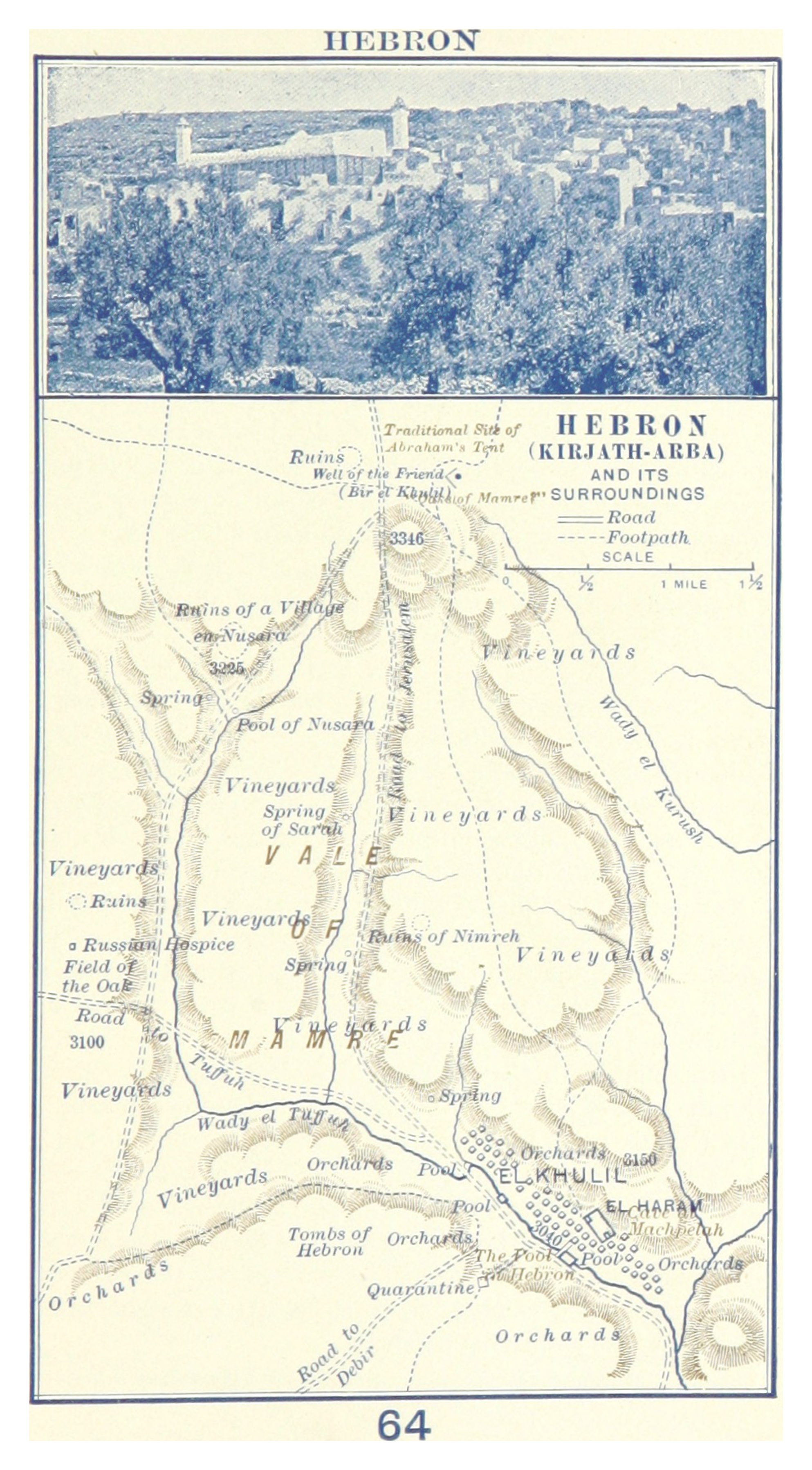
Look at the photograph at the top of this map — a real 19th-century photograph of Hebron, taken when Maccoun compiled this atlas in 1899. The city is ancient, terraced, and built on the slopes of a limestone ridge. It looks, in many ways, as it must have looked when Jacob finally arrived here after his long journey from Haran — finding his father Isaac still alive at Mamre, in the Vale shown on the map below the photograph.
Find the Vale of Mamre on the map — the broad open valley in the center. This is the same vale where the oaks of Mamre once stood, where Abraham had his tents, where God appeared to him with two angels before the destruction of Sodom, and where Sarah died and was buried. Note the label "Traditional Site of Abraham's Tent" near the top of the map, and the "Spring of Sarah" just below it. These are not arbitrary designations — they reflect continuous local memory going back thousands of years about where the patriarch camped and where his wife drew water.
The most significant feature on this map is El Haram — find it in the lower-right, labeled alongside "Machpelah." This is the enclosure built over the Cave of Machpelah, which Abraham purchased from Ephron the Hittite in Genesis 23 for 400 shekels of silver. It is one of the most precisely described real-estate transactions in the ancient world — field, trees, cave, and boundaries all specified. Abraham was making a point: he was not merely a sojourner passing through. He was buying a permanent stake in the land God had promised.
Six patriarchs were buried in this cave: Abraham and Sarah, Isaac and Rebekah, Jacob and Leah. The cave of Machpelah remains today one of the most contested pieces of ground on earth. The present structure built over it dates largely to the Herodian period — the same construction techniques visible in Jerusalem's Western Wall — and has been a site of Jewish prayer, Christian pilgrimage, and Muslim veneration for two millennia. Jacob arrived here after twenty years away, and Genesis 35:27 records simply: "And Jacob came to his father Isaac unto Mamre." He made it home. And Isaac died shortly after, at 180 years old, and was buried here by his sons Esau and Jacob.