
Genesis 15 records one of the most extraordinary events in Scripture. Abraham had just returned from the rescue of Lot and his encounter with Melchizedek. God appeared to him in a vision, reassured him, and made a promise: his descendants would be as numerous as the stars. Abraham believed God — and that faith, the text records with stunning brevity, was credited to him as righteousness (Genesis 15:6). The apostle Paul would return to that single verse as the foundation of his entire theology of justification by faith (Romans 4:3).
Then God made a covenant — and the form of the covenant is unlike anything else in the patriarchal narrative. Abraham was instructed to take specific animals — a heifer, a goat, a ram, a turtledove, and a pigeon — cut them in half, and lay the halves opposite each other on the ground. This was the ancient Near Eastern form of a covenant-making ceremony. The parties to the covenant would walk between the pieces — symbolically declaring that if they broke the covenant, they should be cut in two as the animals were. It was a blood oath of the most solemn kind.
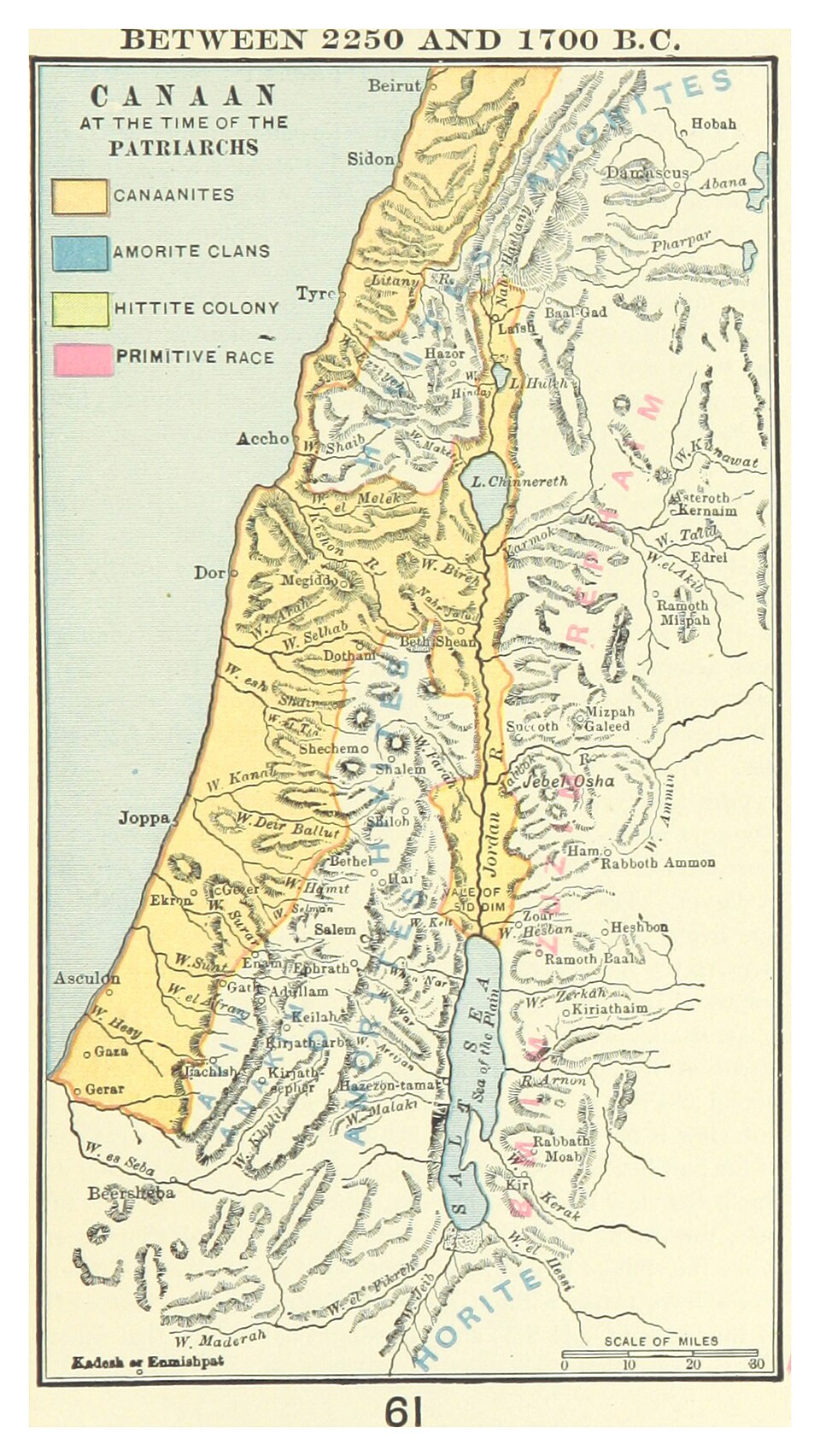
What you are looking at on this map is the land God swore to give. Look at the map carefully. Everything in the yellow Canaanite territory — the coastal plain, the central highlands, the Jordan Valley, the Galilee region in the north — all of this was included in the covenant. But it was larger than just Canaan. Genesis 15:18 defines the boundary with remarkable precision: "from the river of Egypt unto the great river, the river Euphrates." The river of Egypt refers either to the Nile or to the Wadi el-Arish on the Sinai border — southwest of Beersheba, well beyond the bottom of this map. The river Euphrates is far to the northeast, in modern Iraq — far beyond Damascus, which you can see in the upper-right corner. The covenant land encompasses not just Canaan but a vast swath of the ancient Near East: the entire Fertile Crescent from the Nile to the Tigris-Euphrates valley.
Genesis 15:19–21 names ten peoples whose land this includes: the Kenites, Kenizzites, Kadmonites, Hittites, Perizzites, Rephaim, Amorites, Canaanites, Girgashites, and Jebusites. Find them on this map — the Canaanites (yellow throughout the land), the Amorites (blue in the east), the Hittites (green in the north). These were real, documented peoples with real territories. The covenant was not vague. It was specific, geographical, and legally binding.
Here is the most remarkable detail of the ceremony: when darkness fell, Abraham saw a smoking fire pot and a flaming torch pass between the pieces. God moved between the halves — but Abraham did not. In a normal ancient covenant ceremony, both parties walked between the pieces, both accepting the curse of death for violation. But here, only God passed through. Abraham was asleep. God alone took the oath. This was a unilateral, unconditional covenant — resting entirely on God's character and God's word, not on Abraham's faithfulness or Israel's performance. It cannot be broken by human failure. It has not expired. It has not been transferred. The land on this map was promised to Abraham's physical descendants in an eternal, unconditional covenant sealed by the passage of God himself between the pieces of the sacrifice — and that promise stands to this day.