
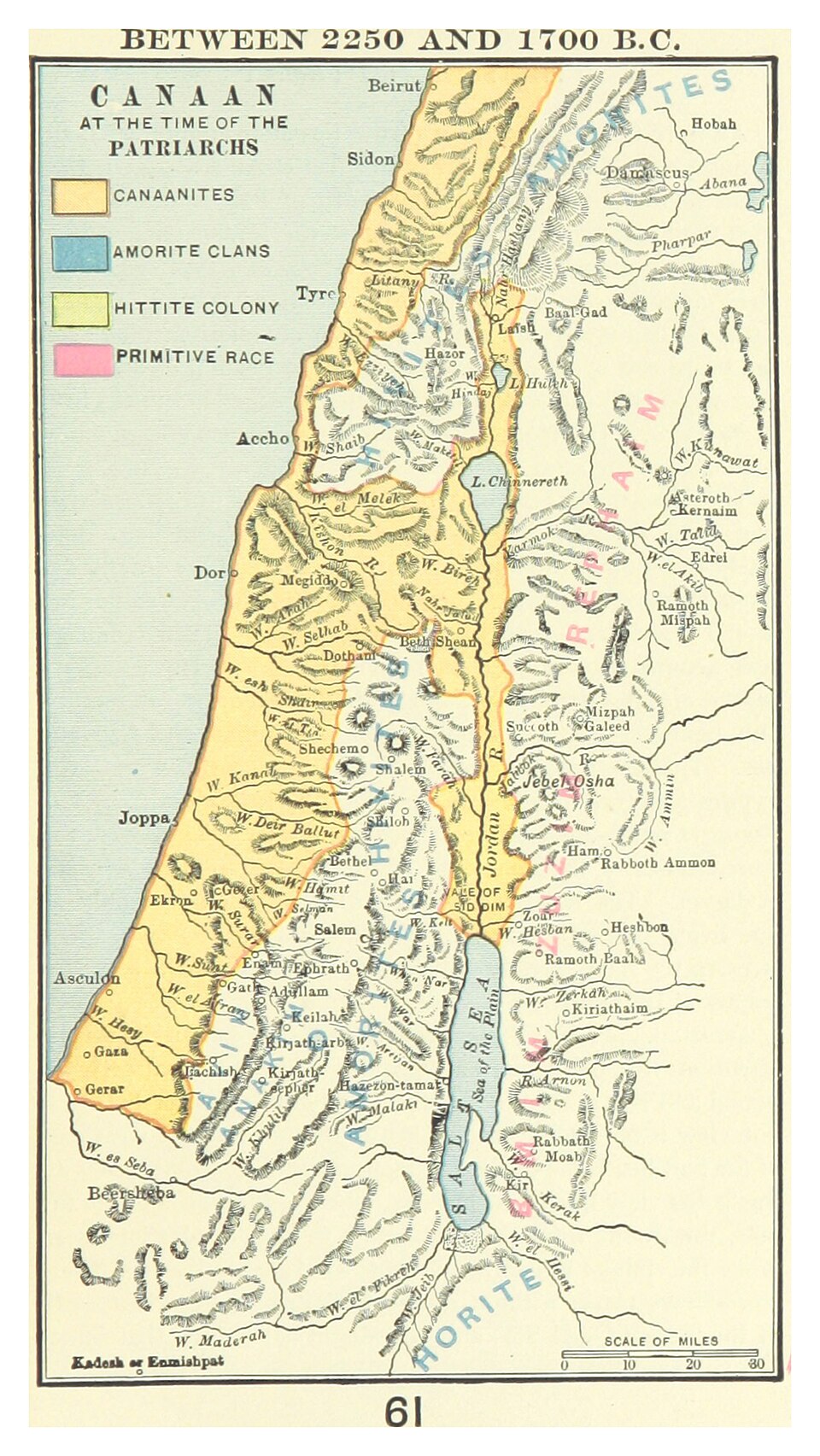
Genesis 14 is unlike any other chapter in the patriarchal narrative. It reads less like family history and more like a military dispatch — kings, alliances, campaigns, battles, captives, and a night raid. It is also, remarkably, the most geographically detailed chapter in the entire book of Genesis, naming cities, regions, valleys, and routes that can be cross-referenced with ancient Near Eastern records. Scholars have debated its historical setting for generations, but the detail and internal coherence of the account have led many to conclude that it preserves genuine historical memory of a real military event.
Understanding the map — the background to the battle. Look at the map before you. The land you are looking at is Canaan as it existed between 2250 and 1700 BC — Abraham's world. The Jordan River runs north to south through the center of the map. The Dead Sea, labeled here as "Sea of the Plain" and "Salt Sea," sits in the lower center-right. Just north of the Dead Sea, find the label "Vale of Siddim" — this valley, now likely submerged under the northern end of the Dead Sea, was the battlefield where Genesis 14 opens. Five city-kings from the cities of the plain — including Sodom and Gomorrah — had been paying tribute to Chedorlaomer, king of Elam, for thirteen years. In the fourteenth year, they rebelled. Chedorlaomer and three allied kings marched south in a massive punitive campaign, sweeping down through Transjordan and striking peoples all along the eastern side of the Jordan before turning on the five cities in the Vale of Siddim. The five kings were defeated. Sodom and Gomorrah were plundered. Among the captives taken was Lot, Abraham's nephew, who had been living in Sodom.
Abraham's pursuit — follow the route on the map. When a survivor brought Abraham the news at his camp near Hebron (find Kirjath-arba in the lower-center of the map — this is Hebron), Abraham immediately armed 318 trained men from his own household and set off in pursuit. The four kings were heading north with their plunder, following the Jordan Valley. Abraham pursued them northward — over 100 miles — to Dan (not labeled on this map but located at the northern headwaters of the Jordan, where the river begins). From Dan he continued the pursuit to Hobah. Now find Hobah on the map — it is in the upper-right corner, northeast of Damascus. Damascus itself is clearly labeled just to the southwest. The text of Genesis 14:15 says Abraham "divided himself against them by night" — a classic night-attack strategy — and smote them, pursuing the retreating kings all the way to Hobah. Lot, his possessions, and all the captured people were recovered.
The return — and Melchizedek. On the return journey south, Abraham passed through the King's Valley — the Valley of Shaveh, traditionally identified with the Kidron Valley east of Jerusalem. Find "Salem" on the map in the central hill country west of the Jordan. This is Jerusalem. Here the king of Sodom met Abraham to thank him and offer him the recovered goods. And here one of the most mysterious figures in all of Scripture appeared: Melchizedek, king of Salem and priest of God Most High. He brought out bread and wine, blessed Abraham, and received tithes from him. The writer of Hebrews would later spend three chapters (Hebrews 5–7) unpacking the theological significance of this encounter, identifying Melchizedek's eternal priesthood as a type of the eternal priesthood of Jesus Christ. Abraham, with characteristic spiritual clarity, refused to keep any of the plunder from the king of Sodom — declaring that he would not allow any man to say "I have made Abram rich." He had just won one of the most remarkable military victories in the ancient world, and he gave the credit entirely to God.
The map before you shows the entire stage on which this drama played out: the valley where the battle happened, the corridor along which the four kings fled with their captives, the city where Melchizedek blessed Abraham, and the remote northern point where 318 men defeated a Mesopotamian army. Everything on this map is real. Every city, river, and region has been verified by archaeology or confirmed by comparative ancient texts. Genesis 14 is not mythology. It is history — and it happened here.