
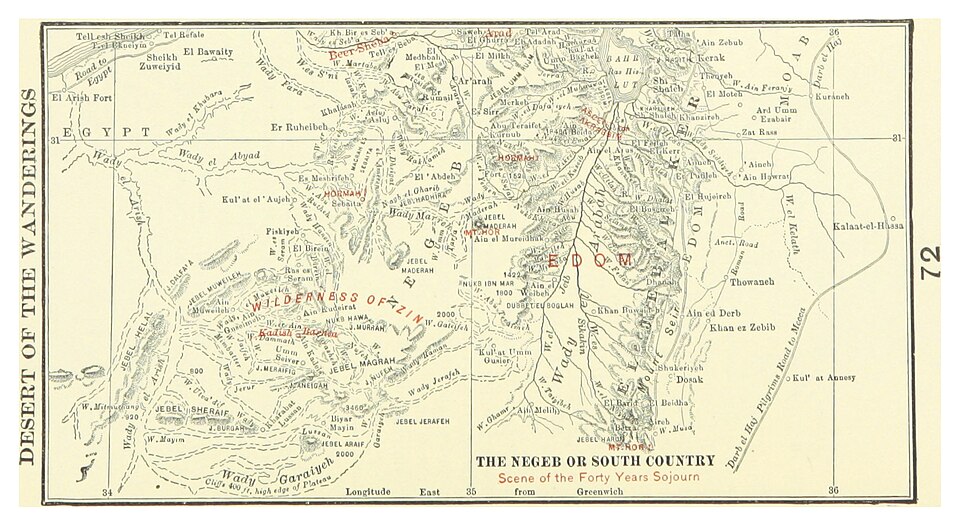
Look at the map before you. This is the wilderness — the Negev, the Desert of the Wanderings, the vast and empty southern land that stretches from the hills of Canaan down to the Egyptian border and across to Edom in the east. This is the terrain Hagar crossed alone. No food stores. No traveling party. No protection. Pregnant, enslaved, mistreated, and fleeing into one of the harshest landscapes on earth. And it was here that the God of the universe found her — not Abraham the patriarch, not Sarah the matriarch, but a foreign slave woman running from an impossible situation — and spoke her name.
The story begins with Sarah's plan. Unable to conceive, she gave her Egyptian servant Hagar to Abraham as a surrogate wife — a practice common in the ancient Near East and documented in the law codes of the period. When Hagar became pregnant, the power dynamic shifted. She "despised her mistress" (Genesis 16:4). Sarah dealt harshly with her. And Hagar fled — south, toward Egypt, toward home, along the road you can trace on the upper-left portion of this map past El Arish Fort and into the Shur wilderness on Egypt's border.
On this map, find Kadesh in the lower-left portion — labeled "Kadesh Abusha" or the Ain Kudeirat area. Genesis 16:14 tells us Beer-lahai-roi, the well where the Angel of the LORD appeared to Hagar, was located "between Kadesh and Bered." So trace your eye slightly northwest of Kadesh on this map — somewhere in that western desert corridor between the Kadesh oasis and the Egyptian border. This is where Hagar stopped. At a well. Alone. And the Angel appeared.
The Angel's words were extraordinary. He acknowledged her suffering, gave a command ("Return to your mistress"), and then delivered a promise almost identical in structure to the covenant God made with Abraham: her descendants through Ishmael would be too numerous to count. Her son would be named Ishmael — "God hears" — because "the LORD hath heard thy affliction" (Genesis 16:11). And Ishmael's character was prophesied with remarkable accuracy: "a wild man; his hand will be against every man, and every man's hand against him; and he shall dwell in the presence of all his brethren" (Genesis 16:12). The Arab peoples — who trace their lineage through Ishmael — have dwelt in exactly this relationship with the surrounding world for four thousand years.
Hagar's response is the most theologically striking detail in the entire account. She gave God a name. Of all the people in Genesis — Abraham, Isaac, Jacob, Moses — Hagar alone names God directly: El Roi. "Thou God seest me." And then she added the question that echoes across every human experience of suffering: "Have I also here looked after him that seeth me?" (Genesis 16:13). In the middle of this desert — the very desert shown on this map — a slave woman asked whether God was real, whether He truly saw her, whether her suffering had been witnessed. And God answered her. The well was named Beer-lahai-roi: "the well of the Living One who sees me." It stands as one of Scripture's most profound declarations that God sees the invisible, hears the unheard, and finds the lost — in every wilderness, including this one.