
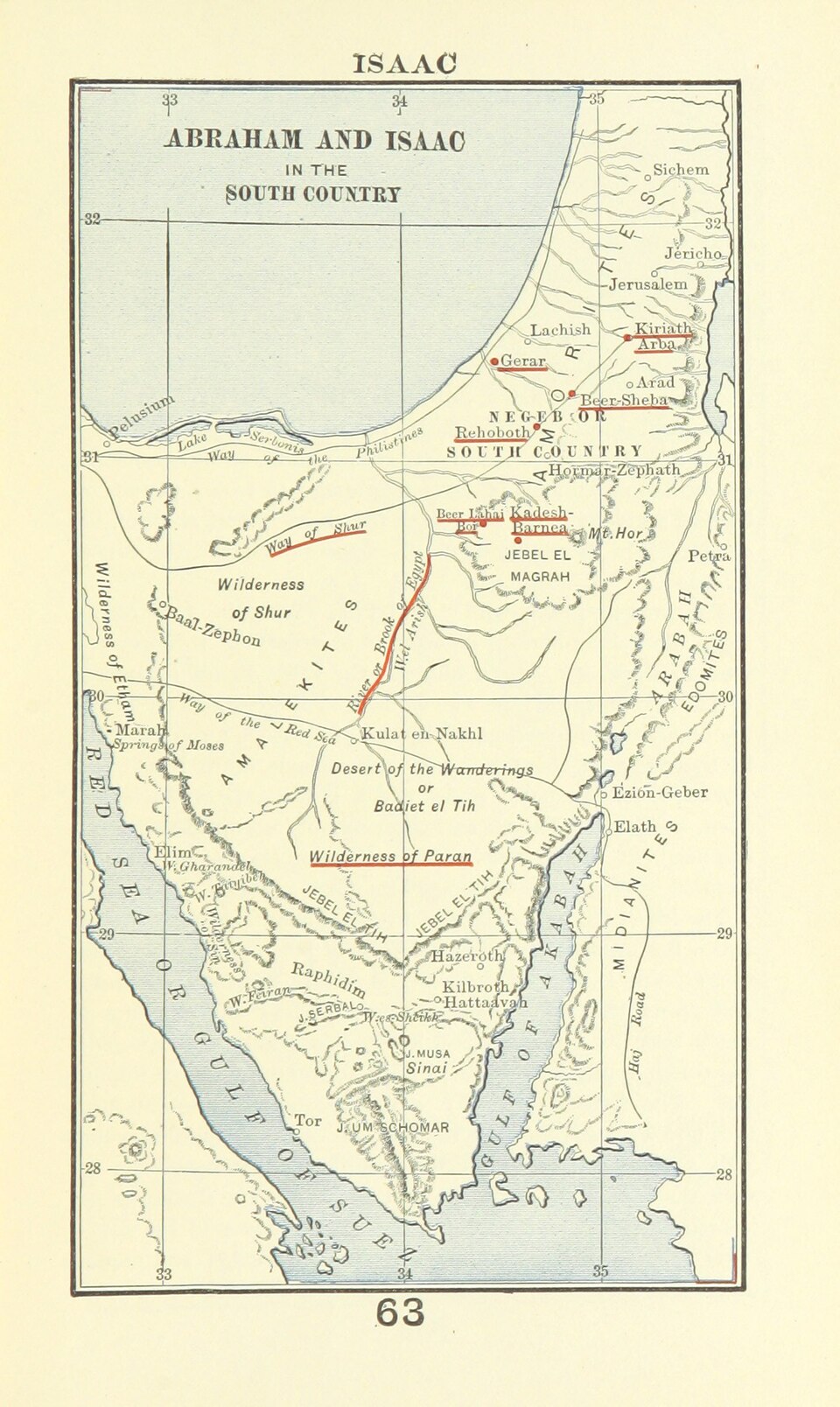
Isaac is the most understated of the three patriarchs. Abraham's life is filled with dramatic moments — the call from Ur, the covenant of the pieces, the rescue of Lot, the binding of Isaac on Moriah. Jacob's life is turbulent — wrestling with God, fleeing from Esau, twenty years of labor and deception with Laban. But Isaac's life, as recorded in Genesis, is quieter, more domestic, more rooted. He barely travels. He stays in the South Country — the Negev — all his life, moving between Beer-Sheba, Gerar, and Beer-lahai-roi within a radius of perhaps fifty miles. The map before you shows virtually the entire geography of Isaac's life.
Look at the red-highlighted locations on this map — they trace Isaac's story precisely. Begin in the upper right at Kiriath-Arba (Hebron). This is where Isaac was born, and it is where he and Ishmael buried Abraham in the cave of Machpelah after his death at 175 years old (Genesis 25:9–10). From there, follow the map southwest to Beer-lahai-roi — the well where the Angel of the LORD had appeared to Hagar. Isaac was living here when his father's servant returned from Mesopotamia with Rebekah. Genesis 24:62–67 records the moment: "Isaac went out to meditate in the field at the eventide: and he lifted up his eyes, and saw, and, behold, the camels were coming." He brought Rebekah into his mother Sarah's tent, and was comforted after her death.
When famine struck, Isaac was tempted to follow his father's example and go to Egypt. God told him explicitly not to go — "go not down into Egypt; dwell in the land which I shall tell thee of" (Genesis 26:2) — and reconfirmed the covenant: the land, the descendants, the blessing to all nations. Isaac obeyed and went instead to Gerar, the Philistine city visible on the center-left of this map. Find Gerar on the map. Here Isaac made the same mistake his father had made — passing Rebekah off as his sister to Abimelech for fear of being killed (Genesis 26:7). Abimelech discovered the deception and confronted Isaac. But God blessed Isaac so abundantly in that land — his harvest a hundredfold in the same year of famine — that the Philistines became jealous and asked him to leave.
The well disputes are one of the most revealing sequences in Isaac's story. As he moved through the valley of Gerar, his servants dug wells, and the Philistine herdsmen repeatedly quarreled over them. The first well he named Esek ("contention"). The second he named Sitnah ("opposition"). The third well — find Rehoboth on the map, highlighted in red — he named Rehoboth, meaning "room": "For now the LORD hath made room for us, and we shall be fruitful in the land" (Genesis 26:22). The patience and faith in that naming is characteristic of Isaac throughout. He did not fight. He moved. He trusted God for space.
Finally Isaac moved to Beer-Sheba — find it on the map, marked in red just east of center. The very night he arrived, God appeared and said: "I am the God of Abraham thy father: fear not, for I am with thee." Isaac built an altar, dug a well, and made a peace covenant with Abimelech. Beer-Sheba became his permanent home for the rest of his long life — 180 years in total. He was buried at Kiriath-Arba by his sons Esau and Jacob, in the same cave where Abraham and Sarah lay. The entire geography of that life — birth, marriage, famine, wells, altar, burial — fits within the boundaries of this single map.