

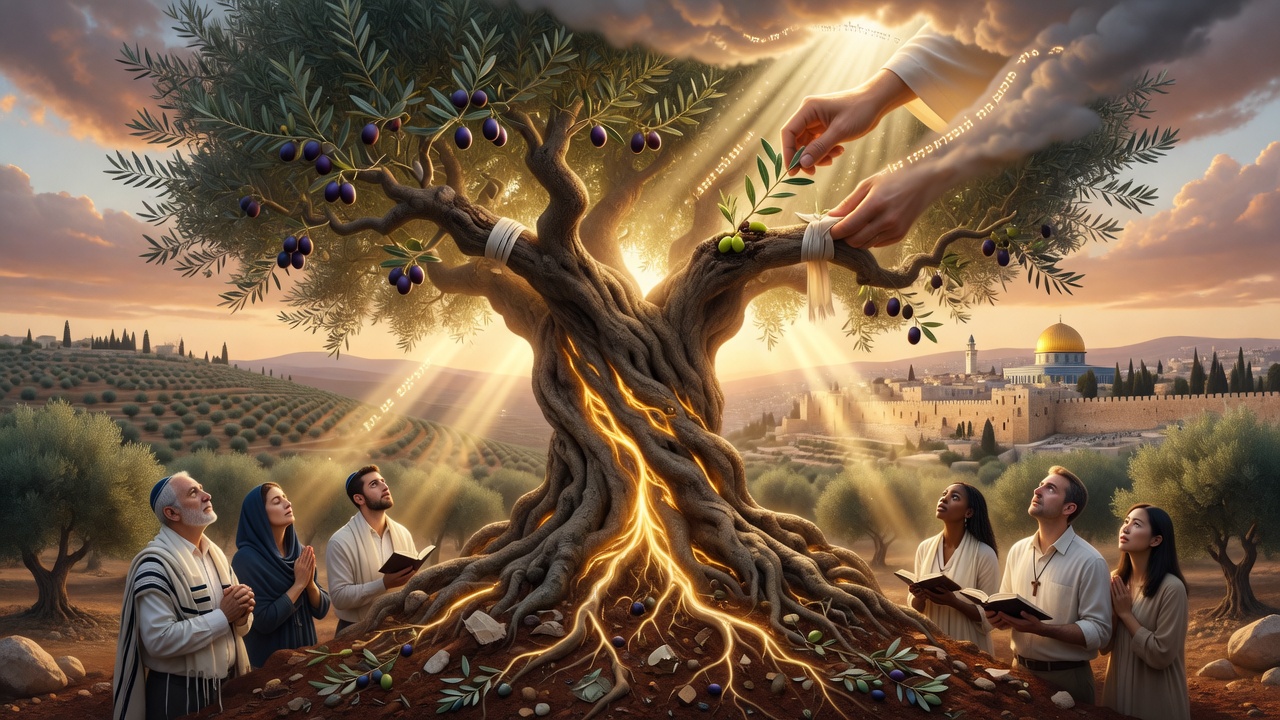
“If the root is holy, so are the branches.”
Part I — Romans 9, 10, and 11: Paul’s Thesis on the Jewish People
A Letter Within a Letter
Romans 9, 10, and 11 stand as one of the most theologically profound and emotionally charged passages in the entire New Testament. These three chapters form a distinct theological unit within Paul’s letter to the Roman believers — a letter within a letter — in which the Apostle sets aside the doctrinal arguments of Romans 1 through 8 and turns his full attention to the question that must have haunted him all of his apostolic life: What has become of Israel? The answer he provides across these three extraordinary chapters is not merely a theological footnote. It is a comprehensive, Spirit-breathed revelation of God’s sovereign plan for the Jewish people, for the Gentiles, and for the ultimate reconciliation of all humanity under the Lordship of Yeshua Ha’Mashiach.
Romans 1 through 8 establishes the universal condition of mankind before God: all have sinned and fallen short of His glory (Romans 3:23). Jew and Gentile alike stand condemned under the Law. But the same grace that condemns offers redemption — through faith in Messiah Yeshua. By the time Paul reaches the great crescendo of Romans 8 (“nothing in all creation will be able to separate us from the love of God that is in Christ Jesus our Lord”), the reader might reasonably ask: if salvation is available to all through faith, then where does this leave the Jewish people, with whom God made His covenant in the first place? Have the promises of God simply been transferred to a new entity called “the Church,” leaving Israel discarded on the ash-heap of history? Paul’s answer, thundering across three chapters, is this: By no means. God has not rejected His people. (Romans 11:1)
Romans 9 — The Sovereignty of God and the Integrity of His Word
Paul opens Romans 9 with an expression of personal anguish that should stop every reader in their tracks. He does not begin with a theological argument. He begins with a broken heart: “I have great sorrow and unceasing anguish in my heart. For I could wish that I myself were cursed and cut off from Christ for the sake of my people, those of my own race, the people of Israel.” (Romans 9:2–3). This is not the language of a man who has left his people behind. This is the language of a man who loves Israel with the love of God Himself.
The core of Romans 9 is the defense of a critical proposition: “It is not as though God’s word has failed.” (Romans 9:6). Everything that follows in chapters 9, 10, and 11 is built upon this foundation. The promises God made to Abraham, Isaac, and Jacob have not been revoked. They have not been nullified by Israel’s stumbling. They have not been transferred to a new people. God is not a man that He should lie, nor a son of man that He should change His mind (Numbers 23:19). The covenants are irrevocable. Paul establishes this by walking through the history of God’s sovereign election: through Isaac, not Ishmael; through Jacob, not Esau. God’s purposes have always been exercised in sovereign freedom, but they have never been arbitrary. They have always flowed from His character — His mercy, His faithfulness, His eternal purposes for the redemption of all creation.
Romans 10 — Israel’s Stumble and the Open Door
Romans 10 is Paul’s diagnosis of Israel’s present condition — and his declaration that the door of salvation stands wide open to all who will enter through faith. The problem, Paul explains, is not that Israel was without knowledge. Rather, “since they did not know the righteousness of God and sought to establish their own, they did not submit to God’s righteousness.” (Romans 10:3). Israel stumbled over the Stumbling Stone — Messiah Himself — not because He was hidden from them, but because they sought to establish their own righteousness through the works of the Law rather than receive the righteousness that comes by faith in Him.
And yet Romans 10 is simultaneously one of the great declarations of universal gospel availability in all of Scripture. “For there is no difference between Jew and Gentile — the same Lord is Lord of all and richly blesses all who call on Him, for, ‘Everyone who calls on the name of the Lord will be saved.’” (Romans 10:12–13). Paul ends Romans 10 with a deeply poignant image of God Himself as the one who has never stopped reaching out: “All day long I have held out my hands to a disobedient and obstinate people.” (Romans 10:21). The hands are still outstretched. Israel has not been abandoned. The invitation has not been withdrawn.
Romans 11 — The Olive Tree, the Mystery, and the Promise
It is in Romans 11 that Paul delivers the fullness of his vision — and where the metaphor of the olive tree takes center stage. He begins by establishing that God has never, even in Israel’s darkest hour, left Himself without a remnant of faithful Israel. Just as in the days of Elijah, when the prophet believed himself to be the last one standing, God revealed that He had preserved 7,000 who had not bowed the knee to Baal, so today there is a remnant — chosen by grace — of Jewish believers in Yeshua (Romans 11:1–5). The existence of this remnant proves that God has not cast away His people.
“Now if some of the branches have been broken off, and you, a wild olive branch, have been grafted in their place to share the rich root of the olive tree, do not boast about being better than the other branches. If you boast, remember that you do not support the root, but the root supports you.”
As Paul writes, the Gentiles are the “wild olive branches” that have been “grafted in” to the root of the olive tree. We are the “wild” branches because we are “foreign” — we are not a natural part of the cultivated olive tree that is rooted in the covenant promises given to Abraham, Isaac, and Jacob. We did not author the Scriptures. We were not given the oracles of God. We were not the recipients of the Mosaic Law, the Tabernacle, the Temple, or the prophetic promises. All of these belong to Israel. Paul was unambiguous about this in Romans 9:4–5, listing the privileges that belong to Israel: “Theirs is the adoption to sonship; theirs the divine glory, the covenants, the receiving of the law, the temple worship and the promises. Theirs are the patriarchs, and from them is traced the human ancestry of the Messiah.”
This is the root that supports us. Not the other way around. We Gentile believers did not create the root. We did not water it, cultivate it, or sustain it. We were grafted into something that was already ancient, already holy, already deeply rooted in the purposes of God. The “other branches” Paul speaks of — the natural branches that were broken off — are the Jewish people who, in their generation, did not receive Messiah. But the root itself — the covenant root of Jesse, of Abraham, of the irrevocable promises of God — remains holy and remains the source of every blessing we have received.
The Warning Against Arrogance — And the Doctrine That Forgot It
“Then you will say, ‘Branches were cut off so that I could be grafted in.’ That’s right! They were broken off because of their unbelief, but you remain only because of faith.” (Romans 11:19–20)
There are those — some of whom would call themselves “Christians” — who, in both arrogance and ignorance, find merit in belittling the Jewish people for their rejection of Ha’Mashiach. In some cases, such attitudes have resulted not merely in insults and contempt but in organized, systematic violence against Jewish communities across the centuries. Out of this platform of arrogance emerged the doctrine known as Replacement Theology — the assertion that the Jewish people, through their rejection of Messiah, have been permanently replaced by the Church as the new Israel, the new chosen people, the sole inheritors of all the covenant promises God made to Abraham, Isaac, and Jacob.
This doctrine is not a fringe position. It has been, in various forms, the dominant theological framework of much of Christendom for most of the past two thousand years. It has gone by different names — Supersessionism, Fulfillment Theology, Covenant Theology in its more extreme expressions — but the core assertion remains the same: the Church has replaced Israel. The promises made to the Jewish people are now the inheritance of the Church. Israel has no further role in the redemptive purposes of God. Scripture does not support this position. Paul anticipated it — and condemned it in advance:
“Do not boast about being better than the other branches. If you boast, remember that you do not support the root, but the root supports you…Do not be arrogant, but be afraid! For if God did not spare the natural branches, He certainly will not spare you either.”
Moreover, the very logic of Replacement Theology destroys the theological foundation on which every Gentile believer stands. If God can revoke His covenant promises to Israel — if He can unilaterally change His mind about the irrevocable — then on what grounds does any Gentile believer have assurance of their own salvation? The security of our standing in God’s grace rests precisely on the same faithfulness of God that guarantees His promises to Israel. A God who abandons Israel is a God whose promises cannot be trusted. A God who keeps His covenant with Israel is a God whose promises to us in Messiah are equally indestructible.
Humility, Faith, and the Continuing Call
As Gentiles grafted into God’s redemptive plan, our calling is not to boast but to serve. Not to elevate ourselves above Israel but to recognize the extraordinary privilege — and the sobering responsibility — of having been included in what God began with Abraham. We were strangers to the covenants of promise (Ephesians 2:12). We had no claim on the God of Israel. We were brought near by the blood of Messiah (Ephesians 2:13) — grafted in, as Paul says, “contrary to nature.” This is grace. This is mercy without precedent. And it demands from us a corresponding humility, a gratitude that expresses itself in how we speak of, pray for, and stand with the Jewish people.
“Consider therefore the kindness and sternness of God: sternness to those who fell, but kindness to you, provided that you continue in His kindness. Otherwise, you also will be cut off.”
The Mystery — And the Coming Restoration
Perhaps the most breathtaking dimension of Paul’s argument in Romans 11 is the disclosure of what he calls “this mystery” (Romans 11:25) — a revelation that he does not want Gentile believers to be “ignorant” of, lest they become “conceited.” The mystery is this: Israel’s hardening is partial and it is temporary. It will last only “until the full number of the Gentiles has come in.” And then — “all Israel will be saved.” (Romans 11:26)
Although in their unbelief the “natural branches” were broken off, in His mercy and love He facilitates their being grafted in again — and as Paul tells us, it will be a perfect fit. As is the nature of Our Father in Heaven, He makes all things new.
“If the Jews do not persist in their unbelief, they will be grafted in again, because God is able to graft them in. After all, if you were cut off from what is naturally a wild olive tree, and contrary to nature were grafted into a cultivated olive tree, how much easier will it be for these natural branches to be grafted back into their own olive tree!”
“For God’s gifts and His call are irrevocable.” (Romans 11:29). The same word — irrevocable — that secures every promise God has ever made to you and to me in Messiah also secures every promise He has ever made to Israel. They stand or fall together. Paul closes this magnificent three-chapter discourse not with a theological summary, but with an explosion of praise:
“Oh, the depth of the riches of the wisdom and knowledge of God! How unsearchable His judgments, and His paths beyond tracing out!… For from Him and through Him and for Him are all things. To Him be the glory forever! Amen.”
This is the only posture available to us. Not boasting. Not arrogance. Not the presumption that we have fully understood the purposes of the Almighty. Only worship, only wonder, and the humble recognition that we are wild branches — grafted in by sovereign grace, sustained by roots we did not plant, and called to stand in faith before the same God who has never, not for one moment, forgotten His people Israel.
Part II — The Olive Tree: Its Nature, Its History, and Its Meaning
“His beauty shall be as the olive tree.”
Of all the trees that grow in the soil of the ancient world, none carries more theological weight in Scripture than the olive. The prophet Hosea reached for it when he wanted to describe the restored beauty of a people reconciled to God. That choice was not arbitrary. In the ancient Near East, the olive was life itself — its fruit pressed into oil that lit lamps, anointed kings, consecrated priests, preserved food, and soothed wounds. Together with grain and wine, olive oil completed the triad of agricultural abundance that God promised the Land would yield (Deuteronomy 7:13). When Moses described the inheritance awaiting Israel, he called it simply “a land of olive trees and honey” (Deuteronomy 8:8). To possess olive trees was to possess the land.
The olive tree itself is a remarkable organism. It grows slowly, lives extraordinarily long, and becomes more gnarled and ancient-looking with each passing century — its trunk thickening, hollowing, splitting, yet continuing to bear fruit long after trees of lesser constitution have died. Young trees bear their first blossoms after five or six years; mature trees between forty and fifty years old are considered to be in their prime. But ancient trees, centuries old, still yield fruit. The olive does not surrender easily to time. It is, in the most literal sense, a tree of endurance.
Its root system is equally formidable — spreading wide and deep to draw moisture from the rocky, dry hillsides of the Mediterranean world where other plants would perish. This is no accident in Paul’s choice of metaphor. The root of Israel’s covenant history — the promises made to Abraham, renewed to Isaac and Jacob, confirmed through the Mosaic covenant and the Davidic throne — is precisely this kind of root: ancient, deep, nourishing, and indestructible.
Grafting — Contrary to Nature, Yet by God’s Design
The practice of grafting olive branches is ancient. Typically, a cultivated variety — one selected and developed over generations for the quality of its fruit — is grafted onto wild stock to benefit from the wild tree’s hardier root system. This is the natural order: the superior cultivated branch receives strength from the wild root. What Paul describes in Romans 11 deliberately inverts this. The wild branches — Gentile believers — are grafted not onto wild stock but into the cultivated tree of Israel’s covenant heritage. As Paul himself acknowledges, this is “contrary to nature.” It is not how olive cultivation works. It is, however, exactly how grace works. The very inversion of the natural order is what makes the mercy so staggering. The wild branch has no claim on the cultivated tree. It did not develop the rootstock. It brings nothing to the union except its willingness to receive. And yet by the sovereign act of the Gardener, it is grafted in — and receives the full nourishment of roots it did not plant.
The Anointing — Oil, Holiness, and the Name of Messiah
Olive oil in Scripture is inseparable from the concept of divine anointing. From Jacob pouring oil on the stone at Bethel to consecrate that place of encounter with God (Genesis 28:18), to Moses consecrating the Tabernacle and all its furnishings with specially prepared anointing oil (Exodus 30:22–29), to the anointing of Israel’s kings and prophets — olive oil was the physical sign of separation to God, of divine authority conferred, of the Holy Spirit’s presence and power. The Hebrew word Mashiach and the Greek word Christos share a single meaning: the Anointed One. He is the One toward whom every anointing in Israel’s history pointed. He is the fulfillment of everything the olive ever signified — the Light of the World whose lamp never goes out, the consecrated King whose throne endures forever, the One in whom both natural and grafted branches find their life.
The Debt of the Grafted Branch
All of this leads to a single, inescapable conclusion: the Gentile believer owes a debt to Israel that he can never fully repay. We did not grow the root; we were grafted into it. We did not write the Scriptures; we received them from Jewish hands. We did not produce the Messiah; He came, in the flesh, from the people of Israel. Every spiritual blessing the Church enjoys flows up through a Jewish root — the covenants, the prophets, the oracles of God, and the Anointed One Himself. Paul names the debt plainly elsewhere: if the Gentiles have shared in Israel’s spiritual blessings, they owe it to Israel to share material blessing in return (Romans 15:27).
This is why the doctrine of replacement is not merely a theological mistake but a kind of ingratitude — the grafted branch turning on the root that feeds it. The wild branch that understands its own story does the opposite. It does not boast over the natural branches; it honors them. It does not despise the people through whom its salvation came; it loves them, prays for them, and longs to see them grafted back into their own tree. To be grafted in is not a license for pride. It is a summons to gratitude, to humility, and to a settled solidarity with the Jewish people — for the root that bears the wild branch is the same root that will, in God’s perfect time, receive the natural branches home. This is the true relationship between the Church and Israel: not replacement, but grateful partaking.