
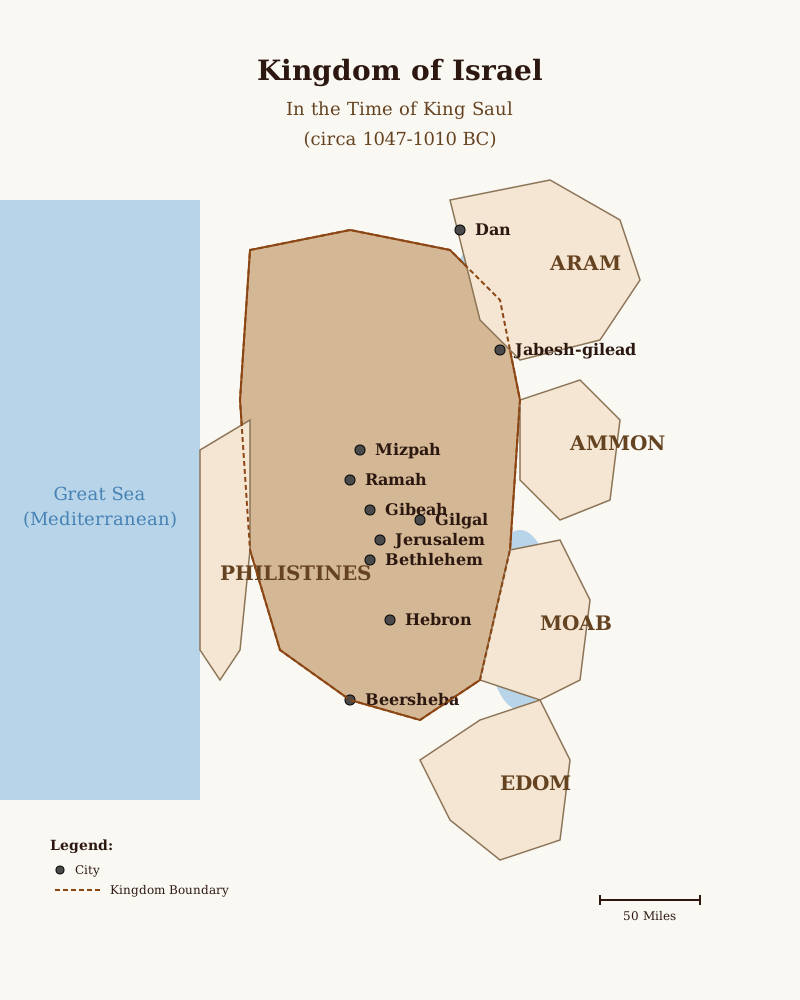
What You Are Looking At
This 1915 map from George Adam Smith’s Atlas of the Historical Geography of the Holy Land is dated c. 1020 BC — the precise era of Saul’s reign. The map shows the tribal territories of Israel as they stood when Samuel anointed Saul. Ramah, Samuel’s hometown in the territory of Benjamin, is the site of the private anointing recorded in 1 Samuel 10:1. Gibeah of Saul lies just south of Ramah — Saul’s own hometown, which would later become the royal capital of his kingdom. Mizpah appears to the southwest, where Samuel later assembled all Israel for the public proclamation of Saul as king by lot (1 Samuel 10:17–24). Gilgal appears to the east near the Jordan, where Saul was formally renewed as king before the people (1 Samuel 11:14–15). Jabesh-gilead sits across the Jordan in the territory of Gad — the besieged city whose rescue by Saul confirmed his fitness to reign. The shaded territories of the surrounding peoples are clearly marked: the Philistines on the western coastal plain, who would dominate the early years of Saul’s reign; the Amalekites in the southern Negev, whom Saul would be commanded to destroy; Ammon across the Jordan to the east; Moab further south along the Dead Sea; and Edom to the deep south. The map is a perfect geographical snapshot of the world into which Israel’s first king was anointed.
“Then Samuel took a vial of oil, and poured it upon his head, and kissed him, and said, Is it not because the Lord hath anointed thee to be captain over his inheritance?”
The Birth of the Monarchy
Map 096 opens Category 4 — The United Kingdom of Israel, the era stretching from 1 Samuel 10 through 1 Kings 11, covering the reigns of Saul, David, and Solomon. With the anointing of Saul, Israel ceased to be a loose confederation of tribes governed by judges and became a kingdom — a transition Israel had demanded and God had reluctantly granted. The Judges era had ended at Ramah with the elders’ request, “Make us a king to judge us like all the nations” (1 Samuel 8:5). Now, in the same town of Ramah, that demand was answered. But the answer was not what the people expected. They wanted a public coronation with crowds and trumpets. God gave them, first, a private anointing — a quiet ceremony with a single vial of oil, witnessed by no one but Samuel and Saul himself.
The Search for Lost Donkeys
The story of how Saul came to be anointed is one of the most striking providences in Scripture. Kish, a wealthy Benjamite from Gibeah, had lost his donkeys. He sent his son Saul — described as “a choice young man, and a goodly: and there was not among the children of Israel a goodlier person than he: from his shoulders and upward he was higher than any of the people” (1 Samuel 9:2) — to find them, along with a servant. After three days of fruitless searching across the territories of Ephraim, Shalisha, and Zuph, Saul was ready to give up and return home so his father would not start worrying about him instead of the donkeys. The servant suggested they first consult the local seer in a nearby city — a man “held in honour” whose words always came true. That seer was Samuel. The Lord had revealed to Samuel the day before: “Tomorrow about this time I will send thee a man out of the land of Benjamin, and thou shalt anoint him to be captain over my people Israel” (1 Samuel 9:16). The donkeys had been the bait. The kingdom was the catch.
“And as for thine asses that were lost three days ago, set not thy mind on them; for they are found. And on whom is all the desire of Israel? Is it not on thee, and on all thy father’s house?”
The Anointing at Ramah
Samuel brought Saul into the city, set him at the head of the guests at a sacrificial feast, and gave him the choicest portion of meat — the priest’s shoulder, set aside for him in advance. They spoke on the rooftop of Samuel’s house in Ramah. The next morning, as Saul prepared to leave, Samuel sent the servant ahead and led Saul aside privately. There, on the outskirts of the city, Samuel poured a small vial of olive oil over Saul’s head, kissed him, and declared him anointed “captain over his inheritance” — the Hebrew word nagid, meaning prince or designated leader. The act was sacramental: oil was the symbol of the Holy Spirit, used to consecrate priests, prophets, and now — for the first time in Israel’s history — a king. Samuel then gave Saul three signs by which he would know the anointing was from the Lord: he would meet two men by Rachel’s tomb, three men at the oak of Tabor, and a band of prophets descending from the high place at Gibeath-elohim. All three signs came to pass that same day. “God gave him another heart” (1 Samuel 10:9), and the Spirit of God came upon him, and he prophesied.
From Private Anointing to Public Kingship
The private anointing at Ramah was only the first of three stages by which Saul became king. Samuel next summoned all Israel to Mizpah, where the choice was confirmed publicly by lot — the lot fell first on the tribe of Benjamin, then on the family of Matri, and finally on Saul son of Kish, who was found hiding among the baggage. He was brought forth, and Samuel proclaimed: “See ye him whom the Lord hath chosen, that there is none like him among all the people? And all the people shouted, and said, God save the king” (1 Samuel 10:24). The third and final stage came after Saul’s rescue of the besieged city of Jabesh-gilead from Nahash the Ammonite. With that victory, the people gathered at Gilgal — the same ancient covenant site where Joshua had circumcised the nation generations earlier — and renewed the kingdom before the Lord (1 Samuel 11:14–15). Three sites, three stages: Ramah for the secret anointing, Mizpah for the public proclamation, Gilgal for the covenant renewal. The map shows them all, clustered in the small territory of Benjamin where the first kingdom of Israel was born.
