
What You Are Looking At
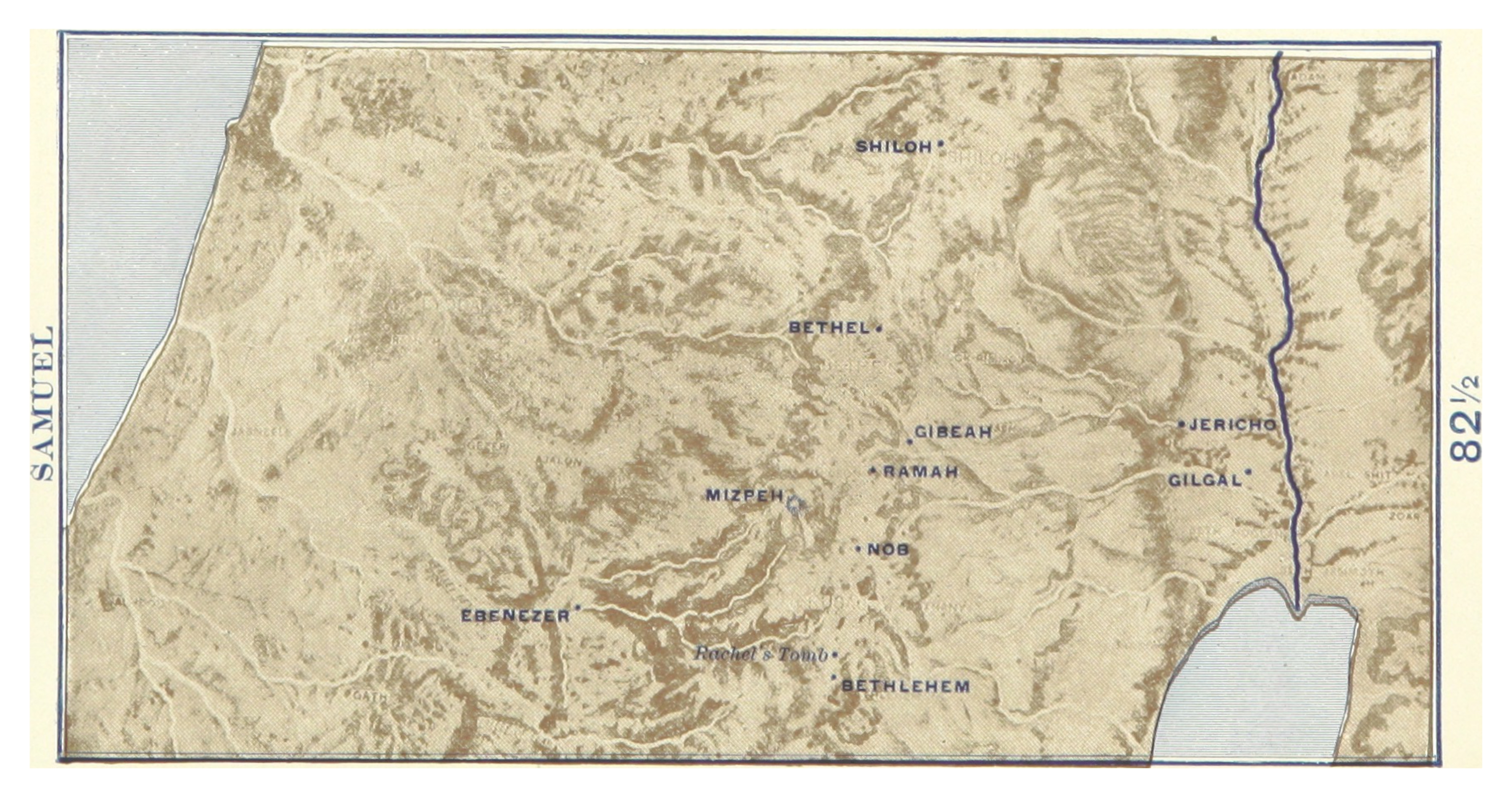
This 1899 Maccoun map is titled simply “SAMUEL” — a dedicated map of the geographical world of Israel’s last judge and first prophet. All four cities of Samuel’s annual circuit are clearly labeled: Shiloh in the north (where Samuel served under Eli and heard God’s call as a child), Bethel in the upper center, Ramah in the center (Samuel’s hometown and permanent base), Mizpeh (Mizpah) to the southwest (where Israel assembled for national covenant renewal), and Gilgal to the east near the Jordan — the ancient covenant site where Joshua had set up twelve memorial stones after the Jordan crossing. Gibeah is labeled to the south of Ramah — the hometown of Saul, who would soon be anointed Israel’s first king at Samuel’s hand. Ebenezer is labeled to the west — the victory memorial stone Samuel erected after the Philistines were routed. Bethlehem appears at the lower center — the city to which Samuel would travel to anoint David. The Jordan River runs down the right side, with Jericho and the Dead Sea (partially visible) to the lower right. The map is a perfect geographical summary of Samuel’s entire ministry.
“And Samuel judged Israel all the days of his life. And he went from year to year in circuit to Bethel, and Gilgal, and Mizpeh, and judged Israel in all those places. And his return was to Ramah; for there was his house; and there he judged Israel; and there he built an altar unto the Lord.”
The Last of the Judges
Samuel stands at the hinge of Israel’s history — the last of the judges and the first of the writing prophets. He was born at Ramah to Hannah, a previously barren woman who had prayed desperately for a child at Shiloh and promised to dedicate him to the Lord. She kept her vow: Samuel was brought to Shiloh as a young child and placed in the service of Eli the high priest. There he heard the voice of God for the first time — a series of calls in the night that Eli eventually recognized as divine, instructing the boy to respond: “Speak, Lord; for thy servant heareth” (1 Samuel 3:9). God’s first word to Samuel was a word of judgment against Eli’s house. Samuel grew into a prophet whose words “did let none of them fall to the ground” (1 Samuel 3:19) — every word he spoke was fulfilled.
The Circuit
Samuel’s judicial circuit covered the central highlands of Ephraim and Benjamin — the heart of Israelite territory. He judged at Bethel (the ancient patriarchal site where Jacob had seen the ladder to heaven and where Jeroboam later placed a golden calf), at Gilgal (the first campsite after the Jordan crossing, where Joshua had circumcised the nation and where Saul would later be crowned and deposed), and at Mizpah (where the nation had assembled in the Gibeah crisis and where Samuel called Israel to covenant renewal). His home was Ramah, where he also built an altar. This circuit kept him in constant movement through the tribal territories of Ephraim and Benjamin — a one-man judiciary for an entire nation.
“Moreover as for me, God forbid that I should sin against the Lord in ceasing to pray for you: but I will teach you the good and the right way.”
The Request for a King
When Samuel grew old and his sons Joel and Abijah proved corrupt judges at Beer-sheba (taking bribes and perverting justice), the elders of Israel came to Ramah with a request that broke Samuel’s heart and marked the end of the Judges era: “Now make us a king to judge us like all the nations” (1 Samuel 8:5). God told Samuel this was not a rejection of Samuel but of God Himself as their king. Samuel warned the people of everything a king would require of them — their sons for his armies, their daughters for his household, their fields and vineyards and olive groves for his officials, a tenth of their grain and flocks. The people refused to listen. “Nay; but we will have a king over us; that we also may be like all the nations; and that our king may judge us, and go out before us, and fight our battles.” The period of the Judges ended not with a dramatic battle but with a theological surrender: Israel chose to be like the nations rather than the peculiar treasure of the Lord.