
What You Are Looking At
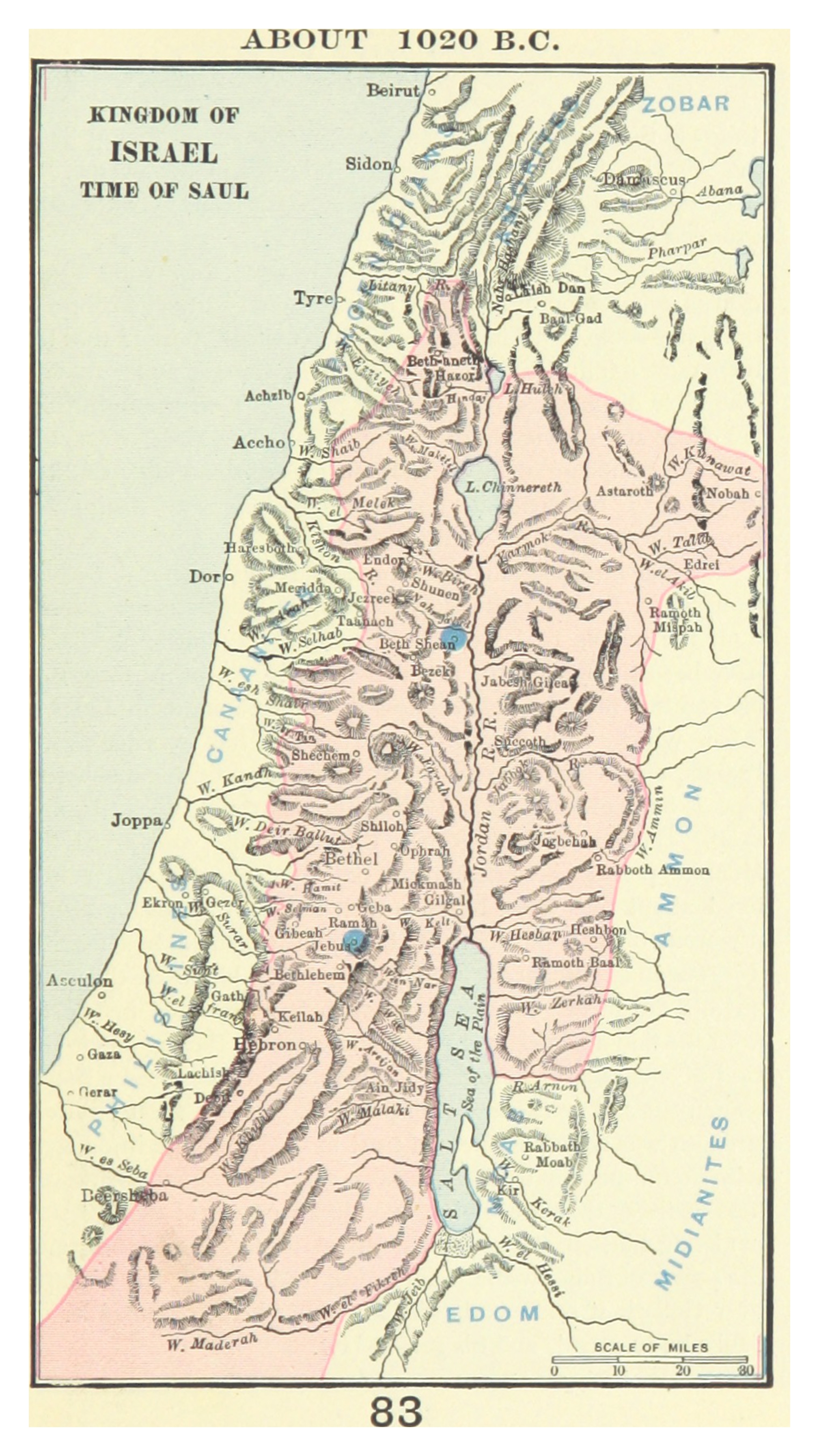
This 1899 Maccoun map is titled “About 1020 B.C. — Kingdom of Israel, Time of Saul.” It shows the full land of Israel at precisely the period when the Ark of the Covenant was captured, held in Philistine territory, and returned. Shiloh is clearly labeled in the central highlands — the site of the Tabernacle and the Ark’s home for approximately 300 years. Ebenezer (where the battle was lost) is visible on the western side. The Philistine cities are visible along the southern coast: Gaza, Asculon (Ashkelon), Gath, and Ekron — all labeled in blue as enemy territory. Gibeah (Saul’s capital) is labeled in the central highlands. Jabesh-Gilead appears to the east of the Jordan — the city Saul would rescue in his first royal act (1 Samuel 11). Ramoth-Gilead is labeled far to the east. The surrounding nations — Ammon, Moab, Edom, Midianites — are all labeled, showing the full geopolitical pressure on Israel at this pivotal moment when the nation was transitioning from the judges to the monarchy, and when its most sacred object had been seized by its most dangerous enemy.
“And when the ark of the covenant of the Lord came into the camp, all Israel shouted with a great shout, so that the earth rang again. And when the Philistines heard the noise of the shout, they said, What meaneth the noise of this great shout in the camp of the Hebrews? And they understood that the ark of the Lord was come into the camp.”
The Fatal Mistake at Ebenezer
After an initial defeat at Ebenezer, Israel’s elders made a catastrophic theological error: they sent to Shiloh for the Ark of the Covenant, believing its physical presence would guarantee victory as it had in Joshua’s day. Hophni and Phinehas — the corrupt sons of the high priest Eli, who had been taking the best of the sacrifices for themselves and committing immorality at the Tabernacle door — accompanied the Ark into battle. Israel’s shout when the Ark arrived was so loud it made the earth ring. The Philistines’ terror when they learned what the sound meant was real. But it was built on a false premise: the Ark was not a magic talisman, and God would not be coerced by its presence. Israel was defeated again, more severely. Hophni and Phinehas were both killed. And the Ark of the Lord was captured by the Philistines. When the news reached Eli at Shiloh, the ninety-eight-year-old high priest fell backward from his seat, broke his neck, and died.
The Ark Among the Philistines
The Philistines placed the Ark in the temple of their god Dagon at Ashdod as a trophy of war. The next morning Dagon’s statue was found prostrate before the Ark. They set it upright. The morning after, Dagon was again prostrate — this time with his head and both hands broken off at the threshold. Simultaneously, severe tumors broke out among the population of Ashdod and spread to every Philistine city where the Ark was moved. After seven months of suffering, the Philistine lords decided to return the Ark to Israel, sending it on a new cart pulled by two milking cows, accompanied by gold guilt offerings. The cows went straight to Beth-shemesh on the border of Judah without turning aside — a detail the Philistine priests recognized as supernatural confirmation.
“Blessed be the Lord, who hath not left thee this day without a kinsman, that his name may be famous in Israel.”
From Beth-shemesh the Ark was moved to Kirjath-jearim in the hill country of Judah, where it remained for twenty years until David brought it to Jerusalem (2 Samuel 6). In that interim, the Tabernacle at Shiloh was apparently destroyed (Jeremiah 7:12 and Psalm 78:60–61 both reference God’s abandonment of Shiloh), and the central Israelite sanctuary ceased to be. The loss of the Ark marks the end of the Judges period’s sacred geography and the beginning of the transition to the monarchy.