
What You Are Looking At
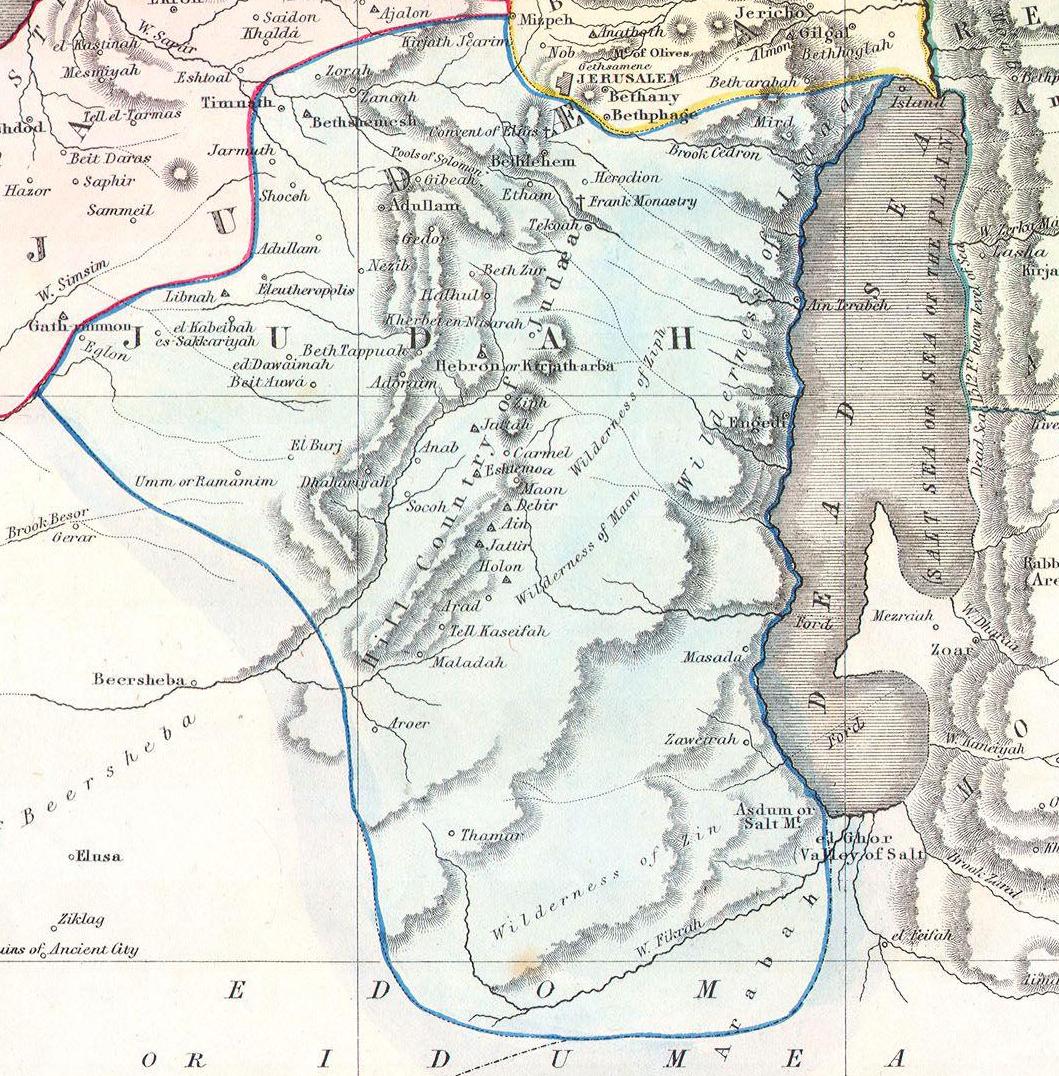
This 1852 Philip hand-coloured map shows the territory of the Tribe of Judah, displayed with the letters J U D A H written prominently across the central portion. Bethlehem is clearly labeled in Judah’s northern hill country — the city to which Ruth and Naomi returned, the city of Boaz, the city from which David would be anointed, and the city where the Messiah would be born. Jerusalem appears at the top of the map with its key landmarks (Mt. of Olives, Bethany, Bethphage). Hebron is labeled in the south — where the patriarchs were buried and where David was first anointed king over Judah. The Dead Sea (Salt Sea) forms the eastern boundary, and at the lower right, the region of Moab is visible beyond the Dead Sea — the land from which Ruth came, and from which she walked with Naomi to reach Bethlehem. The Wilderness of Maon, Wilderness of Ziph, and the rugged southern hill country are labeled — the territory through which David would later flee from Saul. En-gedi and Masada are marked along the Dead Sea shore. The map perfectly frames the story of Ruth’s journey: from Moab (visible at the lower right) across the Jordan and up through the Judean highlands to Bethlehem.
“And Ruth said, Intreat me not to leave thee, or to return from following after thee: for whither thou goest, I will go; and where thou lodgest, I will lodge: thy people shall be my people, and thy God my God.”
Famine, Death, and the Road Back
The book of Ruth is set “in the days when the judges ruled” — placing it squarely within the dark period documented in Judges, yet offering a luminous counter-narrative of faithfulness, kindness, and redemption in the midst of moral chaos. The story begins with a famine in Bethlehem of Judah — painful irony, since “Bethlehem” means “House of Bread.” Elimelech of Bethlehem took his wife Naomi and their two sons across the Jordan to Moab, where bread was available. In Moab, Elimelech died. The two sons married Moabite women — Orpah and Ruth. Within ten years, both sons also died, leaving Naomi widowed and childless in a foreign country with two foreign daughters-in-law.
Ruth’s Pledge
Naomi decided to return to Bethlehem and released both daughters-in-law to go back to their own families. Orpah wept and returned. Ruth refused. Her declaration in Ruth 1:16–17 is one of the most celebrated passages in all of Scripture — a foreigner’s voluntary covenant loyalty to an Israelite mother-in-law, expressed in terms that echo the covenant language of Scripture itself: “Whither thou goest, I will go; and where thou lodgest, I will lodge: thy people shall be my people, and thy God my God.” Ruth chose Naomi’s God, Naomi’s people, and Naomi’s land. She crossed over from Moab into Judah as a convert in all but name.
“And they came to Bethlehem in the beginning of barley harvest.”
The Redemption Line
The book of Ruth ends with a genealogy that is among the most significant in all of Scripture: “And Boaz begat Obed, and Obed begat Jesse, and Jesse begat David” (Ruth 4:21–22). Ruth the Moabitess — a foreigner, a widow, a woman with no claim on Israel’s covenant — became the great-grandmother of David the king. Matthew’s Gospel places her in the genealogy of Jesus Christ (Matthew 1:5). In the darkest period of Israel’s history, when every man did what was right in his own eyes, a Moabite woman’s covenant faithfulness to her mother-in-law and her mother-in-law’s God became a thread in the lineage of the world’s Redeemer. The book of Ruth is the theology of grace in narrative form.