
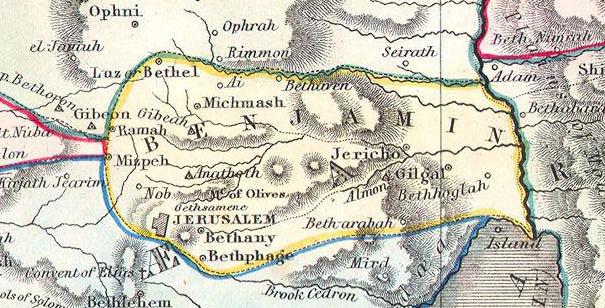
What You Are Looking At
This 1852 Philip hand-coloured map shows the territory of the Tribe of Benjamin, displayed in the yellow shading with the letters B E N J A M I N written across it. The city of Gibeah — the epicenter of the crime that triggered Israel’s first civil war — is clearly labeled in Benjamin’s territory. Ramah and Mizpeh (Mizpah) are also labeled — Ramah is where the Levite and his concubine initially tried to lodge before moving on to Gibeah, and Mizpah is where all Israel assembled to decide on a response to the crime. Gibeon is labeled to the northwest. Jerusalem (labeled Bethsame/Bethsamene) appears at the center — Judges 19:10–12 records that the Levite had passed Jerusalem (then Jebus, a non-Israelite city) and chosen to press on to Gibeah of Benjamin rather than lodge with foreigners. Jericho is visible to the right, with Gilgal nearby. Bethel and Ai appear at the upper left. Anathoth (the future hometown of the prophet Jeremiah) is labeled. The entire map covers the small but densely significant territory of Benjamin — a territory whose Gibeah gave Israel its darkest hour in the Judges period, and would later give Israel its first king.
“In those days there was no king in Israel: every man did that which was right in his own eyes.”
The Crime at Gibeah
The final two chapters of Judges (17–21) are deliberately placed outside the main judge-cycle narrative as appendices that illustrate the full depth of Israel’s moral collapse. The Gibeah narrative (Judges 19–21) is one of the most disturbing passages in the entire Old Testament. A Levite traveling with his concubine through Benjamin stopped for the night in Gibeah. That night, “certain sons of Belial” surrounded the house and demanded the Levite be handed over for homosexual gang rape. The host, following ancient near-eastern hospitality law, refused to give up his male guest but offered his own daughter and the Levite’s concubine instead. The concubine was taken and abused throughout the night; she died at the threshold in the morning. The story is a near-verbatim echo of the Sodom narrative in Genesis 19 — a deliberate comparison that indicts Gibeah as a city that had become as wicked as Sodom.
Civil War and Near-Annihilation
The Levite cut his concubine’s body into twelve pieces and sent one to each tribe of Israel. All Israel assembled at Mizpah — 400,000 warriors — and demanded that Benjamin surrender the guilty men of Gibeah. Benjamin refused and mobilized its own army. The subsequent civil war was devastating. In the first two battles, the Benjaminites actually routed the larger Israelite force, killing tens of thousands. Only on the third day, after fasting and prayer and deploying the successful ambush strategy that had worked at Ai under Joshua, did Israel break Benjamin. Gibeah was burned. Of the entire tribe of Benjamin, only 600 men survived by hiding in the wilderness of Rimmon. Every Benjaminite woman was killed.
“And the children of Benjamin came again at that time; and they gave them wives which they had saved alive of the women of Jabesh-gilead: and yet so they sufficed them not.”
Israel then faced a second crisis: they had sworn at Mizpah that no one would give his daughter to Benjamin in marriage, but now Benjamin was nearly extinct as a tribe. The solution involved both warfare against Jabesh-Gilead (which had not sent its contingent to Mizpah) and the seizure of young women from the annual festival at Shiloh. The narrative ends with the harrowing refrain of Judges 21:25 — the verdict on the entire Judges period: “In those days there was no king in Israel: every man did that which was right in his own eyes.”