
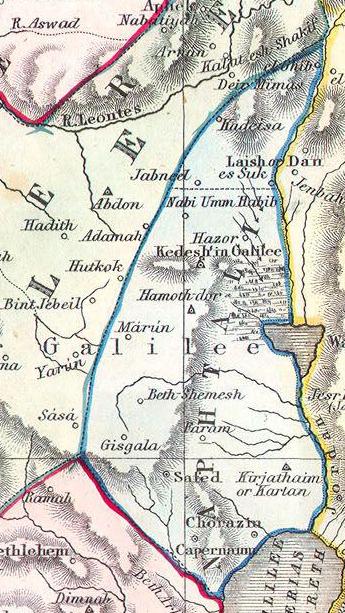
What You Are Looking At
This 1852 Philip hand-coloured map of the territory of Naphtali shows the very destination of the Danite migration. In the upper right portion of the map, the city “Laish or Dan” is clearly labeled — the Canaanite city of Laish that the Danites captured and renamed Dan, establishing it as their new tribal center in the far north of the Promised Land. The map shows the surrounding geography perfectly: Kedesh in Galilee is labeled, one of the six Cities of Refuge and a major Levitical city in Naphtali’s territory. Hazor — the great Canaanite city destroyed by Joshua and the setting of Jabin’s oppression during Deborah’s time — is also labeled. The upper Jordan Valley, where the springs that feed the Jordan emerge from the foot of Mount Hermon, forms the setting for the newly established city of Dan. The map shows precisely the northern region where the Danites ended their journey and settled permanently. Their territory in the south — Zorah, Eshtoal, the Sorek Valley — lay far to the southwest, in what was actually the territory labeled “Dan” on the Map 076 page.
“And they called the name of the city Dan, after the name of Dan their father, who was born unto Israel: howbeit the name of the city was Laish at the first.”
A Migration Driven by Failure
The Danite migration recorded in Judges 18 was not a triumphant expansion but a retreat driven by covenant failure. Dan had been assigned a coastal allotment between Judah, Benjamin, and Ephraim — the same territory shown on the Map 076 page (Philip 1852 Dan) — that included productive lowland and access to the Mediterranean coast near Joppa. But the tribe was unable to secure this land against the Philistines and the Amorites, who “forced the children of Dan into the mountain: for they would not suffer them to come down to the valley” (Judges 1:34). The powerful Philistine city-states on the coast and the Amorite strongholds in the foothills penned Dan into the hill country. The tribe that had numbered 64,400 fighting men in the second census (Numbers 26:43) could not hold its inheritance.
The Scouts Find Laish
Five Danite spies were sent northward to find new land. They eventually reached Laish, a prosperous Phoenician-influenced city at the northern headwaters of the Jordan, isolated from any allies: “And they came to Laish, and saw the people that were therein, how they dwelt careless, after the manner of the Zidonians, quiet and secure; and there was no magistrate in the land, that might put them to shame in any thing; and they were far from the Zidonians, and had no business with any man” (Judges 18:7). The report to the tribe was enthusiastic: Laish was unguarded, wealthy, and vulnerable. Six hundred armed Danites marched north.
Micah’s Idols and the Rival Shrine
On their march north, the Danites passed through the hill country of Ephraim and stopped at the house of a man named Micah, who had set up a private shrine with household idols and hired a young Levite as his personal priest. The Danites took the idols and persuaded the Levite to come with them. They arrived at Laish, destroyed the city, and rebuilt it as Dan. There they established the stolen idols as a religious shrine, with Jonathan ben Gershom (grandson of Moses, according to the Hebrew text) serving as founding priest. The shrine at Dan operated throughout the period of the Judges, and later became one of the two sites — Bethel and Dan — where Jeroboam I placed his golden calves (1 Kings 12:29), establishing the national idolatry of the northern kingdom. A migration that began in covenant failure ended in religious apostasy that would haunt Israel for generations.