
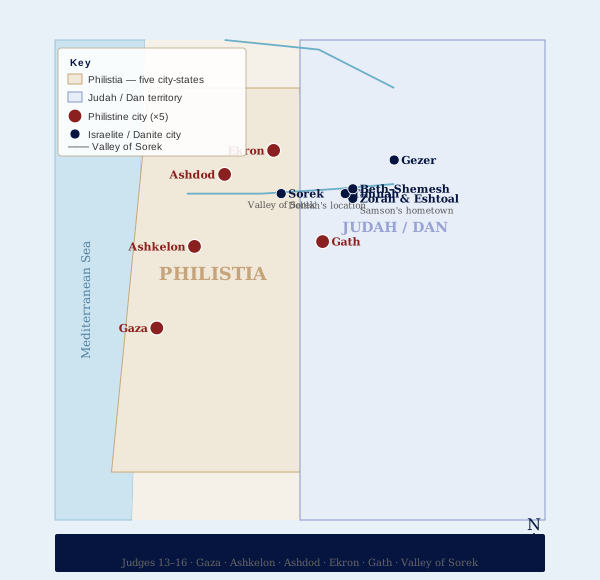
What You Are Looking At
This custom map shows the territory of Philistia — the five city-states of the Philistine confederation along the southwestern coastal plain of Canaan — and the adjacent territory of Judah and Dan where Samson lived. The five Philistine cities are marked in dark red: Gaza at the southwestern extreme (the city whose gates Samson carried off), Ashkelon (where Samson killed thirty men after his riddle was answered), Ashdod to the north, Ekron on the northeastern border of Philistia (later the destination of the captured Ark of the Covenant), and Gath in the foothills. The Valley of Sorek runs from the hill country down through the Philistine plain — it was in this valley that Samson met and fell in love with Delilah. Zorah and Eshtoal are marked in the Israelite territory — Samson’s hometown, where the Spirit of the Lord first began to move on him, and where he was buried between the two cities (Judges 16:31).
“And it came to pass, when she pressed him daily with her words, and urged him, so that his soul was vexed unto death; that he told her all his heart, and said unto her, There hath not come a razor upon mine head; for I have been a Nazarite unto God from my mother’s womb: if I be shaven, then my strength will go from me, and I shall become weak, and be like any other man.”
The Philistine Pentapolis
The Philistines were not native Canaanites but a people who had migrated from the Aegean world (associated with the “Sea Peoples” of Egyptian records) and settled the southwestern coastal plain of Canaan around 1200 BC. They organized themselves into a confederation of five city-states — the pentapolis of Gaza, Ashkelon, Ashdod, Ekron, and Gath — each ruled by a seren (lord). The Philistines possessed iron technology at a time when Israel was still largely limited to bronze, giving them a significant military advantage (1 Samuel 13:19–22 records that Israel had no smiths and had to go to Philistia even to sharpen their plowshares). Their coastal position also gave them control of the main trade routes connecting Egypt with the north.
Samson’s Twenty-Year War
Samson was set apart as a Nazirite from before his birth — consecrated to God, forbidden wine, unclean food, and the cutting of his hair, the outward sign of his vow and the source of his supernatural strength. He judged Israel twenty years. But his entire career was conducted not through military command of an Israelite army but through a series of personal, often revenge-driven confrontations with the Philistines: tying three hundred foxes together by their tails and burning the Philistine grain fields, killing a thousand men with the jawbone of a donkey, carrying the gates of Gaza on his shoulders, and his final act — blind and shorn in the temple of Dagon in Gaza, pulling down the pillars on the assembled Philistine lords. “So the dead which he slew at his death were more than they which he slew in his life” (Judges 16:30).
“Then Samson called unto the Lord, and said, O Lord God, remember me, I pray thee, and strengthen me, I pray thee, only this once, O God, that I may be at once avenged of the Philistines for my two eyes.”
Samson’s story is perhaps the most psychologically complex in the entire book of Judges. He was simultaneously gifted beyond any other judge and compromised by his own desires beyond any other judge. He never led an army or governed a city. He never fully separated himself from the Philistines he was called to fight — seeking wives and companions from among them, even as God sovereignly used his personal conflicts as occasions for striking blows against Philistine power. That such a man was included in Hebrews 11:32’s roll of faith is itself a testimony to divine grace operating through deeply flawed humanity.