
What You Are Looking At
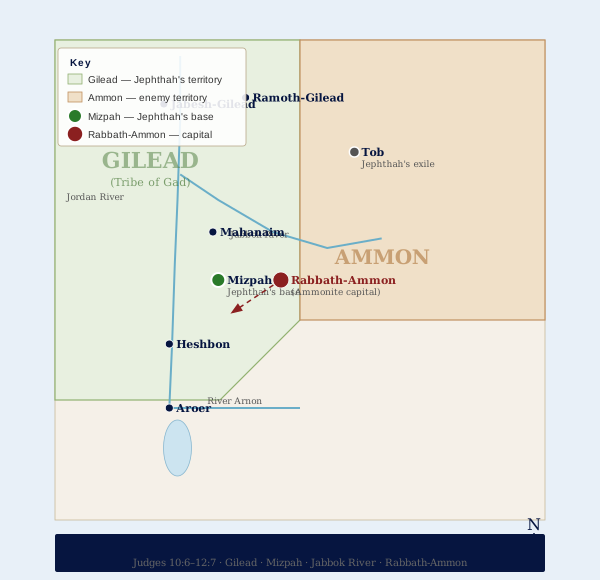
This custom map shows the territory of the Jephthah narrative: the highland region of Gilead (east of the Jordan, the territory of the tribe of Gad), and the territory of Ammon to its east. The Jordan River runs down the left side, with the Jabbok River (Wadi Zarqa) crossing Gilead’s territory and forming a significant geographic boundary. Mizpah of Gilead (marked in green) was Jephthah’s base of operations — the place where he made his vow to the Lord before the battle, and where he returned in victory to face its terrible fulfillment. Rabbath-Ammon (the Ammonite capital, modern Amman, Jordan) is marked in red to the east. Mahanaim is labeled — the ancient site where Jacob had met the angels of God on his return from Paddan-Aram. The land of Tob is marked in the northeast, where Jephthah was living in exile when the Gileadites came to recall him. The River Arnon runs along the southern portion, marking the boundary between Reuben’s territory and Moab.
“And Jephthah vowed a vow unto the Lord, and said, If thou shalt without fail deliver the children of Ammon into mine hands, then it shall be, that whatsoever cometh forth of the doors of my house to meet me, when I return in peace from the children of Ammon, shall surely be the Lord’s, and I will offer it up for a burnt offering.”
The Outcast Called Back
Jephthah was the son of Gilead by a prostitute. His legitimate half-brothers drove him out of his inheritance: “Thou shalt not inherit in our father’s house; for thou art the son of a strange woman.” He gathered a band of “vain men” around him in the land of Tob, northeast of Gilead, and lived as a leader of what amounted to a mercenary company. When the Ammonites made war on Israel and the Gileadite elders found themselves with no military leader capable of resisting, they sent to Jephthah in Tob and begged him to come back and lead them. Jephthah agreed — on condition that he be made head over Gilead if he won. They swore it before the Lord at Mizpah.
The Vow and Its Cost
Before the battle, Jephthah made his famous vow: whatever came out first from his house to meet him on his return would belong to the Lord as a burnt offering. The Spirit of the Lord came upon him, he swept through Ammon from Aroer to Minnith — twenty cities — and the Ammonites were subdued. Jephthah returned to his house in Mizpah, and his daughter — his only child — came out first with timbrels and dancing. When he saw her, he tore his clothes and cried: “Alas, my daughter! thou hast brought me very low, and thou art one of them that trouble me: for I have opened my mouth unto the Lord, and I cannot go back” (Judges 11:35). Interpreters have debated for centuries whether Jephthah actually killed his daughter or dedicated her to perpetual virginity. What is clear is that the vow was rash, the fulfillment tragic, and the law of Moses explicitly forbade child sacrifice — the narrative presents it as a catastrophic example of a man speaking before he thinks.
“And it came to pass, when the children of Ammon made war against Israel, that the elders of Gilead went to fetch Jephthah out of the land of Tob.”
Shibboleth at the Jordan
The aftermath of Jephthah’s victory produced an unexpected second crisis: the Ephraimites, furious at not being invited to share in the battle and its plunder, crossed the Jordan to fight Jephthah. After defeating them, Jephthah posted Gileadite soldiers at the Jordan fords. Each Ephraimite who tried to cross was asked to say the word “Shibboleth.” The Ephraimite dialect had no sh sound, so they said “Sibboleth.” Forty-two thousand Ephraimites died at the fords. The word “shibboleth” has passed into modern languages as a term for any test used to identify group membership — one of the Bible’s most enduring contributions to secular vocabulary.