
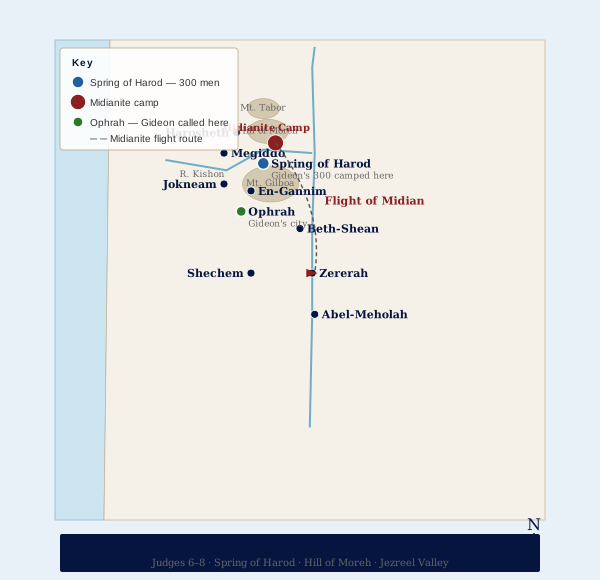
What You Are Looking At
This custom map shows the key locations of the Gideon narrative in the Jezreel Valley and its surrounding hill country. The Spring of Harod (marked in blue) is at the foot of Mount Gilboa, where Gideon’s army of 300 camped on the night of the battle. Directly across the valley, the Hill of Moreh (marked in red) is where the Midianite and Amalekite camp was located. Judges 7:12 describes the enemy: “as the grasshoppers for multitude; and their camels were without number, as the sand by the sea side for multitude.” The dotted red arrow shows the route of the Midianite flight — northeastward toward Beth-shean and the Jordan, past Abel-meholah (the birthplace of Elijah). Ophrah (marked in green) was Gideon’s hometown in the Abiezrite portion of Manasseh, where the angel of the Lord first appeared to him. The Kishon River runs through the valley floor.
“And the Lord said unto Gideon, The people that are with thee are too many for me to give the Midianites into their hands, lest Israel vaunt themselves against me, saying, Mine own hand hath saved me.”
Seven Years of Midianite Oppression
The Midianites were a semi-nomadic people of the Arabian desert east and southeast of the Promised Land. In the period of Judges 6–8, they formed a coalition with the Amalekites and the “people of the East” and began an annual campaign that devastated Israel’s agricultural economy. Every harvest season, the Midianites would cross the Jordan, swarm over the Jezreel Valley, and strip the land bare: “They came up with their cattle and their tents, and they came as grasshoppers for multitude; for both they and their camels were without number: and they entered into the land to destroy it” (Judges 6:5). Israel was reduced to hiding grain in caves and pits. For seven years, the Jezreel Valley — the most agriculturally productive land in Canaan — was stripped every year before Israel could harvest.
Gideon Called at the Winepress
The angel of the Lord appeared to Gideon ben Joash at Ophrah, where Gideon was secretly threshing wheat in a winepress rather than on an open threshing floor — a vivid image of Israel’s humiliation. The angel’s greeting — “The Lord is with thee, thou mighty man of valour” — was either prophetic declaration or divine irony, since Gideon immediately pushed back: “Oh my Lord, if the Lord be with us, why then is all this befallen us?” (Judges 6:13). God’s response was to commission Gideon to deliver Israel, and Gideon’s response was to ask for multiple miraculous signs — the famous fleeces wet and dry on successive mornings (Judges 6:36–40). God granted them both, and Gideon assembled an army.
“By the three hundred men that lapped will I save you, and deliver the Midianites into thine hand: and let all the other people go every man unto his place.”
From 32,000 to 300
Gideon assembled 32,000 men. God immediately told him the army was too large: if Israel won with 32,000, they would claim the victory themselves. By two successive reductions — first sending home all who were afraid (22,000 left), then testing how the remaining 10,000 drank water at the spring of Harod — God reduced the force to 300 men. Those 300 lapped water from their hands like dogs, keeping their eyes up. God chose them. With 300 men carrying only trumpets, torches, and empty clay pitchers, Gideon surrounded the Midianite camp at night. On Gideon’s signal, all 300 broke their pitchers simultaneously, held up their torches, and blew their trumpets, shouting “The sword of the Lord, and of Gideon!” The Midianite camp erupted in confusion and “the Lord set every man’s sword against his fellow, even throughout all the host” (Judges 7:22). The great army destroyed itself.