
What You Are Looking At
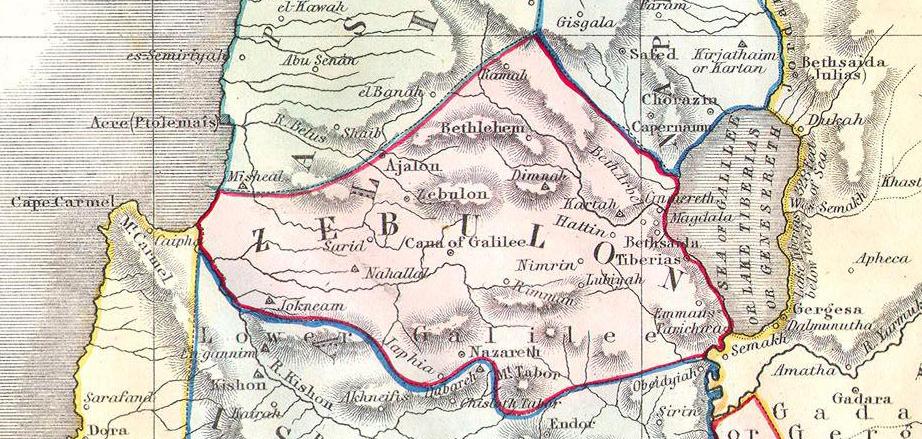
This 1852 Philip hand-coloured map shows the territory of the Tribe of Zebulun, whose land is displayed in the pink shading with the letters Z E B U L O N written prominently across it. Zebulun’s territory was the geographical setting for one of the most dramatic military confrontations in the entire period of the Judges. The Kishon River (R. Kishon) is clearly labeled running through the lower portion of the map — the river whose sudden flooding swept away Sisera’s iron chariot army in the decisive moment of the battle. Mount Tabor (visible near the junction of Zebulun, Issachar, and Naphtali) is labeled where Barak assembled his ten thousand warriors. Nazareth appears in the lower center — located in Zebulun’s hill country, the town where Jesus of Nazareth would grow up centuries after Deborah’s victory. Megiddo is visible at the bottom, guarding the Jezreel Valley’s western pass. The Sea of Galilee (Sea or Lake of Tiberias) forms the eastern boundary. Cape Carmel is at the upper left. The entire map shows the battlefield territory over which the Battle of Kishon was fought.
“And Deborah said unto Barak, Up; for this is the day in which the Lord hath delivered Sisera into thine hand: is not the Lord gone out before thee? So Barak went down from mount Tabor, and ten thousand men after him.”
Twenty Years Under Jabin of Canaan
The third cycle of the Judges period brought oppression from an unexpected direction: not Mesopotamia as with Othniel, not Moab as with Ehud, but from within Canaan itself. Jabin, king of Canaan, reigning from Hazor in northern Galilee (the great Canaanite city-state that Joshua had burned — but which had since been rebuilt), had reasserted Canaanite dominance over the Israelite tribes of the north for twenty years. His military instrument was his general Sisera, commander of an army equipped with nine hundred iron chariots — the most advanced military technology of the ancient Near East. Iron chariots were the tank-equivalent of the ancient world, and Israel had none.
Deborah — Israel’s Only Female Judge
In this crisis, God raised up Deborah — a prophetess and the only woman among the Judges of Israel. She held court under a palm tree in the hill country of Ephraim (Judges 4:5), and the people came to her for judgment. She summoned Barak of Naphtali and delivered God’s command: assemble ten thousand warriors from Zebulun and Naphtali on Mount Tabor, and God would draw Sisera and his chariots to the Kishon Valley and deliver them into Israel’s hand. Barak’s response revealed both his dependence and his hesitation: “If thou wilt go with me, then I will go: but if thou wilt not go with me, then I will not go” (Judges 4:8). Deborah agreed, but prophesied that the honor of the ultimate killing blow would go to a woman, not to Barak.
The Kishon Sweeps Them Away
The tactical logic of assembling on Mount Tabor was brilliant. Tabor was too steep for chariots to ascend, giving Barak’s infantry the high ground. Sisera, drawing his chariots to the valley below, found the terrain suddenly working against him. Judges 5:21 — the poetic Song of Deborah, one of the oldest pieces of Hebrew poetry in existence — records what happened: “The river of Kishon swept them away, that ancient river, the river Kishon.” The winter rains had turned the Kishon Valley floor into a muddy swamp, immobilizing Sisera’s iron-wheeled chariots. Nine hundred chariots became nine hundred traps.
“They fought from heaven; the stars in their courses fought against Sisera.”
Sisera abandoned his chariot and fled on foot northward into the territory of Naphtali, to the tent of Jael, the wife of Heber the Kenite. Jael welcomed him, gave him milk to drink, covered him with a mantle, and when he slept, drove a tent peg through his temple with a hammer. The prophetess’ word had been fulfilled — the victory went to a woman. The land had rest forty years.