
What You Are Looking At
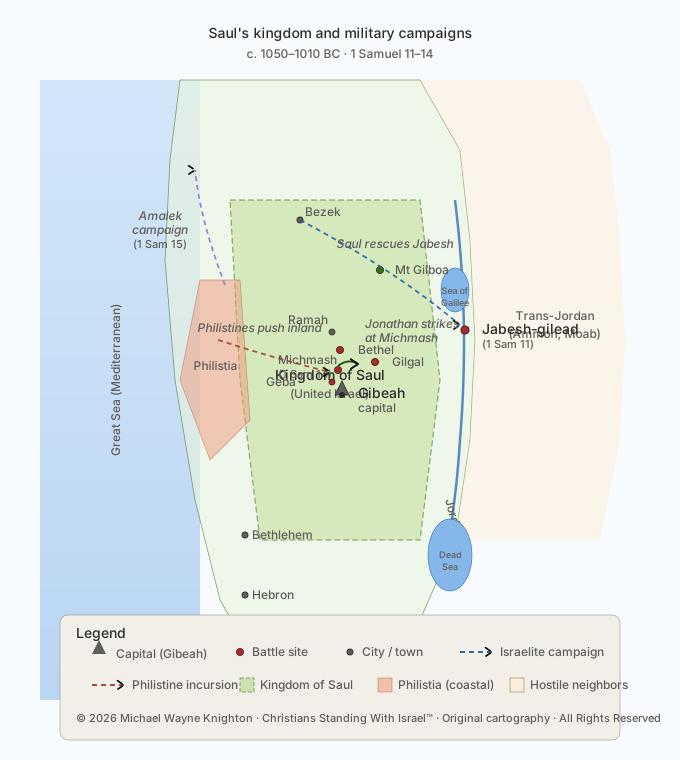
This map is original cartography depicting the Kingdom of Saul at its greatest extent, c. 1050–1010 BC, and the locations of his major military campaigns. The shaded central region marks the territory Saul actually controlled — a compact kingdom centered on the hill country of Benjamin and Ephraim, stretching north into Manasseh and south through Judah. Gibeah, marked with the royal banner, was Saul’s capital and hometown. The cluster of battle sites in the central highlands — Michmash, Geba, Bethel, and Gilgal — marks the geography of 1 Samuel 13–14, where Saul and his son Jonathan fought the Philistines who had pushed inland from the coast. To the east, across the Jordan in the territory of Gad, sits Jabesh-gilead — the besieged city Saul rescued from Nahash the Ammonite (1 Samuel 11), the victory that confirmed his kingship. Mount Gilboa is marked in green to the north — the eventual site of Saul’s death (1 Samuel 31), foreshadowed even here. The orange Philistine corridor along the coast shows the enemy that defined nearly every year of Saul’s reign, and the dashed purple arrow southward marks the campaign against the Amalekites (1 Samuel 15) that would lead to Saul’s rejection. Together the arrows trace the four-front pressure Saul faced from the moment he took the throne: Ammonites east, Philistines west, Amalekites south, and the unfinished conquest of the land itself.
“So Saul took the kingdom over Israel, and fought against all his enemies on every side, against Moab, and against the children of Ammon, and against Edom, and against the kings of Zobah, and against the Philistines: and whithersoever he turned himself, he vexed them.”
The Kingdom Saul Inherited
Saul did not inherit a unified nation. He inherited a loose federation of tribes that had spent two centuries unable to expel the peoples around them. The Philistines on the western coastal plain were, by Saul’s reign, the most dangerous power in the region — iron-armed, organized into a five-city pentapolis (Gaza, Ashdod, Ashkelon, Gath, Ekron), and pushing aggressively inland. The Ammonites east of the Jordan harassed the Transjordanian tribes. The Amalekites raided from the south. Moab, Edom, and the Aramaean kingdoms of the north all pressed against Israel’s borders. The map shows a kingdom under siege from every direction. Saul’s entire reign — every campaign recorded in 1 Samuel 11 through 1 Samuel 31 — was an attempt to push back this pressure and consolidate a kingdom in territory that was still, in many places, contested.
Jabesh-Gilead — The Victory That Made Him King
Saul’s first campaign came almost immediately. Nahash, king of Ammon, marched against the Israelite city of Jabesh-gilead east of the Jordan and demanded the right eye of every man in the city as the condition of surrender. The terrified elders sent messengers across the Jordan begging for help. The messengers reached Gibeah just as Saul was returning from the fields with his oxen. When he heard the report, “the Spirit of God came upon Saul” (1 Samuel 11:6), and his anger was kindled. He cut his oxen in pieces and sent the pieces throughout all the borders of Israel with a chilling message: “Whosoever cometh not forth after Saul and after Samuel, so shall it be done unto his oxen.” The fear of the Lord fell on the people, and they came out as one man. Saul mustered the army at Bezek — 330,000 strong by the biblical count — then crossed the Jordan in a night march and fell upon the Ammonite camp in the morning watch. The slaughter was total. The remaining Ammonites scattered so that “two of them were not left together.” This victory — the dashed blue arrow on the map — was the moment Saul’s kingship became real. The people gathered at Gilgal and “renewed the kingdom” before the Lord (1 Samuel 11:14–15).
Michmash — Jonathan’s Faith and the Philistine Defeat
The Philistine war broke out in the second year of Saul’s reign (1 Samuel 13). The Philistines had advanced inland and occupied the strategic pass at Michmash, while Saul and Jonathan camped across the gorge at Geba. The Philistines fielded an army the text describes as “thirty thousand chariots, and six thousand horsemen, and people as the sand which is on the sea shore in multitude” (1 Samuel 13:5). Saul had six hundred men. The Israelites were so outmatched that, with two exceptions — Saul and Jonathan — not a single Israelite soldier even possessed a sword or spear. The Philistines had imposed a monopoly on blacksmithing throughout the land. Then Jonathan, with only his armor-bearer, climbed the cliffs of Bozez and Seneh by hand and attacked a Philistine outpost. He killed twenty men in a half-acre of ground. The earth itself quaked. Panic swept the Philistine camp, the Philistines began killing one another in the confusion, and the Israelites who had been hiding in caves and rocks came pouring out to join the rout. The dashed green arrow on the map traces that strike. Saul pursued the fleeing Philistines “from Michmash to Aijalon” — the deepest defeat the Philistines had suffered in a generation.
Amalek — The Campaign That Cost Him the Throne
The dashed purple arrow southward marks Saul’s last campaign as God’s chosen king (1 Samuel 15). Samuel came to Saul with a direct command from the Lord: utterly destroy Amalek for what Amalek had done to Israel during the wilderness wanderings. Spare nothing — not man, woman, child, ox, sheep, camel, or donkey. Saul mustered two hundred thousand foot soldiers plus ten thousand men of Judah, marched south past the city of Amalek, and defeated Agag the Amalekite king from Havilah all the way to Shur at the border of Egypt. But he disobeyed. He spared Agag alive, and he spared the best of the sheep, oxen, fatlings, and lambs — destroying only what was vile and worthless. When Samuel confronted him at Gilgal, Saul tried to blame the people. Samuel’s response is one of the most devastating sentences in Scripture: “Hath the Lord as great delight in burnt offerings and sacrifices, as in obeying the voice of the Lord? Behold, to obey is better than sacrifice, and to hearken than the fat of rams. For rebellion is as the sin of witchcraft, and stubbornness is as iniquity and idolatry. Because thou hast rejected the word of the Lord, he hath also rejected thee from being king” (1 Samuel 15:22–23). Saul kept the throne for years after this, but the Spirit of the Lord had already departed. The next chapter, Samuel goes to Bethlehem and anoints a shepherd boy named David.