
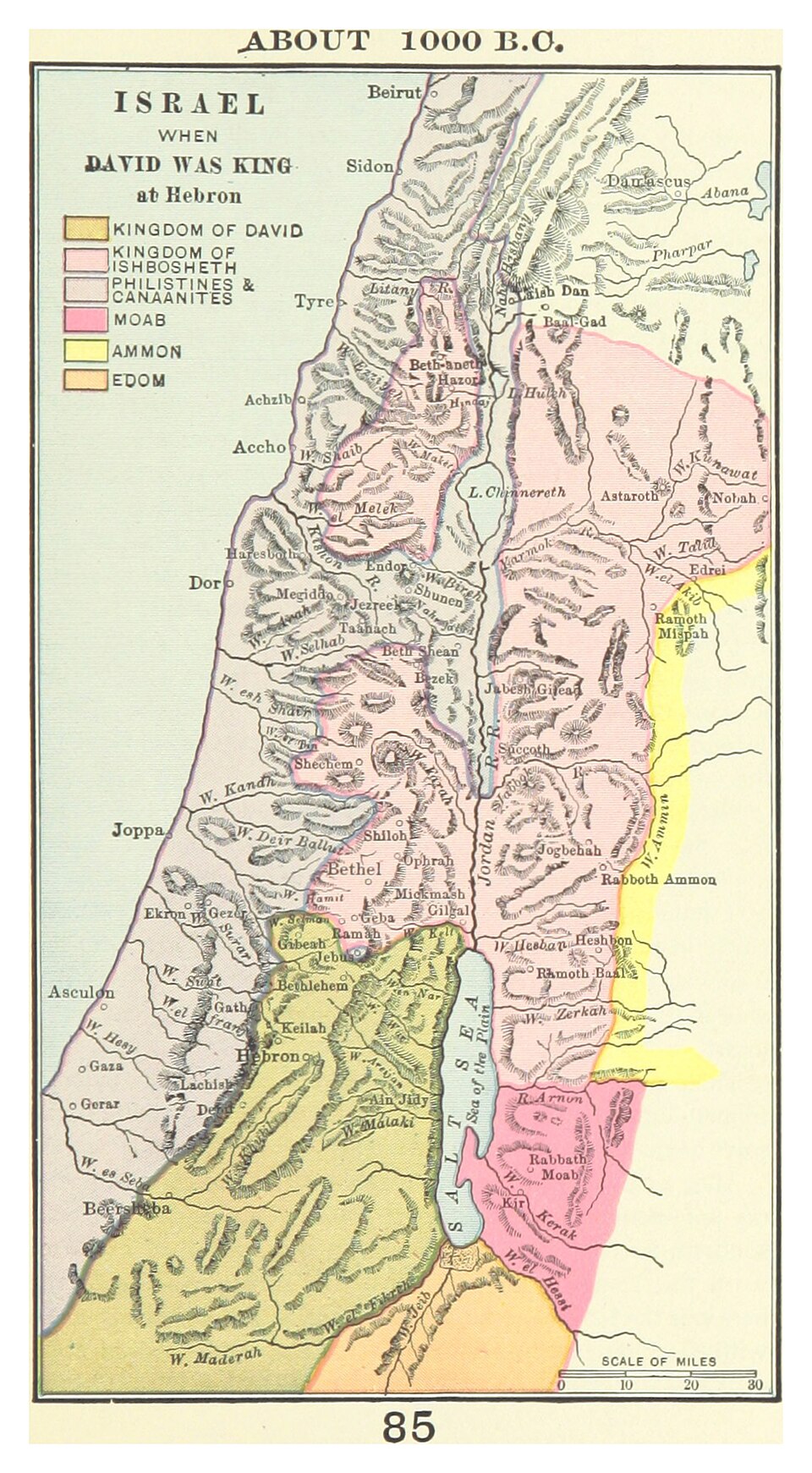
What You Are Looking At
This 1899 map from Townsend MacCoun’s The Holy Land in Geography and in History is dated about 1000 BC — the close of David’s fugitive years and the threshold of his reign. The geography of 1 Samuel 27–30 is on full display. Ziklag sits in the southwestern corner of the map, on the disputed border between Philistia and the Negev. To the west lie the five Philistine cities of the pentapolis — Gaza, Ashkelon, Ashdod, Ekron, and Gath (Achish’s capital, where David first sought asylum). South of Ziklag stretches the open desert: the territory of the Amalekites, Geshurites, and Gezrites whom David raided in secret throughout his sixteen-month exile. The Brook Besor runs west from the highlands to the Mediterranean, the watercourse where David’s exhausted men halted during the pursuit of the Amalekite raiders who had burned Ziklag. To the far north, the map shows Aphek in the Sharon Plain — the Philistine staging point where Achish mustered his five lords for the campaign that would end at Mount Gilboa, and the place where the Philistine lords refused to let David fight against Israel. The map shows the strategic squeeze: David caught between Israel to his north and Egypt to his south, holding a Philistine border town while secretly remaining a Hebrew.
“And David said in his heart, I shall now perish one day by the hand of Saul: there is nothing better for me than that I should speedily escape into the land of the Philistines; and Saul shall despair of me, to seek me any more in any coast of Israel: so shall I escape out of his hand.”
The Breaking Point
1 Samuel 27 opens with David’s lowest moment of faith in the entire narrative. Years of running had worn him down. Saul had pursued him through Ziph, Maon, En-gedi, and Hachilah, and twice David had spared the king’s life. Both times Saul had wept and promised to stop, and both times the pursuit had resumed. David finally concluded that the only way to escape was to leave Israel entirely. He took his six hundred men, their wives, and their children, and crossed into Philistia — to Achish, the son of Maoch, king of Gath. This was the same Achish before whom David had once feigned madness to escape execution (1 Samuel 21). But David came this time not as a lone fugitive but as the captain of a battle-tested militia, and Achish saw the strategic value. Better to have David as a vassal raiding Judah than as a free agent attacking Philistia. Achish welcomed him.
Ziklag — A Philistine Gift, a Royal Inheritance
David asked Achish for a country town to settle in, away from the eyes of the royal court. Achish gave him Ziklag. The grant was politically shrewd on Achish’s part — a remote border post where David could live with his men far from Gath’s noble class — but it became theologically pivotal. From that day forward, the text says, “Ziklag pertaineth unto the kings of Judah unto this day” (1 Samuel 27:6). A Philistine king’s patronage to a Hebrew fugitive accidentally transferred a piece of Philistine territory permanently into Judah’s royal estate. David lived at Ziklag one year and four months — sixteen months of double-dealing in which he raided the Amalekites, Geshurites, and Gezrites in the southern desert, killed every survivor to prevent witnesses, and returned to Achish with the spoil. When Achish asked where he had raided, David named towns in the southern parts of Judah — against Jerahmeelites and Kenites. Achish believed him. “He hath made his people Israel utterly to abhor him; therefore he shall be my servant for ever” (1 Samuel 27:12). Achish thought he had bought a permanent enemy of Israel. He had been deceived from the first day.
Aphek — The Crisis Averted
The crisis came when the Philistines mustered for war against Israel. Achish summoned his army to Aphek in the northern coastal plain, and David and his six hundred men marched at the rear of the column. David was about to be drawn into a battle in which he would either have to fight against his own people or commit treason against the king who had sheltered him. The Lord delivered him from the dilemma through, of all people, the Philistine lords themselves. When the four other Philistine kings saw the Hebrews in the column they protested to Achish: “Make this fellow return... Is not this David, of whom they sang one to another in dances, saying, Saul slew his thousands, and David his ten thousands?” (1 Samuel 29:5). Achish defended David with stunning sincerity — he had “found no fault in him since the day of his falling unto me unto this day” — but the lords were immovable. Achish sent David away. The historical scene is unforgettable: David protested loudly that he was being denied the right to fight, while his heart was almost certainly leaping. He marched his men south to return to Ziklag while the Philistine army marched north to Mount Gilboa, where Saul and Jonathan would die.
Ziklag Burned — The Amalekite Raid
David and his men arrived back at Ziklag on the third day after being dismissed from Aphek — and found the city a smoking ruin. The Amalekites had used the absence of every fighting man in Ziklag to raid the town. They had burned it to the ground and carried off every wife, every child, every possession. No one had been killed, but everyone had been taken. David and his men “lifted up their voice and wept until they had no more power to weep” (1 Samuel 30:4). David’s own wives, Ahinoam the Jezreelitess and Abigail the widow of Nabal, were among the captives. Then the situation deteriorated further: the grieving men, half-mad with loss, began to talk of stoning David. The text says simply, “But David encouraged himself in the Lord his God” (1 Samuel 30:6). He called for Abiathar the priest and the ephod, and he inquired of the Lord: “Shall I pursue after this troop? shall I overtake them?” The answer came back: “Pursue: for thou shalt surely overtake them, and without fail recover all.”
The Brook Besor and the Recovery
The pursuit began immediately. David and his six hundred men rode south after the Amalekite raiders. When they reached the Brook Besor, two hundred of them were too exhausted to cross — fifteen days of forced marching to and from Aphek had broken them. David left the two hundred at the brook to guard the supplies and pressed on with four hundred. Just then they found an Egyptian slave abandoned by the Amalekites in the desert, sick and starving. They fed him bread, water, raisins, and figs, and after three days he revived. He led them straight to the Amalekite camp, where the raiders were spread across the ground “eating and drinking, and dancing, because of all the great spoil that they had taken out of the land of the Philistines, and out of the land of Judah” (1 Samuel 30:16). David fell upon them at twilight and fought through till the evening of the next day. The Amalekites broke and fled, but only four hundred young men on camels escaped. David recovered everything — every wife, every child, every flock and herd, plus enormous additional spoil. The Lord’s promise had been kept to the letter: nothing was missing.
The Statute at the Brook Besor
When David returned to the Brook Besor, the four hundred who had crossed wanted to deny any share of the recovered spoil to the two hundred who had stayed behind with the baggage. David refused, and he made his refusal a permanent statute in Israel: “As his part is that goeth down to the battle, so shall his part be that tarrieth by the stuff: they shall part alike” (1 Samuel 30:24). This principle — that the soldiers in the rear and the soldiers at the front share equally in the victory — became binding law in Israel from that day forward. It is the same principle Paul would later apply to the body of Christ in 1 Corinthians 12: the visible parts and the hidden parts are equally honored, equally rewarded. David also sent portions of the spoil to thirteen towns in southern Judah — the places where he and his men had taken shelter during the wilderness years — from Bethel and Ramoth in the south to Hebron, Aroer, Eshtemoa, and others. He was building, even now, the political coalition that would crown him king at Hebron within weeks. While David was distributing spoil at Ziklag, three days later the runner from Mount Gilboa arrived with the news: Saul and Jonathan were dead. The wilderness years were over. The reign was about to begin.
_p091_ABOUT_1000_B.C._-.jpg)