
What You Are Looking At
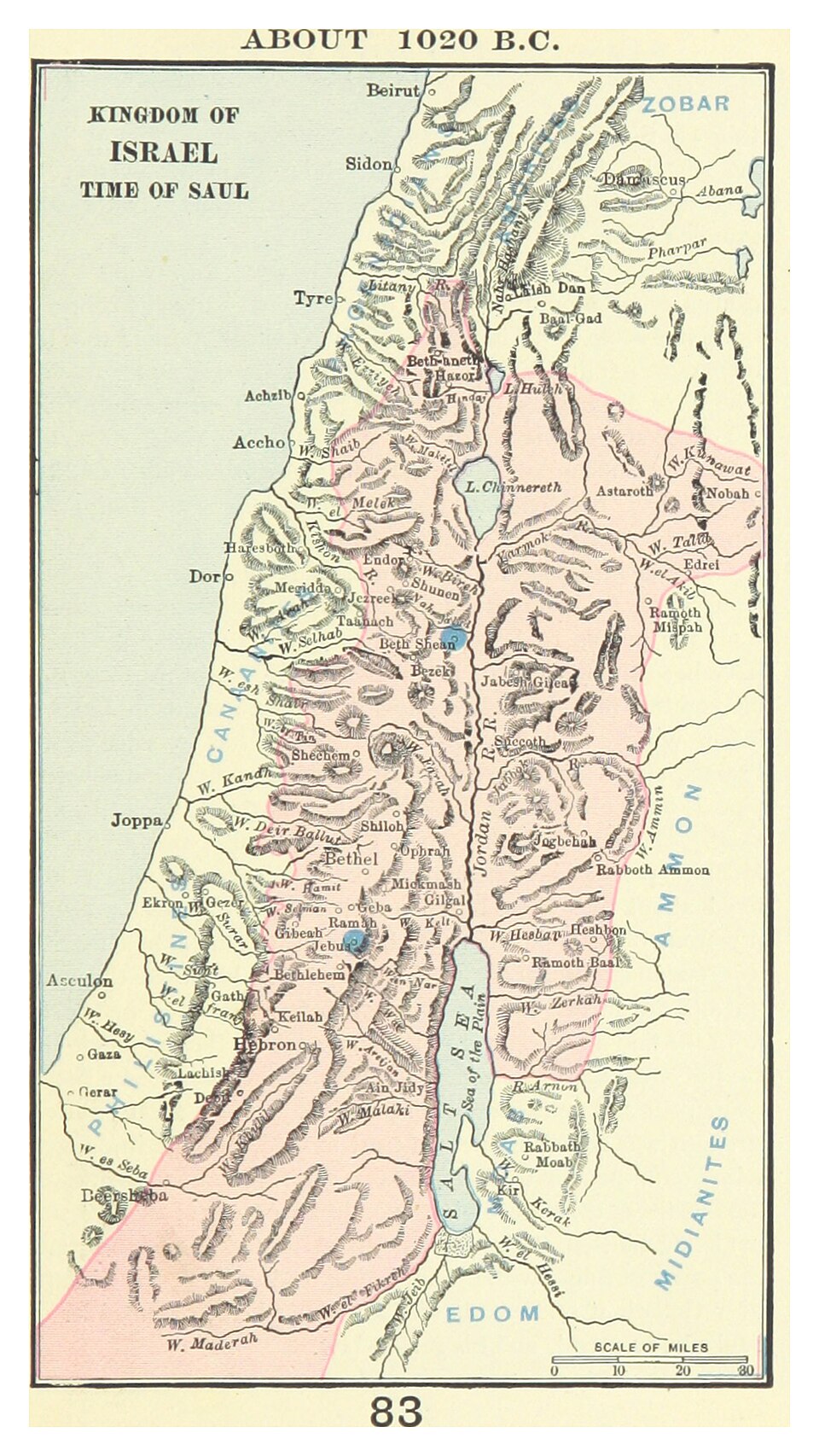
This 1899 map from Townsend MacCoun’s The Holy Land in Geography and in History is dated about 1020 BC — the exact era of David and Goliath. The geography of the battle is laid out clearly. The five Philistine cities of the pentapolis line the southwestern coast: Gaza, Ashkelon, Ashdod, Ekron, and Gath. Gath was Goliath’s hometown. Between the Philistine coastal plain and the Judaean hill country lies a transitional zone of rolling foothills called the Shephelah — the buffer that, for centuries, was the contested frontier between Israel and Philistia. The Valley of Elah is one of several east-west valleys cutting through the Shephelah, and it is the natural highway from the Philistine plain up into Judah — the route an invading Philistine army would take to reach Bethlehem and Jerusalem (still called Jebus, marked on the map). The Philistines camped on the south side of the valley near Socoh; Saul’s army camped on the north side. Between them ran a brook — the very brook from which David picked his five smooth stones. After Goliath fell, the Israelites chased the fleeing Philistines westward toward Gath and Ekron, the two nearest Philistine cities. The map shows every site mentioned in 1 Samuel 17 in their proper geographic relationship.
“Then said David to the Philistine, Thou comest to me with a sword, and with a spear, and with a shield: but I come to thee in the name of the Lord of hosts, the God of the armies of Israel, whom thou hast defied. This day will the Lord deliver thee into mine hand; and I will smite thee, and take thine head from thee; and I will give the carcases of the host of the Philistines this day unto the fowls of the air, and to the wild beasts of the earth; that all the earth may know that there is a God in Israel.”
Why the Philistines Came
The Valley of Elah was not chosen at random. It was strategy. The Philistines had been kept out of the Judaean hill country since Saul and Jonathan’s victory at Michmash years earlier (1 Samuel 14). But the Philistine kings had not stopped probing for a way back in. The Elah Valley was the most exposed of all the western approaches to Judah — a broad, flat corridor with no major Israelite fortress to block it. If the Philistines could push up the Elah, they would split Israel in two: cutting off Judah from Benjamin and the northern tribes, with Bethlehem and Jerusalem lying open behind them. Saul understood this. He brought the army down from the hills and camped on the northern ridge of the valley, blocking the Philistine advance. The two armies sat facing each other across the valley floor for forty days. Neither side wanted to attack uphill. The valley had become a stalemate — and the Philistines knew exactly how to break a stalemate. They sent out a champion.
The Champion of Gath
Goliath of Gath was a soldier from the Anakim line — the giants Israel had failed to fully drive out of the land during the conquest under Joshua. Joshua had cleared the Anakim from the hill country, but a remnant survived in the Philistine cities of Gaza, Gath, and Ashdod (Joshua 11:22). Three generations later, that uncleared remnant produced a man six cubits and a span in height — over nine feet by the traditional measure — with a coat of mail weighing five thousand shekels of brass (about 125 pounds) and a spear whose iron head alone weighed six hundred shekels (15 pounds). He came out every morning and every evening for forty days, shouting the same challenge across the valley: “Choose you a man for you, and let him come down to me. If he be able to fight with me, and to kill me, then will we be your servants: but if I prevail against him, and kill him, then shall ye be our servants, and serve us” (1 Samuel 17:8–9). The text is explicit about what happened in the Israelite camp every morning when Goliath shouted: “Saul and all Israel... were dismayed, and greatly afraid.” Forty days of paralysis. The king Israel had demanded — the tall king, the king who stood “from his shoulders and upward higher than any of the people” — could not, or would not, answer the challenge.
The Shepherd Boy Arrives
David came down from Bethlehem not as a soldier but as a delivery boy. His three eldest brothers — Eliab, Abinadab, and Shammah — were in Saul’s army. Their father Jesse, knowing the army was poorly supplied, sent David with ten loaves of bread, an ephah of parched corn, and ten cheeses to bring to his brothers and their captain. David arrived at the camp just as the army was going out to battle array, and just as Goliath came forward with his daily challenge. David heard the giant’s blasphemy and saw the army flee. His response was not fear. It was indignation. “Who is this uncircumcised Philistine, that he should defy the armies of the living God?” (1 Samuel 17:26). The soldiers around David told him about the king’s standing reward: the man who killed Goliath would be made rich, given the king’s daughter in marriage, and his father’s house would be made free in Israel — exempt from taxes and military service. David asked the same question three times to make sure he had heard right. Then word reached Saul that there was a young man asking about Goliath, and Saul sent for him.
Five Smooth Stones and a Sling
The conversation between Saul and David is one of the great exchanges in Scripture. Saul tried to dress David in his own armor — the armor of the tallest man in Israel on the body of a shepherd boy. David refused: “I cannot go with these; for I have not proved them.” He took them off. He picked up his shepherd’s staff, walked down to the brook in the valley floor, chose five smooth stones, put them in his shepherd’s bag, and walked across no-man’s land toward the giant with only a sling in his hand. The sling was not a child’s toy. A trained slinger could throw a stone at 100 to 150 miles per hour with accuracy at 200 yards — the equivalent of a modern firearm at close range. Goliath, lumbering forward in 125 pounds of bronze armor, was effectively a stationary target. The first stone struck him in the forehead, sank into his skull, and he fell on his face to the earth. David ran to the body, drew Goliath’s own sword from its sheath, and cut off his head. The Philistine army watched their champion fall — and they ran. The map shows the chase: Israel pursued the fleeing Philistines westward down the valley, all the way to the gates of Gath and Ekron. The wounded Philistines fell along the road between Shaaraim and the two cities. The valley that was meant to break Israel had broken Philistia instead.
Why This Mattered
The defeat of Goliath was not just a tactical victory. It was a theological declaration. David said it himself before the duel: “That all the earth may know that there is a God in Israel. And all this assembly shall know that the Lord saveth not with sword and spear: for the battle is the Lord’s, and he will give you into our hands” (1 Samuel 17:46–47). Saul had been Israel’s answer to the Philistine threat — the tall man, the conventional military king the people had demanded so they could be “like all the nations.” But the tall man could not defeat the taller Philistine. The boy with the sling could, because the boy with the sling trusted the Lord. From this moment forward, the trajectory of Israel’s history bends away from Saul and toward David. Saul will keep the throne for years more, but the Spirit of the Lord that came mightily upon David from the day of his anointing at Bethlehem (1 Samuel 16:13) will now be visibly upon him in the eyes of all Israel. The next chapter, Saul will throw a spear at him. The shepherd who killed the giant is now a marked man.
_p087_ABOUT_1020_B.C..jpg)