
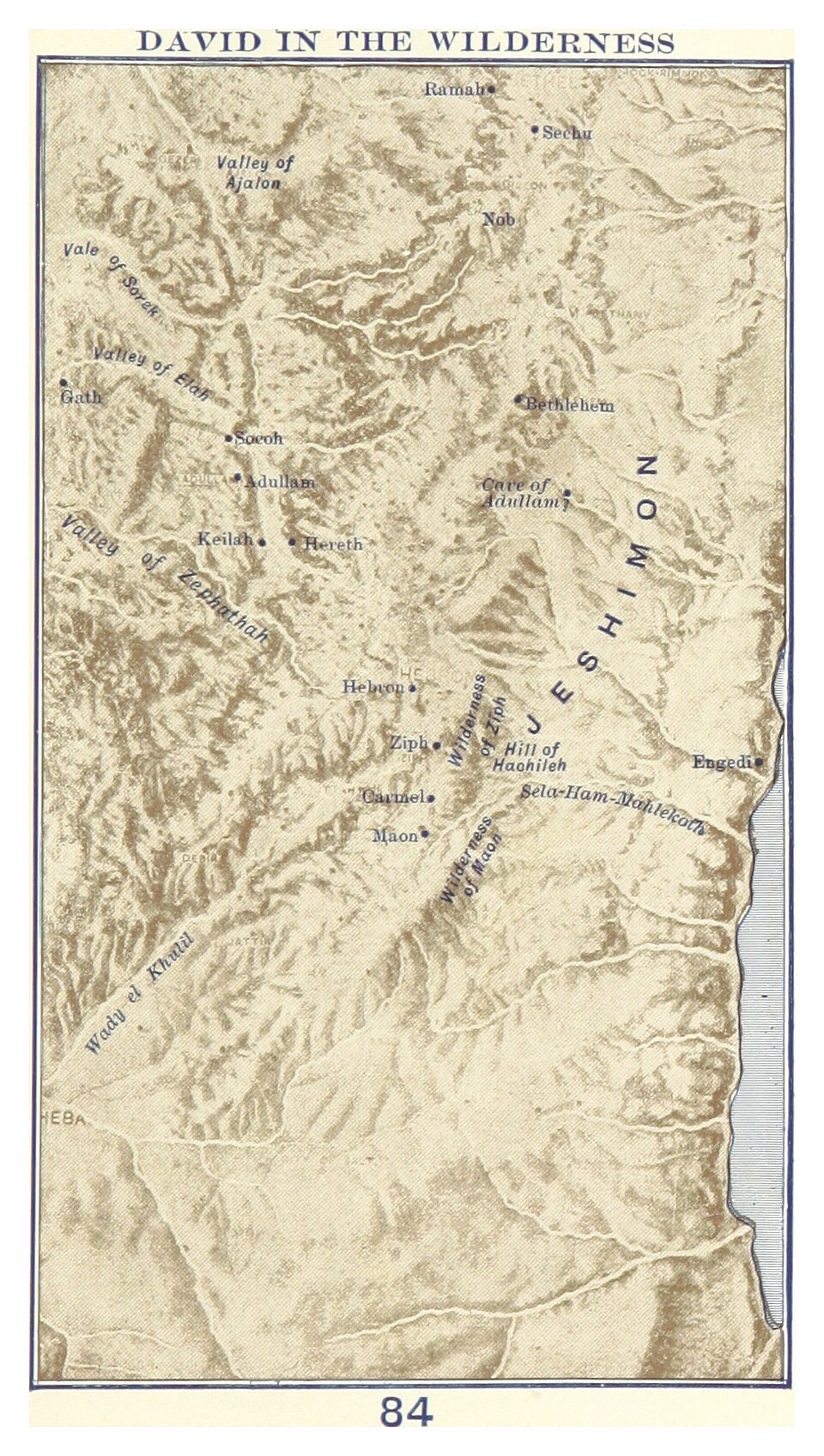
What You Are Looking At
This 1899 map from Townsend MacCoun’s The Holy Land in Geography and in History is dedicated to a single dramatic chapter of Israel’s history: David’s years on the run from King Saul. Every refuge site named in 1 Samuel 19–26 appears here, and you can trace David’s flight from beginning to end. The path starts at Gibeah, Saul’s capital, where David served at court as Saul’s armor-bearer and son-in-law. From there, the flight runs to Ramah, where Samuel sheltered David among the company of prophets. Then to Nob, the priestly city just north of Jerusalem, where Ahimelech the priest gave David the showbread and the sword of Goliath. Then westward to Gath in Philistine territory — a desperate move where David feigned madness to escape Achish, king of Gath. Then back across the border to the cave of Adullam in the Shephelah, where four hundred men gathered to him — the discontented, the indebted, the distressed. From Adullam, David ranged across the wilderness of Judah: Keilah in the Shephelah, the wilderness of Ziph south of Hebron, the wilderness of Maon further south, and the wilderness of En-gedi on the western shore of the Dead Sea — where David spared Saul’s life in the cave. The southernmost site marked is Ziklag, the Philistine border town Achish later gave David as a base of operations for sixteen months. The map shows the geography of a fugitive: every spring, every cave country, every border town that became, for a season, the wilderness pulpit of God’s anointed king.
“The Lord is my rock, and my fortress, and my deliverer; my God, my strength, in whom I will trust; my buckler, and the horn of my salvation, and my high tower. I will call upon the Lord, who is worthy to be praised: so shall I be saved from mine enemies.”
Why David Had to Run
After David killed Goliath, the people sang a song that ended Saul’s patience with the shepherd boy: “Saul hath slain his thousands, and David his ten thousands” (1 Samuel 18:7). Saul understood the math. From that day forward he “eyed David,” and an evil spirit from the Lord came upon him. Twice Saul threw his spear at David in the palace at Gibeah, trying to pin him to the wall. David escaped both times. Saul then tried subtler methods — promoting David to military command in hopes the Philistines would kill him, then offering his daughter Michal in exchange for a hundred Philistine foreskins, expecting David to die collecting them. David came back with two hundred. Saul gave him Michal anyway, then sent men to David’s house to kill him in his bed. Michal lowered David from the window and let him down by a cord. She put a household idol in the bed with goat’s hair at the head and a garment over it, and when the assassins came, she told them David was sick. He was already gone. The flight had begun.
Ramah and Nob — The First Refuges
David ran first to Ramah, to Samuel — the man who had anointed him years earlier in Bethlehem. Samuel took him to Naioth, the prophets’ settlement just outside Ramah, and there a strange thing happened. Three times Saul sent messengers to seize David at Naioth, and three times the Spirit of God fell on the messengers and they prophesied instead. Saul finally came himself, and the Spirit fell on him too — he stripped off his royal robes and prophesied all that day and all that night before Samuel. While Saul lay there exposed and stupefied, David slipped away. He met briefly with Jonathan in the field outside Gibeah — their famous covenant of friendship, sealed with arrows — then ran south to Nob, the priestly city near Jerusalem. There Ahimelech the priest gave him the showbread (the only bread on hand) and Goliath’s sword, which had been kept behind the ephod since the Valley of Elah. Saul’s spy Doeg the Edomite witnessed the exchange, and Saul later used Doeg to slaughter eighty-five priests of Nob and put the entire city to the sword. The first ripples of David’s flight had begun to cost innocent lives.
Gath and Adullam — The Fugitive Becomes a Captain
Out of options inside Israel, David crossed the border into Philistia and went to Gath — the hometown of the giant whose sword he now carried. The irony was not lost on the servants of Achish, king of Gath, who recognized David immediately as “the king of the land” the women had sung about. David, suddenly terrified, “feigned himself mad in their hands, and scrabbled on the doors of the gate, and let his spittle fall down upon his beard” (1 Samuel 21:13). Achish dismissed him as a lunatic, and David escaped back across the border to the cave of Adullam in the Shephelah. There the transformation began. “Every one that was in distress, and every one that was in debt, and every one that was discontented, gathered themselves unto him; and he became a captain over them: and there were with him about four hundred men” (1 Samuel 22:2). The future army of Israel — the men later called “David’s mighty men” — first assembled in this cave. David sent his aged parents to safety across the Jordan in Mizpeh of Moab, then took his band into the forest of Hereth, then west to Keilah, where he rescued the city from a Philistine raid on the threshing floors. Keilah’s thanks was a willingness to betray him to Saul. David moved on before they could.
Ziph and Maon — The Wilderness of Betrayal
David moved south into the wilderness of Ziph, in the highlands south of Hebron. The Ziphites went to Saul and offered to deliver David into his hand. Saul came after him. The two armies converged on opposite sides of a single mountain in the wilderness of Maon, with David hemmed in and Saul about to close the trap, when a messenger arrived telling Saul the Philistines were invading from the north. Saul broke off the pursuit. The text calls the place “Sela-hammahlekoth” — the Rock of Escape. Twice during these wilderness years, David had Saul cornered and could have killed him. The first time was in the cave at En-gedi, where Saul went in to relieve himself and David and his men were hiding deeper in the same cave. David crept up and cut off the skirt of Saul’s robe, then refused to kill him. “The Lord forbid that I should do this thing unto my master, the Lord’s anointed.” The second time was at the hill of Hachilah in the wilderness of Ziph, where David and Abishai crept into Saul’s camp at night, found Saul asleep with his spear stuck in the ground at his head, and took the spear and the cruse of water. David refused to harm him. Both times Saul wept and acknowledged David’s righteousness. Both times Saul went home, and the pursuit resumed within months.
En-gedi and Ziklag — The Final Refuges
The wilderness of En-gedi, on the western shore of the Dead Sea, became David’s most extended base. The terrain was perfect for a fugitive: sheer limestone cliffs riddled with caves, freshwater springs hidden in deep canyons, almost impossible to assault. Many of the Psalms come from this season — Psalm 57, written in the cave; Psalm 142, “a prayer when he was in the cave”; Psalm 63, “in the wilderness of Judah.” David’s eventual move to Ziklag in 1 Samuel 27 was the breaking point of his patience. Worn out by the years of running and convinced Saul would eventually catch him, David crossed into Philistia again — this time to stay. Achish gave him Ziklag as a base, and David lived there sixteen months as a Philistine vassal, secretly raiding the Amalekites and Geshurites while telling Achish he was raiding Judah. The wilderness years end with David on the wrong side of the border, about to be drawn into the battle that would kill Saul and Jonathan on Mount Gilboa.
What These Years Produced
The wilderness made David. The shepherd boy who killed Goliath was not yet a king — he was a folk hero with a sling. The man who came out of the wilderness was a battle-hardened captain of six hundred mighty men, a tactical genius who had survived a king’s pursuit for years, and a poet whose Psalms would shape the worship of Israel and the Church for three thousand years. The wilderness is also where David learned what he refused to do. Twice he could have killed Saul. Twice he refused. He would not stretch out his hand against the Lord’s anointed, even when the Lord’s anointed was hunting him. That refusal — that conviction that vengeance belongs to God and not to the man with the spear — is the principle that would later govern David’s reign over Israel and prefigure the kingship of David’s greater Son. The cave at Adullam, the rock of En-gedi, the wilderness of Maon: these are the seminaries of the king after God’s own heart.
_p089_DAVID_IN_THE_WILDERNESS.jpg)