
"You have heard that it was said, 'You shall love your neighbor and hate your enemy.' But I say to you, love your enemies and pray for those who persecute you."
Earlier today, as I perused through my email and the various news headlines of the day over morning coffee, I happened upon two news stories. They appeared in my inbox within an hour of each other. On the surface, they seemed unrelated — one about terrorism, one about emergency medicine. But as I read them side by side, something profound settled over me. These two stories, taken together, tell you everything you need to know about the conflict between Israel and her enemies. They illustrate, with more clarity than any political speech or diplomatic communiqué ever could, the fundamental moral gulf that separates the two sides.
I want to share both of them with you — and then I want to talk about what they mean. Not just politically. Not just strategically. But morally, spiritually, and prophetically. Because I believe that what is happening in the Middle East is not merely a geopolitical dispute over land. It is a collision of two radically different worldviews — two radically different answers to the question: What does a human life mean? One side has answered that question with rockets, martyrdom cults, and celebrations of slaughter. The other has answered it with ambulances, field hospitals, and a commitment to saving life — even the lives of those who wish them dead. That is the difference between love and hate. And it is on full display for the entire world to see, if only the world would look.
Story One: The Face of Hatred
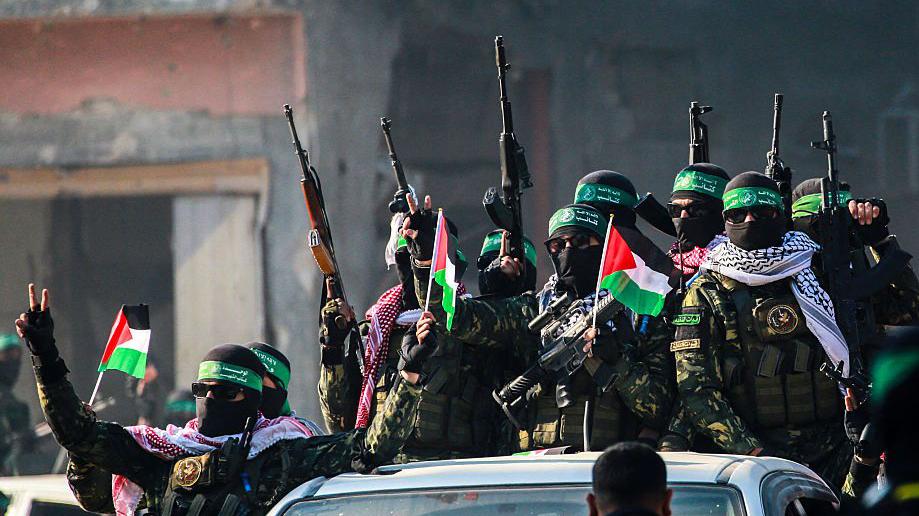
The first story came from a report on Hamas — the Iranian-backed terrorist organization that has governed the Gaza Strip since its violent coup in 2007. It described, in documented detail, the behavior of Hamas operatives and their supporters in the immediate aftermath of attacks on Israeli civilians. The scenes were chilling. People dancing in the streets. Candy distributed to children. Gunfire in the air. Not grief over the loss of life — celebration of it.
This is not a new phenomenon. It is a pattern that has repeated itself for decades, so consistently that it can only be understood as a deep cultural and ideological feature of Hamas — not an aberration. Following the September 11, 2001 attacks in the United States, similar celebrations were documented among Hamas supporters in Gaza and the West Bank. When Israeli mothers were killed in their homes. When school buses were bombed. When teenagers were murdered at discotheques. Every time, the same response: jubilation.
Understanding Hamas requires going back to its founding document. The original 1988 Hamas Charter is one of the most explicit calls to genocide in the modern era. It does not merely call for the destruction of the State of Israel — it calls for the killing of Jewish people wherever they can be found, quoting a hadith in which the Prophet of Islam declares that Judgment Day will not come until Muslims kill the Jews, and the very trees and rocks cry out to point them out. This is not a fringe interpretation. This is the founding document. This is what Hamas was built on.
Since then, Hamas has launched thousands of rockets into Israeli cities — not military targets, but neighborhoods, schools, playgrounds, and synagogues. The rockets are deliberately unguided. They are designed not to hit anything in particular, but to hit somewhere — to spread terror indiscriminately. When those rockets fail to kill, Hamas considers it a failure. When they succeed in killing a grandmother or a child, Hamas considers it a victory and says so publicly.
And yet Hamas leadership routinely tells Western journalists that they have "nothing to lose." That the occupation has left them no choice. That resistance is their only option. But consider what they have actually chosen to do with the resources they possess. Billions of dollars in international aid that were supposed to build schools, hospitals, and infrastructure have instead been used to construct an elaborate tunnel network under Gaza — tunnels not for sheltering civilians, but for storing weapons, launching attacks, and hiding commanders. The people of Gaza live in poverty and despair while their leaders funnel money into a war machine designed to kill Jews. That is not resistance. That is the deliberate use of civilian suffering as a strategic weapon — against Israel's image in the international press, and against the people of Gaza themselves.
Reports documented Hamas members and supporters publicly celebrating rocket attacks on Israeli population centers, with witnesses describing candy distributions and street celebrations following confirmed civilian casualties. Officials cited the attacks as fulfillment of their stated goal to bring life in Israel to a halt. (Source: Ynet News)
The ideology behind this behavior runs deeper than politics. Hamas does not merely want Israeli land. Hamas wants Israeli annihilation — and, beyond that, the annihilation of every Jew on earth. Their leadership has said so in Arabic, in official documents, in mosque sermons, and in media appearances aimed at their own people. The tragedy is that the Western media, conducting interviews in English, rarely bothers to consult what these men say in their own language to their own people. When they do, the mask comes off entirely. There is no two-state solution in their worldview. There is no negotiated peace. There is only victory — meaning the elimination of Israel — or martyrdom in pursuit of it.
That is Story One. That is what hatred looks like.
Story Two: The Face of Love
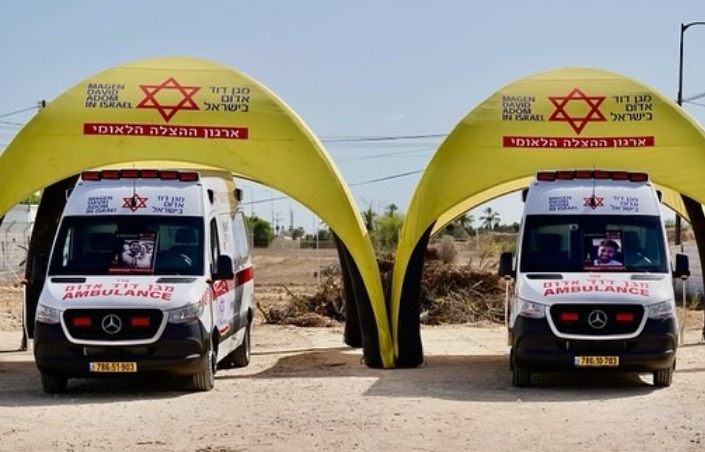
The second story was about Magen David Adom — the Red Star of David, Israel's national emergency medical service. MDA was founded in 1930, nearly two decades before the State of Israel itself existed, by Jewish settlers who understood that a functioning society required organized emergency medicine. Today it operates as Israel's equivalent of the Red Cross, though for many decades it was denied official recognition by the International Red Cross and Red Crescent Movement because the international body refused to accept the Star of David as a protected emblem alongside the cross and crescent. That injustice was only rectified in 2006. The reasons for the original exclusion speak for themselves.
What makes MDA remarkable — and what the news story highlighted — is not merely what it does for Israelis. It is what it does for everyone. MDA paramedics treat Jewish and Arab casualties without distinction. During periods of intense rocket fire, when MDA ambulances rush toward the impact sites, the paramedics inside those vehicles do not first ask the victim's religion or nationality before deciding whether to help. They treat whoever is in front of them. During the height of attacks from Gaza, MDA treated Arab Israeli civilians caught in the crossfire with the same urgency and skill as Jewish Israeli civilians. When Palestinian workers in Israel were injured — sometimes in the very attacks being celebrated in Gaza — MDA was there.
The Hebrew phrase u'vacharta ba'chayyim — "choose life" — comes from Deuteronomy 30:19, and it serves as something of an unofficial motto for Israeli medical culture. It reflects a civilization oriented toward life, toward healing, toward the preservation of human dignity. The IDF operates under a doctrine called tohar haneshek — "purity of arms" — which holds that military force must be used with proportionality and restraint, that non-combatants must be protected even at tactical cost, and that captured enemies must be treated humanely. These are not merely abstract principles. They are instilled in every Israeli soldier through their training.
Compare this to Hamas, which deliberately embeds its military infrastructure inside hospitals, schools, and mosques — not despite the civilian presence, but because of it. The strategy is explicit: use Palestinian civilians as human shields, then blame Israel for the casualties when it responds. When Israeli forces warn civilians to evacuate before striking a military target — dropping leaflets, sending text messages, making phone calls, firing warning shots — Hamas orders people to stay. It wants the casualties. It needs them. The international sympathy generated by civilian deaths is a strategic weapon, and Hamas deploys it with cold calculation.
MDA reports described paramedic teams responding to rocket strike sites in under-armored vehicles, treating casualties including Arab Israelis and foreign nationals, with crews operating continuously through active attack periods without withdrawal. Field commanders cited MDA's founding principle of treating every life equally regardless of origin. (Source: Ynet News)
MDA's ambulances, meanwhile, are increasingly equipped with bulletproof plating. Not because Israel has become a warlike society — but because its paramedics keep getting shot at while trying to save lives. Think about what that means. Israel has had to armor its ambulances because the enemy targets medical personnel. Hamas fires on paramedics. Hamas fires on hospitals — Israeli ones, that is. Meanwhile, Israeli hospitals treat Palestinian patients referred through official coordination channels, including children with cancer and patients with cardiac conditions who cannot receive adequate care in Gaza precisely because Hamas has spent the aid money on rockets instead of medicine.
That is Story Two. That is what love looks like.
Perspective: What This Means for Christians
I want to be careful here not to reduce this to a simple "Israel good, Palestinians bad" narrative. The Palestinian people — ordinary families in Gaza and the West Bank — are not Hamas. Many of them are victims of Hamas every bit as much as they are victims of the conflict itself. They did not choose to be governed by a death cult. They did not choose to have their aid money stolen to build tunnels. They did not choose to be used as human shields. They are people made in the image of God, and their suffering matters. Christians who support Israel must hold both truths simultaneously: that Israel has the right and the obligation to defend its people, and that Palestinian civilians caught in the crossfire deserve compassion and prayer.
But that distinction — between the Palestinian people and Hamas — is precisely the one the international media refuses to make. By conflating Hamas's violence with legitimate Palestinian grievance, the media provides cover for the most nihilistic terrorist organization in the modern Middle East. It launders a genocidal ideology in the language of human rights. And in doing so, it makes peace less likely, not more — because peace requires that one side acknowledge the other's right to exist, and Hamas explicitly refuses to do so.
The moral clarity that these two stories provide is something that Christians especially are called to exercise. We worship a God who is not neutral. The God of the Bible took sides. He chose Abraham, Isaac, and Jacob. He made an everlasting covenant with the Jewish people — a covenant that the New Testament does not annul, but rather extends and fulfills. The Church has been grafted into the olive tree of Israel (Romans 11:17), but that grafting does not uproot the original tree. God's covenant faithfulness to the Jewish people is not a theological embarrassment to be explained away. It is one of the great pillars of biblical history, and it has enormous implications for how Christians understand what is happening in the Middle East today.
Jeremiah 30:3 declares: "For, lo, the days come, saith the LORD, that I will bring again the captivity of my people Israel and Judah, saith the LORD: and I will cause them to return to the land that I gave to their fathers, and they shall possess it." Ezekiel 37 describes a valley of dry bones — a scattered, dead people — being breathed back to life by the Spirit of God and restored to their land. These are not metaphors. They are prophecies, and we have watched their fulfillment in real time over the past century. The return of the Jewish people to the Land of Israel is the most significant prophetic development in two thousand years of history. It is not a coincidence. It is not an accident of geopolitics. It is God keeping His word.
And it is against this backdrop that Hamas's stated goal — the elimination of Israel — must be understood. It is not merely a political ambition. It is a direct assault on the purposes of God in history. That does not mean every Israeli policy is above criticism, or that Christians should be uncritical cheerleaders for any particular government. It means that the existence of Israel — the right of the Jewish people to live in their ancestral homeland in safety and sovereignty — is something Christians have biblical reasons to defend that go far deeper than politics.
Two stories. One week. One about a people who distribute candy when children die. One about a people who arm their ambulances so paramedics can keep saving lives under fire. The difference between love and hate has never been more clearly on display. May God give us eyes to see it, and the courage to say so.
© 2026 Michael Knighton | Christians Standing With Israel™ | All Rights Reserved.