
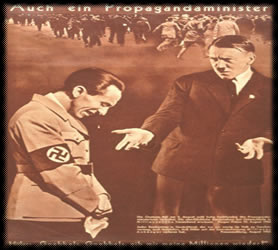
"If you tell a lie big enough and keep repeating it, people will eventually come to believe it. The lie can be maintained only for such time as the State can shield the people from the political, economic and/or military consequences of the lie. It thus becomes vitally important for the State to use all of its powers to repress dissent, for the truth is the mortal enemy of the lie, and thus by extension, the truth is the greatest enemy of the State."— Joseph Goebbels, Nazi Minister of Propaganda
How Propaganda Works — The Mechanics of the Big Lie
Goebbels understood something that his contemporaries in the democratic West were slow to grasp: that the human mind, when bombarded with a consistent and emotionally charged message, will eventually accept it as truth — regardless of the evidence. Propaganda does not argue. It does not reason. It repeats. It saturates. It silences dissent. It replaces historical fact with emotionally resonant narrative, and it does so through every available channel of communication simultaneously.
The Nazi model had three essential components that made it so devastatingly effective. First, total media control — the suppression of any voice that contradicted the narrative. Second, the dehumanization of the target group — in this case the Jewish people, systematically portrayed as parasites, criminals, and the source of Germany's suffering. Third, the constant repetition of a simple, emotionally powerful lie — one that gave the masses a scapegoat and a sense of righteous victimhood. These three components did not die with the Third Reich. They were inherited, refined, and redeployed in the Middle East.
Modern psychology has since given Goebbels’s intuition a name. Researchers call it the illusory truth effect — the well-documented finding that a statement encountered repeatedly is judged more likely to be true than one encountered once, entirely apart from whether it is true. The mind mistakes familiarity for accuracy. A claim heard for the fiftieth time no longer feels like a claim at all; it feels like something one has always known. This is why propaganda invests in volume rather than proof. It is not trying to win an argument, which it would lose; it is trying to make the argument feel unnecessary. By the time the falsehood is challenged, it has already been filed away in millions of minds not as an opinion to be defended but as a background fact of the world — and background facts are almost never re-examined.
The "Big Lie" — A New Propaganda Machine
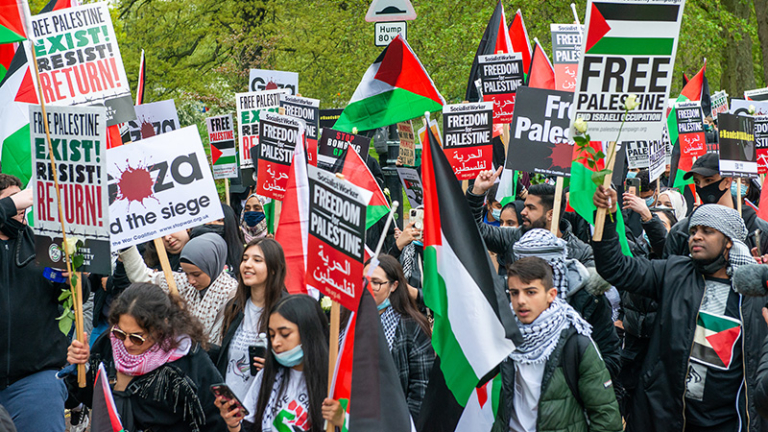
The timing of the lie is itself a confession. It was not in 1948, when Israel was founded, that a distinct "Palestinian" national movement crystallized — it was after 1967. When the surrounding Arab armies were humiliated in the Six-Day War and the dream of erasing Israel by force collapsed, the strategy shifted. If Israel could not be destroyed militarily, it would be destroyed morally — reframed before the world not as a tiny nation of refugees who had rebuilt their ancient homeland, but as a colonial aggressor occupying the land of an indigenous people. For this strategy to work, an indigenous people had to be supplied. The Palestine Liberation Organization had been founded in 1964 — three years before Israel held a single inch of the West Bank or Gaza — which raises the obvious question its own charter cannot answer: if the goal in 1964 was the "liberation" of Palestine, and Judea, Samaria, and Gaza were then in Jordanian and Egyptian hands, exactly whose occupation was being resisted?
Most damning of all are the admissions that have slipped out from within the movement itself. Zuheir Mohsen, a senior figure in the PLO, told a Dutch newspaper in 1977 that the Palestinian people did not exist as a separate identity — that "the existence of a separate Palestinian identity serves only tactical purposes," a political instrument created to advance the Arab struggle against Israel. He went further, conceding that it was only "for political reasons" that the Arabs carefully underlined a Palestinian identity, because Arab national interests demanded the positing of a distinct people in opposition to Zionism. When the architects of a national myth admit, in their own words, that the nation was invented as a weapon, the historian's task is essentially complete. The confession has already been signed.
The confession, moreover, did not begin with the PLO. At the very dawn of the Mandate the Arabs of the region defined themselves not as Palestinians but as Syrians. The Arab congress convened over the question in 1919 resolved that the territory the British were beginning to call Palestine was in truth ‘Southern Syria’ — an inseparable part of the Syrian homeland — and petitioned to be joined to Damascus rather than set apart as any distinct Palestinian nation. Arab leaders of the period testified to British commissions in the same terms: that ‘Palestine’ was a name imposed from outside, that their country had for centuries been a province of Syria, and that a separate Palestinian identity was foreign to them. The claim of a timeless Palestinian nation was contradicted, on the record, by the Arabs of the Mandate themselves — long before the propaganda ministry taught their grandchildren to say otherwise.
The Historical Record the Lie Erases
A lie of this magnitude survives only by erasing the record that contradicts it, and the record contradicting this one is vast. There has never, in all of recorded history, been a sovereign Arab state called Palestine. There was no Palestinian currency, no Palestinian language distinct from Arabic, no Palestinian parliament, no Palestinian king, no Palestinian capital. For the four centuries before the British Mandate, the territory was governed as part of the Ottoman Empire's "Greater Syria" — Bilad al-Sham — an undifferentiated province whose Arabic-speaking inhabitants used Syrian, Egyptian, and Bedouin dialects and identified by religion, clan, and region, not by any "Palestinian" nationhood that no one had yet imagined.
Remarkably, this is conceded even by honest voices within Palestinian academia. Nazmi al-Jubeh, a professor of history and archaeology at Birzeit University near Ramallah, acknowledged in his own scholarship that the modern Palestinian identity was a recent construction, assembled to serve the struggle against Zionism rather than inherited from any ancient and continuous nation. When the very scholars who teach in Palestinian universities admit, in their professional work, that the national story does not withstand historical scrutiny, the claim of an ancient, dispossessed Palestinian nation collapses from the inside. The "indigenous people" of the propaganda posters turn out, on examination, to be a twentieth-century invention wearing the borrowed costume of antiquity.
Ironically, before 1948 it was the Jews of the region who were most readily called "Palestinians." The Palestine Post was a Jewish newspaper. The Palestine Symphony Orchestra was a Jewish ensemble. The "Palestinian" brigades that fought in the British army in the Second World War were overwhelmingly Jewish. The Arab inhabitants of the Mandate, for the most part, rejected the label "Palestinian" as a Zionist imposition and insisted they were simply Arabs, part of the wider Arab nation. The name was only seized and repurposed decades later, once it became useful as a weapon. The history is not hidden. It is merely inconvenient, and so it is buried beneath the steady repetition of the lie.
Consider how recent the entire vocabulary is. The first time the world heard sustained, organized talk of a distinct "Palestinian people" with a national claim was not in antiquity, nor in the Ottoman centuries, nor even under the British Mandate — it was in the second half of the twentieth century, within living memory of people still alive today. A nation that genuinely stretched back thousands of years would not need to have its very name argued into existence in the era of television. The newness of the claim is itself the tell. Authentic peoples do not require a propaganda ministry to inform them that they exist.
The United Nations, the Media, and the Machinery of Delegitimization
No institution has been more thoroughly captured by Arab propaganda than the United Nations. Since Israel's founding, the UN has passed more resolutions condemning Israel than all other nations combined. The UN Human Rights Council — whose membership has included some of the world's most brutal regimes — devotes a permanent agenda item exclusively to Israel, while the systematic oppression of women, ethnic minorities, and religious dissenters across the Arab world goes largely unaddressed. This is not balance. This is not justice. This is the Goebbels model operating at the highest levels of international governance.
Nowhere is the machinery more visible than in the unique apparatus the UN built to sustain the "refugee" claim. Every other displaced population on earth — and there have been many, including the roughly 850,000 Jews expelled from Arab lands in the same era, who were quietly absorbed by Israel and the West — is served by a single agency, the UNHCR, which works to resettle refugees and end their refugee status. The Palestinian Arabs alone were given their own separate agency, UNRWA, operating under a definition found nowhere else: refugee status that is inherited, passed down from generation to generation without end. By this device a population of several hundred thousand in 1948 has been multiplied into the millions, the great majority of whom have never set foot in the land they are told is theirs. No mechanism exists to resettle them, because resettlement would dissolve the grievance — and the grievance, not its resolution, is the point. The "refugee" status is not a humanitarian condition awaiting relief. It is a weapon engineered to be permanent.
The global media has been equally complicit. The language of the conflict has been systematically shaped to favor the Arab narrative — "occupation," "settlements," "Palestinian territories," "disproportionate response." Each of these terms carries embedded assumptions that have been absorbed into the international vocabulary without examination. Israeli self-defense is reframed as aggression. Arab terrorism is sanitized as "resistance." The victims are inverted. The perpetrators are protected. And the lie grows larger with every broadcast cycle.
The Vocabulary of the Lie
Because propaganda works by saturation rather than argument, its most important victories are won at the level of vocabulary — in the words a listener absorbs before he has formed a single conscious opinion. A great deal of the case against Israel is not made in sentences at all; it is smuggled in through nouns and adjectives that arrive with their conclusions already attached. Call the presence of Jews in Judea and Samaria an ‘occupation,’ and the verdict is delivered before the history is heard: an occupier is by definition in the wrong, and the land is by definition someone else’s. Call Israeli towns ‘settlements’ and their residents ‘settlers,’ and the reader pictures colonists planted on foreign soil rather than Jews living in the heartland of the biblical homeland from which their ancestors were once exiled.
The same sleight of hand runs through the entire lexicon. ‘Apartheid’ imports the moral weight of a crime Israel does not commit — in a state where Arab citizens vote, sit in the parliament, serve on the supreme court, and practise medicine and law alongside their Jewish neighbours. ‘Genocide’ is hurled at a conflict in which the Arab population between the river and the sea has multiplied many times over across the very decades of the supposed extermination — the least effective genocide in the history of the word. ‘Cycle of violence’ quietly erases the distinction between the terrorist who seeks out civilians and the soldier who defends them, dissolving aggressor and defender into a single blameless fog. Each term is a small lie that never has to be proved because it is never stated as a claim; it is simply used, and used again, until the listener can no longer think about the subject except in the language his opponents built for him. To adopt the enemy’s vocabulary is to concede the argument before it has begun.
The Campus — Indoctrination of the Next Generation
Perhaps most alarming is the penetration of Arab propaganda into Western universities and seminaries. The academic world — which prides itself on critical inquiry and the pursuit of truth — has in many cases become a breeding ground for the most virulent strains of anti-Israel ideology. Students for Justice in Palestine, funded in part by organizations with documented ties to Hamas and the Muslim Brotherhood, operate on hundreds of campuses across North America and Europe, disseminating the Palestinian narrative as unquestioned historical fact.
The mechanism here is the same one Goebbels described, merely relocated from the state broadcaster to the lecture hall. A simple, emotionally charged narrative — colonizer and colonized, oppressor and oppressed — is repeated across departments, embedded in reading lists, and enforced by social pressure until it acquires the feel of settled knowledge. Students arrive knowing nothing of the Ottoman period, the Mandate, the 1947 partition the Arabs rejected, or the wars of annihilation launched against Israel, and they leave fluent in a vocabulary of "settler colonialism" that no one ever asked them to examine. It is not education; it is catechism. And because it is delivered by professors rather than propagandists, and wrapped in the language of justice rather than hatred, it is believed all the more completely. The next generation does not need to be argued into the lie. It is simply raised inside it.
Even many Christian seminaries — institutions that should be anchored in the biblical record — have embraced replacement theology and Palestinian liberation theology as frameworks for understanding the Israeli-Palestinian conflict. These theological constructs, which strip Israel of its biblical covenant rights and reframe the Palestinian narrative in the language of Christian justice, represent perhaps the most dangerous form of indoctrination — because they come dressed in the garments of faith.
What makes the campus so effective a transmitter is not only what is taught but what is no longer permitted to be questioned. On many faculties a single narrative has hardened into a condition of belonging: the scholar who documents the recent invention of the Palestinian claim, or who defends Israel’s legitimacy, risks the quiet penalties academic communities reserve for heresy — the withheld invitation, the hostile review, the reputation for being ‘difficult.’ Students absorb the lesson without a word being spoken aloud: certain conclusions are safe and others are costly. A discipline that silences one side of a question has stopped teaching students how to think and begun teaching them what to say — which is the precise definition of indoctrination and the exact opposite of education.
The Digital Front — Indoctrination at the Speed of the Algorithm
Goebbels needed a state broadcaster and a captive press to saturate a population; the modern propagandist needs only a telephone. The channels examined so far — the United Nations, the legacy media, the university — move at the speed of institutions. Social media moves at the speed of outrage, and it has become the most powerful engine the lie has ever possessed. A photograph stripped of its context, a clip severed from the minute before it, a hashtag repeated by millions in a single afternoon — these now shape world opinion faster than any editor could once have checked a single fact. And the machinery is built to reward precisely the qualities Goebbels prized: the emotionally simple over the factually complex, the image over the caption, the accusation over the correction.
The algorithm does not ask whether a claim is true; it asks whether it provokes — and the lie is engineered to provoke. Images from other wars entirely, from Syria and Iraq and disasters unconnected to Israel, have been recycled and relabelled as scenes of Israeli cruelty and shared millions of times before any debunking arrives, if it ever does. Casualty figures issued by a terrorist administration are reported as established fact within the hour, headlined, and absorbed; the correction, when it comes, reaches a fraction of the original audience and undoes nothing. Gone is the old friction that once forced a claim to survive an editor before it reached the public. In its place is a system in which a falsehood can circle the earth and lodge itself in a hundred million minds before the truth has finished putting on its shoes. It is the Goebbels model once more — stripped of its uniforms and handed to everyone with a screen — and it is raising a generation inside a lie whose underlying history it has never read a single page of.
Why the Lie Works — and What Defeats It
It is worth pausing to ask why a fabrication so thoroughly contradicted by the historical record has nonetheless conquered so much of world opinion. The answer is not that the evidence favors it; the answer is that the lie is structurally easier to believe than the truth. It is short, emotional, and morally flattering to those who accept it — a tidy story of a small, oppressed people resisting a powerful occupier. The truth, by contrast, is long, complicated, and demands that the listener unlearn things he has been told for decades. Goebbels grasped this asymmetry perfectly: a lie that fits on a placard will always travel faster than a truth that requires a book. Repetition does the rest. Say "occupation" ten thousand times and it ceases to be a claim that must be proved and becomes a fact that everyone simply knows.
There is also a darker comfort in the lie, and it explains why it is embraced so fiercely by people who have no stake whatever in the Middle East. The oppressor-and-oppressed frame offers the listener something almost irresistible: a way to feel righteous at no cost. To denounce Israel is to be instantly enrolled among the compassionate and the brave, the enemies of injustice — a moral standing purchased for the price of a slogan. The frame flatters its adopter even as it deceives him. And once a belief has become a badge of one’s own goodness, evidence against it is no longer merely unwelcome; it is felt as an attack upon the self. This is why the lie is defended with an intensity its holders almost never bring to ordinary questions of fact. They are not defending a historical claim. They are defending the flattering portrait of themselves that the claim permits them to keep.
This is why the subsequent parts of this series matter, and why the work of patient documentation is not optional. The lie cannot be answered with a louder slogan; it can only be answered with the record — name by name, date by date, document by document. When one traces the specific historical falsehoods on which the myth depends, and then examines the manufactured outrage that protects it from scrutiny, the construction comes apart. A lie maintained by repetition is vulnerable to exactly one thing: the steady, unembarrassed restatement of the truth, offered as often and as confidently as the lie itself.
For the Christian, there is an added dimension the propagandist cannot touch. The Jewish people are, in the words of Scripture, the apple of God's eye (Zechariah 2:8) — a people bound to Him by an everlasting covenant that no campaign of delegitimization can annul. To stand for the truth about Israel's history is therefore not merely to defend a set of facts; it is to align oneself with what God Himself has declared concerning the land, the people, and the promise. The propaganda machine can rewrite a textbook. It cannot rewrite the Word of God.
Perspective
"The Big Lie" of today represents a propaganda machine that, once again, has swayed public opinion in favor of all that is anti-Semitic. Once again, the Jewish people have witnessed an international community caustically aligning itself against them — effectively pushing the Jewish people not into the mass graves of genocide, but to the brink of demographic suicide. With foreign governments — including that of the United States — and a global media sympathetic to the "Palestinian cause," Israel continues to be pressured to relent and concede, relinquishing more of her land to a conglomeration of Arab states sworn to her demise.
The Christian community has a responsibility that goes beyond political commentary. We are called to "speak up for those who cannot speak for themselves" (Proverbs 31:8), to "pray for the peace of Jerusalem" (Psalm 122:6), and to stand without apology on the side of God's eternal covenant with the Jewish people. That covenant — reaffirmed throughout Scripture and sealed in the promises of God — cannot be undone by a propaganda campaign, however sophisticated, however well-funded, or however widely repeated.
A lie, told one thousand times, is still a lie. And the truth of God's Word — concerning the land, the people, and the covenant — has been told not a thousand times, but ten thousand times, across four thousand years of recorded history. That is the counter-narrative. That is our ground. And on that ground, we stand.
Let no one mistake the stakes for merely academic. The propaganda examined here is not a harmless difference of historical opinion; it is the ideological fuel that has powered terror campaigns, justified the murder of Jewish civilians as "resistance," and pressured a tiny nation to surrender the very territory God promised to her forefathers. Every distortion absorbed by a university student, every inverted headline accepted by a newspaper reader, every UN resolution rubber-stamped against the Jewish state, adds another layer to a structure whose ultimate aim has never changed since 1964: not coexistence beside Israel, but Israel's disappearance. To answer the lie, then, is not an exercise in point-scoring. It is a defense of a people marked for elimination by those who first had to erase that people's history in order to justify erasing the people themselves.
The believer's confidence rests on something the propagandist can never overcome. Empires have risen to erase the Jewish people and have themselves been swept into the dust while Israel endures. Pharaoh tried, and Egypt's gods are museum pieces. Babylon tried, Rome tried, and a Nazi regime built a continent-wide machine for the purpose — and still the descendants of Abraham gather today in Jerusalem, in their own land, speaking their own restored language, governing their own state. A lie sustained by repetition is a fragile thing set against four thousand years of covenant faithfulness. The myth of "Palestine" will go the way of every other attempt to write Israel out of history: it will be exposed, and it will pass. The land, the people, and the promise will remain. This series exists to hasten that exposure, one documented truth at a time.