

The previous installment examined the effectiveness surrounding the dissemination of anti-Semitic propaganda by a conglomeration of Arabs who would call themselves "Palestinians." Following the model of their Nazi predecessors, the Arabs have effectively unleashed a campaign of misinformation that has been heard and seen with a high degree of frequency. In so doing, they have not only shaped public opinion, but have also been extremely effective in garnering support sympathetic to an ideology that portrays them as "refugees" who have been somehow victimized and displaced by the creation of the Jewish state. In their refusal to recognize Israel's right to exist, they claim the region as their own — delving further into the nonsensical by referring to it as "Palestine."
Behold, the lie — the inveracity in your midst.
And so, for the purposes of this writing, let us assume, if but for a moment, that we have the capability of "time travel" and have elected to traverse the millennia. The period in time is approximately 2,000 BC; the location is the land of Canaan. What would we see?
A Trip Through Time
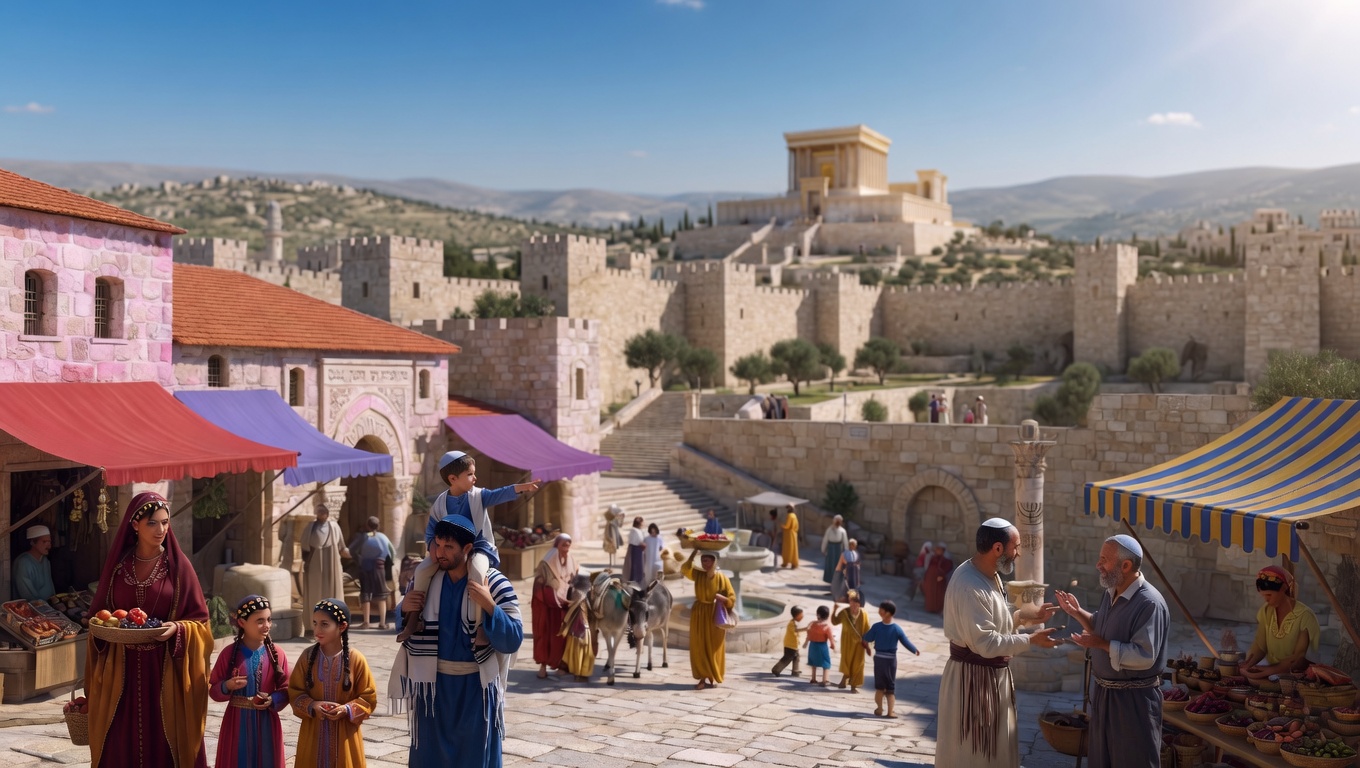
A Nation Forged by God
In the centuries that followed, Israel would flourish as a nation — forged by the tenacity of Saul, the faith and courage of David, and the wisdom and brilliance of Solomon. David established Jerusalem as the eternal capital of the Jewish people approximately 3,000 years ago — a full millennium before the birth of Islam, and nearly two millennia before any notion of a "Palestinian people" existed in the political imagination of the Arab world. Solomon built the First Temple on Mount Moriah — the same mount where Abraham had offered Isaac, and where God's presence would dwell among His people.
The historical record of Jewish sovereignty in this land is not a matter of religious belief alone — it is confirmed by archaeology, epigraphy, and the written records of every major civilization of the ancient Near East. The Tel Dan Stele, discovered in northern Israel in 1993, contains the first extrabiblical reference to "the House of David" — confirming the historical existence of David's dynasty. The Siloam Tunnel inscription, carved during the reign of Hezekiah, describes the engineering feat recorded in 2 Kings 20:20. The Lachish Letters document the final days before Nebuchadnezzar's siege of Jerusalem. The Cyrus Cylinder records the Persian king's decree allowing the Jewish exiles to return to their homeland.
Older still is the witness of Israel’s enemies. The Merneptah Stele, an Egyptian victory monument carved around 1208 BC, boasts of the pharaoh’s campaigns in Canaan and names among the peoples he claims to have struck down a people called Israel — the earliest mention of Israel by name anywhere outside the Bible, more than three thousand years ago, in the very land in question. Earlier still, the Amarna Letters of the fourteenth century BC preserve the correspondence of Canaanite city-kings with their Egyptian overlords. Across this entire ancient archive — Egyptian, Canaanite, Assyrian, Babylonian, Persian — a people called Israel appears again and again. A people called Palestine appears nowhere at all. The stones that name Israel three thousand years ago have never once been made to name an ancient Palestinian nation, because none was there for them to name.
However, for Israel, intense suffering and persecution would lie ahead in the coming seasons as she would become downtrodden by the Gentiles — enemies who would go on to destroy her eternal capital, Jerusalem, and its inhabitants, as well as the First and Second Temples. However, the same God whose wrath punished Israel for her disobedience would also be the One who would vindicate her in deliverance — time and time again.
Where Are They Now?
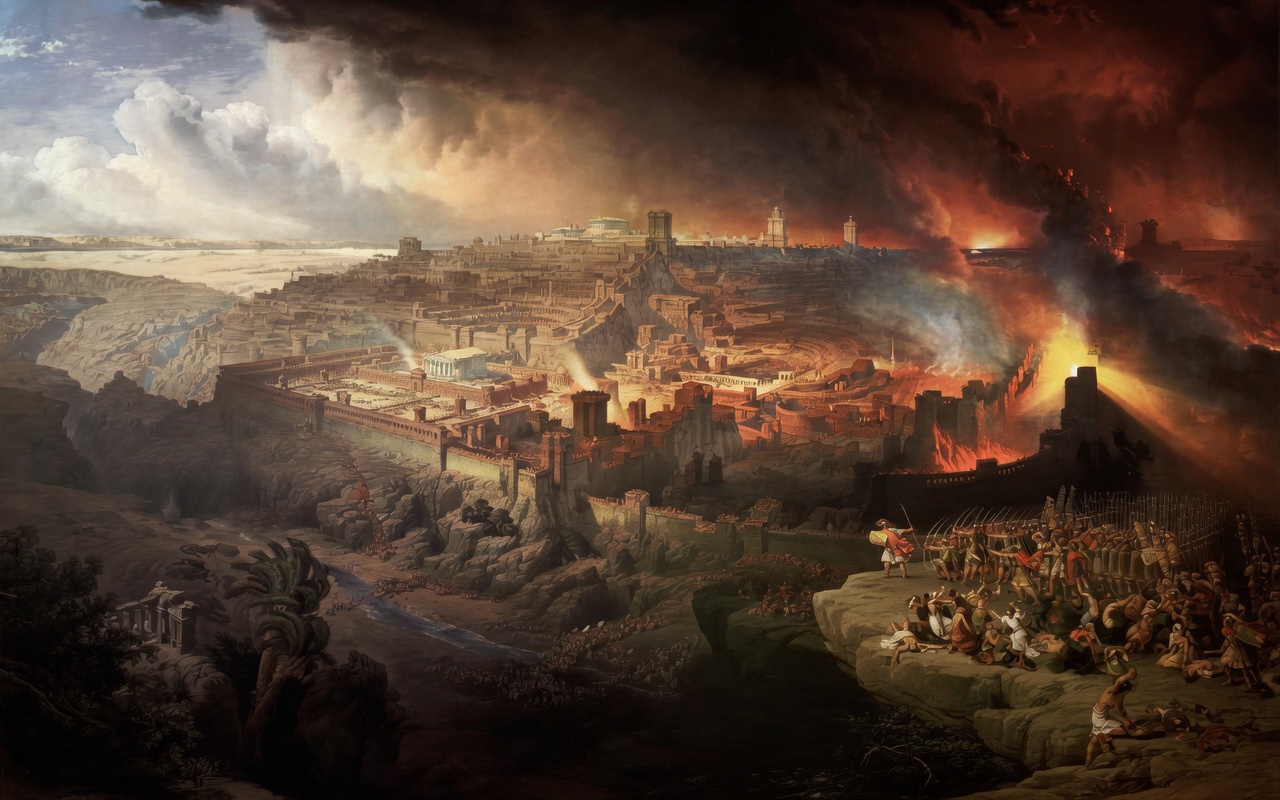
The Presence That Never Ended
The myth requires that the Jewish people vanished from the land after Rome’s conquest and returned in the twentieth century as foreign colonists — strangers with no more claim to the soil than any other settler. The historical record refuses the story. Jewish life in the land never wholly ceased. Through the Byzantine centuries, through the Arab conquest and the caliphates, through the Crusader massacres and the Mamluk and Ottoman eras, a Jewish presence endured — diminished, persecuted, taxed, and driven from one town to another, but never extinguished. In 1267 the great sage Nachmanides re-established the Jewish community of Jerusalem; the rabbinic academies of Tiberias had flourished centuries before; and in the sixteenth century the hill town of Safed became one of the most important centres of Jewish learning anywhere in the world.
It was in Safed, not in some European exile, that Rabbi Joseph Karo compiled the Shulchan Aruch, the code of Jewish law still followed the world over, and that Isaac Luria taught the mysticism that reshaped Jewish devotion. Jerusalem, Hebron, Safed, and Tiberias — the four holy cities — sustained Jewish communities across the very centuries the myth insists the Jews were absent. When the modern return began, it was not a foreign people arriving in a strange land; it was the swelling of a stream that had never entirely run dry. The Jews who came in the nineteenth and twentieth centuries were joining kinsmen who had kept the lamps lit in the land through the whole of the long night. There is no analogous Palestinian continuity to set beside it, for the elementary reason that there was no distinct Palestinian people whose continuity might be traced.
The Name "Palestine" — A Roman Insult, Not an Arab Heritage
The very name "Palestine" is itself an act of historical erasure — and it was perpetrated not by Arabs but by Romans. After crushing the Bar Kokhba revolt in 135 AD, the Emperor Hadrian deliberately renamed the province of Judea "Syria Palaestina" — derived from "Philistia," the ancient enemies of Israel — in an explicit attempt to sever the Jewish people's connection to their land. It was a political act of spite, not a recognition of Arab sovereignty. The Arabs who today call themselves "Palestinians" have appropriated a Roman colonial insult as their national identity — a name that has nothing to do with Arab history and everything to do with Rome's attempt to erase Jewish history.
Prior to 1948, the term "Palestinian" was most commonly used to refer to the Jews living in the British Mandate territory. The Jerusalem Post was originally called the Palestine Post. The Jewish Brigade that fought with the Allies in World War II carried the Palestine insignia. Arab leaders of the pre-1948 period consistently rejected the label "Palestinian," insisting they were part of the broader Arab nation. The rebranding of Arab residents of the region as a distinct "Palestinian people" with an ancient national identity is a post-1948 political construction — a deliberate act of narrative engineering designed to reframe the Arab-Israeli conflict as a colonial dispossession rather than what it actually was: a failed Arab military attempt to destroy the newborn Jewish state.
A Record Without a People
Before turning to the question of statehood, it is worth lingering on the sheer evidentiary silence where a Palestinian antiquity ought to be. Every genuine ancient people left fingerprints across the archaeological and documentary record: inscriptions, coins, legal contracts, royal annals, temples, burial practices, a written language. The Jewish people left all of these, in abundance, across three thousand years — from the Tel Dan Stele and the Lachish Letters to the Dead Sea Scrolls and tens of thousands of catalogued artifacts bearing Hebrew script and the names of Israelite and Judean kings. Where is the parallel record for an ancient Palestinian nation? There are no Palestinian kings in any chronicle. There is no Palestinian script, no Palestinian coinage, no Palestinian legal corpus, no Palestinian royal archive, no Palestinian temple, no Palestinian liturgy. The very names by which Scripture and the ancient world knew this land — Canaan, Israel, Judah, Judea — are not Palestinian names at all.
Consider the coins alone. The Hasmonean kings struck their own coinage in the second and first centuries BC; the rebels of the Great Revolt minted silver shekels stamped ‘Jerusalem the Holy’ in Hebrew; the fighters of Bar Kokhba struck coins bearing the legend ‘for the freedom of Israel.’ Persian-era coins of the province read ‘Yehud’ — Judah. These are not religious symbols but the hard currency of self-government, the mint-marks of a people ruling itself in its own land, and they survive by the thousands in the world’s collections. Now name a single ancient coin struck by a Palestinian state, in a Palestinian language, bearing the name of a Palestinian king. There is none. There never was a mint, because there never was a kingdom. The coins of Israel are catalogued by curators; the coins of ancient Palestine have never been found, because they were never made.
A national museum tells the story plainly. A people with a four-thousand-year history can fill galleries with the physical evidence of its civilization. The artifacts of Jewish antiquity overflow the museums of Jerusalem and the great collections of the world. By contrast, the search for the material culture of an ancient, sovereign Palestine comes up empty — not because the artifacts have been hidden or destroyed, but because there was never a distinct ancient nation there to produce them. The absence is not a gap in the record. The absence is the record.
No State, Not Once — What the Record Actually Shows
Strip away the rhetoric and ask the simplest possible question: when, in all of recorded history, did a sovereign state called Palestine exist, ruled by a Palestinian people, with a Palestinian government, capital, currency, and borders? The answer is never — not once, in four thousand years. This is not a Zionist talking point; it is the plain testimony of the historical record, and it can be traced century by century without a single gap into which a Palestinian state might be inserted.
The one apparent exception proves the rule. Under the early Arab caliphates the region did contain an administrative district called Jund Filastin — a military province of the Umayyad and Abbasid empires, governed from its seat at Ramla and answerable to the caliph in Damascus and later Baghdad. But a district is not a nation and a governor is not a king. Jund Filastin was a subdivision of a vast Arab empire ruled from far away, its very name a geographic label inherited from the Romans, its rulers imperial appointees rather than a sovereign Palestinian people governing themselves. It no more constitutes an ancient Palestinian state than a Roman province constitutes an independent nation. In four thousand years the land has been a province of many empires and the homeland of exactly one sovereign people — and that people was Israel.
For the four centuries from 1517 to 1917, the land was governed by the Ottoman Empire as part of the administrative region of Greater Syria — Bilad al-Sham — ruled from Damascus and Constantinople, never as an independent Palestinian entity. Before the Ottomans came the Mamluks, and before them a succession of Arab caliphates, Crusader kingdoms, Byzantines, and Romans — not one of which was a Palestinian state, and not one of which was governed by a people calling themselves Palestinians. When the Ottoman Empire collapsed after the First World War, the League of Nations placed the territory under British administration in 1922. Throughout the twenty-eight years of the British Mandate, the land was administered by British colonial officials — again, no Palestinian state, no Palestinian sovereign, no Palestinian government-in-waiting.
The Ottoman centuries make the point sharper still, for under Ottoman rule the land was not even a single administrative unit that a later nation might have inherited. It was carved among several districts — the Sanjak of Jerusalem, which in its later years reported directly to Constantinople, together with territories governed from the provinces of Beirut and Damascus. There was no Ottoman province of ‘Palestine’ with fixed borders, a capital, and a people of that name — only a stretch of Greater Syria divided for the convenience of a Turkish empire. The very borders the world now argues over were not drawn by any Palestinian nation; they were drawn by British and French diplomats after the First World War, carving up the defeated Ottoman lands. A people that had existed from antiquity would have bequeathed its own map. This map was drawn for the region from outside, and only in the twentieth century.
The decisive proof lies in the very peace proposals that are now invoked on the Palestinians' behalf. When the British Peel Commission proposed partition in 1937, and when the United Nations proposed partition again in 1947, both spoke explicitly of dividing the land between a Jewish state and an Arab state. Neither document mentions a "Palestinian state," for the elementary reason that no such concept existed in the minds of the diplomats, the Arabs, or anyone else at the time. The Arabs rejected the 1947 partition outright and launched a war to destroy the Jewish state in its cradle. Had they accepted it, an Arab state would have stood for more than seventy-five years by now. There was no Palestinian state in 1948 not because Israel prevented one, but because the Arab world rejected the one offered and chose war instead.
And here lies the fact most fatal to the myth: from 1948 to 1967, the West Bank was held by Jordan and the Gaza Strip by Egypt — nineteen full years during which not a single voice in the Arab world proposed creating a Palestinian state in those territories. No Palestinian state was declared in Gaza. None in the West Bank. The "occupation" so loudly condemned today did not yet involve Israel at all; the land was in Arab hands, and the Arab world felt no urgency whatsoever to grant the Palestinians a homeland. The Palestinian cause was discovered only after 1967 — precisely when it became useful as a weapon against Israel rather than a genuine national aspiration. Even the founding leader of the movement, Yasser Arafat, was not born in the land he claimed: he was born in Cairo, an Egyptian, a fact his own biography could never erase.
The pattern of rejection only deepens the point. In 2000 at Camp David, and again in 2008, Palestinian leaders were offered a state comprising virtually all of the West Bank and Gaza with a capital in eastern Jerusalem — and both times the offer was refused, without a counter-proposal. A movement whose central grievance was genuinely the absence of a state would not refuse a state when one was placed in its hands. The refusals reveal what the historical record already implies: the goal was never the establishment of a Palestinian state beside Israel, but the elimination of the Jewish one. A people demands a homeland; a weapon demands a target. The behavior of the leadership, decade after decade, has told the world which of the two it was actually holding. A genuine national movement builds; this one, offered the chance to build, chose instead to keep fighting the existence of its neighbor.
The Land the Travelers Described
If a thriving Palestinian nation occupied this land for centuries, the travelers who visited it would have seen one. They did not. The nineteenth-century European and American visitors who crossed the land — men with no Zionist agenda, many of whom had never met a Jew — recorded with near-unanimity a desolate, sparsely populated, neglected territory, not the homeland of a flourishing indigenous people. The French poet Alphonse de Lamartine, traveling in 1835, described a land emptied of inhabitants, writing that outside the gates of Jerusalem he saw no living object and heard no living sound. He was not describing a populous Palestinian nation. He was describing an emptiness.
The American author Mark Twain, who toured the land in 1867 and recorded his impressions in The Innocents Abroad, was blunter still. He found the country largely desolate and unlovely, a silent and mournful expanse of barren hillsides and empty valleys where one could ride for miles without encountering a human being. The fertile, crowded Arab homeland of the modern imagination simply was not there to be seen. What changed the land was not the arrival of a Palestinian nation but the return of the Jewish people, who drained the swamps, irrigated the deserts, planted the forests, and built the cities — after which, and only after which, the surrounding Arab population grew rapidly, drawn by the economic opportunity the Jewish revival created. The demographic facts run precisely opposite to the myth: Arab population growth followed Jewish development, rather than Jewish arrival displacing a dense native Arab society.
The eyewitnesses were not two but many. The British consul in Jerusalem through the mid-nineteenth century, James Finn, reported repeatedly to London on a countryside emptying of its inhabitants, with vast tracts lying uncultivated for want of people to work them. Ottoman tax and population records from the period tell the same story in figures: a thinly settled land of a few hundred thousand souls all told — Muslim, Christian, and Jewish together — across a territory that today holds many millions. Traveller after traveller, clergymen and surveyors and novelists and diplomats with no common agenda and often no love for the Jews, recorded the same desolation independently of one another. When a dozen unconnected witnesses describe the same empty landscape across a century, the convergence is not conspiracy; it is testimony. The teeming ancestral Palestine of the propaganda posters is contradicted not by Zionist assertion but by the disinterested record of the people who actually went and looked.
This is the quiet devastation of the eyewitness record. The land was not stolen from a teeming Palestinian nation, because no teeming Palestinian nation was there to be robbed. The witnesses who walked the hills before the Zionist return saw stones, not statehood; emptiness, not a nation. The myth requires a populous, ancient Palestine that the people who actually visited the place never managed to find.
Perspective
The Jewish people would come to know bondage and death — from Babylon to Birkenau — on a level unseen by any other group of people, and they would experience much suffering. However, as is the nature of a God who never parts from His promises, they would be restored to and flourish in their land each time. This was a truth foretold. Unlike the "Palestinian" myth that has been repeatedly and caustically advanced into the global marketplace of ideas, it need not be said a thousand times to become defined as truth.
The historical record does not support the Palestinian narrative. The archaeological record does not support it. The linguistic record does not support it. The genetic record does not support it. The ancient documents of every civilization that touched this land do not support it. What the record does support — overwhelmingly, consistently, and across every discipline of historical inquiry — is the deep, ancient, and unbroken connection of the Jewish people to the land of Israel. The manufactured outrage that shields this myth from scrutiny cannot change what the stones, the scrolls, and the chronicles record.
Even the evidence written in the body confirms the record written in the ground. Modern population genetics has found that the great branches of the Jewish people — the Ashkenazi communities of Europe, the Sephardi communities of the Mediterranean, the Mizrahi communities of the Middle East — despite two thousand years of separation and dispersion, share a common core of ancestry tracing back to the ancient Levant. Jews scattered to Poland, to Morocco, to Yemen, and to Iraq carry in their genomes the signature of a shared origin in this land. The people who returned in the modern age were returning, in the most literal biological sense, to the place their ancestors came from. The land did not receive strangers. It received its own children, home at last, exactly as the prophets had said they would be.
In fact, it needn't be said at all.
Let the contrast stand in its full weight. On one side is a people whose presence in this land is attested by archaeology, epigraphy, language, genetics, and the written records of every empire that ever ruled the region — a people who built Jerusalem three thousand years ago, who were exiled and returned, who were scattered to the ends of the earth and gathered again, exactly as their prophets foretold. On the other side is a national claim that cannot produce a single ancient king, a single ancient coin, a single ancient inscription, or a single century in which a sovereign Palestinian state governed this land. One of these is history. The other is a narrative assembled in the twentieth century and reinforced by relentless repetition. To call them equal claims, as the world's diplomats and journalists routinely do, is not balance. It is the triumph of propaganda over the plain evidence of four thousand years.
For the Christian who takes Scripture seriously, none of this should surprise. The God of Abraham, Isaac, and Jacob promised this land to the descendants of Abraham as an everlasting possession, and the entire sweep of recorded history — secular and sacred alike — has borne witness to the keeping of that promise. The inveracity of the Palestinian myth is not merely a historical error to be corrected; it is a direct contradiction of what God Himself declared concerning the land and the people. The myth says the Jewish connection to the land is a recent colonial intrusion. History, archaeology, and the Word of God say otherwise, with one voice. And the testimony of that one voice does not need to be repeated a thousand times to be true. It was true the first time it was spoken, and it remains true now.