

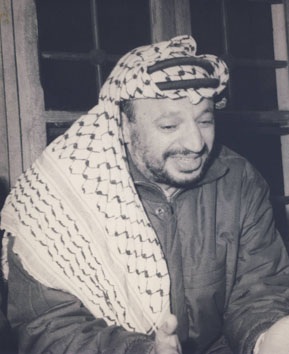
The story of “Palestinian” national identity cannot be told without confronting the story of the man who did more than any other single individual to construct it: Yasser Arafat. Born Mohammed Abdel Rahman Abdel Raouf Arafat al-Qudwa al-Husseini, he spent five decades presenting himself to the world as the embodiment of an ancient people’s struggle to reclaim their stolen homeland. He won the Nobel Peace Prize. He addressed the United Nations. He shook hands with American presidents. And virtually every significant claim he made about himself, his people, and his intentions was a fabrication.
Arafat was not born in Jerusalem, as he repeatedly claimed. He was born in Cairo, Egypt, in approximately 1929, to a family with roots in Gaza and Egypt. His own Egyptian birth certificate, examined by biographers including Alan Hart and Danny Rubinstein, confirms this. His uncle, Amin al-Husseini — the Grand Mufti of Jerusalem who collaborated with Hitler during World War II — was a significant early influence. But Arafat himself was not Palestinian in any meaningful sense of the word at the time he began building a Palestinian identity. He was an Egyptian-born Arab nationalist who chose to weaponize the emerging Palestinian narrative as his vehicle to power.
Born Egyptian, Made “Palestinian”
The detail Arafat spent his life concealing is the one that unravels the entire narrative. He insisted, again and again, that he had been born in Jerusalem — the holy city, the heart of the homeland he claimed had been stolen from his people. It was not true, and he knew it was not true. The man who became the living symbol of Palestinian indigeneity was an Egyptian, born and raised in Cairo, who spent his formative years far from the land he would later claim as his birthright. There is a bitter irony in it: the founding father of “Palestinian” identity could not himself claim to have been born in Palestine without lying about it.
Arafat understood, with the instinct of a propagandist, that the cause needed a people, and that the people needed an identity. He is reported by his own biographer to have grasped this with startling candor. In Alan Hart’s Arafat: A Political Biography, he is quoted declaring: “The Palestinian people have no national identity. I, Yasser Arafat, man of destiny, will give them that identity through conflict with Israel.” Whatever one makes of the precise wording, the strategy it describes is exactly what unfolded. The identity was not the cause of the struggle; it was the product of it. A nation was to be forged in the furnace of perpetual war with the Jewish state, and the war, not the nation, was always the point.
Arafat did not build this project alone. According to Ion Pacepa, the highest-ranking Soviet-bloc intelligence officer ever to defect to the West, who served for a time as a handler in the Eastern-bloc apparatus that managed Arafat, the Soviet Union invested heavily in the PLO as an instrument of Cold War strategy — drafting elements of its program, financing its operations, and training its cadres in Eastern Europe. Pacepa’s testimony, which includes the striking claim that Soviet intelligence helped manufacture a Jerusalem birth story to replace Arafat’s Cairo origins, is disputed in its details and rests largely on his own account; it should be weighed as the testimony of a single, if uniquely placed, witness. But the broader, well-documented picture is not in serious dispute: the PLO was a creature of the Cold War as much as of the Middle East, and the reframing of the conflict from an Arab war against Israel into a “national liberation struggle” of an oppressed indigenous people followed a script that served Moscow’s interests precisely. The “Palestinian people” as a political identity was, in significant measure, a product of that campaign.
It is worth pausing on what this means, because it is routinely obscured. To say that the modern Palestinian national identity was politically constructed in the second half of the twentieth century is not to deny that millions of real human beings today identify as Palestinian, nor to dismiss their experiences as fictional. Identities, once forged, become real to those who hold them, and a person born into the third generation of that identity holds it as sincerely as anyone holds any nationality. The point is narrower and historical: this identity was not an ancient inheritance reaching back into antiquity, as the propaganda insists, but a recent creation with a traceable origin, a datable beginning, and a documented political purpose — the negation of the Jewish state. Arafat did not discover a slumbering nation and awaken it. He assembled one, deliberately, for a purpose, and named the assembling “liberation.” That is the birth of the people the world now takes for granted — not in antiquity, but within living memory, at the hands of a man who was himself no Palestinian at all.
Fatah and the Strategy of Terror
In the late 1950s, while working as a civil engineer in Kuwait, Arafat co-founded the Fatah movement — an Arabic acronym meaning “conquest” or “opening.” Fatah’s founding charter was explicit: its goal was not the creation of a Palestinian state but the destruction of the State of Israel. The very name was an acronym in reverse: Harakat at-Tahrir al-Watani al-Filastini — Palestinian National Liberation Movement — reversed as “Fatah” rather than “Hataf,” which means “sudden death” in Arabic. Even the word choice was deliberate: Fatah launched its first military operation against Israel on January 1, 1965, attacking Israel’s National Water Carrier. Not a single inch of the West Bank or Gaza was under Israeli control at that time — Jordan and Egypt held those territories. Yet Arafat was already at war with Israel.
From the beginning, Fatah and the broader PLO under Arafat’s leadership embraced terrorism as a primary tactic. Attacks on Israeli civilians, hijackings, bombings, and assassinations were not aberrations — they were policy. The Democratic Front for the Liberation of Palestine, a PLO faction, murdered 22 Israeli schoolchildren in a 1974 massacre at Ma’alot. The Popular Front for the Liberation of Palestine hijacked multiple civilian airliners. And in 1972, Arafat’s own Black September organization — an operational arm of Fatah — carried out the murder of eleven Israeli athletes and coaches at the Munich Olympic Games. Arafat denied involvement for the rest of his life. The evidence that he personally ordered the operation has been documented by multiple former intelligence officials and is considered established historical fact.
“The goal was never a Palestinian state alongside Israel. The goal was a Middle East without Israel. Arafat said so himself, in Arabic, when he thought the West was not listening.”
The 1974 UN Speech — Terror Rewarded With a Podium
On November 13, 1974 — just two years after Munich — Yasser Arafat became the first representative of a non-governmental organization to address the United Nations General Assembly in a plenary session. He arrived wearing a military holster and delivered a speech that was part threat and part performance, ending with what became one of the most quoted lines in the history of the UN: “Today I have come bearing an olive branch and a freedom fighter’s gun. Do not let the olive branch fall from my hand.” The international community, which two years earlier had watched eleven Israelis butchered at an Olympic Games, gave him a standing ovation. The diplomatic rehabilitation of Yasser Arafat — and with it, the legitimization of the Palestinian cause as he defined it — had begun.
The United Nations, from that moment, became one of the primary stages on which the Palestinian narrative would be performed, refined, and exported to the world. The 1975 UN resolution declaring that “Zionism is a form of racism” — adopted with the support of the Arab bloc and Soviet Union, and later revoked in 1991 — was the most visible product of Arafat’s successful campaign to transform the Israeli-Palestinian conflict from a security question into a moral inversion, in which the one functioning democracy in the Middle East would be recast as the aggressor and the PLO, with its documented campaign of terrorism, would be recast as a liberation movement.
Oslo and the Nobel Peace Prize — A Fraud Rewarded
The Oslo Accords of 1993, signed on the White House lawn with Bill Clinton presiding, were celebrated as a historic breakthrough. Arafat, Israeli Prime Minister Yitzhak Rabin, and Foreign Minister Shimon Peres jointly received the Nobel Peace Prize in 1994. One member of the Nobel Committee resigned in protest. Kare Kristiansen, a Norwegian politician, resigned specifically because she considered Arafat unworthy of the award, stating that “Arafat’s past is too filled with violence, terror and bloodshed for me to be able to support his candidacy.” She was right — and events would prove it.
The Oslo Accords required Arafat and the PLO to renounce terrorism and accept Israel’s right to exist. In public, in English, to Western audiences, Arafat made these commitments. In Arabic, to Palestinian audiences, he described Oslo as merely a tactical step — a first phase of a longer strategy aimed at Israel’s eventual elimination. The phrase he used repeatedly was hudna — a temporary truce, not a permanent peace. Israeli intelligence documented numerous occasions on which Arafat, in Arabic, compared the Oslo process to the Prophet Muhammad’s Treaty of Hudaybiyyah — a truce that Muhammad used to buy time before breaking it and conquering Mecca. Arafat was not hiding what he meant. He was saying it openly, in the language his intended audience understood.
Camp David 2000 — The Offer That Exposed Everything
In July 2000, at Camp David, President Bill Clinton brought Arafat and Israeli Prime Minister Ehud Barak together for what would become the most illuminating moment in the history of the Israeli-Palestinian conflict. Barak, in a breathtaking act of political risk, offered Arafat a Palestinian state on approximately 97% of the West Bank and Gaza, with East Jerusalem as its capital, and a solution to the refugee issue that would allow hundreds of thousands of Palestinians to return or receive compensation. It was, by the assessment of virtually every neutral observer — including Clinton himself — the most generous offer ever made to the Palestinian leadership in history.
Arafat said no. He made no counter-offer. He walked away. Within weeks, the Second Intifada had begun, with suicide bombings in Israeli restaurants, buses, markets, and hotels killing over a thousand Israeli civilians over the following years. Clinton, in his memoir My Life (2004), placed the blame squarely on Arafat: “Arafat never said no; he just couldn’t bring himself to say yes.” In later interviews, Clinton was more direct, stating that Arafat’s failure at Camp David was a colossal mistake and that Arafat had told him, shortly before Arafat’s death, that Clinton was “a great man” — to which Clinton responded that he was not a great man, because he had not delivered peace, and Arafat was the reason.
Dennis Ross, the chief US negotiator at Camp David, was even blunter. In his book The Missing Peace (2004), Ross documented in exhaustive detail how Arafat systematically refused every proposal and offered nothing in return, ultimately concluding that Arafat was psychologically and politically incapable of ending the conflict because his identity — and the identity of the movement he had built — depended on the conflict continuing. A Palestinian state alongside Israel would have ended Arafat’s reason for being. He could not accept it.
“A Palestinian state alongside Israel would have ended Arafat’s reason for being. He could not accept it — so he walked away and sent young men to blow themselves up on Israeli buses.”
The Corruption — A People Robbed by Their Own Leader
While Arafat presented himself to the world as the selfless spokesman of a dispossessed people, he was simultaneously presiding over one of the most corrupt political structures in the modern world. The Palestinian Authority, under Arafat’s personal control, received billions of dollars in international aid from the United States, the European Union, and Arab states. Substantial portions of these funds were systematically diverted. A 2003 report by the International Monetary Fund found that approximately $900 million in Palestinian Authority revenues had been transferred to an account under Arafat’s direct control between 1995 and 2000, bypassing the Palestinian treasury entirely.
When Arafat died in November 2004, his wife Suha — who had been living in Paris on a reported monthly stipend of $100,000 from Palestinian funds — disputed control of his estate. Forbes magazine estimated Arafat’s personal fortune at the time of his death at approximately $300 million, with some estimates running considerably higher. The people whose cause Arafat had championed for forty years — the people in whose name he had ordered terrorism, launched wars, and rejected peace — remained in the refugee camps where they had been placed in 1948, no closer to statehood, no better housed or fed or educated, and with their future mortgaged to a mythology that their leader had found more useful than their actual welfare.
What Arafat Built — and What He Did Not Build
In forty years of leading the Palestinian national movement, Yasser Arafat did not build a state. He did not build functioning democratic institutions. He did not build a currency, an independent judiciary, a professional civil service, or a viable economy. He built a cult of personality, a security apparatus of competing militias, a global propaganda machine, and a narrative of victimhood so effectively disseminated that it became, for much of the world, the accepted version of events in the Middle East. He built the myth of Palestine as a modern political reality — not because the myth was true, but because it was necessary to sustain the war against Israel in the arena of international public opinion after Arab armies had failed to win it on the battlefield.
The Palestinian people, to the extent that they are a distinct people at all, are primarily the victims of Arafat’s choices, not Israel’s. Every time a genuine opportunity for statehood was within reach, Arafat turned it away — in 1947, when the Arab world rejected the UN Partition Plan; in 1948, when five Arab armies chose invasion over peace; in 1967, when the Arab League adopted the “three no’s” of Khartoum — no peace, no recognition, no negotiations; and in 2000, when Arafat walked away from Camp David and returned to terrorism. At every junction, the choice was war over peace, mythology over statehood, and the perpetuation of Palestinian suffering over its resolution.
The Biblical Perspective — God’s Land Is Not a Bargaining Chip
From a biblical perspective, the story of Yasser Arafat is not primarily a political story. It is a spiritual one. The Land of Israel is the land that God gave to Abraham, Isaac, and Jacob and their descendants — not as a conditional grant, but as an everlasting covenant. Every political movement, every diplomatic initiative, and every act of violence aimed at stripping Israel of that land is, at its foundation, an act of rebellion against the God who made the covenant. Arafat’s movement — whatever its human motivations and political calculations — was, in its ultimate significance, another chapter in the long history of the nations raging against God’s purposes for Israel.
Psalm 2 describes this ancient pattern with precision: “Why do the nations conspire and the peoples plot in vain? The kings of the earth rise up and the rulers band together against the Lord and against his anointed, saying, ‘Let us break their chains and throw off their shackles.’ The One enthroned in heaven laughs; the Lord scoffs at them” (Psalm 2:1–4). The nations have conspired. They have plotted. They have invested billions of dollars, sent armies, and constructed elaborate mythologies. And God’s people have returned to their land, rebuilt their cities, and established a state that is today a regional military, technological, and economic power. The covenant was not revoked. The promise was not voided. The return was not prevented. History has vindicated the Word of God — not the word of Yasser Arafat.
There is a final irony in the life of the man who set out to invent a people. He gave them a flag, an anthem, a cause, and a global sympathy unmatched by any other stateless population on earth. What he never gave them was a state — because the state was never the goal, and because accepting one would have ended the conflict on which his entire identity, and theirs as he had constructed it, depended. He left his people poorer, more dependent, and further from sovereignty than a different leader might have, having spent the world’s generosity and his own people’s blood on a war he could not win and would not end. The tragedy of the Palestinian Arabs is real, but its primary author was not Israel. It was the Egyptian from Cairo who told them they were a nation, and then made certain they would remain forever at war to prove it. To recognize this is not to despise the ordinary people caught in the wreckage of his choices; it is to refuse the lie that cost them so much, and to tell instead the truth that alone can point toward a better future — one built not on a manufactured grievance against Israel, but on the acceptance of what God long ago declared concerning the land and the people to whom He gave it.