

The Theological Background of Christian Zionism
Part I — Reflection
Academic Publication: This article was peer-reviewed and published in both English and Hebrew by the Ariel Center for Policy Research (ACPR), Israel's prestigious policy research institution. Knighton, Michael. 2008. "Theological Background of Christian Zionism." Nativ: Ariel Center for Policy Research 121 (2): 53–64.

Over the centuries, Christian support of the state of Israel has been looked upon with a suspicious and vigilant eye. In fact, history will clearly show that the essence of pure evil, operating under the guise of "Christianity", has facilitated a complete and justifiable collapse in Judeo-Christian relations. Only recently has the relationship between the Jewish people and Christians become fruitful, and the "mending" process, albeit positive, continues to evolve. Even so, the question remains: "Why do Christians support the state of Israel?"
Christian Zionism, a theological belief that identifies the restoration of the Jewish people to their biblical homeland as the literal fulfillment of biblical prophecies foretold thousands of years ago, may arguably exist as the most oft-misunderstood "form" of Christianity today. Moreover, Christian Zionist dogma has been the recipient of much indignation from those who would inaccurately and misguidedly opine and define it as "unbiblical" and/or "extreme". However, a comprehensive examination of the theological background of Christian Zionism will reveal several relevant misconceptions. Moreover, after reading this analysis, one may likely discern that Christian Zionism is not a "fundamentalist movement", as it were, but a manifestation and implementation of a sound, theological doctrine predicated upon Scriptural truth. In so doing, one may likely and accurately generalize that the Christian support of the state of Israel should not be looked upon as a biblical doctrine "exclusive" to Christian Zionism, but to all of Christianity.
Prior to examining the theological foundation of Christian Zionism, it is imperative to first explore its definition. Specifically, what is "Christian Zionism"? Fundamentally, Christian Zionism is the belief which holds that the land of Israel is sacred ground given by God to a people whom He foreknew, the Jewish people — the "apple of His eye". Furthermore, Christian Zionism rises and falls on God's "everlasting" covenant with Abraham, as well as a vast array of biblical prophecies, dating back thousands of years, in which Hebrew prophets such as Jeremiah, Isaiah, Zechariah and Ezekiel foretold of an eventual, albeit certain restoration of the Jewish people to their biblical homeland. As such, Christian Zionists identify the declaration of the state of Israel in May, 1948, as the most significant fulfillment of biblical prophecy in the modern era. Finally, Christian Zionism vehemently maintains that God's promises to the Jewish people are still very much alive today.
"Christian Zionism", also known as "Biblical Zionism", originates from the term "Zionism". Although the term "Zionism" is considered a political movement in secular circles, it is entirely biblical in nature. Zionists seek to support, facilitate, and advance the return of the Jewish people and sovereignty to their native homeland — the land of Israel. Christians who see the restoration of the Jewish people to their land, as well as the establishment of the sovereign nation of Israel in 1948, as the literal fulfillment of biblical prophecy are known as "Christian Zionists".
Christian Zionists recognize the Jewish people as the "apple of God's eye" — His Chosen people — and hold firm that God's promises, established in the Abrahamic Covenant, were unconditional. Christian Zionists are "Biblical advocates" for the Jewish people and the state of Israel, standing with them on an international stage notorious for its clear and present anti-Semitic bias. Furthermore, they stand in firm, diametrical opposition to land concessions of any type involving the forfeiture of the holy land of Israel, as it is a sacred manifestation of the promises of God to the people He calls the "apple of His eye". Christian Zionists also seek to stand with Israel, showing her unconditional support, solidarity, and love whilst praying for her spiritual return to the God of Abraham, Isaac, and Jacob.
As this analysis will show, the theological dogma surrounding Christian Zionism runs contrary to the worldview definitions of "fanaticism" and "extremism", but represents a doctrinally sound interpretation of biblical text. Moreover, the reader will soon find that the term "Christian Zionist" is nothing more than an intricate label describing the Bible-believing Christian. This, however, was not always the case — and in order to discover the truth of today, one must first uncover yesterday's inveracity.
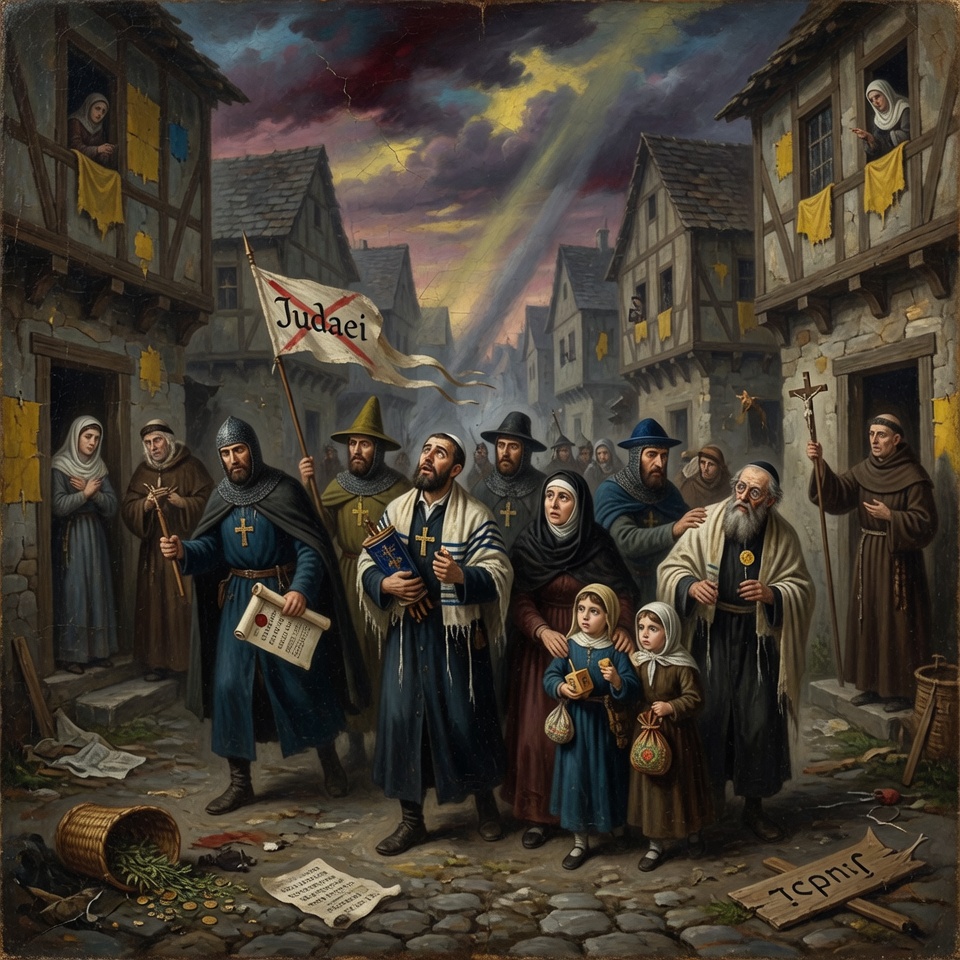
To a large degree, the Christians of today are either ignorant of a long history of Christian anti-Semitism, or the theological offspring of it. The relationship between the Jews and Christians of today is a direct reflection of their history and is subsequently in need of much repair. This was a history riddled with anti-Semitic doctrines and teachings that, in the name of Christianity, begat a scathing hatred so caustic that it would lead to the slaughter of millions of Jews.
The origin of Christian anti-Semitism can be traced to the earliest days of the church, and over the centuries gained momentum by way of a concept known as "collective guilt". This was an assertion which placed the blame for the Crucifixion of Christ at the feet of the Jewish people and charged them with the crime of deicide. The concept of collective guilt gave birth to an era of hatred of the Jewish people that would span some 2,000 years, and is widely recognized as the foundation of not only Christian anti-Semitism, but as the catalyst to some of history's darkest periods as well. In the end, the blemish resulting from 2,000 years of Jewish-Christian relations can be found in the history of the church, not the synagogue — and to gain a clear understanding of the origin of such hatred, one must go no further than the writings of the early church founders.
The collapse of Judeo-Christian relations did not occur in a single moment, nor by the hand of any one man. It was, rather, the cumulative product of a theological architecture assembled brick by brick over the span of centuries — each generation of churchmen inheriting the prejudices of the last, refining them, and passing them forward with the added weight of ecclesiastical authority. What began as theological disagreement between the early church and the synagogue hardened, over time, into doctrine; and what hardened into doctrine eventually calcified into a worldview so pervasive that it required no defense, no scrutiny, and no apology. By the time the consequences of that worldview became impossible to ignore, the hatred had already woven itself into the very fabric of Christendom.
At the center of this collapse stood the charge of deicide — the accusation that the Jewish people, collectively and perpetually, bore the guilt for the death of Christ. It is difficult to overstate the corrosive power of this single idea. By transferring the actions of a handful of first-century individuals onto an entire people, and by extending that guilt forward through every subsequent generation, the church manufactured a permanent class of the condemned. The Jew was no longer a neighbor, a merchant, or a fellow inhabitant of the city; he was, in the theological imagination of the age, a living reminder of the crucifixion and a standing object of divine displeasure. This was not an incidental prejudice. It was a load-bearing element of a theological system, and it performed precisely the function it was designed to perform: it justified contempt.
What makes this collapse so tragic — and so instructive for the student of Christian Zionism — is that it stood in direct contradiction to the plain testimony of Scripture. The Apostle Paul, himself a Jew, had warned the Gentile believers in Rome against precisely this arrogance. “Boast not against the branches,” he wrote. “But if thou boast, thou bearest not the root, but the root thee” (Romans 11:18). Paul understood that the Gentile church had been grafted into a covenant that was never its own by birthright, and he labored to remind the early believers that God had not cast away His people. Yet within a few short generations, the very warning Paul had issued was inverted. The branches came to despise the root. The grafted-in came to imagine themselves the natural tree.
This inversion was not merely an error of interpretation; it was a severing of the church from its own foundation. For if the covenant with Abraham could be revoked, if the promises to Israel could be transferred wholesale to the church, and if the Jewish people could be recast as the rejected and the accursed, then the God who made those promises was revealed as capricious — a God whose word could not be trusted to endure. The early architects of anti-Semitic doctrine did not perceive that in condemning the Jew, they were quietly undermining the reliability of the very God they claimed to serve. A covenant that can be broken once can be broken again; a promise that expires for Israel offers no security to the church.
The human cost of this theological collapse cannot be measured in doctrines alone. Each refinement of the deicide charge, each sermon delivered against the “Christ-killers,” each conciliar decree restricting Jewish life, descended in time from the pulpit to the street. Theology written in the quiet of the monastery became violence enacted in the public square. The ghetto, the forced conversion, the expulsion, the massacre — these were not aberrations that betrayed Christian teaching; they were, with grievous consistency, the logical fruit of it. A people declared guilty by heaven could expect little mercy from earth. And so the centuries unfolded in a grim procession of catastrophe, each one bearing the fingerprints of a church that had forgotten Paul’s warning and abandoned the root from which it grew.
It is worth pausing to consider how thoroughly this collapse reversed the natural order of the relationship. Christianity did not arise as a rival to Judaism, nor as its successor, but from within it. Its founder was a Jew; its earliest apostles were Jews; its Scriptures were, for the first decades of its existence, the Hebrew Scriptures alone. The first believers worshipped in the Temple and reasoned in the synagogues. Every foundational truth the church would come to proclaim — the covenant, the law, the prophets, the Messiah Himself — was received as an inheritance from the Jewish people. To turn against that people, then, was a kind of theological patricide: the church raising its hand against the very lineage through which it had received the knowledge of God.
That the church could perform such an act, and perform it for so long without sustained protest, testifies to the seductive power of a doctrine that flatters its holder. Replacement theology offered the Gentile church a tempting proposition — that it had not merely joined the people of God, but supplanted them; that the blessings of the covenant were now its exclusive possession while the curses remained the property of the Jew. It was a theology of self-congratulation disguised as orthodoxy, and its appeal lay precisely in what it permitted: the believer could claim the entire patrimony of Israel while disclaiming any debt to the Israelite. The collapse of Judeo-Christian relations was, in this sense, not only a failure of charity but a failure of gratitude — a refusal to honor the root that bore the branch.
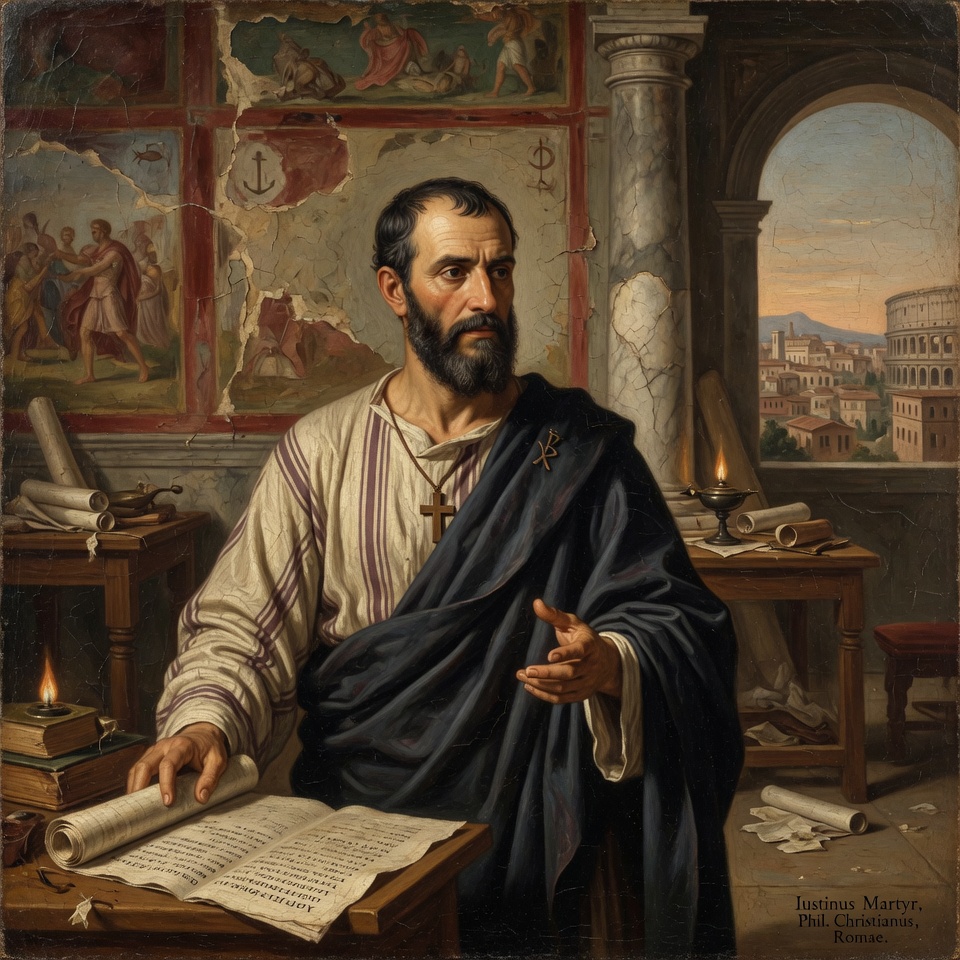
Considered a founder of Replacement Theology, Justin the Martyr (100–165 A.D.), in his Dialogue with Trypho, a Jew (ca. 160 AD), surmised that the Jews, through their treatment of Christ, are the root cause of all "unrighteousness":
Among early Christianity's most prolific writers, none other was quite as influential as Origen (185–254 A.D.). As much of a philosopher as he was a theologian, Origen was considered one of the most innovative and creative thinkers of his time. Even so, he expressed nothing but contempt for the Jewish people, by way of open condemnation, for their treatment of Christ:
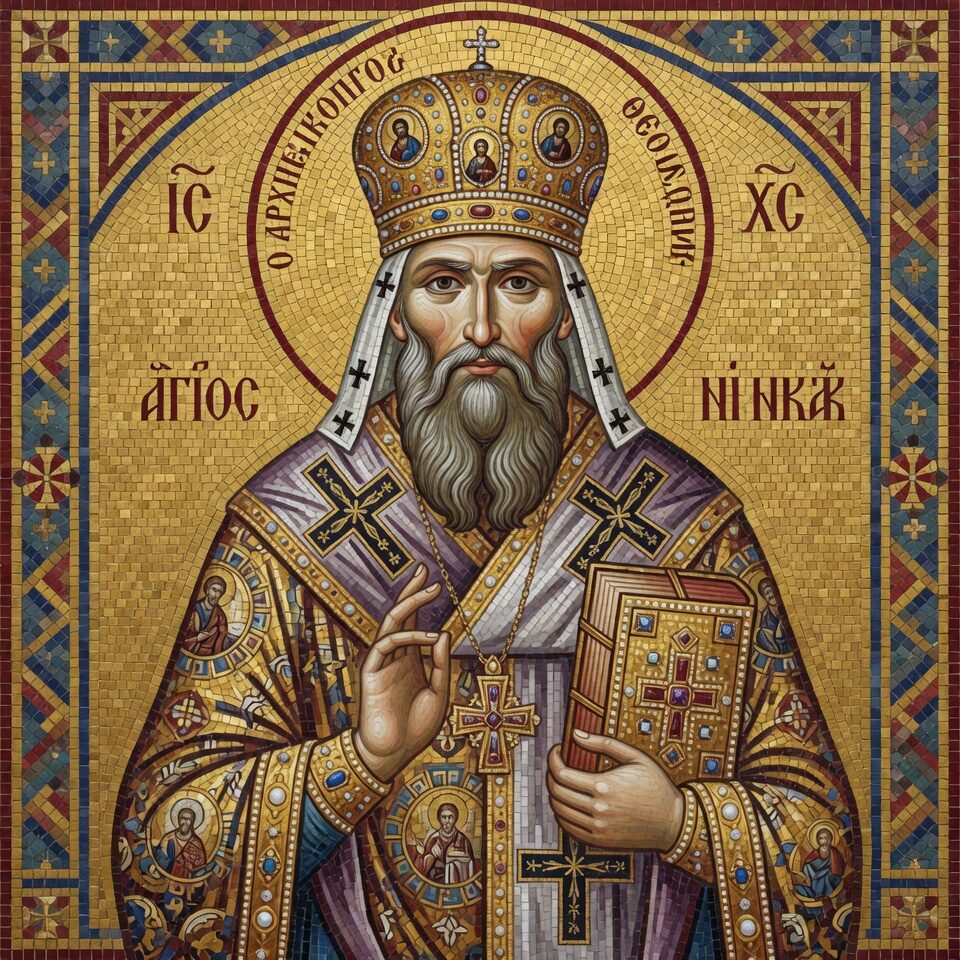
Still another example of anti-Semitism in the early Christian church can be found in the writings of the Archbishop of Constantinople John Chrysostom (344–407 A.D.). Known as the "greatest preacher in the early church", Chrysostom used his eloquent preaching style to advance his venomous hatred of the Jews by giving them the name "assassins of Christ" in his Orations Against The Jews:
It should be mentioned that Chrysostom was later venerated as a "saint" by the Roman Catholic Church. His assertions are said to have had a deep influence on Christian attitudes toward the Jews, and his homilies and sermons were used as tools for teaching in seminaries and colleges. Subsequently, his anti-Semitic rhetoric — all of which was advanced in the name of Christianity — is said to have been embraced by the Nazis in the 1930s in an attempt to justify and facilitate a complete and systematic elimination of the entire Jewish race.
In the centuries that followed, anti-Semitic doctrines and teachings would continue to come forth from the writings and sermons of Christianity's most influential figures. The Jews were strictly prohibited from owning land, holding public offices, practicing Judaism, and building synagogues. Moreover, the Jews were looked upon as "perpetual slaves" to the Church for their role in the death of Christ. By the 11th century, the Jewish standing in society had all but completely deteriorated — setting the stage for what is arguably one of Christianity's darkest periods: the Crusades.
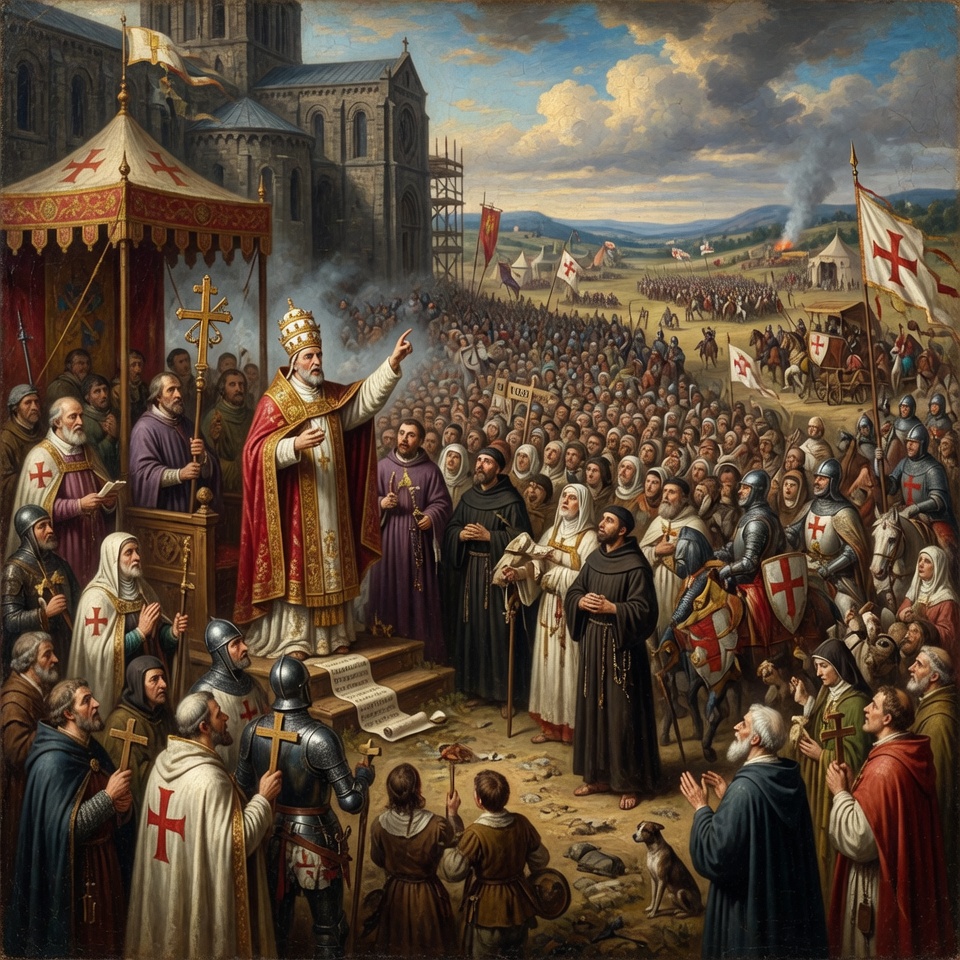
In 1095, Pope Urban II delivered his infamous speech in front of a large crowd at the Council of Clermont, urging them to engage in a Christian "holy war" to liberate Jerusalem from Muslim rule. For their efforts, Urban II promised a complete remission of sins. Subsequently, the First Crusade was launched.
During the First Crusade, no less than three legions of "holy warriors" departed their central European cities en route to the Holy Land. Their journey would take a lethal, anti-Semitic turn into a region in western Germany known as the "Rhineland" — an area with an abundant Jewish presence. Under the following moniker, coined by Count Emicho, a bloodlust ensued:
"Why fight Christ's enemies abroad when they are living among us?" 5
Led by Peter the Hermit and Count Emicho, thousands of Jews were forced to convert to Christianity. Those who resisted were slaughtered. 5,000 Jews were murdered and another 1,200 committed suicide rather than face conversion. Similar anti-Semitic persecutions and executions were sustained through eight more crusader expeditions — a period of time that spanned some 200 years.
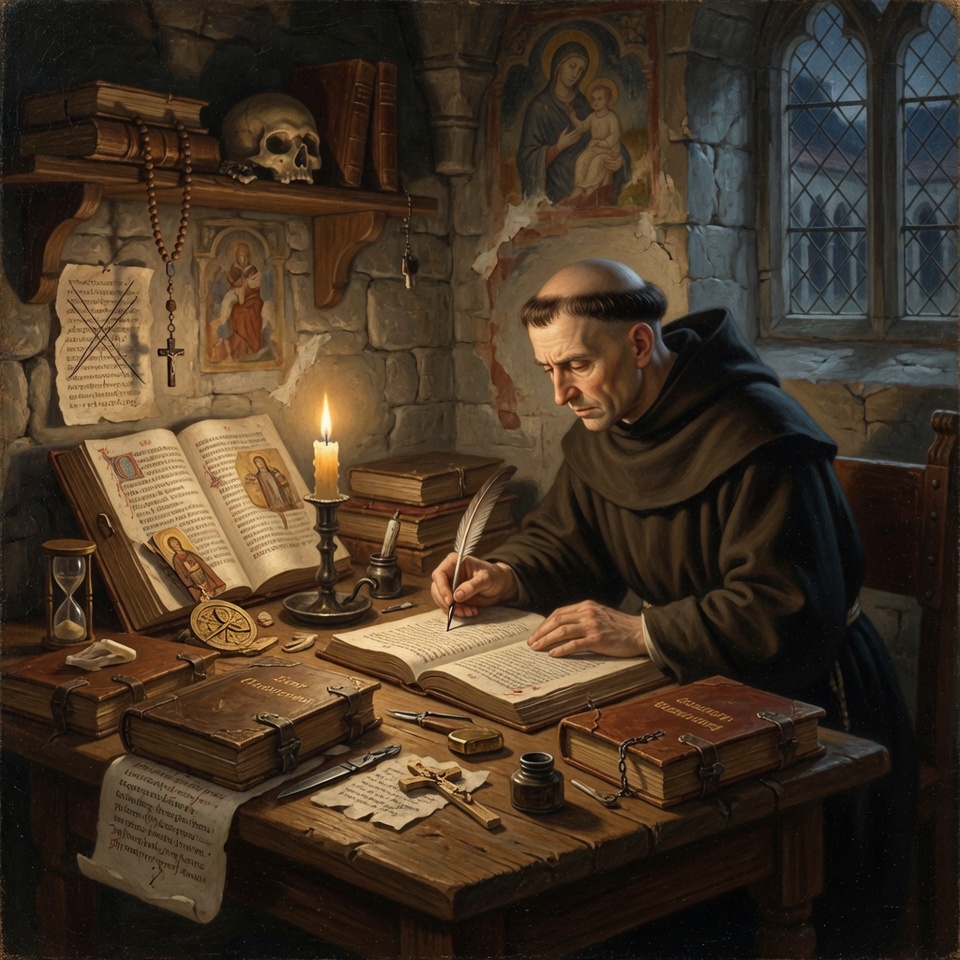
By the turn of the 13th century — a period known as the "High Middle Ages" — the church had given birth to a number of writers whose commentaries revealed a high level of diversity in Christian dogma. An example of such diversity may be found by examining the writings of Saint Thomas Aquinas.
Aquinas' writings are said to have laid the foundation of modern Christian doctrine, and are widely regarded as worthy of inclusion among modern Christendom's most influential contributions. His suppositions regarding the Jewish people — particularly their culpability for the death of Christ — appear nebulous at best; antagonistically insidious at worst.
Arguably the most concise examples of Aquinas' views regarding the Jewish people can be found in Summa Theologica, where he opined that the Jews were guilty of what he termed "affected ignorance" — a doctrine stating that the Jewish leaders willfully turned Jesus over to Pilate with full knowledge that He was the Promised Messiah:
Through an examination of Aquinas' doctrine of "affected ignorance", one can conclude that it unequivocally stands in diametric opposition to the relevant teachings of the apostle Paul, who advocated that the Jews were guilty of "invincible ignorance" — in that they were judicially "blinded" by God to the identity of Messiah. Christian Zionism is predicated upon an unequivocal cohesiveness with the teachings of the apostle Paul:
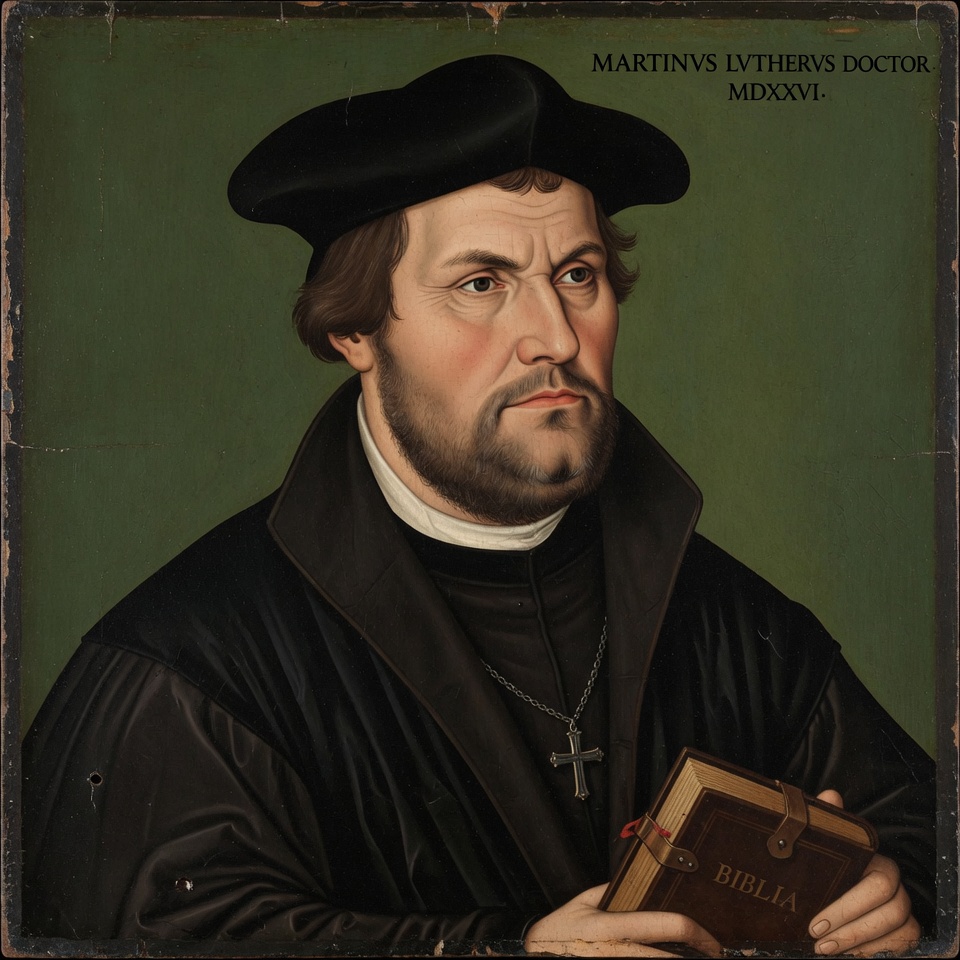
By the mid-16th century, the Christian church had produced numerous philosophers and theologians whose writings and rhetoric would serve as not only the source of hatred of the Jewish people, but the catalyst for the anti-Semitic venom that would riddle the annals of modern history. Unbeknownst to many of today's Christians, such hatred was advanced by none other than the "Father of Protestantism" himself — Martin Luther.
Known primarily as the architect behind "The Reformation", Luther emerged with kindness towards the Jewish people, as evidenced in his book That Jesus Christ was born a Jew. Luther's kindness apparently did not come without condition, for it quickly turned to vitriol when his efforts to convert Jews to Christianity failed. In one of his last literary works, On the Jews and Their Lies, Luther begat an onslaught of hatred on multiple fronts. Labeling them "the devil's people", he advocated the burning of Jewish synagogues, seizing and/or destroying their property, and death:
Unlike Luther in 1546, such anti-Semitic hatred would not meet its death. Indeed, it lived on, festered, and materialized into the modern era — arguably serving as a precursor to Nazi ideology. Such an assertion has been widely debated by those who maintain that Luther's rhetoric had little or no impact on the Nazi mindset. However, the implication of Luther's influence is reinforced when one considers that it was none other than Julius Streicher, an architect of the Nazi propaganda machine, who was presented with a copy of Luther's On the Jews and Their Lies in 1937 by the city of Nuremberg — the very city in which he would later be tried, condemned and executed for his part in the slaughter of millions of Jews.
1 Martyr, J., & Slusser, M. (2003). Dialogue With Trypho (Selections from the Fathers of the Church). Catholic University of America Press.
2 Roberts, A., & Donaldson, J. (2001). Ante-Nicene Christian Library: The Writings of Origen. Adamant Media Corporation.
3 Chrysostom, J. (1999). Discourses Against Judaizing Christians (The Fathers of the Church, 68). Catholic University of America Press.
4 Bongars, Gesta Dei per Francos, trans. in Oliver J. Thatcher and Edgar Holmes McNeal, eds., A Source Book for Medieval History (New York: Scribners, 1905), 513–17.
5 Benbassa, Esther (2001). The Jews of France: A History from Antiquity to the Present. Princeton University Press.
6 Fathers of the English Dominican Province, trans. Summa Theologica. Westminster, MD: Christian Classics, 1981.
7 Luther, Martin. On the Jews and Their Lies, cited in Michael, Robert. "Luther, Luther Scholars, and the Jews," Encounter 46 (1985) No. 4:343–344.