

From Rebirth to Tribulation: Israel’s Role in the End-Time Timeline

There are dates that divide history, and then there is May 14, 1948. On that Friday afternoon, in a modest hall in Tel Aviv, a people who had been scattered for nineteen centuries declared themselves a nation again, and the world watched something happen that the prophets had promised but that no honest student of the nations had any natural reason to expect. Empires had risen and fallen over the graves of conquered peoples. The Babylonians, the Hittites, the Philistines, the Edomites — all gone, absorbed, forgotten. The Jewish people alone, exiled, hunted, and dispersed to the four corners of the earth, returned to the very land their fathers had walked, speaking again the language of Isaiah, and planted a flag where a flag had not flown in their name since the days of Rome.
Scripture had said it would be so, and Scripture had said it would be sudden. "Who hath heard such a thing? who hath seen such things? Shall the earth be made to bring forth in one day? or shall a nation be born at once? for as soon as Zion travailed, she brought forth her children" (Isaiah 66:8). The prophet asks a question that demands the answer no one — no one has heard such a thing, because in the ordinary course of the world it does not happen. Nations are not born in a day. They form over centuries, out of tribes and territories and slow accumulations of custom. Yet Isaiah insists that this is precisely what God would do with Zion, and on a single day in 1948 the question was answered in the affirmative before the eyes of the whole watching earth.
We do not point to 1948 as the fulfillment of every promise, nor as the arrival of the kingdom. We point to it as a hinge — the moment the door of prophetic history swung back open. For the believer who takes the Word of God at its word, the rebirth of Israel is not an accident of twentieth-century politics. It is the visible restarting of a story God paused but never abandoned, and it is the event from which the whole end-time timeline takes its bearings. To understand where the timeline is going, we must first see clearly where, and when, it began again.
Nor did the regathering stop at statehood. For nineteen centuries Jerusalem itself had remained under Gentile dominion, and the Lord Jesus had marked that very condition as a measure of the age: "and Jerusalem shall be trodden down of the Gentiles, until the times of the Gentiles be fulfilled" (Luke 21:24). The word until is the hinge within the hinge — a trodden-down Jerusalem was never the permanent verdict but a season with an appointed end. In 1967, for the first time since A.D. 70, the city came again under Jewish sovereignty. Whatever one makes of the politics, the prophetic significance is hard to miss: the times He spoke of were visibly moving toward their fullness, and the stage of Jerusalem — not merely the land — was being made ready for the final scenes.
The Regathering Foretold
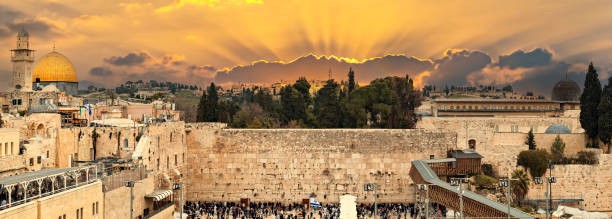
What happened in 1948 was not a surprise to the Scriptures; it was a fulfillment written down so plainly that the wonder is not that it occurred but that so many had stopped expecting it. Through Ezekiel, God spoke to a people in exile and made a promise that no exile in history had ever been given with such specificity: "For I will take you from among the heathen, and gather you out of all countries, and will bring you into your own land" (Ezekiel 36:24). Not gathered from one captivity, as in the days of Babylon, but from all countries — a worldwide dispersion answered by a worldwide return.
Then comes the vision that has stirred the church for generations: the valley of dry bones (Ezekiel 37). The prophet is set down in a valley full of bones, "very many" and "very dry," and is asked the question that hangs over every graveyard of dead hopes: "Son of man, can these bones live?" (Ezekiel 37:3). The answer is given not in argument but in resurrection. Bone comes to bone, sinew and flesh rise upon them, and breath enters them, and they stand upon their feet, "an exceeding great army." And lest anyone mistake the meaning, God interprets His own vision: "these bones are the whole house of Israel... Behold, O my people, I will open your graves, and cause you to come up out of your graves, and bring you into the land of Israel" (Ezekiel 37:11–12). The first stage of that prophecy — the bones assembling into a body, a nation reconstituted in the land — is exactly what the modern observer can see. The breath of true spiritual life, the national turning to God, is the stage still to come, and it belongs to the later chapters of the timeline we are tracing.
Isaiah saw the same thing and marked it as a second gathering: "And it shall come to pass in that day, that the Lord shall set his hand again the second time to recover the remnant of his people" (Isaiah 11:11). The first recovery brought them home from Babylon; the second, Isaiah says, would draw them "from the four corners of the earth" (Isaiah 11:12) — a global ingathering that fits no event in ancient history and fits the twentieth and twenty-first centuries with uncanny precision. Jeremiah adds the tone of a shepherd: "He that scattered Israel will gather him, and keep him, as a shepherd doth his flock" (Jeremiah 31:10). And Amos seals it with a promise of permanence: "And I will plant them upon their land, and they shall no more be pulled up out of their land which I have given them, saith the LORD thy God" (Amos 9:15).
Nor is this a late idea, sprung up only with the prophets of the exile. Moses himself, centuries earlier, had set it into the Law as the far horizon of the covenant: "that then the LORD thy God will turn thy captivity, and have compassion upon thee, and will return and gather thee from all the nations, whither the LORD thy God hath scattered thee... and the LORD thy God will bring thee into the land which thy fathers possessed" (Deuteronomy 30:3–5). Scattering and regathering were written into Israel's charter from the very beginning. The same God who warned of exile in one breath promised the return in the next, so that the dispersion itself, however long and however bitter, could never be the last word over His people.
This is the foundation of everything that follows. The regathering is not the end of the prophetic story. It is the stage being set for the final act.
Israel Back in the Land and Daniel's Seventy Weeks
If the regathering set the stage, the prophecy of Daniel's seventy weeks tells us the clock by which the final act is measured — and why that clock could not even begin to tick again until Israel was home. The angel Gabriel gave Daniel a sweeping framework: "Seventy weeks are determined upon thy people and upon thy holy city" (Daniel 9:24). The Hebrew speaks of seventy sevens, understood across the centuries as seventy periods of seven years — a span of 490 years decreed concerning Daniel's people, the Jews, and Daniel's city, Jerusalem. Not the church. Not the nations. Thy people and thy holy city. The prophecy is anchored, from its first sentence, to Israel and to Jerusalem.
Gabriel then divides the seventy weeks. From the commandment to restore and rebuild Jerusalem, seven weeks and sixty-two weeks — sixty-nine in all — would pass until "Messiah the Prince" (Daniel 9:25), after which "shall Messiah be cut off, but not for himself" (Daniel 9:26). The reckoning runs with remarkable accuracy to the time of the crucifixion. But notice what the text says comes after the cutting off of Messiah: the people of a coming prince "shall destroy the city and the sanctuary" (Daniel 9:26) — fulfilled when Rome leveled Jerusalem and burned the temple in A.D. 70. And there the count visibly pauses. Sixty-nine weeks have run. One week — the seventieth, the final seven-year period — remains undelivered.
For nearly two thousand years that seventieth week has stood unfulfilled, because the conditions Daniel's prophecy assumes simply did not exist. The prophecy concerns Jerusalem and a functioning Jewish national life centered on the holy city. With the Jewish people scattered and Jerusalem in Gentile hands, the stage for the seventieth week was struck. The regathering of 1948, and the return of Jewish sovereignty over Jerusalem in 1967, restored precisely the conditions the prophecy requires. We do not set dates; the Scripture forbids the presumption, and wisdom counsels against it. But we can say what the text itself implies: the seventieth week is a future seven-year period that concerns a regathered Israel and a Jerusalem under Jewish life, and the events of the last century have, for the first time in millennia, made such a week possible again. The clock that Rome stopped now has, once more, a board on which to run.
It is worth dwelling on how exact the earlier reckoning proved, for it is the warranty on the part still future. Gabriel tied the start of the count to "the going forth of the commandment to restore and to build Jerusalem" (Daniel 9:25) — a decree historians locate in the reign of Artaxerxes, when Nehemiah was sent to rebuild the city and its walls (Nehemiah 2). From that decree, the sixty-nine weeks run with striking precision to the days of Messiah's public presentation and His being cut off. A prophecy that lands its first sixty-nine sevens so accurately is not a prophecy to be doubted on its final seven. The same God who measured the centuries to the Messiah's first coming has measured the week that belongs to His return; the gap between is the present age, the long parenthesis in which the fulness of the Gentiles is gathered in and Israel waits for the lifting of the veil.
The Gathering Coalition
A restored Israel does not return to a peaceful neighborhood. From the moment of her rebirth, the nation has lived under siege, and the prophets foresaw exactly this — a gathering of hostile powers against the regathered people, drawn as if by an invisible hook. The eighty-third Psalm reads like a headline: "they have said, Come, and let us cut them off from being a nation; that the name of Israel may be no more in remembrance" (Psalm 83:4). The confederacy named there — Edom, the Ishmaelites, Moab, the Hagarenes, Tyre, and the rest — maps with sober ease onto the ring of peoples surrounding modern Israel, all bound by the single stated aim of erasing the Jewish nation.
Beyond that near circle, Ezekiel sees a larger and later storm. In chapters 38 and 39, a coalition headed by Gog, of the land of Magog, with Persia, Cush, and Put, and peoples from the far north, comes "like a cloud to cover the land" (Ezekiel 38:9), in "the latter years" against "the mountains of Israel, which have been always waste: but it is brought forth out of the nations" (Ezekiel 38:8). The phrase is precise and pointed: a land long desolate, now repopulated out of the nations — that is, the regathered Israel — becomes the magnet for an invasion from the north and from Persia. The modern reader scarcely needs the names decoded to recognize the configuration of powers now arrayed against Jerusalem. And the outcome Ezekiel records is not Israel's cleverness but God's intervention: the invader falls "upon the mountains of Israel" (Ezekiel 39:4), and the nations know "that I am the LORD" (Ezekiel 38:23).
The point for our timeline is this: hostility toward the regathered nation is not a sign that the prophecy has failed. It is one of the prophesied features of the era. The coalition gathers because Israel has returned. The siege is itself a fulfillment.
Zechariah sharpens the picture and tells us where the pressure finally concentrates: not on the land in general but on the city. "Behold, I will make Jerusalem a cup of trembling unto all the people round about... And in that day will I make Jerusalem a burdensome stone for all people: all that burden themselves with it shall be cut in pieces, though all the people of the earth be gathered together against it" (Zechariah 12:2–3). Two images, both vivid: a cup that intoxicates and unsteadies those who reach for it, and a stone too heavy to lift that wounds all who try to move it. That Jerusalem — a single small contested city — should become the fixation of the whole earth is itself a marvel that the daily news quietly confirms. The prophets did not foresee Israel ignored and forgotten in the last days. They foresaw Israel, and Jerusalem above all, as the very center of the world's attention and the world's hostility — exactly the place she occupies now.
The Covenant and the False Peace
Into this pressure of nations and the longing of a weary world for security, the seventieth week opens — and it opens not with a war but with a treaty. "And he shall confirm the covenant with many for one week" (Daniel 9:27). A coming ruler — the "prince that shall come" whose people destroyed the city — confirms a covenant, an agreement, with the many, and that act of guaranteed peace marks the beginning of the final seven years. Here is one of the great ironies of the end-time timeline: the door to the worst tribulation in Israel's history is opened by what looks like the best of news. A guarantee. A settlement. A peace at last for the embattled nation.
It will not hold, and Daniel says so in the same breath: "and in the midst of the week he shall cause the sacrifice and the oblation to cease, and for the overspreading of abominations he shall make it desolate" (Daniel 9:27). Halfway through the seven years — three and a half years in — the guarantor of peace reveals himself as the desolator. The worship he had permitted he now halts; the sanctuary he had protected he now defiles. This is the event the Lord Jesus called "the abomination of desolation, spoken of by Daniel the prophet" (Matthew 24:15), and He treated it as the signal for Israel to flee. The false peace becomes the trigger for the time of trouble.
We should be sober here, and Scripture-bound rather than sensational. The text does not give us a name or a date. It gives us a pattern: a covenant of false security, broken at its midpoint, turning protection into persecution. The believer's task is not to identify a man on the evening news but to recognize the shape of the thing so as not to be deceived by it — for the deception will be precisely that it comes wearing the face of peace.
Paul gives the same warning in a single arresting line. The day of the Lord, he says, comes as a thief in the night; "for when they shall say, Peace and safety; then sudden destruction cometh upon them, as travail upon a woman with child; and they shall not escape" (1 Thessalonians 5:3). The cry of "peace and safety" is not incidental to the trap — it is the very slogan under which the trap is sprung. A world exhausted by conflict, and an Israel weary of unrelenting siege, will be especially vulnerable to a guarantee that promises exactly what everyone most longs to hear. The believer who has read Daniel and Paul together is not cynical about peace, but neither is he naive: he knows that the most dangerous moment of the age may arrive dressed as the answer to every prayer.
The Time of Jacob's Trouble
The Scriptures do not soften what the second half of the seventieth week will mean for Israel. Jeremiah names it with a phrase that has never lost its weight: "Alas! for that day is great, so that none is like it: it is even the time of Jacob's trouble; but he shall be saved out of it" (Jeremiah 30:7). Note both halves of the verse, for they hold together and must never be separated. It is a day like no other — the time of Jacob's trouble, a tribulation aimed squarely at the descendants of Jacob, at Israel. And yet the same sentence that names the trouble names the deliverance: he shall be saved out of it. The trouble is real and the salvation is certain, and both are the promise of God.
The Lord Jesus described the same period: "For then shall be great tribulation, such as was not since the beginning of the world to this time, no, nor ever shall be" (Matthew 24:21). He warned those in Judaea to flee to the mountains without delay (Matthew 24:16), language that only makes sense if the affliction falls upon a Jewish population living in the land — which is to say, upon a regathered Israel. The book of Revelation pictures the same reality in symbol: a woman, clothed with the sun, with the moon under her feet and a crown of twelve stars — Israel, by the imagery of Joseph's dream (Genesis 37:9) — pursued by the dragon into the wilderness, where she is kept and nourished "a thousand two hundred and threescore days" (Revelation 12:6), the same three and a half years.
But the emphasis of the prophets falls, finally, not on the severity of the trouble but on the faithfulness of the One who preserves His people through it. The dragon's pursuit fails. The wilderness becomes a place of divine keeping. The fire that would consume becomes the furnace that refines. "I will bring the third part through the fire, and will refine them as silver is refined, and will try them as gold is tried: they shall call on my name, and I will hear them: I will say, It is my people: and they shall say, The LORD is my God" (Zechariah 13:9). The time of Jacob's trouble is not the abandonment of Israel. It is the crucible in which a scattered, regathered, and besieged people is brought, at last, to call upon the name of their God.
Through the worst of it, God keeps a remnant and seals them as His own. John sees an angel ascending "having the seal of the living God," and the command to hold back judgment "till we have sealed the servants of our God in their foreheads" (Revelation 7:2–3) — and the sealed are numbered out of "all the tribes of the children of Israel" (Revelation 7:4), twelve thousand from each tribe named in turn. The detail matters: the tribes of Israel are not dissolved into history but preserved, identified, and protected by name in the very hour of trouble. Whatever the symbolism of the number, the message is unmistakable — the affliction of Jacob is bounded, watched over, and sealed by the hand of God, who will not let the furnace consume the people He intends to refine. The dragon rages, but he rages on a leash, and the woman in the wilderness is fed and kept for the appointed time.
“The time of Jacob’s trouble is not the abandonment of Israel. It is the crucible in which His people are brought, at last, to call upon the name of their God.”
"All Israel Shall Be Saved"
And here the timeline turns from trouble to triumph, for the purpose of the whole has been, from the beginning, redemption. The prophet Zechariah was given the most tender and astonishing word in all of Israel's prophetic future: "And I will pour upon the house of David, and upon the inhabitants of Jerusalem, the spirit of grace and of supplications: and they shall look upon me whom they have pierced, and they shall mourn for him, as one mourneth for his only son" (Zechariah 12:10). In the extremity of the time of Jacob's trouble, with the nations gathered and deliverance nowhere in human reach, the eyes of Israel are opened. They look upon the One who was pierced — the rejected Messiah — and they recognize Him, and they mourn, and they are received.
The apostle Paul, himself an Israelite of the tribe of Benjamin, was given the same revelation and called it a mystery, lest the Gentile church grow proud: "blindness in part is happened to Israel, until the fulness of the Gentiles be come in. And so all Israel shall be saved: as it is written, There shall come out of Sion the Deliverer, and shall turn away ungodliness from Jacob" (Romans 11:25–26). The blindness is "in part" and it is "until" — a temporary, purposeful hardening with a fixed expiration. When the fulness of the Gentiles has come in, the veil lifts, and the nation that was set aside is brought home not merely to its land but to its God.
This is the answer to every theology that would write Israel out of the story. Paul forecloses it: "Hath God cast away his people? God forbid" (Romans 11:1). "For the gifts and calling of God are without repentance" (Romans 11:29). The God who chose Israel does not un-choose. The end-time timeline does not end with Israel's destruction or replacement; it ends with Israel's salvation, the very thing the prophets promised and the apostle confirmed.
Paul's olive-tree image makes the relationship plain and guards against every arrogance. Some natural branches were broken off, he says, and wild branches — believing Gentiles — were grafted in "among them, and with them" to partake of the root and fatness of the olive tree (Romans 11:17). But the grafting in of the Gentile does not uproot the tree; the believer is reminded that he bears not the root, but the root bears him (Romans 11:18). And the branches broken off are not discarded forever: "God is able to graft them in again," and indeed, "how much more shall these, which be the natural branches, be graffed into their own olive tree?" (Romans 11:23–24). Even now, Paul insists, "there is a remnant according to the election of grace" (Romans 11:5) — Jewish believers in every generation who are the firstfruits and pledge of the national turning yet to come. The end-time salvation of Israel is therefore not a reversal of the gospel but its full flowering: the natural branches, regrafted, into their own tree.
The Return of the Messiah
The mourning of Israel and the gathering of the nations against Jerusalem reach their resolution in a single event: the return of the Messiah Himself. Zechariah, having described the spirit of grace poured out, goes on to describe the One upon whom they look arriving in person and in power. "Then shall the LORD go forth, and fight against those nations, as when he fought in the day of battle. And his feet shall stand in that day upon the mount of Olives, which is before Jerusalem on the east" (Zechariah 14:3–4). The same Mount of Olives from which the Lord ascended (Acts 1:11–12) receives Him again, and at His coming the mountain splits and deliverance breaks over the besieged city.
The Revelation of John shows the same return in its glory: heaven opened, and "a white horse; and he that sat upon him was called Faithful and True, and in righteousness he doth judge and make war" (Revelation 19:11). On His vesture and on His thigh is written a name, "KING OF KINGS, AND LORD OF LORDS" (Revelation 19:16). The armies of heaven follow Him, and the gathered hostility of the nations against Jerusalem is broken in an hour. What human treaties could not secure and human armies could not defend, the returning King accomplishes by His own presence.
This is the climax toward which the entire timeline has been bending — not the triumph of a coalition, not the survival of a clever nation, but the personal return of Israel's Messiah to the very city the prophets named, to fight for His people and to reign. The trouble of Jacob ends where it was always going to end: at the feet of the One who stands again upon the Mount of Olives.
And His coming will be no vague spiritual sentiment but a personal, visible, bodily return — the same Lord, in the same manner. As the disciples watched Him ascend from that very mountain, two messengers told them plainly, "this same Jesus, which is taken up from you into heaven, shall so come in like manner as ye have seen him go into heaven" (Acts 1:11). The One who left will be the One who returns — to the same place, in the same flesh, now glorified. The hope of believing Israel and the hope of the church do not run on separate tracks toward separate ends; they converge on a single horizon: the appearing of the King.
The Millennial Kingdom
The return of the King is not the end of the story but the beginning of the age the prophets longed to see — a restored Israel at the center of a healed world. After the deliverance of Jerusalem, Zechariah hears the promise: "Thus saith the LORD; I am returned unto Zion, and will dwell in the midst of Jerusalem: and Jerusalem shall be called a city of truth; and the mountain of the LORD of hosts the holy mountain" (Zechariah 8:3). The city that was the focus of the nations' rage becomes the dwelling place of God among men, a city of truth, with old men and women sitting again in her streets and children playing in them (Zechariah 8:4–5) — the picture of peace after the storm.
Isaiah saw the same age and its outward reach: "the mountain of the LORD'S house shall be established in the top of the mountains... and all nations shall flow unto it" (Isaiah 2:2). From Jerusalem the law goes forth, and from that center the nations are taught the ways of God, "and they shall beat their swords into plowshares, and their spears into pruninghooks: nation shall not lift up sword against nation, neither shall they learn war any more" (Isaiah 2:4). The weapons that the coalition once turned against the regathered nation are turned, in the kingdom, into the tools of cultivation. Israel, far from being erased, becomes the seat from which blessing flows to all the families of the earth — the very promise made to Abraham at the beginning now reaching its fullness (Genesis 12:3).
The kingdom is also the home of covenants kept. Ezekiel hears that in that day the people will be one nation under one shepherd: "and David my servant shall be king over them... Moreover I will make a covenant of peace with them; it shall be an everlasting covenant with them... and will set my sanctuary in the midst of them for evermore" (Ezekiel 37:24–26). Jeremiah hears the inward side of the same promise — the new covenant "with the house of Israel, and with the house of Judah," in which God writes His law upon their hearts, is their God, and "will remember their sin no more" (Jeremiah 31:31–34). Land, throne, sanctuary, and a renewed heart: every strand of promise that ran through Israel's long and broken story is gathered up and tied off in the kingdom of the returned King. Nothing God began with Abraham is left unfinished.
This is the destination of the timeline. Rebirth was the hinge; tribulation was the crucible; the return of the King was the deliverance; and the kingdom is the home. The God who gathered the dry bones into a body, and brought the body through the fire, sets His people at last in a land that will never be uprooted, under a King who will never be cut off.
Conclusion: The Proof of His Faithfulness
Trace the line from end to end, and one truth stands over all of it: God keeps His word to Israel. He promised to scatter, and He scattered. He promised to gather, and in our own lifetimes He has gathered. He promised a time of trouble, and the nations gather even now around the one small country whose existence Scripture said would draw them. He promised salvation, return, and a kingdom — and the God who has been right about everything that can already be checked has earned the trust of those who wait for the rest.
This is why the rebirth of Israel matters to the Christian, and why the end-time role of Israel is not a side issue for prophecy enthusiasts but a question that touches the very faithfulness of God. If the promises to Israel can fail, then no promise is safe, and the believer's own hope rests on sand. But if God keeps His covenant with Israel — visibly, against every natural odds, in the sight of all the nations — then the same God can be trusted to keep every promise He has made to all who are His. Israel's timeline is, in the end, a long demonstration of one short verse: "the gifts and calling of God are without repentance" (Romans 11:29).
And so the believer's posture is not idle curiosity but active solidarity. To stand with Israel is not to endorse a government or to read tomorrow's headlines into ancient texts; it is to align oneself with what God has plainly said He is doing, and to take Him at His word that He will finish it. "Pray for the peace of Jerusalem" (Psalm 122:6) is not nostalgia. It is the prayer of people who have read the end of the story and know who wins.
Until that day, the calling is steadiness. Headlines will alarm, coalitions will gather, and voices will rise to declare that Israel's story is finished or that the church has quietly inherited her promises and left her behind. The Scriptures answer all of it with a single, patient assurance: God is not finished, and God does not fail. The rebirth was real, the trouble will be real, the deliverance will be real, and the kingdom will be real — because the One who promised them is real, and faithful, and near. To trace Israel's timeline from rebirth to tribulation to kingdom is, in the end, to watch the character of God put on display across the centuries. Blessed, then, are those who watch, and stand, and pray.
---