
 Bible Prophecy
The Coming Gog and Magog War — Ezekiel 38 and the Latter-Day Coalition Against Israel
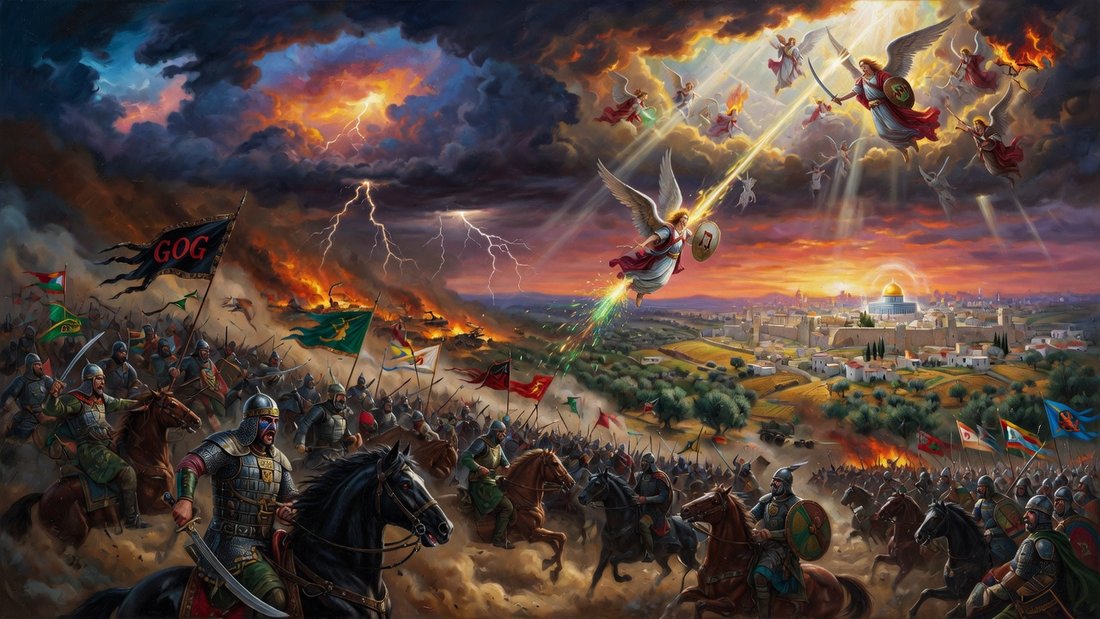
Among all the prophecies of the Hebrew Scriptures, few have stirred the imagination of the watching church like the two chapters that close the great central section of Ezekiel. In chapters thirty-eight and thirty-nine the prophet sees a coalition gathered out of the far corners of the known world — a confederacy of nations led by a figure called Gog, of the land of Magog — sweeping down upon a people lately restored to their own land. For most of the long centuries since Ezekiel wrote, these chapters were read as a sealed and distant mystery, a vision belonging to some unimaginable future. In our own generation, with the people of Israel regathered to the soil their fathers were driven from, and with the ancient names of the prophecy stirring again upon the map of the modern Near East, they read instead like a headline waiting to be written.
This article is written to set that vision in order. Its purpose is not to fix a date, for the Lord Himself has reserved the times and the seasons in His own power, and the history of prophecy interpretation is littered with the wreckage of confident men who thought otherwise. Nor is it written to identify a single modern nation behind each ancient name with the false precision of the sensationalist. It is written instead to lay bare the architecture of the prophecy itself — to ask plainly who gathers, when they gather, why they gather, and how, according to the unbreakable word of God, the gathering ends. For the Christian who stands with Israel, Ezekiel thirty-eight and thirty-nine are not a riddle to be feared but a revelation to be trusted, because their final word is not the triumph of the coalition but the vindication of the God who keeps Israel and does not sleep.
A word of caution belongs at the threshold. Every time conflict flares in the Middle East, a chorus arises proclaiming that the war of Gog and Magog has at last begun, and every such proclamation that has proved premature has done a small injury to the credibility of the prophetic word in the eyes of a skeptical world. The sober reader will hold two things together: a settled confidence that this prophecy will be fulfilled exactly as written, and a humble refusal to force the morning newspaper into the mold of the vision before its time. What follows, then, is an attempt to read Ezekiel for what Ezekiel says.
The Vision of Ezekiel
Ezekiel prophesied among the captives by the river Chebar, in the years when Judah lay broken and Jerusalem was a ruin. The placement of the Gog prophecy within his book is itself a key to its meaning. It does not stand in the section of judgment against Judah, nor among the oracles against the surrounding nations. It comes immediately after the chapters of restoration — after the vision of the valley of dry bones, in which the whole house of Israel, long dead and scattered, is knit together, raised up, and breathed into by the Spirit of God; and after the promise that the two sticks of Judah and Ephraim shall become one in the hand of the Lord, that Israel shall be gathered from among the heathen and planted in her own land under one shepherd forever. Only when the nation has been raised and resettled does the prophet turn to Gog. The order is deliberate. The invasion of Gog is an event of the restored land, not of the scattered exile.
The vision itself unfolds with a terrible grandeur. The Lord commands the prophet to set his face against Gog and to prophesy against him, declaring that He will turn him back and put hooks into his jaws and bring him forth with all his army — horses and horsemen, a great company with bucklers and shields, all of them handling swords. Gog comes from his place out of the north parts, he and many people with him, ascending like a storm and covering the land like a cloud. He comes against the mountains of Israel, against a people gathered out of many nations, in the latter years, to take a spoil and to take a prey. And then, at the height of his power and at the moment of his confidence, the hand of God falls upon him, and the would-be conqueror becomes a sacrifice upon the very mountains he came to plunder.
Who Is Gog, and Where Is Magog?
The first questions the text presses upon us concern the identity of the invader. Gog appears to be a personal name or title — a prince, a leader, the head of the coalition — while Magog is named as a land and a people. In the table of nations in Genesis, Magog stands among the sons of Japheth, the northern and seafaring branch of the human family, alongside Gomer, Madai, Javan, Tubal, Meshech, and Tiras. Meshech and Tubal, named here as peoples over whom Gog is the chief prince, are likewise Japhethic peoples associated by the ancient writers with the regions of Asia Minor and the lands beyond the Black and Caspian Seas — the far north as the geography of Scripture reckons direction, with the holy city of Jerusalem as its fixed center.
A long-running question attends the phrase the King James Version renders “the chief prince of Meshech and Tubal.” The Hebrew word translated “chief” is rosh, and a number of careful interpreters have argued that it should be read not as a common adjective but as a proper noun — the name of a people, Rosh, alongside Meshech and Tubal. Both readings have been defended by able scholars, and the question cannot be settled by zeal. What is not in doubt, on either reading, is the direction from which the storm gathers: out of the uttermost parts of the north, the prophet says, Gog and his confederates descend.
Here the reader must resist two opposite errors. The first is to treat the ancient names as mere antiquarian curiosities, drained of any reference to the world that is. The second, far more common in our own day, is to seize upon a single modern nation and pin to it the name of Gog with a confidence the text does not warrant, so that the prophecy becomes a hostage to the shifting alliances of the hour. The wiser course is to receive what the prophet plainly gives: a gatherer of nations, arising from the far north, who assembles a great confederacy against the restored land of Israel. The precise modern map will be made plain in the day of fulfillment; the shape and the direction are made plain now.
The Gathering of the Nations
Gog does not come alone. Ezekiel names his confederates with care, and the roster is worth reading slowly, for it draws a circle around Israel from several points of the compass. With Gog, the prophet says, come Persia, Cush, and Phut — that is, the great power to the east and the peoples of the south, of Africa and the lands below Egypt. With him also come Gomer and all his bands, and the house of Togarmah of the north quarters, and all his bands, and many people with them. The coalition is not a single neighbor with a border grievance; it is a confederacy drawn from east and south and far north alike, converging upon a land that lies, as it always has, at the crossroads of the continents.
What is striking is that every one of these names belongs to the table of nations in Genesis — to the world as the surrounding peoples were known to ancient Israel. Magog, Gomer, Tubal, Meshech, and Togarmah are sons and grandsons of Japheth; Cush and Phut are sons of Ham; Persia stands to the east as it has stood since the days of Cyrus. This is not the geography of a modern atlas but the world as the ancient Israelites knew it, the same ring of nations that framed the whole drama of the Old Testament now summoned to frame its final chapter. The geography that bounded Israel in the beginning bounds her at the end. The same nations among whom she was scattered are the nations gathered against her when she has been brought home.
One name on the roster speaks with particular clarity to our own moment. Persia stands first among the named confederates, and Persia and the modern state of Iran are the same nation, separated only by a change of name in the twentieth century. A regime that has made the destruction of Israel a fixed article of its public creed, that has armed and funded a ring of proxies around the Jewish state, and that has labored openly to acquire the means of catastrophic war, sits precisely where Ezekiel placed it — among the gatherers, in the east, in the latter years. The Christian reader does not need to force the identification; he need only notice that the prophet named the place, and that the place has a name in the headlines.
A Land of Unwalled Villages
The prophecy is anchored not only in geography but in time, and the marker of time is among its most arresting features. Gog comes, Ezekiel says, in the latter years, against a land that is brought back from the sword and gathered out of many people, against the mountains of Israel which had long been waste, but which are now inhabited by a people brought forth out of the nations, all of them dwelling safely. He comes, the prophet says, to a land of unwalled villages, to a people at rest, that dwell safely, all of them dwelling without walls, having neither bars nor gates.
For the whole of the long dispersion, this precondition was simply impossible. There was no regathered Israel; there were no Jewish villages on the mountains of Israel to be invaded; there was no nation dwelling in the land to provoke the envy and the avarice of a confederacy. A scattered people cannot be the object of an invasion of their land, for they have no land. The vision presupposes the very thing that for nineteen centuries did not exist and could not be imagined — a people brought home from many nations and resettled upon the ancient hills. That precondition is, in our generation, a plain matter of public record. The people have been gathered from more than a hundred countries; the waste places have been built and inhabited; the mountains of Israel are populated once more. The stage that Ezekiel described as the setting of the invasion has, for the first time in two thousand years, actually been set.
The God Who Brings Them Up
It would be a grave misreading of these chapters to suppose that they describe a contest whose outcome is in doubt, or a moment in which the purposes of God are threatened by the malice of men. The most startling note in the whole prophecy is struck at its very opening, where the Lord declares of Gog, “I will turn thee back, and put hooks into thy jaws, and I will bring thee forth, and all thine army.” The gatherer of the nations is himself gathered. The mover is moved. The one who imagines that he devises an evil plan of his own is in fact drawn up to the mountains of Israel by the sovereign hand of the God of Israel, for a purpose that the invader does not understand and would not consent to if he did.
This is not to say that God is the author of the wickedness in the heart of Gog; the evil thought, the covetous design, the will to plunder a peaceful people — these are Gog’s own, and for them he is justly judged. It is to say that the God who keeps Israel governs even the rage of those who hate her, and bends their very assembling to His own ends. The coalition believes it is choosing its moment; in truth its moment has been appointed. The hook is in the jaw before the first banner is raised. And this is precisely the comfort of the prophecy for the people of God: the invasion is not the failure of the divine plan but an instrument within it.
Fire Upon the Mountains
The judgment, when it falls, is depicted not as the triumph of Israel’s arms but as the direct intervention of Israel’s God. In the day that Gog comes against the land, the prophet says, the fury of the Lord shall come up in His face, and there shall be a great shaking in the land of Israel, so that the mountains are thrown down and every wall falls to the ground. The Lord calls for a sword against Gog throughout all His mountains, and every man’s sword is turned against his brother in the confusion of the host. He pleads against him with pestilence and with blood, and rains upon him and upon his many bands an overflowing rain, and great hailstones, fire, and brimstone. The mighty confederacy that ascended like a storm to cover the land is itself overwhelmed, not by the strategy of generals but by the hand of heaven, upon the very mountains it came to seize.
The aftermath, described in chapter thirty-nine, only deepens the picture of total reversal. The weapons of the fallen host become fuel; the burial of the slain becomes a labor of months; the birds and beasts are summoned to a great sacrifice. The point of the grim imagery is singular and unmistakable. The nation that lifted itself up against the people of God is brought utterly low, and the land that was marked for spoil becomes instead the grave of the spoiler. Every weapon formed against Israel, here as everywhere in Scripture, fails of its purpose and recoils upon the head of the one who forged it.
That the Nations May Know
Why does God permit, and indeed superintend, so vast a gathering against His people, only to destroy it? The prophet does not leave us to guess, for the answer is repeated like a refrain through both chapters. “Thus will I magnify myself, and sanctify myself,” the Lord declares, “and I will be known in the eyes of many nations, and they shall know that I am the LORD.” The war of Gog and Magog is, at its deepest level, a theological event before it is a military one. Its purpose is the vindication of the holy name of God in the sight of all the heathen — that the nations which have so long denied Him, or claimed His promises for themselves, or mocked the smallness and the suffering of His covenant people, may see with their own eyes that the God of Israel is the living God, and that He keeps His word.
This is the great theme that binds Ezekiel’s vision to the whole counsel of Scripture. From the covenant with Abraham — “I will bless them that bless thee, and curse him that curseth thee” — to the song of the Psalmist who beheld the nations raging and the Lord that sitteth in the heavens laughing, the testimony is one. The fate of Israel is bound to the faithfulness of God, and the assault upon Israel is finally an assault upon the throne of heaven, which no confederacy of earth has ever overturned or ever shall. Gog gathers the nations to take a prey; God uses the gathering to make His name known to the ends of the earth.
What This Means for the Christian Zionist
How, then, should the believer who loves Israel read these chapters in a generation when the ancient names are stirring? With sober watchfulness, and not with feverish date-setting. The signs that Ezekiel named — a people regathered from many nations, the waste mountains inhabited again, the old confederate powers ranged once more to the east and the north and the south — are no longer matters of imagination but matters of record, and the wise will mark them. But the same humility that refuses to despair refuses also to presume. We are not given the day or the hour, and the believer who announces the war of Gog with every fresh barrage of rockets serves neither the truth nor the credibility of the prophetic word.
What the Christian Zionist may hold with perfect confidence is the conclusion of the matter, for the conclusion is the very thing the prophet was given to reveal. The coalition will gather; the storm will rise; and the God who neither slumbers nor sleeps will be magnified upon the mountains of Israel before the eyes of all the nations. The believer’s task in the meantime is not to calculate but to stand — to bless the people God has promised to bless, to pray for the peace of Jerusalem, and to bear witness, against every fashionable denial, that the covenant of God is not broken and His purposes are not overthrown.
The world as the ancient Israelites knew it is the world that gathers at the end, and the God who set the bounds of the nations in the beginning sets the term of their gathering at the last. The mountains that were made waste are inhabited again. The names long buried are stirring. And over the regathered land, as over the scattered exile before it, the same word stands that has stood from Abraham’s day to ours: the One who keeps Israel shall neither slumber nor sleep, and the word of our God shall stand for ever.