
What You Are Looking At
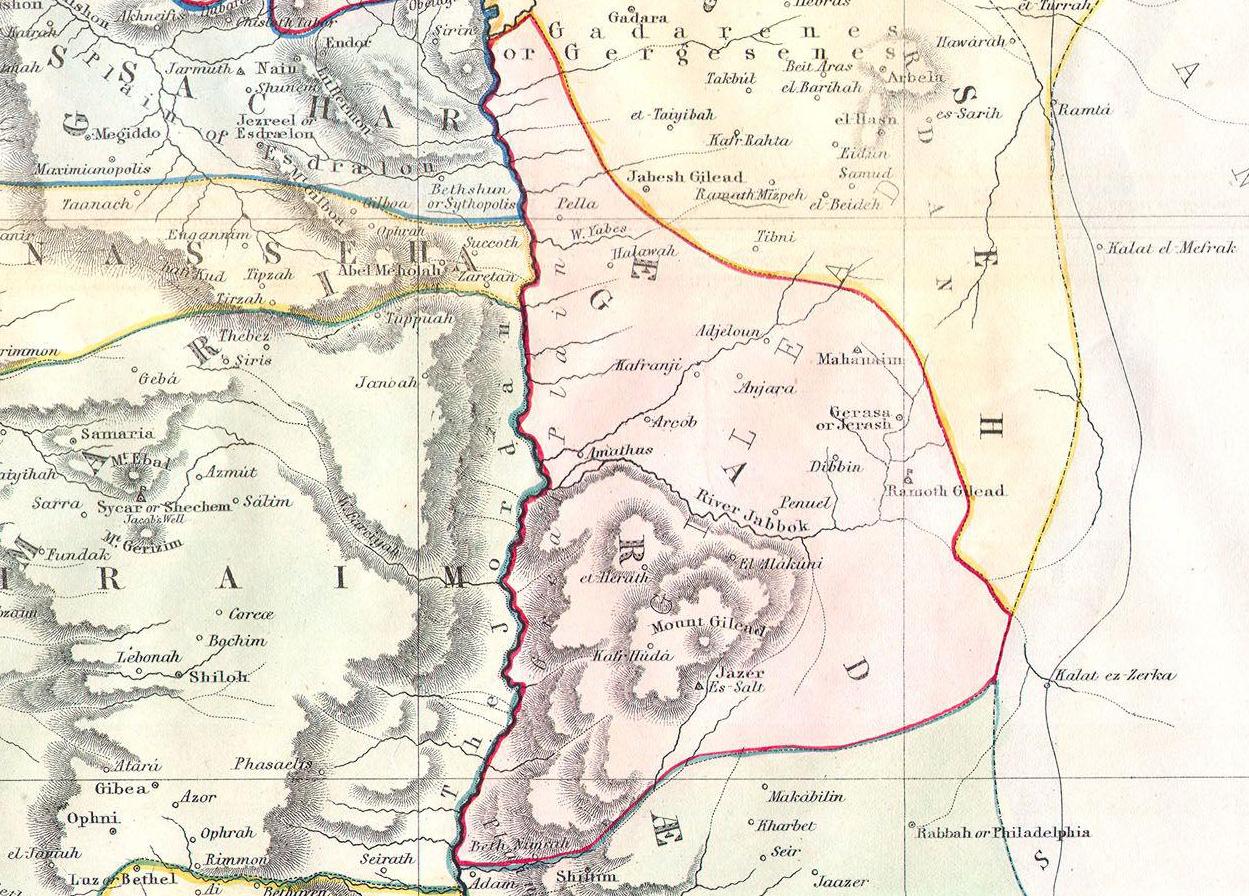
This 1852 Philip map shows the territory of Gad east of the Jordan River, highlighted in pink shading. The large letters G A D are written across the territory. The Jordan River forms the western boundary, running vertically down the left side of the map. To the north, Manasseh’s eastern half-tribe territory is visible (labeled MANASHA). The city of Jabesh-Gilead is marked in the northern portion of Gad’s land — the city whose rescue by Saul would launch Israel’s first king into national prominence (1 Samuel 11). Mahanaim is labeled in the central portion — where Jacob had his famous encounter with angels (Genesis 32:2), where David would later flee during Absalom’s rebellion (2 Samuel 17), and where Abner set up Ish-bosheth as a rival king after Saul’s death (2 Samuel 2). Ramoth-Gilead appears to the east — one of the Cities of Refuge and the contested fortress-city over which Israel and Aram (Syria) fought repeatedly throughout the period of the divided kingdom. Mount Gilead is prominently shown in the center, with the River Jabbok running through the territory — the stream at which Jacob wrestled with the angel of God (Genesis 32:22–32). On the western side of the Jordan, Ephraim’s territory is visible with Shechem and Mt. Gerizim labeled.
“And Moses gave inheritance unto the tribe of Gad, even unto the children of Gad according to their families. And their coast was Jazer, and all the cities of Gilead, and half the land of the children of Ammon, unto Aroer that is before Rabbah; and from Heshbon unto Ramath-mizpeh, and Betonim; and from Mahanaim unto the border of Debir.”
The Request East of Jordan
The Transjordanian settlement of Reuben and Gad (and the eastern half of Manasseh) originated in a specific request made to Moses before the conquest of Canaan began. When Israel had already defeated Sihon king of the Amorites and Og king of Bashan, the tribes of Reuben and Gad surveyed the conquered territory east of the Jordan and saw that it was ideal for cattle. They came before Moses with a petition: “The country which the Lord smote before the congregation of Israel is a land for cattle, and thy servants have cattle: wherefore, said they, if we have found grace in thy sight, let this land be given unto thy servants for a possession, and bring us not over Jordan” (Numbers 32:4–5).
Moses initially reacted with alarm, comparing their request to the faithlessness of the ten spies who had discouraged Israel from entering Canaan. But Reuben and Gad quickly offered a covenant: they would leave their families and flocks in fortified cities east of the Jordan and cross with Israel as armed soldiers to fight until every tribe received its inheritance west of the Jordan. Only then would they return to their land. Moses accepted the covenant and assigned Gilead to Gad and the southern Transjordan plains to Reuben.
Gilead — The Heart of Gad
Gad’s territory centered on Gilead — the rugged, heavily forested highland east of the Jordan, stretching from the River Jabbok northward. Gilead became a byword for remoteness, refuge, and healing. The “balm of Gilead” (Jeremiah 8:22; 46:11) was a celebrated medicinal resin produced in this region. When David fled from Absalom, it was to Mahanaim in Gilead that he crossed the Jordan — where the people of the land brought him beds, basins, earthen vessels, wheat, barley, flour, parched grain, beans, lentils, honey, curds, sheep, and cheese (2 Samuel 17:27–29). Gilead’s remoteness made it a place of provision and refuge.
From Gilead came Jephthah the judge, the son of Gilead by a prostitute, who was driven away by his half-brothers but called back in Israel’s hour of need against the Ammonites (Judges 11). From Gilead also came Elijah the prophet — “Elijah the Tishbite, of the inhabitants of Gilead” (1 Kings 17:1) — perhaps the most dramatic figure in all the prophetic tradition, who burst onto the scene with his announcement of drought and whose whole ministry was defined by the rugged, uncompromising character of Gilead itself.