
What You Are Looking At
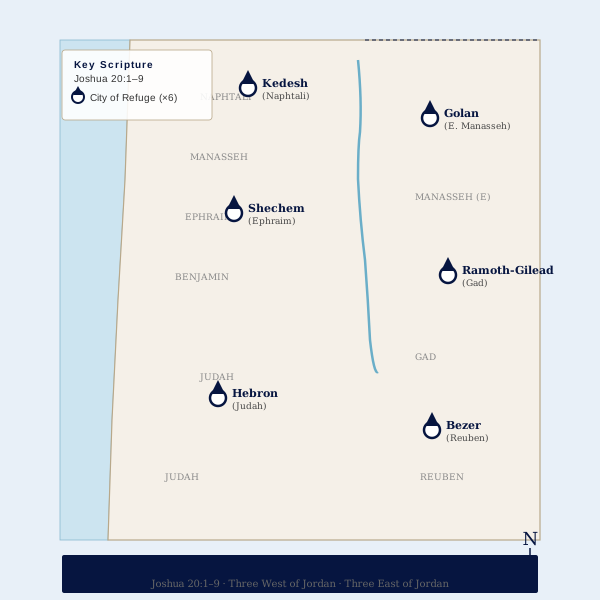
This map charts the locations of all six Cities of Refuge established by Joshua in fulfillment of God’s command through Moses (Numbers 35; Joshua 20). Three cities were designated west of the Jordan and three east of the Jordan, positioned so that no person in the land would be more than approximately a day’s journey from one. The six cities are: Kedesh in the tribe of Naphtali (northern Galilee), Shechem in the tribe of Ephraim (central highlands), and Hebron in the tribe of Judah (southern highlands) — west of the Jordan. Golan in the tribe of East Manasseh (Bashan), Ramoth-Gilead in the tribe of Gad (central Transjordan), and Bezer in the tribe of Reuben (southern Transjordan) — east of the Jordan. The triangular arrow symbol marks each city. All six were also Levitical cities, administered by the priests, reinforcing the connection between divine law, priestly authority, and the right of asylum.
“And they appointed Kedesh in Galilee in mount Naphtali, and Shechem in mount Ephraim, and Kirjath-arba, which is Hebron, in the mountain of Judah. And on the other side Jordan by Jericho eastward, they assigned Bezer in the wilderness upon the plain out of the tribe of Reuben, and Ramoth in Gilead out of the tribe of Gad, and Golan in Bashan out of the tribe of Manasseh.”
The Legal Purpose
The Cities of Refuge addressed one of the most difficult problems in ancient legal systems: how to handle accidental killing in a society governed by the law of blood vengeance. Under Mosaic law, deliberate murder was a capital offense (Exodus 21:14). But if a person killed another accidentally — by mischance, not malice — the law distinguished this from murder and provided a mechanism for justice rather than unlimited vendetta. The “avenger of blood” — the nearest male kinsman of the victim — had a legal right to kill the killer. The City of Refuge interrupted this process and provided the accused with safety and a fair hearing before the community elders.
Numbers 35:11–12 defines the principle: “Then ye shall appoint you cities to be cities of refuge for you; that the slayer may flee thither, which killeth any person at unawares. And they shall be unto you cities for refuge from the avenger; that the manslayer die not, until he stand before the congregation in judgment.” The roads leading to refuge cities were required by rabbinic tradition to be kept wide and well-maintained, with clear signposts at every crossroads reading Miklat — “Refuge.”
The High Priest and the Duration of Asylum
One of the most theologically striking aspects of the cities of refuge law is its connection to the death of the high priest. Numbers 35:25–28 states that the person found innocent of intentional murder must remain in the City of Refuge until the death of the high priest who was serving at the time of the trial. After the high priest’s death, the manslayer could return freely to his own land. This provision has fascinated biblical theologians for centuries: the death of the high priest functioned as a kind of atonement that released the one under protection. The parallel to Christ as High Priest — whose death releases those who flee to Him for refuge from the condemnation they deserve — is explicitly drawn in Hebrews 6:18–20, which speaks of “we who have fled for refuge to lay hold of the hope set before us.”
A Theological Type
The six Cities of Refuge are widely understood in Christian theology as a type of Christ. Like the refuge cities, Christ is available to all — to the native-born and the foreigner alike (Numbers 35:15). Like the roads to the refuge cities, the gospel is to be made plain and accessible. Like the asylum seeker who had to flee immediately to the city to be safe, the sinner must flee to Christ without delay. And like the high priest whose death secured the release of those sheltered in the city, it is the death of Christ that secures the eternal freedom of those who take refuge in Him.