
What You Are Looking At
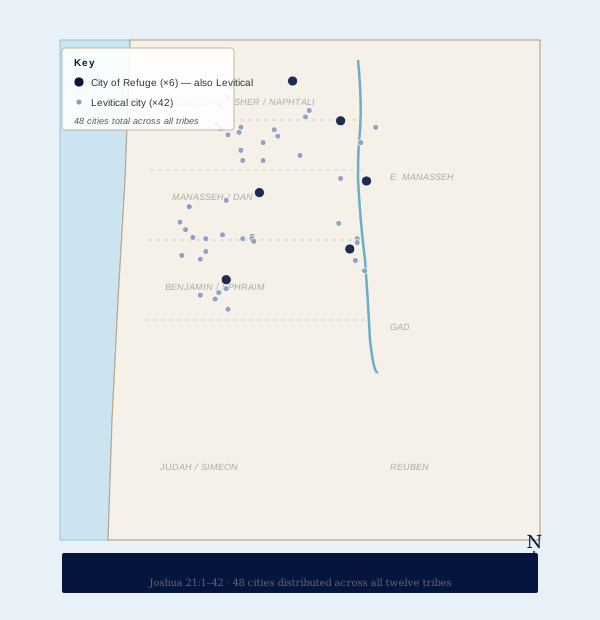
This map shows the distribution of all 48 Levitical cities across the land of Israel as assigned in Joshua 21. The large dark dots mark the six Cities of Refuge (which were also Levitical cities): Kedesh, Shechem, Hebron, Golan, Ramoth-Gilead, and Bezer. The smaller dots show the remaining 42 Levitical cities distributed throughout every tribal territory. The map’s primary message is geographic: no tribal territory was without a Levitical presence. From the far north in Naphtali (Kedesh, Hammoth-dor, Kartan) to the deep south in Judah and Simeon (Hebron, Libnah, Jattir, Eshtemoa, Ain, Juttah); from the coastal plain of Dan (Eltekeh, Gibbethon, Aijalon) to the Transjordanian highlands of Reuben (Bezer, Jahaz, Mephaath) and Gad (Ramoth-Gilead, Mahanaim, Heshbon, Jazer) — God placed priestly cities throughout the entire inheritance. The three Levitical families (Kohathites, Gershonites, Merarites) each received cities in different regions, ensuring that the full priestly ministry was distributed geographically rather than concentrated in one place.
“All the cities of the Levites within the possession of the children of Israel were forty and eight cities with their suburbs. These cities were every one with their suburbs round about them: thus were all these cities.”
Why No Levitical Territory?
The tribe of Levi was the only tribe that received no continuous territorial block in the division of the Promised Land. God’s explanation was clear and direct: “The Lord God of Israel himself is their inheritance” (Joshua 13:33). The Levites had been set apart for the service of the Tabernacle — to carry the sacred furniture during the wilderness journey (Numbers 3–4), to assist the priests in the sanctuary service, to teach the law to Israel, and to serve as judges and administrators of justice throughout the land. Their calling was spiritual and national, not agricultural or military. They were to live among the people as a priestly presence, not apart from them in a separate territory.
Numbers 35:1–8 records the command God gave to Moses: each tribe was to give cities to the Levites from their allotment, with the surrounding pasturelands extending 1,000 cubits from the city walls in every direction, and a full 2,000 cubits for the open country. The Levites did not own these cities — they lived in them. The land remained the property of the tribe that gave it. The Levites received right of residence and use, not title of ownership.
God’s Design for Priestly Distribution
The 48 Levitical cities were not randomly scattered. They were distributed with deliberate geographic and demographic purpose. The Aaronite priests — the descendants of Aaron who served at the altar — received cities near the center of the land, within easy travel of Shiloh and later Jerusalem. The Kohathites (non-Aaronite) received cities in the central and southern territories. The Gershonites received cities in the north — Issachar, Asher, Naphtali, and eastern Manasseh. The Merarites received cities in Zebulun, Reuben, and Gad.
The practical effect was profound. In every village in Israel, within a reasonable journey, there would be a city where Levites lived: men who knew the law of Moses, who could settle disputes, who could teach Israel’s children, who could perform the ceremonies of purification, and who could identify and diagnose conditions under the Mosaic code. The Levites were God’s distributed teachers, judges, and worship leaders — embedded throughout the nation so that no community would be without access to the covenant and its requirements. When this system worked, it was remarkable. When it broke down — as it did repeatedly in the period of the Judges — the consequences were catastrophic.