
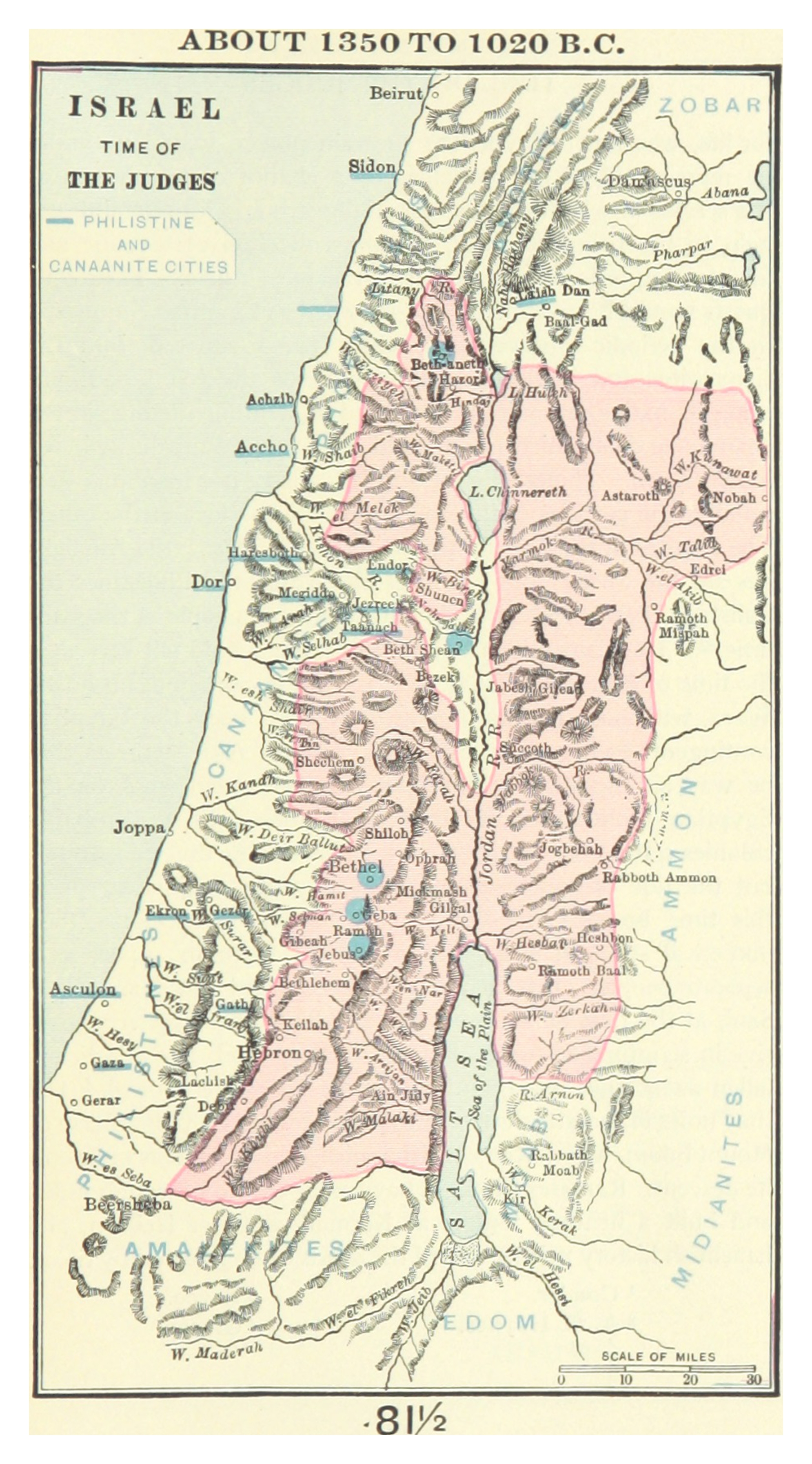
What You Are Looking At
This 1899 Maccoun map is titled “About 1350 to 1020 B.C. — Israel, Time of the Judges.” It covers the full extent of the land during the 330-year period between the death of Joshua and the anointing of Saul as Israel’s first king. The pink shading shows the territory Israel actually held during this period. The blue labels mark the Philistine and Canaanite cities that remained outside Israelite control — the unconquered strongholds that would become the instruments of Israel’s oppression. Along the coast you can see the Philistine city-states: Gaza, Ashdod, Asculon (Ashkelon), Gath, and Ekron. In the north, Hazor, Sidon, and the Phoenician cities remained under Canaanite control. The map also shows the surrounding nations that oppressed Israel during this period: the Philistines to the west, Ammon (Rabboth Ammon) to the east, Moab (with Kir) to the southeast, Edom to the south, and the Midianites to the east. Key Israelite cities are labeled: Shiloh (the Tabernacle site), Bethlehem, Hebron, Shechem, Megiddo, Ramah (Samuel’s hometown), Ophrah (Gideon’s city), Bethel, Mizpah, and others associated with specific judges. The Jordan River runs down the center, with Succoth and Jabesh-Gilead visible on the eastern bank.
“And yet they would not hearken unto their judges, but they went a whoring after other gods, and bowed themselves unto them: they turned quickly out of the way which their fathers walked in, obeying the commandments of the Lord; but they did not so. And when the Lord raised them up judges, then the Lord was with the judge, and delivered them out of the hand of their enemies all the days of the judge.”
The Death of Joshua and the Crisis That Followed
The book of Judges opens with a deceptively simple question: “After the death of Joshua it came to pass that the children of Israel asked the Lord, saying, Who shall go up for us against the Canaanites first?” (Judges 1:1). The question reveals the immediate post-Joshua reality: the conquest was unfinished, the Canaanites remained, and Israel had no single appointed leader to direct them. Joshua 24:31 had stated: “Israel served the Lord all the days of Joshua, and all the days of the elders who outlived Joshua, who had known all the works of the Lord which He had done for Israel.” But when that generation died, the generation that followed “did not know the Lord nor the work which He had done for Israel” (Judges 2:10).
The first chapter of Judges catalogs the incomplete conquest. Tribe after tribe is listed alongside the Canaanites it failed to drive out: Manasseh did not drive out the inhabitants of Beth-shean, Taanach, Dor, Ibleam, or Megiddo. Ephraim did not drive out the Canaanites at Gezer. Zebulun did not drive out the inhabitants of Kitron or Nahalol. Asher did not drive out Acco, Sidon, Ahlab, Achzib, Helbah, Aphik, or Rehob. Naphtali did not drive out Beth-shemesh or Beth-anath. Dan was forced into the hill country. The repetition is deliberate and devastating.
The Theological Cycle of Judges
Judges 2:11–19 presents the theological framework that governs the entire book. It is a cycle repeated seven times with different judges and different oppressors: Israel does evil in the sight of the Lord and serves the Baals. The Lord’s anger burns against Israel, and He delivers them into the hand of plunderers. The plunderers distress them greatly. The people cry out to the Lord. The Lord raises up a judge. The judge delivers Israel. The judge dies. Israel returns to corruption, worse than their fathers. The cycle repeats. The repetition is not literary laziness — it is a theological diagnosis. The problem was not military weakness or political instability. It was covenant unfaithfulness. And the solution was not a stronger army or better government, but return to the Lord who had delivered them from Egypt and given them the land.
The book of Judges ends with two appendices (chapters 17–21) that show the full depth of Israel’s spiritual and moral collapse: an unauthorized Levite runs a private idol shrine (chapters 17–18), and a horrific gang crime in Gibeah of Benjamin leads to a near-annihilation of the entire tribe of Benjamin in a civil war (chapters 19–21). The book’s closing refrain is among the most haunting in all of Scripture: “In those days there was no king in Israel: every man did that which was right in his own eyes” (Judges 21:25).