
What You Are Looking At
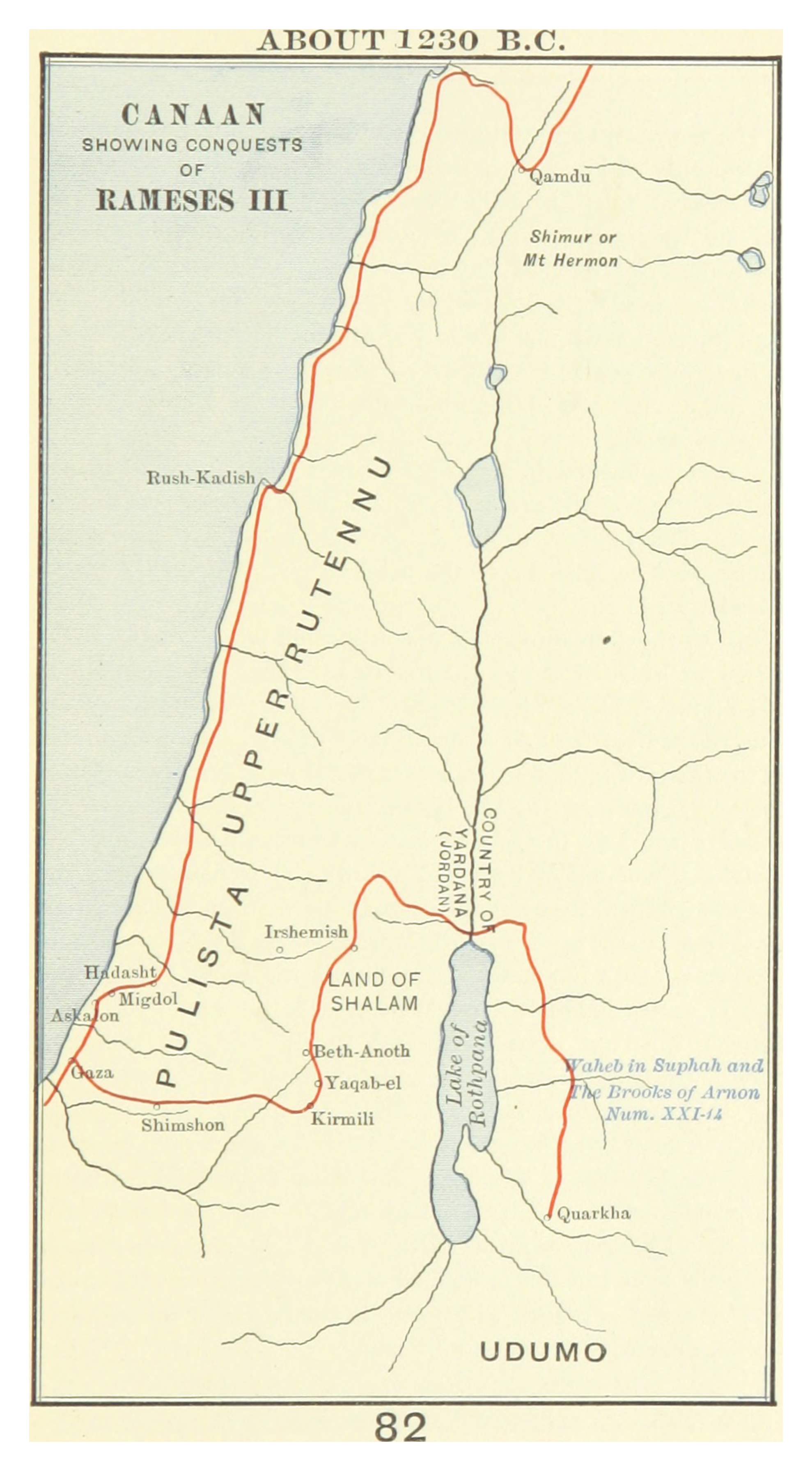
This 1899 Maccoun map is titled “About 1230 B.C. — Canaan Showing Conquests of Rameses III.” It shows the land of Canaan during the early period of the Judges, when Canaan was contested between Egyptian imperial power, Philistine city-states, and the emerging tribal society of Israel. The map uses Egyptian geographical terminology to label the land: “Pulista Upper Rutennu” — Pulista being the Egyptian name for the Philistine coastal region and Upper Retenu being Egypt’s term for Canaan and Syria. The red boundary lines show the extent of Rameses III’s influence or campaigns through the land. The Jordan River runs down the center, the Dead Sea (labeled “Lake of Rothpana”) appears in the east-center, and UDUMO (Edom) occupies the southern portion. Along the coast, Gaza, Ashkelon (Ascalon), and Migdol mark the Philistine zone. This map illustrates the geopolitical pressure under which early Israel lived: surrounded by the remnant Canaanite powers, the advancing Philistines, and the long arm of Egyptian imperial ambition. Into this contested, pressurized landscape, Othniel emerged as Israel’s first deliverer.
“And when the children of Israel cried unto the Lord, the Lord raised up a deliverer to the children of Israel, who delivered them, even Othniel the son of Kenaz, Caleb’s younger brother. And the Spirit of the Lord came upon him, and he judged Israel, and went out to war: and the Lord delivered Chushan-rishathaim king of Mesopotamia into his hand.”
The First Oppression
The very first oppression in the Book of Judges came from an unexpected and distant direction: Cushan-Rishathaim, king of Aram-Naharaim — which translates as “Mesopotamia,” literally “Aram of the Two Rivers.” This was not one of Israel’s near neighbors like the Philistines or Moabites. This was a power from the far northeast, from the region of the upper Euphrates, sweeping down through the Fertile Crescent into Canaan. The name “Cushan-Rishathaim” itself may be a contemptuous Hebrew nickname meaning “Cushan of Double Wickedness” — a deliberate distortion of the original name to express the narrator’s theological judgment on the oppressor.
The oppression lasted eight years — long enough for the people to feel the weight of their covenant unfaithfulness, and short enough to show God’s relative mercy. The cycle that would repeat throughout Judges is stated here for the first time in its full form: Israel did evil, God’s anger burned, God sold them into the hand of their enemy, the people cried out, and God raised up a deliverer.
Othniel — The Model Judge
Othniel is the only judge about whom the text records no character flaw, no personal failure, no spiritual compromise. He is presented as the ideal: a man from a faithful lineage (nephew of Caleb, who had wholly followed the Lord), who had already proven his courage by capturing Debir during the conquest (Joshua 15:16–17), and who responded to his divine calling without hesitation. The Spirit of the Lord came upon him, he judged Israel, he went out to war, and the Lord delivered Cushan into his hand. Full stop. The land had rest for forty years.
Biblical scholars have long recognized that Othniel’s account serves as the theological prototype for every subsequent judge. The pattern — oppression, crying out, the Spirit of the Lord, deliverance, rest — is established here in its purest form and then progressively complicated and darkened as the book proceeds. Ehud must use deception. Gideon must overcome fear and doubt. Samson’s gifts are compromised by moral weakness. Jephthah makes a rash vow. Each successive judge mirrors Othniel’s pattern but falls short of it in some way. Othniel stands at the head of the judges as the standard no one else quite reached — a reminder of what Israel’s deliverers were meant to be when the Spirit of God moved freely through a willing and faithful servant.