
What You Are Looking At
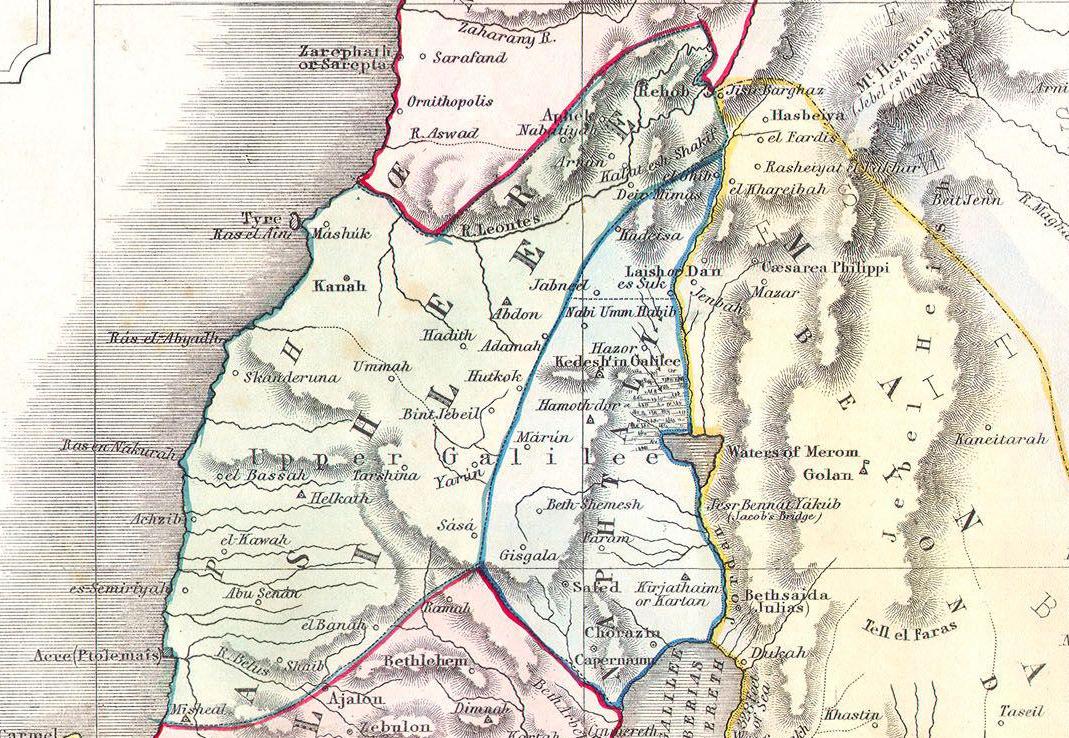
This 1852 Philip map is a combined map showing both Asher and Naphtali — the two northernmost tribes of western Canaan. The letters A S H E R are spread across the coastal region on the left side of the map, while N A P H T A L I fills the inland Galilean highlands to the right. Along the coast, the city of Tyre (bottom left) marks the approximate northern limit of Asher’s coastal territory, with Sidon further north. Kedesh in Galilee is clearly labeled — one of the six Cities of Refuge and a major Levitical city in Naphtali. Hazor, the great Canaanite city burned by Joshua (Joshua 11:13) and later the capital of Jabin whose general Sisera was defeated by Deborah and Barak, is also marked. In the right portion, the Waters of Merom and Golan label the territory near which Joshua won the northern campaign. The Sea of Galilee appears at the lower right. Mount Hermon looms in the upper right — the highest point in the region and the northern boundary of the land. Key Asherite cities including Abdon, Helkath, and Misheal (Misheal) are labeled on the coast. The map perfectly captures the geography of Upper Galilee — the territory that would later become the setting for much of Jesus’ ministry.
“The fifth lot came out for the tribe of the children of Asher according to their families... The sixth lot came out to the children of Naphtali, even for the children of Naphtali according to their families. And their coast was from Heleph, from Allon to Zaanannim, and Adami, Nekeb, and Jabneel... and reacheth to Zebulun on the south side, and reacheth to Asher on the west side, and to Judah upon Jordan toward the sunrising.”
Asher — The Coastal Tribe
Asher received a long, narrow strip of territory running along the Mediterranean coast from Mount Carmel northward to the region of Sidon — one of the most commercially valuable stretches of coastland in the ancient world. Jacob’s blessing in Genesis 49:20 declared that Asher’s “bread shall be fat, and he shall yield royal dainties.” The coastal plain of Asher, with its olive groves and rich farmland, fulfilled this prophecy literally: the territory was known for its agricultural abundance. Yet Joshua 19:28–29 and Judges 1:31–32 record that Asher did not drive out the inhabitants of many of its major cities — including the great Phoenician cities of Tyre, Sidon, and Acco. “But the Asherites dwelt among the Canaanites, the inhabitants of the land, for they did not drive them out.”
Despite this failure, Asher is not entirely without honor. When the infant Jesus was presented in the temple, an elderly prophetess named Anna was present — identified as “of the tribe of Asher” (Luke 2:36). She had served God fasting and praying in the temple for decades, and she gave thanks to God and proclaimed redemption to all who were looking for it. A woman of Asher was among the first to recognize the Messiah.
Naphtali — The Tribe of the Galilee
Naphtali received the heartland of what the New Testament calls Galilee: the highland territory west of the Sea of Galilee, running north to the Litani River and east to the Jordan. Jacob’s blessing described Naphtali as “a swift deer” who “gives beautiful words” (Genesis 49:21). From Naphtali came Barak, the military commander whom the prophetess Deborah summoned to lead Israel’s army against Sisera and the forces of Jabin king of Canaan (Judges 4:6). The battle was fought at Mount Tabor, and the subsequent defeat of Sisera — killed by the tent peg of Jael the Kenite — is celebrated in the great Song of Deborah (Judges 5), one of the oldest pieces of Hebrew poetry in the Bible.
Isaiah 9:1–2 contains a prophecy specifically for Naphtali’s land: “Nevertheless the gloom will not be upon her who is distressed... He will honor Galilee of the Gentiles, by the way of the sea, beyond the Jordan. The people who walked in darkness have seen a great light.” Matthew 4:13–16 quotes this passage to describe Jesus settling in Capernaum, in the territory of Zebulun and Naphtali, to begin His public ministry. The land that Jacob blessed and Isaiah prophesied over became the primary theater of the incarnate ministry of the Son of God.