
What You Are Looking At
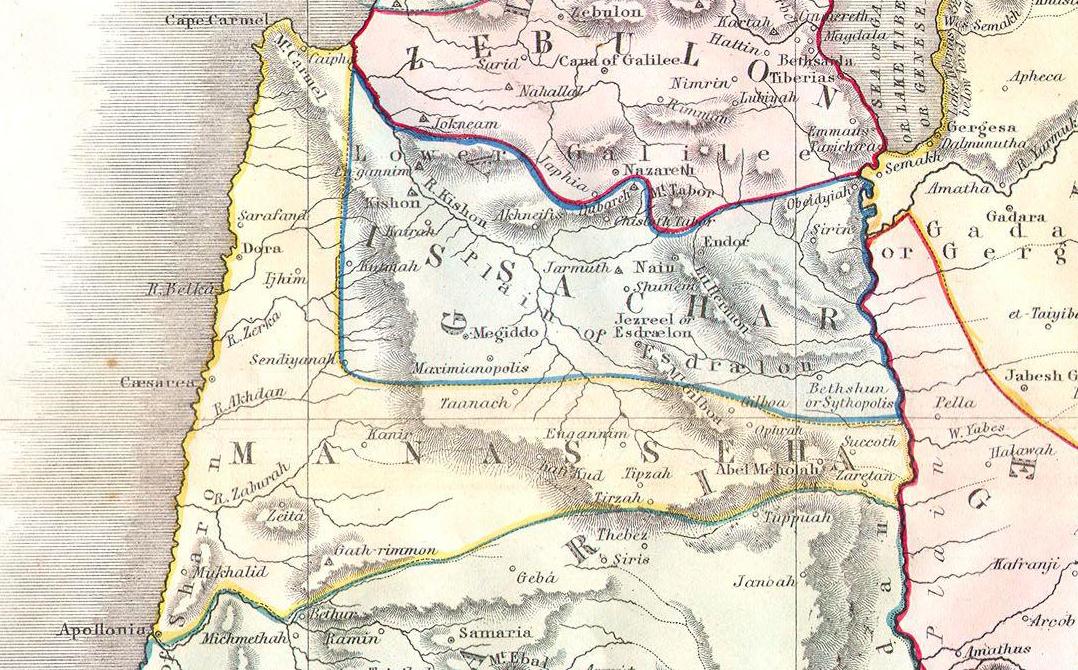
This 1852 Philip map shows the territory of the Tribe of Manasseh — specifically the western half of Manasseh (the half-tribe west of the Jordan), which is the portion assigned in Joshua 17. The territory of Manasseh occupies the lower portion of the map with its name visible. Above it, the territory of Issachar is labeled, and Zebulun appears at the top. The coastal strip along the left side shows the Plain of Sharon and the Carmel ridge. Key geographic features visible include the Jezreel Valley (also labeled Esdraelon) in the northern section, the strategic valley that runs from the Jordan to the Mediterranean and formed part of Manasseh’s territory. The cities of Megiddo, Taanach, and Jokneam — all within or on Manasseh’s borders — are clearly marked. Shechem (Mt. Gerizim and Mt. Ebal areas) visible in the lower portion marks the spiritual center of the region. The border with Ephraim runs through the lower portion of the map, while the Jordan River forms the eastern boundary. The map captures the broad, agriculturally rich territory that made Manasseh one of the wealthiest and most strategically positioned tribes in all Israel.
“There was also a lot for the tribe of Manasseh; for he was the firstborn of Joseph: namely, for Machir the firstborn of Manasseh, the father of Gilead; because he was a man of war, therefore he had Gilead and Bashan. There was also a lot for the rest of the children of Manasseh by their families... and their coast was from Asher to Michmethah, that lieth before Shechem.”
The Largest Allotment
Manasseh received a uniquely large inheritance because the tribe was divided into two halves on opposite sides of the Jordan River. The eastern half-tribe — descendants of Machir the firstborn of Manasseh — had already received Gilead and Bashan east of the Jordan (Numbers 32). The western half-tribe received the central territory of Canaan north of Ephraim, stretching from the Jordan valley westward to the Mediterranean coast between Asher and the Carmel ridge. Together, the two halves of Manasseh constituted the largest territorial inheritance of any tribe.
The western territory was agriculturally exceptional. The Jezreel Valley — the broad, flat plain running across the north of Manasseh’s land — was one of the most fertile strips of soil in the entire region, fought over by empires for millennia. Its strategic value was matched only by its productivity. The city of Megiddo, which commanded the main pass through the Carmel ridge, sat on Manasseh’s northern boundary with Issachar and is mentioned specifically in Joshua 17:11 as one of the cities Manasseh possessed but could not drive out the Canaanites from.
The Daughters of Zelophehad
One of the most remarkable legal precedents in the entire Torah is embedded in Manasseh’s allotment. Five daughters of a man named Zelophehad — Mahlah, Noah, Hoglah, Milcah, and Tirzah — came before Moses during the wilderness period and petitioned: “Why should the name of our father be removed from among his family because he had no son? Give to us a possession among our father’s brothers” (Numbers 27:4). God affirmed their case, established a permanent legal precedent for daughters to inherit when there was no male heir, and when Joshua allotted the land, these five women came forward again and received their inheritance among their father’s brothers (Joshua 17:3–6). Their names became cities.
Gideon — The Manassite Judge
The tribe of Manasseh produced one of the most celebrated heroes of the Judges period: Gideon of the clan of Abiezer. He was called by the angel of the Lord at Ophrah, in the heart of Manasseh’s territory, while threshing wheat in a winepress to hide it from the Midianites who had oppressed Israel for seven years. Gideon’s response to his divine calling — “O my Lord, if the Lord is with us, why then has all this happened to us?” (Judges 6:13) — is one of the most honest and human cries of faith in all of Scripture. His campaign against Midian with only 300 men carrying torches and trumpets became the archetypal story of divine victory through impossible odds.