
What You Are Looking At
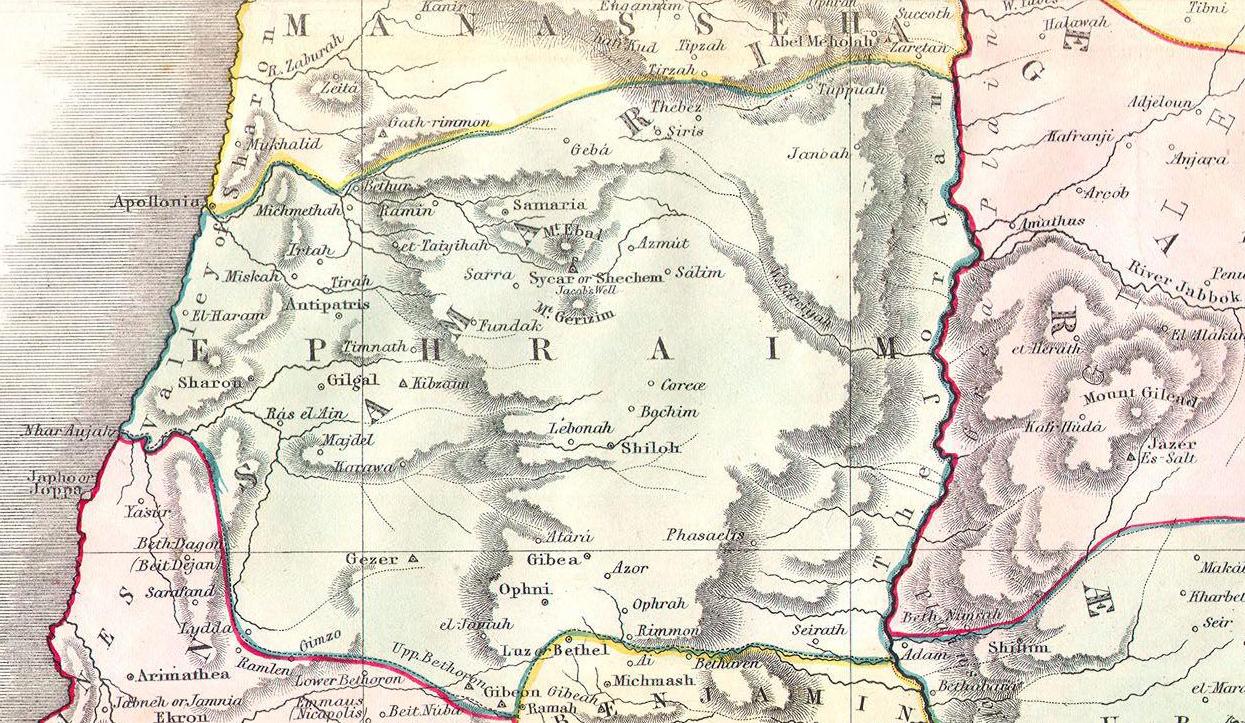
This 1852 Philip hand-coloured map is dedicated to the territory of the Tribe of Ephraim. Ephraim’s land occupies the central portion of the map, shown in the light shading with the letters E P H R A I M written across it. The territory of Manasseh is visible above, and Benjamin (B E N J A M I N, abbreviated at the bottom) lies immediately to the south. Along the coast you can see Joppa (Japho or Joppa) at the lower left — though Joppa itself fell within Dan’s allotment, it marks the coastal orientation of the region. Moving inward, the Valley of Sharon is labeled on the coastal plain. Key interior cities include Shiloh in the center of Ephraim’s territory — the site where the Tabernacle was set up after the conquest. Shechem (labeled “Sycar or Shechem” with Jacob’s Well marked) lies on the border with Manasseh, flanked by Mount Ebal and Mount Gerizim. Gezer appears on the southwestern border with Dan — the Canaanite fortress-city that Israel never drove out during Joshua’s lifetime. Lower Bethoron marks the strategic northwestern pass. Samaria (later city, built on a hill in Ephraim’s territory) is also marked. Gilgal and Shiloh remind the reader that Ephraim’s land contained the spiritual center of Israel during the entire period of the Judges.
“And the border of the children of Ephraim according to their families was thus: even the border of their inheritance on the east side was Ataroth-addar, unto Beth-horon the upper; and the border went out toward the sea to Michmethah on the north side; and the border went about eastward unto Taanath-shiloh, and passed by it on the east to Janohah.”
The Dominant Tribe of the North
Ephraim was the second son of Joseph, born in Egypt and adopted by Jacob as his own with the blessing that the younger would surpass the elder (Genesis 48:13–19). That prophetic reversal shaped the entire subsequent history of Israel. Although Manasseh was the firstborn, Ephraim received the primary blessing, and in the centuries that followed Ephraim became the most powerful and influential tribe in the northern region. The name “Ephraim” became virtually synonymous with the northern kingdom of Israel in the prophetic writings, just as “Judah” stood for the southern kingdom.
Ephraim’s territory occupied the central hill country north of Benjamin and south of Manasseh — a region of hills, valleys, springs, and agricultural richness. Its western boundary descended to the coastal plain near Gezer, and its eastern boundary ran along the Jordan Valley. The territory contained Shiloh, which became the central worship site for all Israel after the conquest, and Shechem, the ancient covenant center near the tombs of the patriarchs.
Shiloh — The Heart of Ephraim
After the conquest, the congregation of Israel assembled at Shiloh, located in the heart of Ephraim’s territory, and set up the Tabernacle there (Joshua 18:1). Shiloh became the spiritual capital of the nation for approximately 300 years — from the completion of the conquest until the Philistines captured the ark of God in the days of Eli (1 Samuel 4). The ark’s capture at the Battle of Ebenezer and its removal from Shiloh was so catastrophic that the site became a byword for divine judgment: “But go ye now unto my place which was in Shiloh, where I set my name at the first, and see what I did to it” (Jeremiah 7:12).
Samuel was born to Hannah at Shiloh and dedicated to the Lord’s service there from childhood (1 Samuel 1–2). The prophet Ahijah of Shiloh was from Ephraim’s territory (1 Kings 11:29). And Jeroboam I, who divided the united kingdom and made Ephraim the capital of northern Israel, was himself an Ephraimite — fulfilling Moses’ ancient blessing that Ephraim’s descendants would be “tens of thousands” (Deuteronomy 33:17).
Gezer — The Unconquered Fortress
Joshua 16:10 records one of the most significant admissions in the tribal allotment narratives: “And they drave not out the Canaanites that dwelt in Gezer: but the Canaanites dwell among the Ephraimites unto this day.” Gezer was a powerful Canaanite city controlling the access route from the coastal plain to the central highlands. Its Canaanite inhabitants remained in Ephraim’s territory, paying tribute but not driven out. Gezer would not finally come into full Israelite possession until the time of Solomon, when an Egyptian pharaoh conquered it, burned it, and gave it to his daughter as a wedding gift — and Solomon rebuilt it (1 Kings 9:16–17). Even the mighty Gezer ultimately became part of the covenant inheritance.