
What You Are Looking At
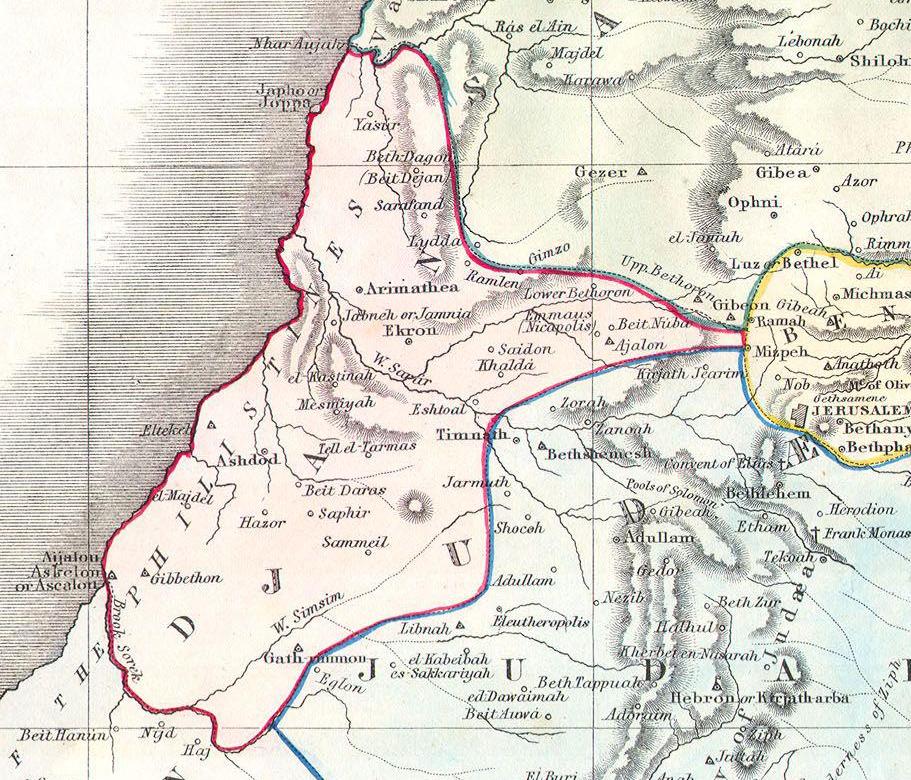
This beautifully hand-coloured 1852 map from the Philip Atlas of Palestine is dedicated entirely to the territory of the Tribe of Dan. Dan's allotted land is shown in the pink shading across the central coastal strip, with the large letters D A N written prominently across it. Along the northwestern edge, Joppo/Joppa (modern Jaffa, now part of Tel Aviv) marks Dan's northern coastal boundary. The territory of the Philistines presses in hard from the west — which is exactly why Dan struggled to hold this land. Key Danite cities visible on the map include Ekron, one of the five Philistine city-states; Lydda in the coastal plain; Arimathea in the foothills; Eshtoal and Zorah in the Sorek Valley, the homeland of Samson; Timnah, where Samson took his Philistine wife; and Gibbethon, a contested border town. At the right side of the map, the blue-bordered yellow zone marks Benjamin's territory, with Jerusalem visible in the lower right corner, Gibeon, Ramah, and Bethel to the north. Gezer, the powerful Canaanite fortress-city Israel never fully subdued, appears on Dan's northeastern boundary. The map captures precisely the geographical pressure that forced Dan to eventually abandon this coastal plain and migrate to the far north.
“The seventh lot came out for the tribe of the children of Dan according to their families. And the territory of their inheritance was Zorah, Eshtaol, Ir Shemesh, Shaalabbin, Aijalon, Jethlah, Elon, Timnah, Ekron, Eltekeh, Gibbethon, Baalath, Jehud, Bene Berak, Gath Rimmon, and Me Jarkon and Rakkon, with the region near Joppa.”
The Last Tribe to Receive Its Inheritance
Dan was the seventh tribe assigned its territory at Shiloh and the last of the western tribes to receive a formal allotment. Its inheritance was a compact strip of the central coastal plain — wedged between Judah to the south, Benjamin to the east, Ephraim to the north, and the Philistines to the west. In theory, Dan had been given valuable territory. In practice, they could not hold it.
Joshua 19:47 records the problem with painful brevity: “The territory of the children of Dan was too small for them.” The Philistines pressed hard against Dan's western boundary, and the Amorites drove the Danites into the hill country and refused to allow them to descend to the valley (Judges 1:34). The tribe that had been second largest in the census of Numbers found itself unable to secure even the modest allotment it had been given.
The Sorek Valley — Samson's Homeland
Despite their territorial struggles, the tribe of Dan produced one of the most famous figures in the entire Book of Judges: Samson. He was born in Zorah, visible on this map in the southern Sorek Valley foothills, a Nazirite from birth, set apart by God as a deliverer of Israel from Philistine oppression. His entire life story plays out on this map — from his birth in Zorah, to his marriage in Timnah, to his capture by Delilah in the Valley of Sorek, to his final act at Gaza. The territory Dan could not conquer militarily became the arena where one man, empowered by the Spirit of God, waged a personal war against the Philistines for twenty years (Judges 13–16).
“Then the Spirit of the Lord began to move upon him at Mahaneh Dan, between Zorah and Eshtaol.”
The Migration North — Laish Becomes Dan
Judges 18 records one of the most significant tribal movements in the period of the Judges. Aware that their coastal territory was slipping away, a group of six hundred armed Danite warriors set out northward. They found their new home at Laish, a prosperous, isolated city near the headwaters of the Jordan River at the foot of Mount Hermon, whose people lived “quietly and securely” with no allies to protect them. The Danites attacked, destroyed the city, and rebuilt it, naming it Dan after their ancestor. The city of Dan at the northern extreme of the land gave rise to the familiar phrase “from Dan to Beer-sheba” — the complete geographic extent of Israel from north to south.
The Spiritual Decline of Dan
The tribe's migration north was accompanied by religious compromise that had lasting consequences. The Danites set up idols at their new city and established an unofficial priestly line — a shrine operating in parallel with the Tabernacle at Shiloh for generations. Centuries later, when Jeroboam I divided the kingdom, he set up golden calves at Bethel and Dan (1 Kings 12:29), declaring: “Here are your gods, O Israel, which brought you up from the land of Egypt.” The shrine at Dan, established by Danite apostasy in the period of the Judges, became one of the two great centers of Israel's national idolatry — contributing directly to the spiritual decay that ultimately led to the Assyrian conquest and exile of the northern kingdom in 722 BC.
