
The Tribe of Simeon — Its Territory
Joshua 19:1–9
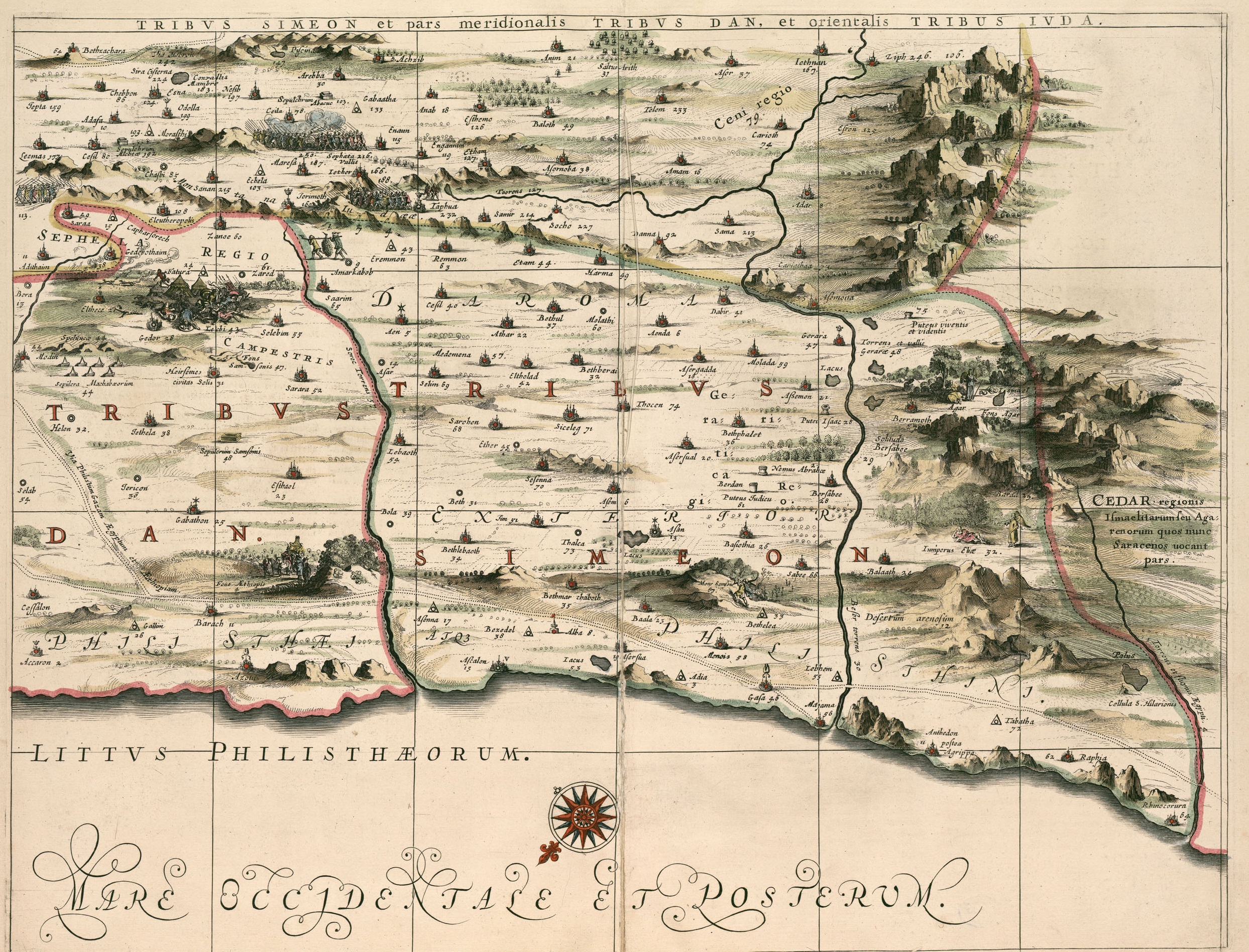
Tribus Simeon et pars meridionalis Tribus Dan, et orientalis Tribus Juda — an engraved historical map of the southernmost tribal territories of Canaan. Public domain.
What You Are Looking At
This richly detailed engraved map bears the Latin title “Tribus Simeon et pars meridionalis Tribus Dan, et orientalis Tribus Juda” — “The Tribe of Simeon and the southern part of the Tribe of Dan, and the eastern part of the Tribe of Judah.” It covers the southernmost region of Canaan, exactly where Simeon's inheritance was located. Along the bottom runs the Philistine coastline (labeled “Littus Philisthaorum”) and the Mediterranean Sea (labeled “Mare Occidentale et Posterum”), with the coastal plain densely populated by Philistine city names. Moving inland, look for Beer-sheba — the most important city in Simeon's territory and the ancient southern boundary of the Promised Land, giving rise to the biblical phrase “from Dan to Beer-sheba.” The map also shows the territory of Dan to the northwest (the coastal area and Shephelah foothills) and portions of Judah's eastern land on the right side. The decorative cartouche and style of the map mark it as classical European biblical cartography, produced at a time when scholarly attention to the precise geography of the Holy Land was considered essential to understanding the Scriptures. The names of Simeon's cities from Joshua 19 are plotted throughout the southern area, making this a direct visual companion to the text.
“The second lot came out for Simeon, for the tribe of the children of Simeon according to their families. And their inheritance was within the inheritance of the children of Judah... The inheritance of the children of Simeon was within the inheritance of the children of Judah, for the share of the children of Judah was too much for them. Therefore the children of Simeon had their inheritance within the inheritance of that people.”
— Joshua 19:1, 9 (NKJV)
A Territory Within a Territory
The allotment of Simeon was unique among all the tribes of Israel. Unlike every other tribe, Simeon did not receive a geographically distinct and separate block of territory. Its inheritance was located entirely within the territory of Judah. Joshua 19:9 provides the explanation directly: “The share of the children of Judah was too much for them.” Judah's territory, being the largest allotment, contained more land than its population could fully occupy and cultivate. The southern Negev borderlands around Beer-sheba were therefore reassigned from within Judah's excess to form Simeon's inheritance. This arrangement produced an unusual tribal geography that would have lasting historical consequences.
Over time, with Simeonite territory surrounded on all sides by Judah, the distinction between the two tribes gradually blurred. By the time of the later monarchy, Simeon had largely been absorbed into Judah as a distinct tribal entity. By the New Testament period, Simeon is rarely mentioned as a separate tribe. The loss of a distinct geographic identity over centuries was not accidental. It reflected something Jacob had spoken prophetically over Simeon at his deathbed centuries before.
Beer-sheba — The Anchor City
The most important city in Simeon's inheritance was Beer-sheba, listed first in Joshua 19:2. Beer-sheba carried patriarchal weight matched by few places in the entire land. Abraham dug a well there and made a covenant with Abimelech, naming the place Beer-sheba — “well of the oath” or “well of seven” (Genesis 21:31). Isaac received a divine vision at Beer-sheba (Genesis 26:23–25). Jacob had a vision there on his journey down to Egypt (Genesis 46:1–4). The phrase “from Dan to Beer-sheba” became the standard biblical idiom for the entire length of the Promised Land — Dan at the northern extreme, Beer-sheba at the southern. That Beer-sheba fell within Simeon's allotment gave the smallest and southernmost tribe an anchor city of enormous symbolic significance.
Simeon's Cities
Joshua 19 lists seventeen cities in Simeon's allotment. Many carried deep history. Hormah — where Israel had suffered a devastating wilderness defeat (Numbers 14:45) and later won a decisive pre-conquest victory (Numbers 21:3) — was in Simeon's territory. Ziklag, later given to David by the Philistine king Achish during David's years of exile from Saul, was a Simeonite city (1 Samuel 27:6) and became the base from which David launched raids against Israel's enemies while appearing to serve the Philistines. Beth-Marcaboth means “house of chariots,” and Hazar-Susah means “horse enclosure” — suggesting that the region had long-standing military significance related to cavalry forces.
The Fulfillment of Jacob's Prophecy
The absorption of Simeon into Judah reads in retrospect as the fulfillment of Jacob's ancient blessing in Genesis 49:5–7. Jacob had grouped Simeon and Levi together and declared: “I will divide them in Jacob and scatter them in Israel.” Levi was scattered as priests throughout all the tribes, living in 48 cities rather than a single territory. Simeon was scattered within the boundaries of Judah. The two brothers who had acted together in violent anger at Shechem received inheritances that denied them a consolidated geographic power base. In God's providence, this was not merely punishment. It was design — the scattering of Levi produced a priestly presence throughout all Israel, and the absorption of Simeon into Judah concentrated the southern kingdom around the royal tribe from which the Messiah would come.
© 2026 Michael Knighton | Christians Standing With Israel™ | All Rights Reserved