
The Persian Empire
Historical & Biblical Background
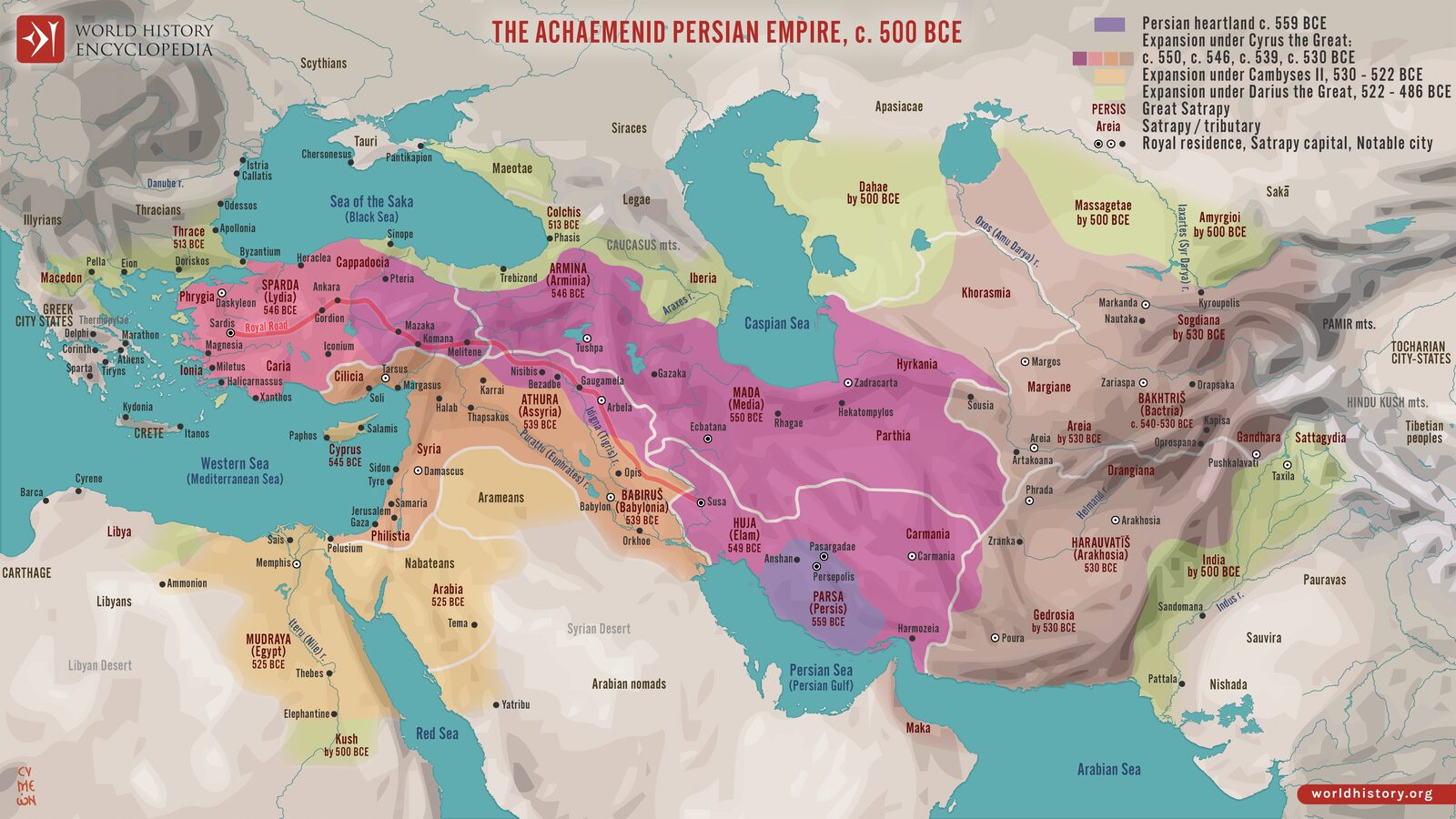
The Achaemenid Persian Empire was the largest empire the ancient world had yet seen — stretching from Greece and Libya in the west to India in the east, encompassing over 5 million square kilometers and some 50 million people, roughly 44% of the world's population at its height. For the Jewish people, Persia was not an oppressor but a liberator. It was the empire that ended the Babylonian exile, allowed the Jews to return to Jerusalem, financed the rebuilding of the Temple, and gave Israel 200 years of relative peace and autonomy.
Cyrus the Great — Named by Prophecy
The most extraordinary thing about Cyrus the Great in Scripture is that he was named by the prophet Isaiah approximately 150 years before his birth. Isaiah 44:28 reads: "That saith of Cyrus, He is my shepherd, and shall perform all my pleasure: even saying to Jerusalem, Thou shalt be built; and to the temple, Thy foundation shall be laid." Isaiah 45:1 calls him God's "anointed" — the only non-Israelite in Scripture given that title. When Cyrus conquered Babylon in 539 BC and issued his famous decree allowing the Jews to return to Jerusalem, he was fulfilling a prophecy written in the days of King Hezekiah. Josephus records that Cyrus was shown this very prophecy and was moved by it.
The Books of the Bible Set in Persia
Four major biblical books are set entirely within the Persian Empire. Ezra records the return of the exiles and the rebuilding of the Temple under Cyrus and Darius. Nehemiah records the rebuilding of Jerusalem's walls under Artaxerxes, from the palace at Susa. Esther is set entirely at the Persian court in Susa — "Shushan the palace" — during the reign of Ahasuerus (Xerxes I). Daniel records the transition from Babylonian to Persian rule, with Daniel serving in the court of Darius the Mede and Cyrus the Persian. All of these settings are visible on this map.
The Royal Road — Communication Across an Empire
The red line marked on this map is the Royal Road — a 2,700-kilometer highway built by Darius the Great connecting Sardis (in western Turkey) to Susa (in southwest Iran). Royal couriers using relay stations could cover the entire distance in about seven days — a communication system that made the empire governable. It was on this road that Nehemiah's news from Jerusalem reached Susa (Nehemiah 1:1–3), and from this road that the king's letters authorizing Nehemiah's return to Jerusalem were dispatched (Nehemiah 2:7–9).
Daniel's Prophecy of Persia
The Persian Empire appears in Daniel's visions as the silver chest of the great statue (Daniel 2:32), the bear raised up on one side (Daniel 7:5), and the ram with two horns — Media and Persia — pushing westward, northward, and southward (Daniel 8:3–4). The angel Gabriel explicitly identifies the ram as "the kings of Media and Persia" (Daniel 8:20). The expansion shown in stages on this map — Media first, then Persia's explosive growth under Cyrus — is exactly what Daniel's imagery depicts.
"That saith of Cyrus, He is my shepherd, and shall perform all my pleasure: even saying to Jerusalem, Thou shalt be built; and to the temple, Thy foundation shall be laid... I have even called thee by thy name: I have surnamed thee, though thou hast not known me."— Isaiah 44:28; 45:4 (KJV)
Key Scripture References
Ezra 1:1–4 — Cyrus's decree freeing the Jews to return to Jerusalem
Ezra 6:1–12 — Darius confirms Cyrus's decree; Temple rebuilt
Nehemiah 1–2 — Nehemiah at Susa; Artaxerxes authorizes rebuilding of Jerusalem's walls
Esther 1:1–2 — "In the days of Ahasuerus... which reigned from India even unto Ethiopia"
Daniel 2:32 — The silver chest of the statue — the Persian Empire
Daniel 8:3–4, 20 — The ram with two horns — Media and Persia
Daniel 10:13 — "The prince of the kingdom of Persia withstood me one and twenty days"
Daniel 11:2 — Four Persian kings after Cyrus; then the mighty Greek king