
The Arabian Peninsula in Ancient Times
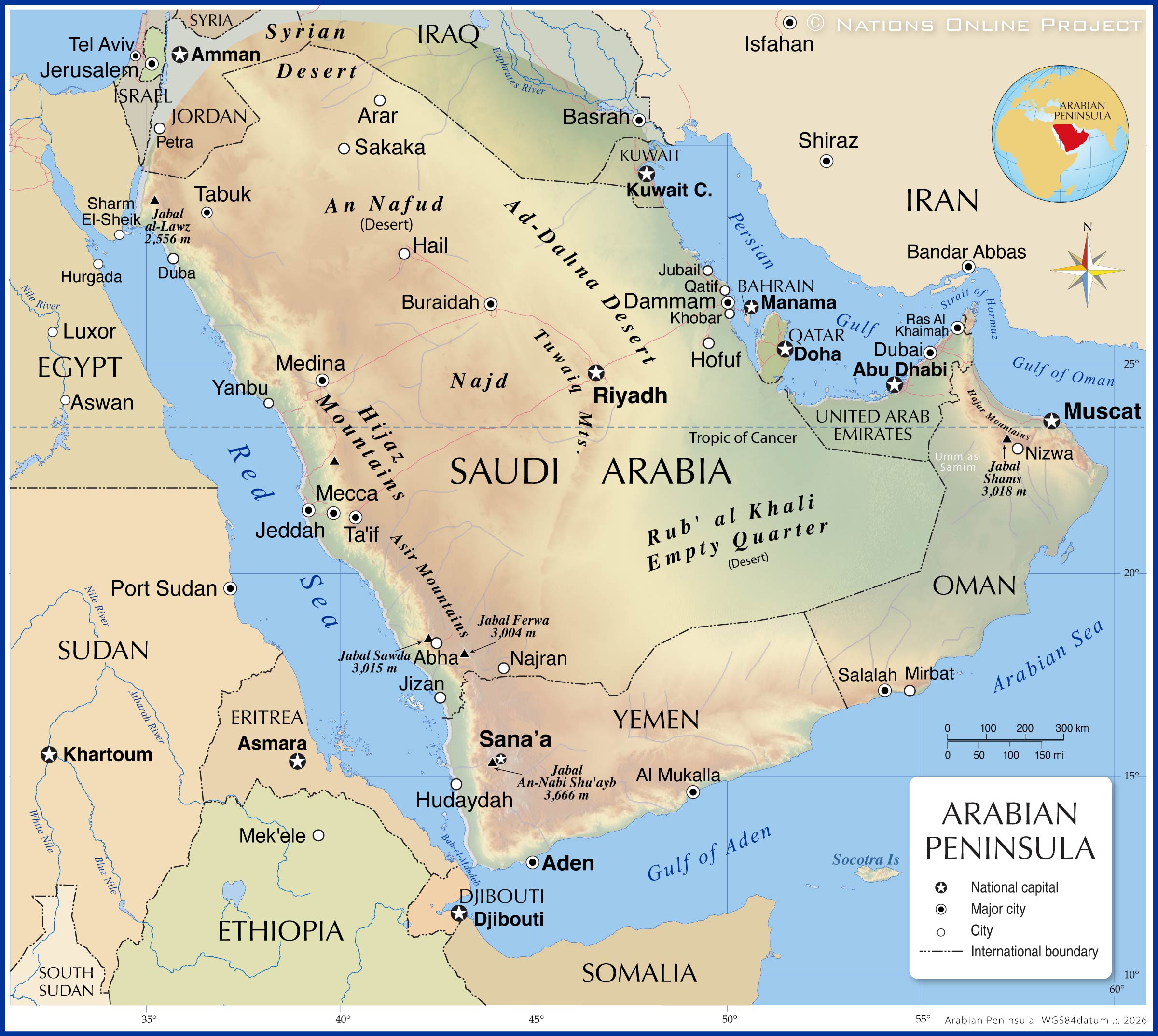
Historical & Biblical Background
The Arabian Peninsula is one of the largest landmasses on earth — a vast subcontinent of desert, mountain, and coastline stretching from the Red Sea to the Persian Gulf, from the Fertile Crescent in the north to the Indian Ocean in the south. In ancient times it was not merely empty wilderness. It was the homeland of peoples whose names fill the pages of Scripture, the source of luxury goods that enriched Solomon's kingdom, and the land from which, one day, a religion would emerge that would change the history of the world.
Ishmael — Father of the Arab Peoples
The biblical connection to Arabia begins with Ishmael, Abraham's firstborn son by Hagar the Egyptian. God made a covenant with Ishmael too — not the covenant of the Promised Land, but a covenant of blessing and multiplication: "I will make him a great nation" (Genesis 17:20). Ishmael's twelve sons became the twelve princes of the Arab peoples, settling "from Havilah unto Shur, that is before Egypt, as thou goest toward Assyria" (Genesis 25:18) — a description that maps almost exactly onto the northwestern Arabian Peninsula visible on this map. The Arab world is not an accident of history. It is a fulfillment of God's promise to Abraham's firstborn.
The Queen of Sheba — Solomon's Royal Visitor
Sheba — the land of the Queen who traveled to Jerusalem to test Solomon's wisdom (1 Kings 10:1–13) — is located in what is today Yemen, at the southwestern tip of the Arabian Peninsula. The ancient Sabaean civilization of Yemen was one of the wealthiest in the ancient world, its prosperity built on the incense trade — frankincense and myrrh carried along the Incense Route northward through Arabia to the markets of the Mediterranean. When the Queen of Sheba arrived in Jerusalem with "camels that bare spices, and very much gold, and precious stones" (1 Kings 10:2), she was bringing the wealth of Arabia to the court of Israel's greatest king.
Ophir, Havilah and Solomon's Gold
Solomon sent his fleet from Ezion-geber (Eilat, at the top of this map's Red Sea) to Ophir, returning with 420 talents of gold (1 Kings 9:26–28). Ophir's exact location remains one of the great geographical mysteries of Scripture — candidates include Yemen, Oman, Somalia, India, and even Zimbabwe. Havilah, noted in Genesis 2:11 as the land "where there is gold," may correspond to a region of northwestern Arabia. Whatever the precise locations, the Arabian Peninsula was the biblical world's primary source of gold, frankincense, myrrh, and precious stones.
Arabia in Prophecy
The Arabian Peninsula appears in the last-days prophecies in a remarkable way. Ezekiel 38:13 mentions "Sheba, and Dedan, and the merchants of Tarshish" as standing aside and asking questions when Gog attacks Israel — suggesting these Arabian nations are not part of the invading coalition. Isaiah 60:6–7 prophesies that "the multitude of camels shall cover thee, the dromedaries of Midian and Ephah; all they from Sheba shall come: they shall bring gold and incense; and they shall shew forth the praises of the LORD." The wealth of Arabia, which once flowed to Solomon, will one day flow to the greater Son of David.
"The multitude of camels shall cover thee, the dromedaries of Midian and Ephah; all they from Sheba shall come: they shall bring gold and incense; and they shall shew forth the praises of the LORD."— Isaiah 60:6 (KJV)
Key Scripture References
Genesis 17:20 — God's covenant with Ishmael — twelve princes, a great nation
Genesis 25:12–18 — The twelve sons of Ishmael and their territory
1 Kings 9:26–28 — Solomon's fleet to Ophir from Ezion-geber
1 Kings 10:1–13 — The Queen of Sheba visits Solomon in Jerusalem
Job 6:19 — "The troops of Tema looked, the companies of Sheba waited for them"
Isaiah 21:13–17 — Burden of Arabia — Kedar, Tema, Dedan
Isaiah 60:6–7 — Arabia's wealth flowing to the Messiah's kingdom
Ezekiel 38:13 — "Sheba, and Dedan" — not part of Gog's coalition
Galatians 4:25 — "Sinai is a mountain in Arabia" — Paul's geographical note