
The Greek Empire Under Alexander
Historical & Biblical Background
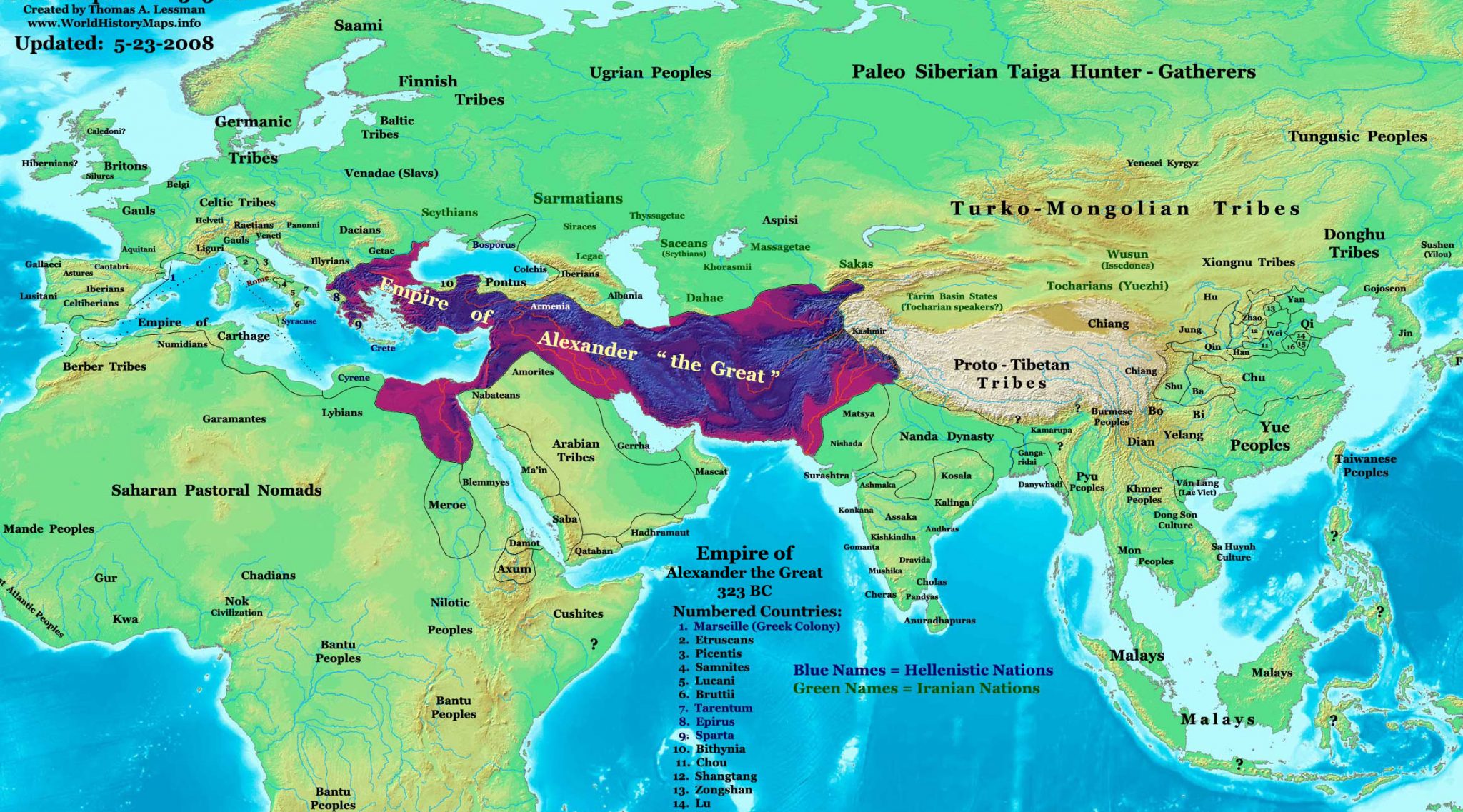
In thirteen years — from 336 to 323 BC — Alexander III of Macedon conquered an empire stretching from Greece to northwestern India, covering over 5 million square kilometers. He never lost a battle. He crossed the Hellespont with 37,000 men and dismantled the Persian Empire — the greatest power on earth — in a series of stunning victories at the Granicus, Issus, and Gaugamela. He founded over twenty cities bearing his name, including Alexandria in Egypt, which became the greatest city in the world. He died at 32 in Babylon, of fever. And he had been described, in precise detail, by the prophet Daniel approximately 200 years before his birth.
Daniel's Vision — The Great Goat
In Daniel 8, written during the Babylonian exile around 550 BC, the prophet sees a vision: a he-goat comes from the west "on the face of the whole earth, and touched not the ground" — describing the speed of Alexander's advance. The goat has one great horn between its eyes — Alexander himself. It attacks the ram with two horns (Media and Persia) and shatters it completely. "The he goat waxed very great: and when he was strong, the great horn was broken; and for it came up four notable ones toward the four winds of heaven" (Daniel 8:8). At Alexander's death, his empire was divided among four of his generals — exactly as Daniel foretold.
Alexander and Jerusalem
The Jewish historian Josephus records a remarkable encounter between Alexander and the high priest Jaddua at Jerusalem. When Alexander was marching south after his victory at Issus (333 BC), he demanded tribute from Jerusalem. The high priest, according to Josephus, met him in priestly robes at the city gate. Alexander dismounted, bowed before the high priest, and was shown the book of Daniel — in which Alexander saw his own conquest described. He spared Jerusalem, offered sacrifice at the Temple, and granted the Jews favorable terms. Whether or not every detail of this account is accurate, Alexander did treat Jerusalem far better than he treated other cities, and the Jews thrived under early Hellenistic rule.
The Greek Language — God's Preparation for the Gospel
Alexander's most enduring legacy for biblical history was not military but linguistic. His conquests spread the Greek language — Koine Greek — across the entire Near East and Mediterranean world. This common tongue persisted for centuries after his death. When God chose to give the world the New Testament, He gave it in Koine Greek — the language Alexander's empire had spread from Spain to India. The Septuagint (the Greek translation of the Hebrew Old Testament, completed in Alexandria c.250 BC) was also a direct product of Alexander's Greek world. Without Alexander, the New Testament could not have reached the world as it did.
The Four Successor Kingdoms — Setting Up Antiochus
When Alexander died without a clear heir, his empire fractured into four successor kingdoms — exactly as Daniel 8:8 predicted. The Seleucid kingdom (Syria and the East) and the Ptolemaic kingdom (Egypt) fought repeatedly over the land of Israel, which sat between them. It was from the Seleucid line that Antiochus IV Epiphanes arose — the "little horn" of Daniel 8 who desecrated the Temple in 167 BC, triggering the Maccabean revolt and the miracle of Hanukkah. The entire chain — Alexander, division, Seleucids, Antiochus, Maccabees — was outlined in Daniel centuries before it happened.
"The rough goat is the king of Grecia: and the great horn that is between his eyes is the first king. Now that being broken, whereas four stood up for it, four kingdoms shall stand up out of the nation, but not in his power."— Daniel 8:21–22 (KJV)
Key Scripture References
Daniel 7:6 — The leopard with four wings and four heads — Alexander and his four successors
Daniel 8:5–8 — The he-goat from the west; the great horn broken; four in its place
Daniel 8:20–22 — Angel interprets: the goat is Greece; the horn is the first king
Daniel 11:3–4 — "A mighty king shall stand up... and his kingdom shall be broken"
Zechariah 9:1–8 — Zechariah describes Alexander's campaign route through the Levant
1 Maccabees 1:1–9 — Alexander's conquests described in the Apocrypha
Acts 6:1 — "Hellenists" — Greek-speaking Jews in the early church, product of Alexander's world