
The Kingdom of Moab
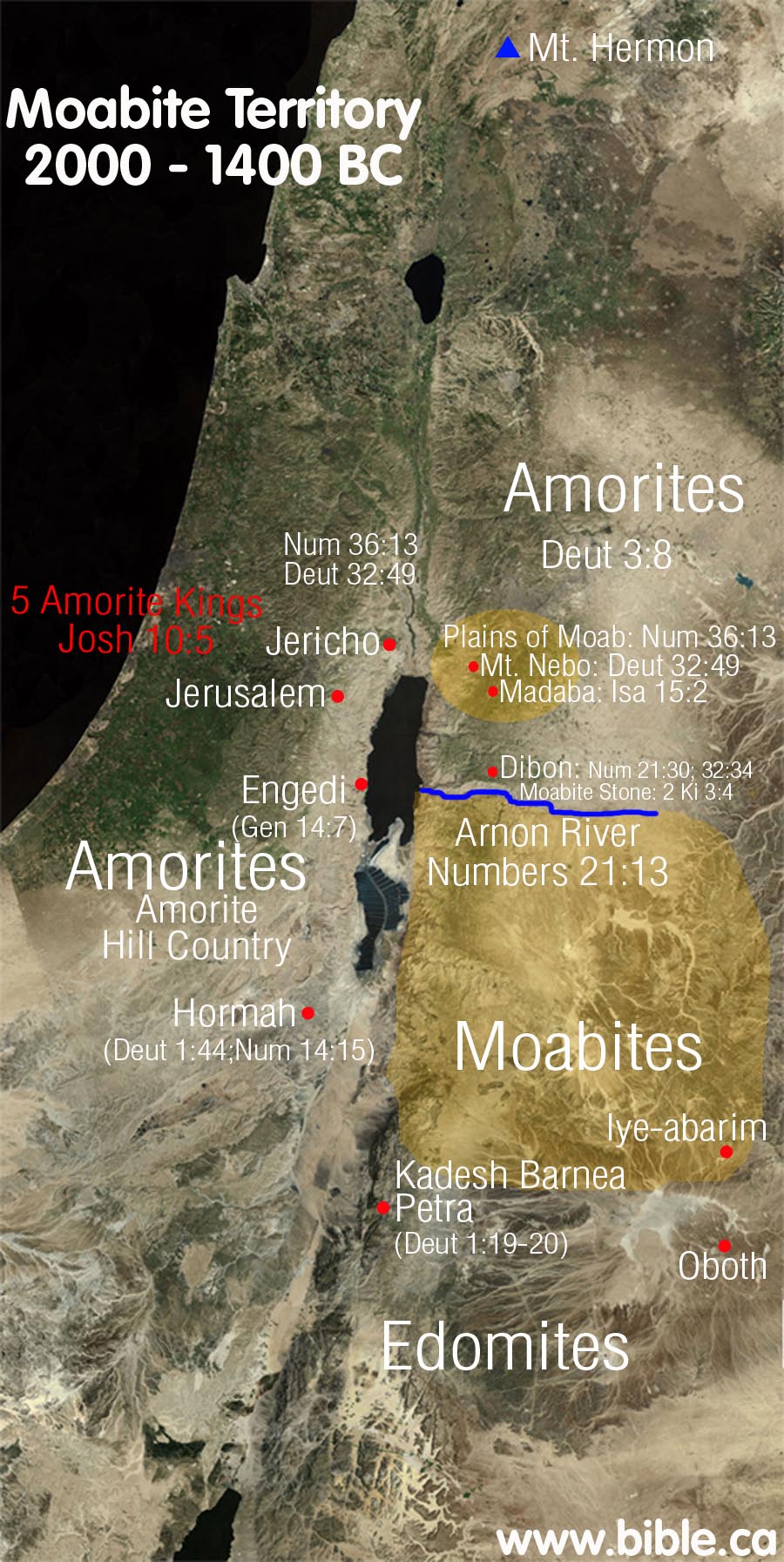
Historical & Biblical Background
Moab occupies a fascinating place in biblical history — neither fully foreign nor fully within the covenant, a nation born of compromise and yet woven into the redemptive line of the Messiah Himself. The Moabites were the descendants of Lot's elder son Moab, born of the incestuous union after the destruction of Sodom (Genesis 19:37). They settled the high plateau east of the Dead Sea, bounded on the north by the Arnon River and on the south by the Zered — the territory shown in gold on this map.
Israel and Moab — A Complex Relationship
Like Edom, Moab was kin to Israel — descendants of Abraham's nephew Lot. God told Moses to respect Moab's territory: "Distress not the Moabites, neither contend with them in battle: for I will not give thee of their land for a possession; because I have given Ar unto the children of Lot for a possession" (Deuteronomy 2:9). Yet Moab hired Balaam to curse Israel (Numbers 22), seduced Israel into Baal worship at Peor (Numbers 25), and oppressed Israel for eighteen years under Eglon in the time of the Judges (Judges 3:12–14). Because of their hostility, a Moabite was excluded from the congregation of Israel "even to the tenth generation" (Deuteronomy 23:3).
The Plains of Moab — Israel's Final Camp
The Plains of Moab, visible at the top of the gold-shaded territory on this map, are where Israel pitched camp after forty years of wilderness wandering — directly opposite Jericho, on the east bank of the Jordan. It was here that Moses gave his final sermons (the book of Deuteronomy), here that the law was renewed, and here that Moses climbed Mount Nebo to view the Promised Land before he died. The whole drama of Deuteronomy is set on this visible plateau looking west across the Jordan valley to Canaan.
Ruth — The Moabitess in the Messianic Line
The most remarkable thing about Moab in Scripture is what it contributed to the Messianic line. Ruth was a Moabitess — a woman from the territory shown on this map. When her mother-in-law Naomi returned to Bethlehem after the death of her husband and sons, Ruth refused to leave her. Her declaration — "thy people shall be my people, and thy God my God" (Ruth 1:16) — stands as one of the most beautiful confessions of faith in all of Scripture. Ruth married Boaz, became the great-grandmother of King David, and is listed by name in the genealogy of Jesus Christ (Matthew 1:5). God's grace reaches even to Moab.
The Moabite Stone
Dibon — marked on this map — is the site where the Moabite Stone (also called the Mesha Stele) was discovered in 1868. Erected by King Mesha of Moab around 840 BC, it is one of the most important archaeological finds in biblical history — an inscription that directly references "Israel," "the house of David," and the God of Israel, confirming multiple biblical accounts from 2 Kings 3. It is now in the Louvre in Paris.
"And Moses went up from the plains of Moab unto the mountain of Nebo, to the top of Pisgah, that is over against Jericho. And the LORD shewed him all the land of Gilead, unto Dan... And the LORD said unto him, This is the land which I sware unto Abraham, unto Isaac, and unto Jacob, saying, I will give it unto thy seed: I have caused thee to see it with thine eyes, but thou shalt not go over thither."— Deuteronomy 34:1–4 (KJV)
Key Scripture References
Numbers 21:13 — The Arnon River — Moab's northern boundary
Numbers 22–25 — Balak hires Balaam to curse Israel; Moab seduces Israel at Peor
Deuteronomy 2:9 — God commands Israel to respect Moab's territory
Deuteronomy 34:1–6 — Moses views Canaan from Mt. Nebo and dies in Moab
Judges 3:12–30 — Eglon of Moab oppresses Israel; Ehud's deliverance
Ruth 1–4 — Ruth the Moabitess; her faithfulness and marriage to Boaz
2 Kings 3:4 — Mesha king of Moab; the Moabite Stone context
Matthew 1:5 — Ruth the Moabitess listed in the genealogy of Jesus Christ