
The Kingdom of Edom
Historical & Biblical Background
The Kingdom of Edom occupies a unique and tragic place in biblical history. The Edomites were not strangers to Israel — they were brothers, the descendants of Esau, Jacob's twin (Genesis 36:1). This makes their persistent hostility to Israel all the more grievous, and their prophetic judgment all the more severe. No nation in the Old Testament receives a harsher sentence than Edom. The entire book of Obadiah is devoted to Edom's judgment, and passages in Isaiah, Jeremiah, Ezekiel, Amos, and Malachi all pronounce doom on "the brother of Jacob."
Esau — Father of Edom
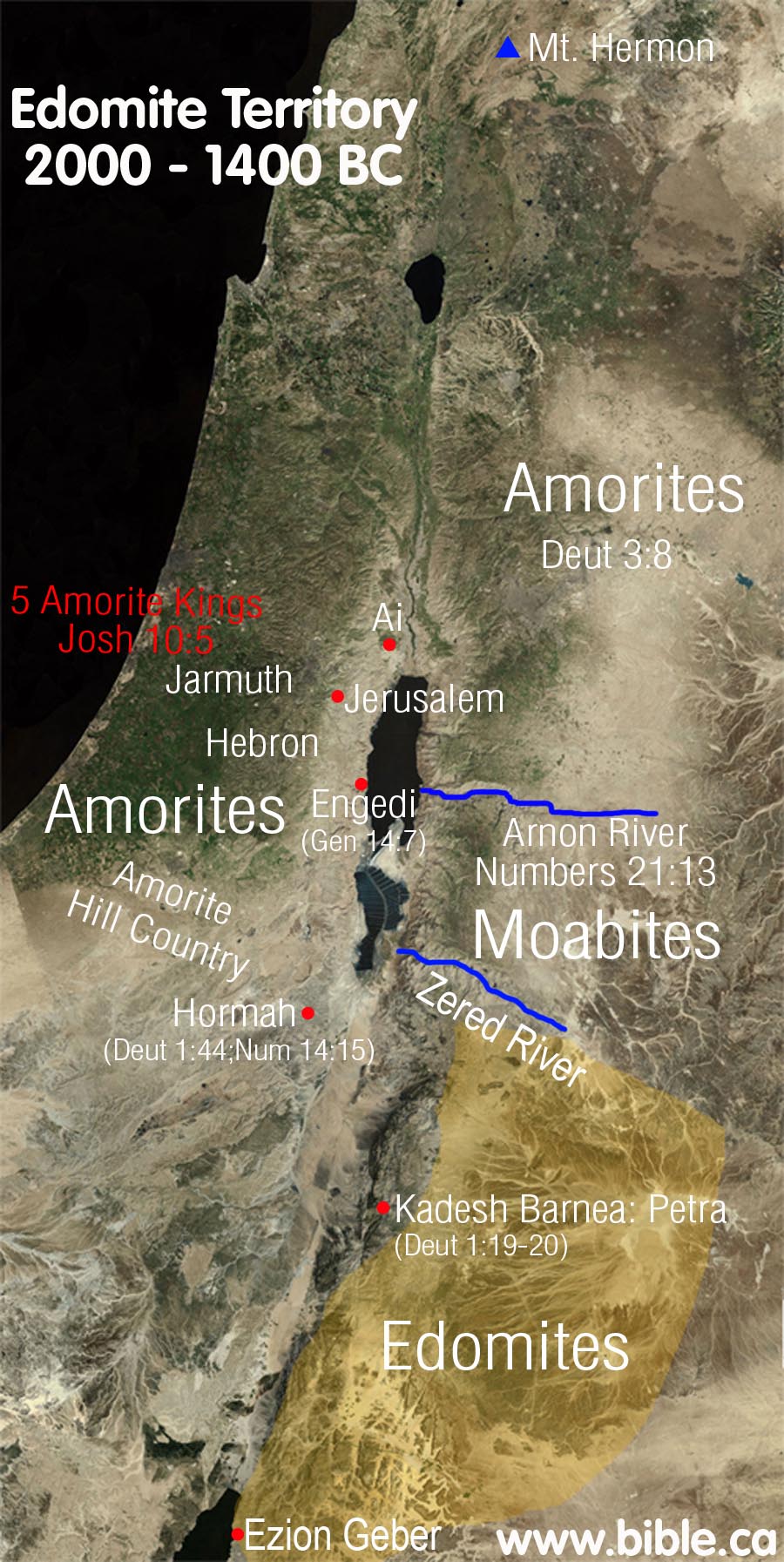
The conflict between Israel and Edom began before birth. In the womb, Jacob and Esau struggled, and God told Rebekah: "two nations are in thy womb... the one people shall be stronger than the other people; and the elder shall serve the younger" (Genesis 25:23). Esau sold his birthright for a bowl of lentil stew. He married Hittite women. He settled in the rugged mountains of Seir, south of the Dead Sea — the territory shown as Edom on this map. Genesis 36 records his descendants becoming kings in Edom long before Israel had a king — a fact the Bible notes as a marker of Esau's earthly success and spiritual forfeiture.
Edom and the Exodus
When Moses led Israel through the wilderness and sought to pass through Edom on the King's Highway, Edom refused — threatening war: "Thou shalt not pass by me, lest I come out against thee with the sword" (Numbers 20:18). Israel was forced to go around, adding miles to an already exhausting journey. This was a profound betrayal of kinship. Yet God commanded Israel: "Thou shalt not abhor an Edomite; for he is thy brother" (Deuteronomy 23:7). Even in Edom's hostility, God maintained the covenant of brotherhood.
Edom's Great Sin — Standing Aside at Jerusalem's Fall
Edom's darkest hour came when Nebuchadnezzar destroyed Jerusalem in 586 BC. The Edomites not only stood aside — they cheered. "Remember, O LORD, the children of Edom in the day of Jerusalem; who said, Rase it, rase it, even to the foundation thereof" (Psalm 137:7). Obadiah 1:11–14 catalogs their sins in devastating detail: they stood on the other side, rejoiced at Judah's disaster, boasted in the day of distress, cut off those who escaped, and handed over survivors to their enemies. For this, the prophets pronounced utter and irrevocable destruction.
The Fulfilment — Petra and the End of Edom
The prophecies against Edom have been fulfilled with remarkable precision. Obadiah declared: "there shall not be any remaining of the house of Esau" (Obadiah 1:18). Malachi called Edom's mountains "the border of wickedness" and said God had laid waste their heritage "for ever" (Malachi 1:3–4). By the first century AD the Edomites — by then known as Idumeans — had been absorbed into the Jewish people, and after 70 AD they disappear entirely from history as a distinct nation. The rose-red city of Petra, carved into the Edomite cliffs, stands today as a tourist attraction — a monument to a people God said would be "cut off for ever."
"The pride of thine heart hath deceived thee, thou that dwellest in the clefts of the rock, whose habitation is high; that saith in his heart, Who shall bring me down to the ground? Though thou exalt thyself as the eagle, and though thou set thy nest among the stars, thence will I bring thee down, saith the LORD."— Obadiah 1:3–4 (KJV)
Key Scripture References
Genesis 36:1–43 — The descendants of Esau/Edom; their kings listed
Numbers 20:14–21 — Edom refuses Israel passage on the King's Highway
Deuteronomy 23:7 — "Thou shalt not abhor an Edomite; for he is thy brother"
Psalm 137:7 — Edom cheering at Jerusalem's destruction
Obadiah 1:1–21 — The entire book devoted to Edom's judgment
Isaiah 34:5–17 — God's sword falls on Edom
Malachi 1:2–5 — "Jacob have I loved, but Esau have I hated"
Romans 9:13 — Paul quotes Malachi on Esau and Jacob