
Ancient Phoenicia & Its Sea Ports
Historical & Biblical Background
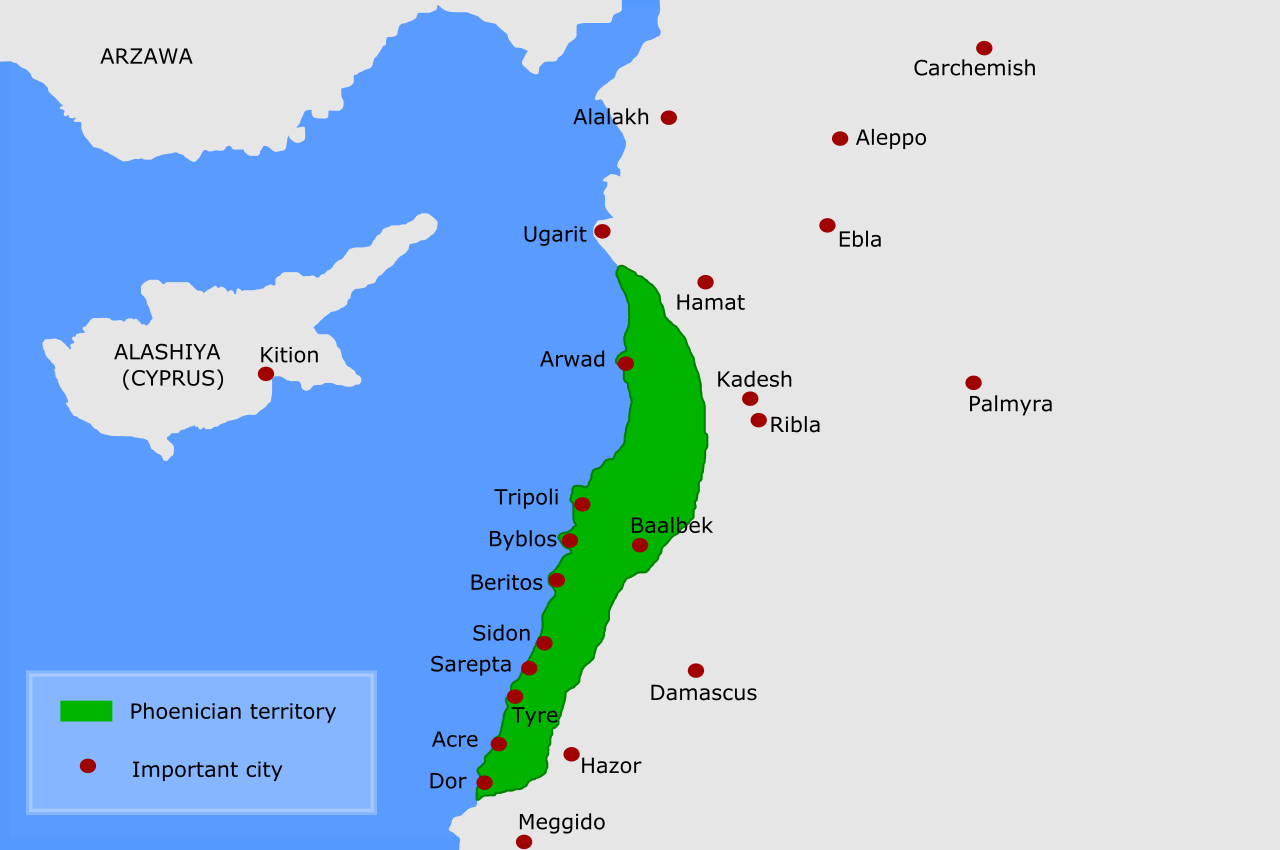
Phoenicia was one of the most influential civilizations in history — not through military conquest but through commerce, craftsmanship, and communication. Occupying a narrow coastal strip of modern Lebanon and northern Israel, the Phoenicians became the greatest maritime traders of the ancient world, establishing colonies across the Mediterranean from Cyprus to Spain, and giving humanity one of its most enduring gifts: the alphabet. Their territory on this map is the green sliver between the Mediterranean and the Lebanon mountains — small in size, immense in impact. To the south lay the Philistine coast; inland rose the hill country of Israel and, further east, the kingdoms of Aram and Damascus.
The Purple Empire — Why They Were Called Phoenicians
The very name “Phoenician” comes from the Greek phoinix, meaning purple-red — a tribute to the single industry that made these cities fabulously wealthy. Along this coast, and nowhere else in such abundance, lived the murex sea-snail, from whose glands the Phoenicians extracted a dye of deep crimson-purple so costly it became the colour of kings. It took thousands of crushed shells to dye a single garment, and mounds of their broken shells still line the ancient harbours. This “Tyrian purple” clothed royalty from Jerusalem to Rome; when Scripture makes purple and scarlet the very fabric of wealth and majesty (Exodus 26; Proverbs 31:22; Luke 16:19), it is Phoenicia’s trade that stands behind the image. A people named for a colour built an empire on the sea.
Byblos — Where the Bible Got Its Name
Byblos — visible on this map — is one of the oldest continuously inhabited cities on earth, and it gave the world the word "Bible." The Greeks called it Byblos, from which came their word for papyrus (byblos) and then their word for book (biblion) — and ultimately the English word "Bible." It was through Byblos that Egyptian papyrus was exported to Greece, and it was here that the Phoenician alphabet — the ancestor of Greek, Latin, and ultimately all Western alphabets — was developed. Every letter you are reading right now traces its ancestry to Phoenicia.
Hiram of Tyre and Solomon's Temple
Tyre — the greatest Phoenician city, shown near the bottom of the green territory — plays a pivotal role in Israel's golden age. King Hiram of Tyre was a close ally of both David and Solomon. When Solomon announced his intention to build the Temple, Hiram supplied the cedar and cypress timber from the Lebanon mountains, the skilled craftsmen to work stone and metal, and Hiram-abi the master craftsman who cast the Temple's bronze pillars, the bronze sea, and all its sacred vessels (1 Kings 5–7). Without Phoenicia, Solomon's Temple could not have been built as it was. God used a pagan king and his craftsmen to supply the house of the LORD.
Sarepta — Elijah and the Widow
Sarepta (Zarephath), shown on this map between Sidon and Tyre, is where God sent the prophet Elijah during the three-year drought — into the heartland of Jezebel's own homeland. There Elijah lodged with a Phoenician widow, multiplied her flour and oil, and raised her dead son (1 Kings 17:8–24). Jesus later cited this incident explicitly: "Many widows were in Israel in the days of Elias... but unto none of them was Elias sent, save unto Sarepta, a city of Sidon, unto a woman that was a widow" (Luke 4:26). God's grace always extended beyond Israel's borders.
Jezebel of Sidon and the Battle for Israel’s Soul
The same coast that sheltered Elijah also produced his fiercest enemy. When Ahab king of Israel married Jezebel, “the daughter of Ethbaal king of the Zidonians” (1 Kings 16:31), he imported Phoenicia’s gods along with his bride. Jezebel filled Israel with the worship of Baal and Asherah, fed hundreds of their prophets at her table, and hunted the prophets of the LORD to the death. It was against this Sidonian queen and her imported cult that Elijah stood alone on Mount Carmel (1 Kings 18). The irony is exact: while a Sidonian queen tried to drown Israel’s faith in Baal, a Sidonian widow at Sarepta was sheltering the LORD’s prophet and confessing His word. The same nation supplied both Israel’s temptation and a testimony to God’s grace.
The Judgment of Tyre — Ezekiel's Prophecy
Tyre's pride and wealth also made it the subject of one of Scripture's most detailed prophecies. Ezekiel 26–28 pronounces judgment on Tyre in vivid detail — that its stones and timber would be thrown into the sea, that it would become "a bare rock, a place for the spreading of nets" (Ezekiel 26:14). Alexander the Great's siege of Tyre in 332 BC — when he scraped the mainland city into the sea to build a causeway to the island fortress — is often cited as a remarkable fulfillment of this prophecy. The ancient city of mainland Tyre was never rebuilt as a great city. Modern Tyre (Sur) is a modest Lebanese town.
"And they shall destroy the walls of Tyrus, and break down her towers: I will also scrape her dust from her, and make her like the top of a rock. It shall be a place for the spreading of nets in the midst of the sea."— Ezekiel 26:4–5 (KJV)
Amos and the Broken Brotherhood
Tyre’s judgment was not only for pride but for betrayal. The prophet Amos condemned Tyre because “they delivered up the whole captivity to Edom, and remembered not the brotherly covenant” (Amos 1:9) — selling refugees who had fled to them into the hands of the kingdom of Edom. The old friendship between Hiram and David had curdled, in Tyre’s later merchants, into a traffic in human beings. Wealth without mercy, Scripture warns, invites the judgment of God however dazzling the empire that amasses it.
Tyre and Sidon in the Gospels
The names of Tyre and Sidon do not vanish with the Old Testament. Jesus Himself withdrew into their region, and there a Gentile mother — called a Canaanite by Matthew and a Syrophenician by Mark — begged Him to heal her daughter. When He tested her with the saying that the children’s bread should not be cast to dogs, she answered with such humble faith that He marvelled: “O woman, great is thy faith” (Matthew 15:21–28; Mark 7:24–30). Earlier He had warned the unbelieving towns of Galilee that “if the mighty works... had been done in Tyre and Sidon, they would have repented long ago” (Matthew 11:21) — the pagan coast would rise to judge the privileged. And when Paul sailed home from his third journey, the disciples at Tyre, with their wives and children, knelt with him on the shore to pray (Acts 21:3–6). The purple empire had become a harbour of the church.
Key Scripture References
1 Kings 5:1–12 — Hiram of Tyre supplies cedar for Solomon's Temple
1 Kings 7:13–47 — Hiram-abi crafts the Temple's bronze work
1 Kings 16:31 — Ahab marries Jezebel, daughter of the king of Sidon
1 Kings 17:8–24 — Elijah at Zarephath/Sarepta — the widow's oil and son
Amos 1:9–10 — Judgment on Tyre for delivering Israelites to Edom
Ezekiel 26–28 — The full prophecy against Tyre and its king
Matthew 15:21–28 — Jesus in the region of Tyre and Sidon; the Canaanite woman
Mark 7:24–30 — The Syrophenician woman’s faith in the region of Tyre
Acts 21:3–6 — Paul and the disciples of Tyre pray together on the shore
Luke 4:26 — Jesus cites Elijah's ministry to the widow of Sarepta