
The Kingdom of Ammon
Historical & Biblical Background
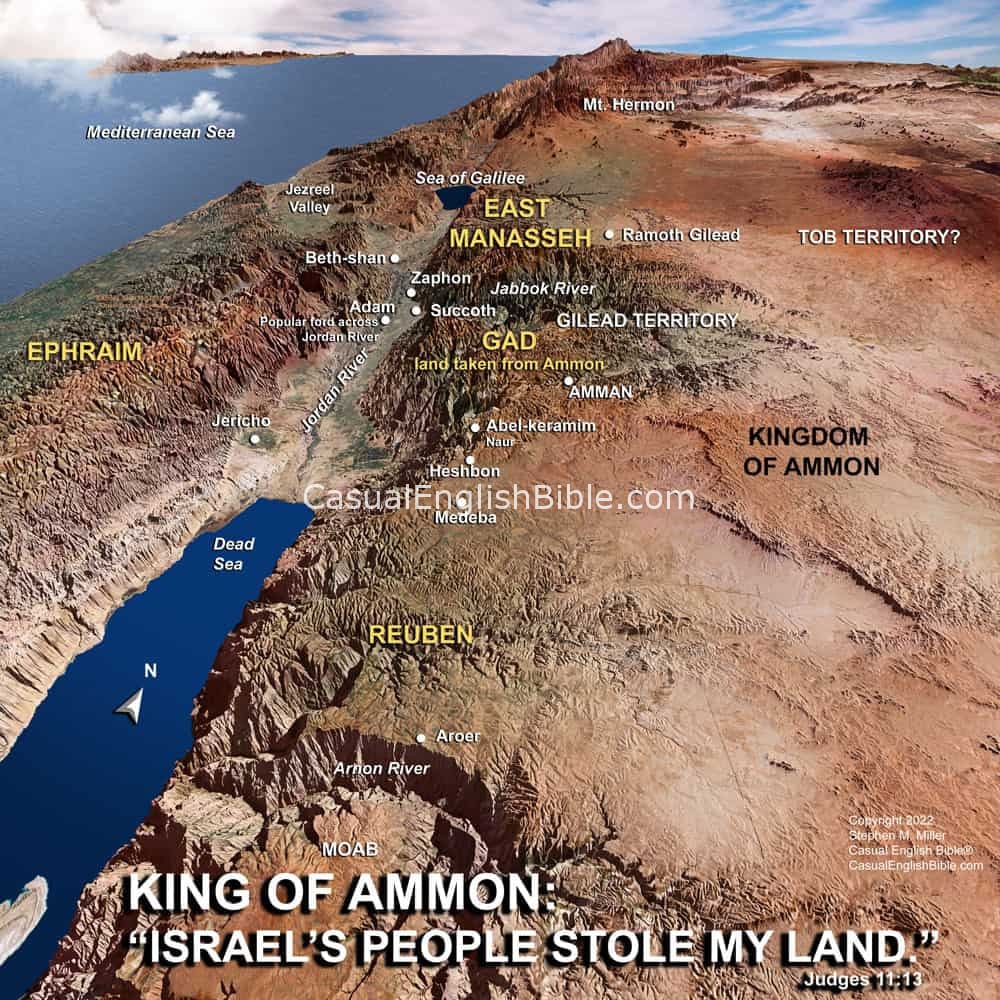
Like their neighbors Moab, the Ammonites were descendants of Lot — born of his younger daughter after the destruction of Sodom (Genesis 19:38). They settled east of the Jordan River and the Dead Sea, in the territory of modern central Jordan, with their capital at Rabbath-Ammon — a city that still exists today as Amman, the capital of Jordan. The name of one of the oldest cities in the ancient world is preserved in a modern Arab capital — a remarkable continuity of history.
Ammon and the Land Question
The land dispute captured in the map's headline — "Israel's people stole my land" — comes directly from Judges 11:13, where the King of Ammon confronts Jephthah. It is a dispute about Gilead, the fertile territory between the Jabbok River and the Arnon, shown clearly on this map as the territory of Gad labeled "land taken from Ammon." Jephthah's diplomatic reply (Judges 11:14–27) is one of the most carefully reasoned arguments in all of Scripture — citing history, precedent, and divine sovereignty — and it reads like a legal brief that could have been written yesterday.
Jephthah's Victory and His Vow
When diplomacy failed, Jephthah went to war — and God gave him victory over the Ammonites, striking down twenty cities from Aroer to Abel-keramim (Judges 11:33), visible on this map. But Jephthah's story is shadowed by his rash vow before the battle — that whatever came out of his house first would be offered as a burnt offering. His daughter came out first. The tragedy of Jephthah's vow has been debated by scholars for centuries; what is beyond debate is that his impulsive words cost him everything he came home to celebrate.
Ammon Throughout Israel's History
The Ammonites appear repeatedly as adversaries of Israel. They allied with Moab and Amalek to oppress Israel under Eglon (Judges 3:13). They oppressed Israel for eighteen years before Jephthah's deliverance (Judges 10:8). Nahash the Ammonite threatened to gouge out the right eye of every man of Jabesh-gilead — and it was Saul's response to that threat that launched his kingship (1 Samuel 11). David later fought the Ammonites after they humiliated his ambassadors (2 Samuel 10). Solomon's foreign wives included Ammonites, who turned his heart to their god Molech (1 Kings 11:1–7). And the prophet Nehemiah's enemy Tobiah was an Ammonite (Nehemiah 2:10).
Ammon Today — A Living Reminder
The capital of Jordan — Amman — takes its name directly from the ancient Ammonites. A city founded by Israel's ancient adversaries is today the capital of a nation that shares a peace treaty with Israel. The ancient land disputes of Judges 11 have not disappeared; they have simply changed their language. Understanding the biblical history of Ammon helps explain the deep roots of the modern conflict over the Transjordanian territories — roots that go back not centuries but millennia.
"Then Jephthah sent messengers unto the king of the children of Ammon, saying... While Israel dwelt in Heshbon and her towns... three hundred years; why therefore did ye not recover them within that time? Wherefore I have not sinned against thee, but thou doest me wrong to war against me: the LORD the Judge be judge this day between the children of Israel and the children of Ammon."— Judges 11:14–27 (KJV, condensed)
Key Scripture References
Deuteronomy 2:19 — God commands Israel not to take Ammon's land
Judges 10:6–11:33 — Ammonite oppression; Jephthah's victory
Judges 11:12–27 — Jephthah's diplomatic brief — the land argument
1 Samuel 11:1–11 — Nahash threatens Jabesh-gilead; Saul rises
2 Samuel 10–12 — David's war against Ammon; Uriah the Hittite
1 Kings 11:1–7 — Solomon's Ammonite wives; worship of Molech
Amos 1:13–15 — Prophecy of judgment against Ammon
Ezekiel 25:1–7 — "Because thou saidst, Aha, against my sanctuary"