
Abraham in Egypt
Historical & Biblical Background
Abraham had barely arrived in Canaan when the first test came — not a test of courage or obedience, but of trust. A severe famine struck the land God had just promised him. The natural response was to go where food was available — Egypt, the most reliable granary of the ancient world, watered by the Nile regardless of rainfall in Canaan. Abraham went down into Egypt. It was a decision that would set a pattern repeated throughout the Bible — the Promised Land failing to provide, and God's people looking to Egypt for survival.
The Deception — Sarai as Sister
Approaching Egypt, Abraham was afraid. Sarai was beautiful, and he feared the Egyptians would kill him to take her. He asked her to say she was his sister rather than his wife — technically a half-truth, as she was his half-sister (Genesis 20:12) — but a deception nonetheless. The plan backfired spectacularly. Pharaoh's officials noticed Sarai's beauty, praised her to Pharaoh, and she was taken into his house. Abraham received gifts of livestock and servants — including, apparently, an Egyptian maidservant named Hagar who would later become the mother of Ishmael and the source of centuries of conflict.
God's Intervention
God did not leave Sarai in Pharaoh's house. He struck Pharaoh and his household with great plagues — the same word used for the plagues of the Exodus — until Pharaoh discovered the truth. "What is this that thou hast done unto me? Why didst thou not tell me that she was thy wife?" (Genesis 12:18). Pharaoh sent Abraham away with Sarai and all his possessions intact. The father of faith had failed — and God had protected the covenant despite him. It is one of Scripture's most honest portraits of a flawed man through whom God was working anyway.
Gerar — The Same Mistake Repeated
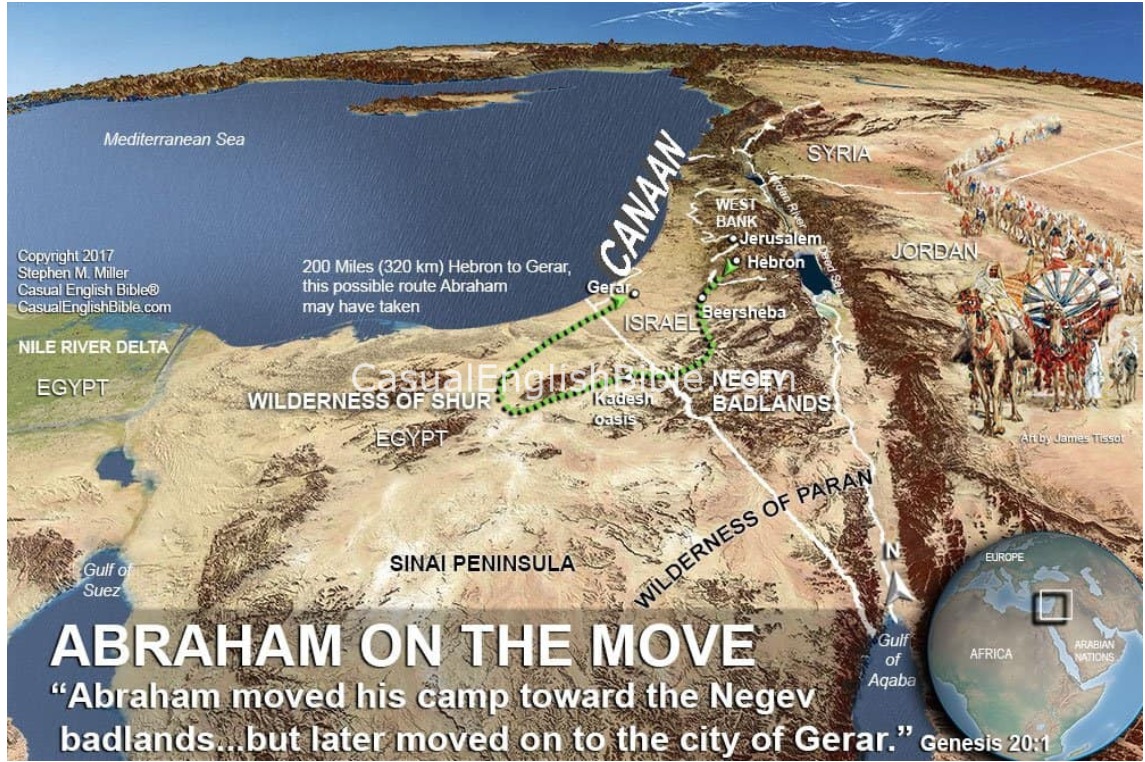
This map focuses on Abraham's later move to Gerar — shown on the green dotted route — which is the setting of Genesis 20. There Abraham repeated the same deception with Abimelech king of Gerar, again claiming Sarai was his sister. God appeared to Abimelech in a dream before he touched Sarah and warned him. Abimelech confronted Abraham, who confessed his fear and rationalized his deception. God healed Abimelech's household, and Abraham — remarkably — was enriched again. The pattern is striking: Abraham's weakness, God's faithfulness, the covenant preserved despite human failure.
"And Abram went up out of Egypt, he, and his wife, and all that he had, and Lot with him, into the south. And Abram was very rich in cattle, in silver, and in gold."— Genesis 13:1–2 (KJV)
Key Scripture References
Genesis 13:1–4 — Abraham returns from Egypt enriched; returns to Bethel
Genesis 16:1 — Hagar introduced as "an Egyptian" — likely acquired during the Egypt visit
Genesis 20:1–18 — Abraham in Gerar; the same deception with Abimelech
Genesis 21:22–34 — Abraham settles in Beersheba after the Gerar episode
Psalm 105:12–15 — God's protection of Abraham: "Touch not mine anointed"