✡ "Pray for the peace of Jerusalem" — Psalm 122:6
Christians Standing With Israel
Home Site Map Search About Us Our Beliefs Online Bible Maps of Israel Articles Grafted In? Apple of His Eye Contact
TOPICS
Israel — Then & Now Anti-Semitism Middle East Christian Zionism Bible Prophecy US & Israel Media Bias Spiritual Deception Arab-Israeli Conflict Islamic Extremism The Iranian Threat Miscellaneous
LATEST: New article by Michael Knighton  •  Subscribe to our weekly newsletter  •  400 Maps of Israel now available  •  Online Bible (KJV) now online
Advertisement
Map 032  ·  The Patriarchs & the Exodus  ·  Genesis 12:1–5

Abraham's Journey from Haran to Canaan
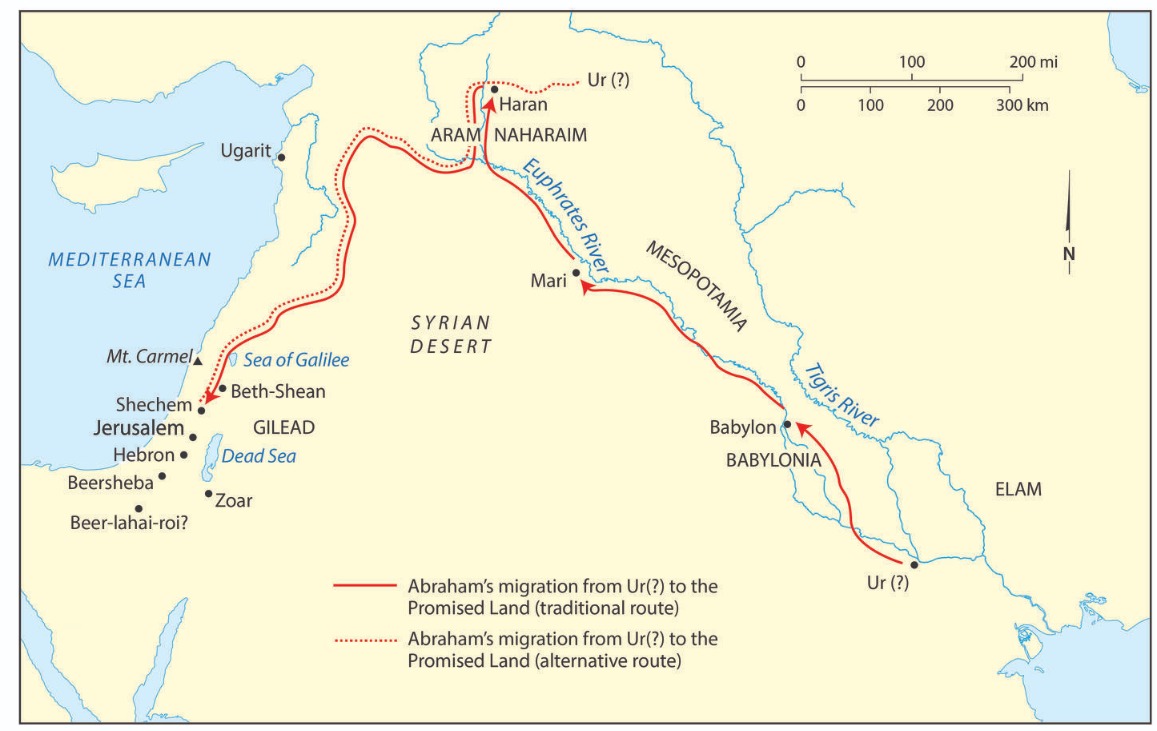
The moment of full obedience — when Abraham left everything behind and entered the land God would give to his descendants forever
"Now the LORD had said unto Abram, Get thee out of thy country, and from thy kindred, and from thy father's house, unto a land that I will shew thee: And I will make of thee a great nation, and I will bless thee, and make thy name great; and thou shalt be a blessing... So Abram departed, as the LORD had spoken unto him."
— Genesis 12:1–4 (KJV)
Map of Abraham's migration from Haran to the Promised Land showing the traditional route (solid red line) southwest from Haran through Syria, down through Canaan to Shechem, Jerusalem, Hebron and Beersheba, and the alternative route (dotted red line) taking a more coastal path
"Abraham's migration from Ur(?) to the Promised Land" — the second leg of Abraham's journey, from Haran southwest into Canaan, showing both the traditional and alternative routes.
Source: Map by Bill Nelson. From The Posen Library of Jewish Culture and Civilization, vol. 1. Used for educational purposes.
Route Key
Traditional route — southwest from Haran through Syria and down into Canaan
Alternative route — more coastal path into Canaan
What This Map Shows
✦ Haran — Abraham's starting point for this leg of the journey
✦ Aram Naharaim — the region Abraham left behind
✦ The Euphrates River — crossed on the way out of Mesopotamia
✦ Mari — the middle-Euphrates city on the traditional route
✦ The Syrian Desert — the landscape traversed heading southwest
✦ Ugarit — the great coastal city to the northwest
✦ Shechem — Abraham's first stop in Canaan; first altar built here
✦ Jerusalem — future site of the Temple, visible on the route
✦ Hebron — where Abraham eventually settled and was buried
✦ Beersheba — the southern boundary of Canaan
✦ Beer-lahai-roi — where Hagar encountered God
✦ Zoar — near the future site of Sodom and Gomorrah
✦ Mt. Carmel, Sea of Galilee, Dead Sea — landmarks of the Promised Land
✦ Gilead — the Transjordanian territory east of the Jordan River

Historical & Biblical Background

After Terah died in Haran, God spoke to Abraham again — and this time Abraham obeyed completely. "So Abram departed, as the LORD had spoken unto him" (Genesis 12:4). He was seventy-five years old. He took his wife Sarai, his nephew Lot, all their possessions, and "the souls that they had gotten in Haran" — servants and members of their household — and set out for a land he had never seen, toward a destination God had not yet named. It is one of the great acts of faith in all of Scripture.

Shechem — The First Stop, The First Promise

Abraham's first recorded stop in Canaan was Shechem — visible on this map — at "the plain of Moreh." There God appeared to him and made the first explicit promise of the land: "Unto thy seed will I give this land" (Genesis 12:7). Abraham built his first altar there. Shechem sits in the heart of what is today the West Bank — and the promise made there has never been revoked. Every dispute over that land today has its roots in this moment.

The Sevenfold Blessing

Before Abraham took a single step toward Canaan, God gave him a sevenfold promise in Genesis 12:2–3 — one of the most important passages in all of Scripture. God promised to make Abraham a great nation, to bless him, to make his name great, to make him a blessing, to bless those who bless him, to curse those who curse him, and that in him all families of the earth would be blessed. That final promise — "in thee shall all families of the earth be blessed" — is quoted by Paul in Galatians 3:8 as the gospel preached in advance to Abraham. The journey on this map is not merely a migration. It is the beginning of the plan of redemption.

Hebron — Abraham's Permanent Home

After passing through Shechem and Bethel, Abraham eventually settled in Hebron — visible at the bottom of the route on this map — where he lived for most of his remaining years. It was in Hebron that he entertained the three visitors who announced Isaac's birth (Genesis 18). It was near Hebron at Machpelah that he bought the only land he ever owned in Canaan — a burial cave — for four hundred shekels of silver (Genesis 23). Abraham, Isaac, Jacob, Sarah, Rebekah, and Leah are all buried there. The Cave of Machpelah in Hebron is one of the most contested holy sites in the world today.

"And the LORD appeared unto Abram, and said, Unto thy seed will I give this land: and there builded he an altar unto the LORD, who appeared unto him."
— Genesis 12:7 (KJV)

Key Scripture References

Genesis 12:1–3 — The sevenfold blessing; God's call to leave Haran
Genesis 12:4–5 — Abraham departs Haran at age 75
Genesis 12:6–7 — Abraham arrives at Shechem; first promise of the land
Genesis 12:8–9 — Abraham moves toward Bethel; builds a second altar
Genesis 13:14–17 — God expands the land promise — north, south, east, west
Genesis 23:1–20 — Abraham buys the cave of Machpelah in Hebron
Galatians 3:8 — Paul: the gospel was preached to Abraham in Genesis 12:3
Hebrews 11:8–10 — Abraham's faith — "he went out, not knowing whither he went"
Map Citation: Map by Bill Nelson. From The Posen Library of Jewish Culture and Civilization, vol. 1. Used for educational purposes. Historical background written by Michael Knighton  ·  Christians Standing With Israel
MAP 031
Abraham's Journey from Ur to Haran
MAP 033
Abraham in Egypt
Advertisement