
Abraham's Journey from Ur to Haran
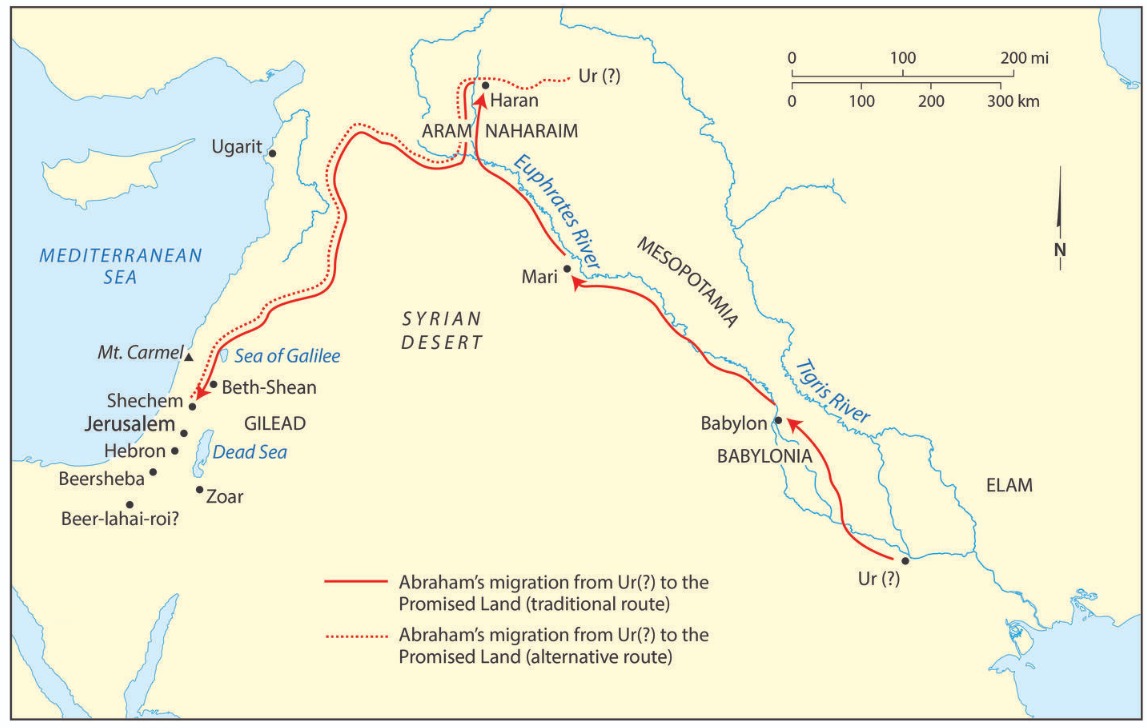
Historical & Biblical Background
The journey mapped here is the beginning of everything. Without this migration — without one elderly man and his family leaving the most powerful city on earth at the word of an unseen God — there is no Israel, no Scripture, no Messiah, no gospel. Every promise God ever made to Abraham's descendants, every prophecy of the Old Testament, every page of the New, traces its origin to the moment Terah and his son Abram packed their belongings and left Ur for a destination they could not yet name.
Where Was Ur?
This map notes "Ur(?)" — the question mark reflecting a genuine scholarly debate. The traditional identification places Ur at Tell el-Muqayyar in southern Iraq, near Basra — one of the great cities of ancient Sumer. This is the site excavated by Leonard Woolley in the 1920s, where the magnificent Royal Tombs confirmed an extraordinarily wealthy Bronze Age civilization. An alternative view places Ur in northern Mesopotamia, nearer to Haran — which would explain why the family stopped there rather than continuing south. The traditional southern location remains the majority scholarly view, and is the one shown as the start of the solid red route on this map.
The Route — Following the Euphrates
The traditional route shown on this map makes geographical sense. Traveling directly west from southern Ur across the Syrian Desert would have been impossible — too vast, too waterless, too dangerous. Instead, the family followed the Euphrates River northward — through Babylonia, past the city of Mari, up through the region called Aram Naharaim ("Aram of the Two Rivers") — and stopped at Haran, a well-watered city in the upper Euphrates region of modern Turkey. Haran was not a random stopping point. It was a city Abraham knew — his brother Nahor had settled there — and it sat at a crossroads of ancient trade routes.
Why Did They Stop at Haran?
Genesis 11:31 says they "came unto Haran, and dwelt there" — and Genesis 11:32 records that Terah died in Haran at the age of 205. The journey to Canaan was interrupted, perhaps by Terah's age and declining health, perhaps by the comfortable familiarity of Haran's culture (which shared Ur's moon-god religion). Abraham himself did not resume the journey until after Terah died and God spoke to him again: "Now the LORD had said unto Abram, Get thee out of thy country, and from thy kindred, and from thy father's house, unto a land that I will shew thee" (Genesis 12:1). Haran was a pause, not the destination. God was not finished.
Stephen's Account — The Call Came First in Ur
The apostle Stephen, in his great speech before the Sanhedrin (Acts 7:2–4), clarifies that the original call of God came to Abraham while he was still in Mesopotamia, before he dwelt in Haran: "The God of glory appeared unto our father Abraham, when he was in Mesopotamia, before he dwelt in Charran." The call was not given in Haran — it was given in Ur. Haran was the partial obedience. Canaan was the full obedience, which only came after Terah died and Abraham was free to finish what God had started.
"The God of glory appeared unto our father Abraham, when he was in Mesopotamia, before he dwelt in Charran, and said unto him, Get thee out of thy country, and from thy kindred, and come into the land which I shall shew thee. Then came he out of the land of the Chaldaeans, and dwelt in Charran: and from thence, when his father was dead, he removed him into this land, wherein ye now dwell."— Acts 7:2–4 (KJV)
Key Scripture References
Genesis 11:31 — Terah departs Ur with Abram, Lot, and Sarai; they settle in Haran
Genesis 11:32 — Terah dies in Haran at age 205
Genesis 12:1–4 — God calls Abram from Haran; he departs at age 75
Genesis 15:7 — "I am the LORD that brought thee out of Ur of the Chaldees"
Acts 7:2–4 — Stephen: the call came while Abraham was still in Mesopotamia
Hebrews 11:8 — "By faith Abraham obeyed; he went out, not knowing whither he went"
Joshua 24:2–3 — "Your fathers dwelt on the other side of the flood... and I took your father Abraham"