
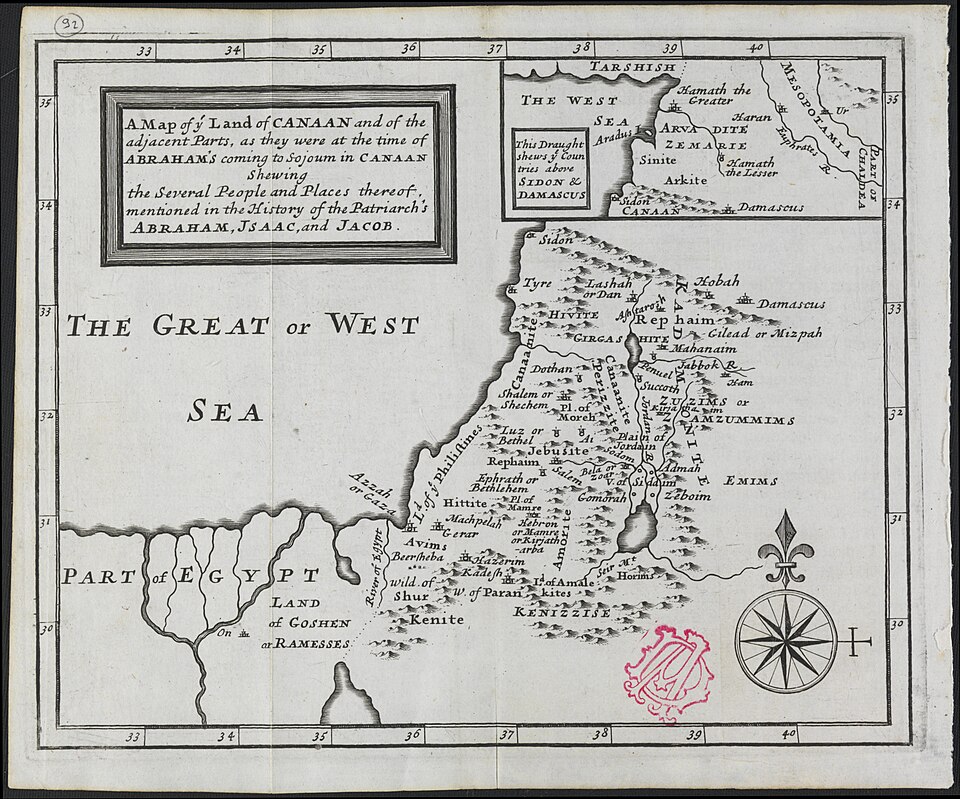
By the time Abraham and Lot returned from Egypt, both men had become extraordinarily wealthy. Genesis 13:2 records that Abraham was "very rich in cattle, in silver, and in gold" — wealth accumulated in part through Pharaoh's gifts during their sojourn. Lot, too, had "flocks, and herds, and tents." The problem was that the land between Bethel and Ai where they had camped together could not sustain both households. Their herdsmen began to quarrel over pasture and water rights, and the conflict threatened to tear apart the extended family.
Abraham's response to this crisis reveals the extraordinary character of the man. As the elder and the patriarch — as the one to whom God had made the covenant promises — he had every social and moral right to choose first. Instead, he offered Lot the first choice of the land. "Is not the whole land before thee?" he said. "Separate thyself, I pray thee, from me: if thou wilt take the left hand, then I will go to the right; or if thou depart to the right hand, then I will go to the left" (Genesis 13:9). This was not weakness — it was the generosity of a man who trusted God completely. Abraham did not need to secure his own future by shrewd negotiation. He had already received the promise directly from the Almighty.
Lot, by contrast, made his choice by sight rather than by faith. He "lifted up his eyes" — a phrase that appears repeatedly in Genesis when characters make consequential decisions based on outward appearances — and beheld the plain of Jordan, "well watered every where, before the LORD destroyed Sodom and Gomorrah, even as the garden of the LORD, like the land of Egypt" (Genesis 13:10). The comparison to Eden and to Egypt is telling. The Jordan plain looked paradisiacal — lush, fertile, abundantly watered. Lot chose it without hesitation and journeyed east, pitching his tent "toward Sodom."
That phrase — toward Sodom — is one of the most ominous in the patriarchal narrative. It was a directional description that would become a spiritual epitaph. Genesis 13:13 records laconically: "But the men of Sodom were wicked and sinners before the LORD exceedingly." Lot had looked at the landscape and seen opportunity. He had not looked at the moral and spiritual character of the people among whom he would be living. Step by step, the man who had left Ur with Abraham and walked with him through Canaan and Egypt, the man who had witnessed God's faithfulness firsthand, would find himself settling in Sodom itself (Genesis 14:12), then sitting in the city gate as a respected elder (Genesis 19:1), then barely escaping with his life as the city burned.
After Lot departed, God spoke to Abraham again — and notably, the promise expanded. "Lift up now thine eyes," God said — the same verb used of Lot, but now directed by God rather than by appetite — "and look from the place where thou art northward, and southward, and eastward, and westward: For all the land which thou seest, to thee will I give it, and to thy seed for ever" (Genesis 13:14–15). Lot had chosen a portion and lost it. Abraham had deferred his choice and received everything. The contrast is stark and deliberate. Lot's gaze toward the well-watered plain was a model of worldly calculation. Abraham's gaze, directed by God to survey all four horizons, was the gaze of covenant faith.
Abraham moved south to the oaks of Mamre, near Hebron — a city that would become central to the patriarchal story. It was here that he would host the three angelic visitors. It was here that Sarah would die and be buried in the cave of Machpelah, the first piece of the Promised Land the patriarchs would actually own. Hebron would later become one of the great cities of Judah, the capital of David's kingdom before Jerusalem, and a city of enormous biblical significance to this day.
The parting of Abraham and Lot is a story about two men standing before the same horizon and seeing entirely different things. One saw fertile land and chose it. The other trusted a promise he could not yet see and received far more than he had given up. It is, in miniature, the entire story of faith.